In this article:
What changed: Added metro routes to Wat Pho and Wat Arun, the ticket sales cutoff time at the Grand Palace, and separate opening hours for the Wat Suthat museum. Clarified the clothing requirements at the palace and the free-entry condition for children under 120 cm in height.
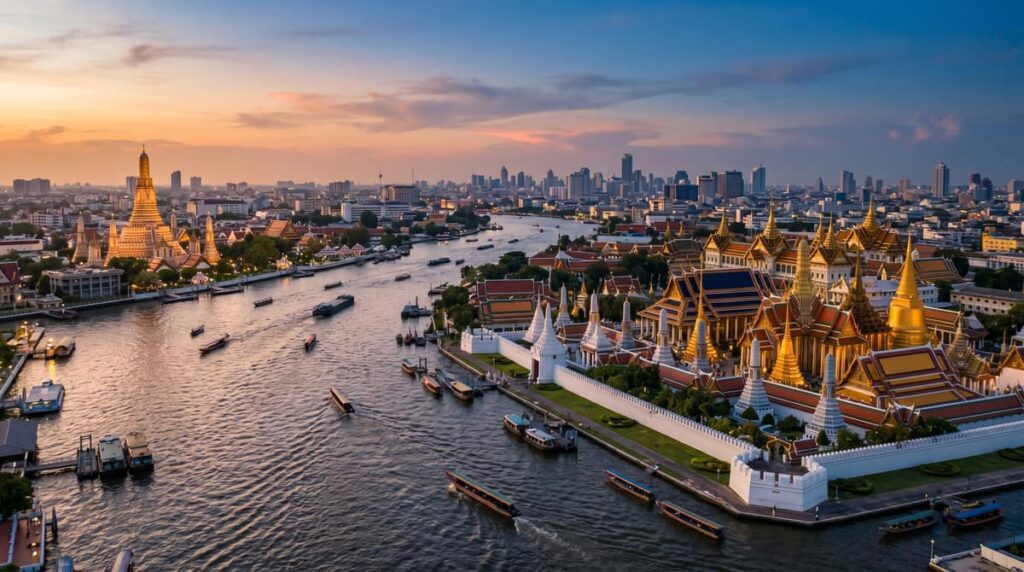
For a first visit, it is convenient to start with the core three: Wat Phra Kaew in the Grand Palace, Wat Pho, and Wat Arun. This sequence combines the palace complex, the Reclining Buddha, and temple architecture by the river. Below are separate ticket prices, schedules, metro approaches, and a route with a lunch break.
Current as of October 2026. Conditions may change; for the palace, it is especially useful to distinguish between visiting hours and the ticket sales cutoff time.
The selection includes eight temples. The Grand Palace is described as the visiting complex of Wat Phra Kaew, and Loha Prasat as a structure inside Wat Ratchanatdaram: we do not count them as separate temples. The whole selection does not need to fit into one outing. Choose sites by interest, prepare suitable clothing, and budget separately for ferry crossings, food, and additional services.
Which of Bangkok’s temples to visit first
For a first visit, we suggest this core route:
- Wat Phra Kaew in the Grand Palace — The Emerald Buddha and the palace complex.
- Wat Pho — The Reclining Buddha and the option to add a visit to the massage school.
- Wat Arun — the central prang, the temple grounds, and the view from the opposite bank.
You don’t have to pick everything at once. If large statues interest you most, start with the Reclining Buddha; if waterside architecture does, start with Wat Arun. For a detailed introduction to the palace complex, see the guide to the Grand Royal Palace.
The full selection: Wat Phra Kaew, Wat Pho, Wat Arun, Wat Saket, Wat Traimit, Wat Suthat, Wat Benchamabophit, and Wat Ratchanatdaram. After the core three, choose additional sites based on what you want to see: a city panorama, the Golden Buddha, marble architecture, or a metal structure with spires.
Wat Pho — Temple of the Reclining Buddha
The main attraction here is the Reclining Buddha, covered in gold leaf, with a length of 46 meters and a height of 15 meters. The dimensions and gilding are given by a travel blog (KKday). Don’t limit your visit to the main hall alone: leave time for the temple grounds.
As of October 2026, the Tourism Authority of Thailand lists admission 300 ฿ and hours 08:30–20:00, with last entry at 19:30. This is the tourism authority’s schedule; the hours given in other sources differ. From MRT Sanam Chai station to the temple, it is about 5 minutes on foot.
After your visit, you can stop by the traditional Thai massage school at the temple. Its official page lists identical rates for Thai massage and foot massage:
- 340 ฿ for 30 minutes;
- 520 ฿ for 60 minutes;
- 1 040 ฿ for 120 minutes.
Massage is paid separately from admission. If you include it in your plans, leave a separate break for it so you don’t rush to the next temple.
For navigation — Show on the map. For a more detailed visit — detailed guide to Wat Pho.
Wat Arun — Temple of Dawn
The temple stands on the western bank of the Chao Phraya River, opposite Wat Pho. Its central prang rises more than 70 meters, according to the Bangkok guidebook (Na Tanao). Looking at the porcelain decoration up close and viewing the temple’s silhouette across the river are different experiences, so you can include both in your outing.
As of October 2026, the Tourism Authority of Thailand lists admission 200 ฿ and hours 08:00–18:00. The nearest Blue Line metro station is MRT Itsaraphap. If you are going straight to this temple, the river crossing is not required.
If you continue your outing after Wat Pho, the crossing to the other bank is the ferry at Tha Tien Pier. Leave the waiting time and the crossing itself as a separate stage of the route.
The evening view from the other bank is not the same as visiting the grounds. Don’t leave buying a ticket until your waterside walk, and don’t build your plan around a required climb to the upper tiers.
You can view the location, and details about the visit are in detailed guide to Wat Arun.
The Grand Palace and Wat Phra Kaew — Temple of the Emerald Buddha
The Grand Palace is a complex, and Wat Phra Kaew is a temple inside it. A visit combines the palace buildings and the Temple of the Emerald Buddha; there is no need to count them as separate temples in the selection.
According to official practical information, the ticket for foreigners costs 500 ฿. It includes access to Wat Phra Kaew and the Queen Sirikit Museum of Textile, located inside the complex.
Regular visiting hours — 08:30–16:30, but tickets are sold only from 08:30 to 15:30. This makes a significant difference for those planning to arrive after lunch: the complex’s closing time does not mean the ticket office is open until then.
According to official answers to questions, children enter free under 120 cm in height. The wording refers specifically to height, not to the child’s age. Online ticket purchases are non-refundable, so decide on your visit date before buying.
A calendar entry showing availability on a specific date does not guarantee the same arrangement in the future. For navigation, save the Grand Palace on the map.
Other temples: Golden Mount, Golden Buddha, and Loha Prasat
Wat Saket — Golden Mount.
You can go here for the climb and the city panorama. According to the Tourism Authority of Thailand, the spiral staircase up the Golden Mount has 344 steps — factor this into your plan.
The temple grounds and the climb to the viewing platform are different parts of the visit. Published rates differ; the comparison is in the table below, and free access to the grounds should not be treated as a guaranteed condition. For navigation — Show on the map.
Wat Traimit — Temple of the Golden Buddha.
The main reason to include this temple in your outing is the Golden Buddha statue. It is convenient to combine the visit with the Chinatown / Yaowarat district, leaving time for both the temple and the neighborhood.
Guidebooks differ on the price of viewing the statue and on museum ticket terms. Before paying, check which areas your chosen option includes. Save Wat Traimit on the map; the day can continue with a stroll through Chinatown.
Wat Benchamabophit — Marble Temple.
This temple suits those interested in materials and architectural details. According to the tourism service Avian Experiences, it was commissioned during the reign of Rama V and features Italian Carrara marble.
The tourism authority lists the fee 100 ฿ and access to the main hall until 17:00. The hall’s time should not automatically be treated as the closing time for the whole grounds. For the route — Find Wat Benchamabopit.
Wat Suthat — Temple by the Giant Swing.
The landmark in front of the temple is the Giant Swing. This stop can be chosen for an outing that includes temple architecture and a recognizable monument.
The temple and the museum have separate fees and schedules. If you are interested in the museum, choose a suitable day, not just an arrival time: its schedule is limited to certain days of the week and public holidays. For navigation — Wat Suthat on the map.
Wat Ratchanatdaram and Loha Prasat.
The eighth temple in the selection is Wat Ratchanatdaram, and Loha Prasat is inside its complex. The Russian-language guidebook “Nasha Planeta” describes the structure as a multi-level metal pyramid.
According to the guidebook on Thailand (Thaizer), the height of the structure is 36 meters, and its top is decorated with 37 spires. It can be included in an extra outing for its unusual form; we do not count Loha Prasat as a separate temple. The current fee and the operator’s schedule are not confirmed.
Prices and opening hours: as of October 2026
The table separates visiting hours, last entry, and ticket sales cutoff. For Wat Pho, the schedule is listed on the Wat Pho page of the Tourism Authority of Thailand; it differs from the hours found in other sources.
| Temple or paid site | Price in baht | Visiting hours | Last entry or ticket sales cutoff | Source and data limitations |
|---|---|---|---|---|
| Grand Palace and Wat Phra Kaew | 500 ฿ for foreigners | 08:30–16:30 | Ticket sales: 08:30–15:30 | Official practical information and palace calendar; regular visiting hours |
| Wat Pho | 300 ฿ | 08:30–20:00 | Last entry: 19:30 | Tourism Authority of Thailand; schedules differ across sources |
| Wat Arun | 200 ฿ | 08:00–18:00 | A separate last-entry time is not confirmed | Tourism Authority of Thailand |
| Wat Saket / Golden Mount | 50 ฿ per the tourism authority; 100 ฿ for the climb per the guidebook | 08:00–18:00 per the tourism authority | A separate time is not confirmed | The authority and the guidebook “Nasha Planeta” give different amounts; the operator’s current fee has not been established |
| Wat Traimit: statue and museum | Guidebook (Bangkok Spirit): 40 ฿ for the statue or 100 ฿ with the heritage museum; guidebook (Your Thai Guide): 100 ฿ for the statue and separately 100 ฿ for the museum | The operator’s current schedule is not confirmed | A separate time is not confirmed | Ticket terms and prices in guidebooks differ; the operator’s current fee has not been established |
| Wat Benchamabophit | 100 ฿ | Main hall accessible until 17:00 | A separate time is not confirmed | Tourism Authority of Thailand; closing time for the entire grounds is not established |
| Wat Suthat: temple / museum | Temple — 100 ฿; museum — separately 200 ฿ | Temple: 08:30–20:00; museum: Friday, Saturday, Sunday and public holidays, 09:30–16:00 | A separate time is not confirmed | Tourism Authority of Thailand; the museum should not be considered included in the regular entrance ticket |
| Wat Ratchanatdaram / Loha Prasat | Current fee not confirmed | Current schedule not confirmed | Not confirmed | No confirmed operator terms for planning a visit |
For rows with listed official fees and tourism authority fees, check the current cost before visiting. Discrepancies for the Golden Mount and the Golden Buddha do not prove a price increase or decrease.
These are separate entrance fees. Ferry crossings, food, water, massage, and other extra services require a separate budget.
Dress code and etiquette at Bangkok’s temples
For visiting Bangkok’s temples, prepare clothing that covers your shoulders and knees. This is practical advice for your trip, not a claim that every complex has the same formal rules.
The Grand Palace has specific requirements. Sleeveless clothing and shorts are prohibited; a shawl worn over sleeveless clothing does not replace a suitable top. This option is also listed among unsuitable attire in the official rules of the Grand Palace.
Bring with you:
- lightweight cotton or linen trousers or a long skirt;
- a T-shirt with sleeves, not a tank top or crop top;
- comfortable shoes that are easy to take off where required;
- water and a hat for walking between sites.
Don’t count on solving the clothing issue with a guaranteed rental at the entrance. Preparing in advance is easier than changing your route because of unsuitable attire.
Speak quietly inside, take off your shoes where signs indicate, and don’t point your feet toward images of the Buddha. Don’t disturb people who are praying, and respect the personal boundaries of monks. The guidebook (Bangkok Spirit) advises women not to touch a monk or hand him objects directly from hand to hand.
For a broader introduction to local customs, read etiquette rules in Thailand.
How to get there: metro, piers, and ferries
You can reach the old city by metro. The Tourism Authority of Thailand provides the following reference points for the temples:
- MRT Sanam Chai — the access point to Wat Pho, about 5 minutes on foot.
- MRT Itsaraphap — the nearest Blue Line station to Wat Arun.
- MRT Sam Yot — the access point to Wat Suthat, about 10 minutes on foot.
River transport remains a separate option. Tha Chang Pier serves as a reference point for trips to the Grand Palace, and Tha Tien Pier for visiting Wat Pho and crossing to Wat Arun. Before boarding, check the direction and stops of the specific service rather than choosing a boat just by its flag color.
To reach Wat Traimit, you can plan an approach from MRT Hua Lamphong station or a walk through Chinatown. For the Marble Temple, it is convenient to consider a taxi as a separate leg of the trip.
Don’t tie your whole day to an expected boat schedule. If you want to skip the ferry, start a separate visit to Wat Arun from Itsaraphap station. Other transport options are covered in the guide to Bangkok’s transport.
One-day route through the main temples
Here is a suggested sequence for a self-guided visit. This is a planning example: the pace depends on the areas you choose, breaks, and transport waits.
- The Grand Palace and Wat Phra Kaew. You can start at the regular opening time 08:30. Prepare suitable clothing in advance and leave time to explore the complex.
- Wat Pho. Continue on to the Reclining Buddha. If you want a massage, set aside a separate break for it.
- Lunch and rest. Take a break before crossing to the other bank. Consider food, water, and transport separately from tickets.
- River crossing. Use Tha Tien Pier as a reference point and allow for waiting for the boat.
- Wat Arun. Plan your visit to the grounds within visiting hours. The climb to the upper tiers should not be a condition for a successful outing.
It’s more pleasant without rushing. If you feel tired or start late, choose part of the core three instead of trying to catch up on everything.
The evening view of Wat Arun from the opposite bank can be kept as a separate ending to the day. It does not require a promise of getting inside in the evening; sunset and lighting-on times should not be used as fixed points in the schedule.
How to distribute the other temples across additional outings
We suggest distributing the remaining Bangkok temples by interest, rather than gathering them into a mandatory list for the next day. This grouping helps you choose the content of an outing; it does not replace checking the route and entrance hours.
- Wat Traimit and Chinatown — a temple with the Golden Buddha statue and a continuation of the walk around the neighborhood.
- Wat Saket — an option for those who want a panorama and are ready for the stairs.
- Wat Ratchanatdaram and Wat Benchamabophit — a choice for the sake of different architectural materials and forms.
- Wat Suthat — the temple by the Giant Swing; plan a museum visit according to its separate schedule.
For families or visitors who find climbing difficult, it is better to reduce the number of stops and add breaks. You can skip the Golden Mount and satisfy your interest in architecture with other items on the list. This is not a promise of full accessibility of the buildings: assess stairs and entry conditions at each specific site.
You don’t have to devote your entire free day to temples. If you want to vary your plans, look at other attractions in Bangkok.
Photos, closures, and scams near temples
Before taking photos, check the signs in the specific hall. Don’t assume you may photograph in every room, don’t disturb people who are praying, and don’t point your camera directly at monks. If you want to photograph a person, ask for permission first.
Flying drones over the Grand Palace grounds is prohibited. The ban is stated in the official rules of the Grand Palace and applies specifically to this area.
The official calendar for October 8, 2026 shows that the Grand Palace and the Temple of the Emerald Buddha are available throughout a regular visiting day. This entry applies to that specific date and does not guarantee the absence of future restrictions.
If a stranger tells you “the palace is closed” and immediately offers a shopping trip, don’t agree automatically. The order of steps is simple:
- Check the calendar on the palace’s official website.
- Go to the official entrance and check the information there.
- If there is an actual restriction, choose your own alternative for the outing.
The closure message alone does not prove a scam. What should raise suspicion is an offer to urgently replace your plans with someone else’s route. For more tips, see how to avoid scams in Thailand.
Frequently Asked Questions ❓
How many of Bangkok's temples can you realistically see in one day?
For a first visit, it makes sense to choose Wat Phra Kaew in the Grand Palace, Wat Pho, and Wat Arun. This is an example of a program you can shorten based on how you feel and how much time you have. The other temples are better left for additional outings.
Can you enter a temple in shorts or a short skirt?
For your trip, prepare clothing that covers your shoulders and knees. At the Grand Palace, sleeveless clothing and shorts are officially prohibited; a shawl worn over sleeveless clothing is also listed among unsuitable options. Don’t count on a wrap replacing suitable clothing.
How much does admission to Bangkok's main temples cost in 2026?
As of October 2026, the ticket to the Grand Palace with Wat Phra Kaew for foreigners costs 500 ฿, Wat Pho — 300 ฿, Wat Arun — 200 ฿. Ferry crossings, food, and extra services are paid separately; check the current ticket prices before visiting.
Where can you get clothing if you arrive at a temple unprepared?
Don’t count on a guaranteed rental at the entrance: its availability and current terms are not confirmed. It is more reliable to prepare long trousers or a skirt and a top with sleeves in advance.
What should you do if someone on the street says the Grand Palace is closed today?
Check the message against the official calendar and at the official entrance. Don’t immediately agree to a shopping route suggested by a stranger. Real closures are possible, so the closure message alone does not prove a scam.
Can you take photos inside temples?
Check the signs and rules for the specific hall before shooting, respect people who are praying, and don’t point your camera directly at monks. Don’t assume you can photograph in every room. Flying drones over the Grand Palace grounds is officially prohibited.
Are Bangkok's temples suitable for visiting with children?
Choose a short program with breaks and factor in the climbs. Children enter the Grand Palace free of charge under 120 cm in height; the official Wat Pho page lists the same condition. The Golden Mount at Wat Saket is reached by a staircase with 344 steps, so this stop can be skipped.
Conclusion
For a first visit, choose Wat Phra Kaew in the Grand Palace, Wat Pho, and Wat Arun. Add the other temples based on your interests: panorama, the Golden Buddha, marble, or metal architecture with spires. Don’t try to turn the entire selection into a mandatory program for a single outing.
Prepare clothing with sleeves and covered knees, choose a metro approach or the river option, and leave room for breaks. Visiting hours, last entry, and ticket sales cutoff are different restrictions, especially at the palace. Save the table and map links, then put together a route that works for you. Fees, access, and rules may change.
Prepared by MyThai.online editorial team.