In this article:
What has changed: Wat Pho’s visiting hours are 08:00–19:30; admission is 300 baht, and children under 120 cm tall enter free. Thai massage and foot massage cost 340 baht for 30 minutes and 520 baht for 60 minutes.
The Temple of the Reclining Buddha in Bangkok is a temple complex where you can see a gilded statue, royal chedis, galleries with images of the Buddha, and a school of traditional massage. For a self-guided visit, it is enough to choose your transport in advance and prepare clothing that covers your shoulders and knees. The published admission fee is 300 baht, and visiting hours are 08:00–19:30; children under 120 cm tall enter free.
Don’t limit your walk to the main hall. The chedis, stone figures and galleries help you see the complex beyond the famous statue, and you can add a massage to your visit if you wish. If you plan to continue your day at the palace or on the other side of the river, leave time for transfers, separate tickets and rest.
This guide will help you understand the admission conditions, choose between the metro and river transport, and plan a route without rushing. We will cover the temple’s history and massage prices separately.
Current at the time of publication
Wat Pho: Admission Fee and Opening Hours
As of October 2026
| Condition | Published information |
|---|---|
| Admission fee | 300 baht |
| Visiting hours | 08:00–19:30 |
| Free admission for children | Height under 120 cm |
These conditions are published on the official visiting page for Wat Pho. The children’s discount is worded in terms of height, not age: under 120 cm, so a child of exactly that height does not fall under the published wording.
The travel reference Your Thai Guide describes the complex as open daily. When planning, rely on the published hours, but do not equate the closing time with the last ticket sale time, since no separate last-entry time is given here.
Check before your visit what the ticket includes, including a bottle of water, and any additional discounts for Thai citizens. These conditions should not be treated as guaranteed just because travel guides mention them; their absence from a brief summary does not mean they have been cancelled either.
Starting your walk at the temple is convenient if you plan to explore the old city afterward. However, do not plan to arrive at opening time expecting empty halls: the number of visitors and queues can vary.
How to Get to Wat Pho: Metro and River Transport
The way you travel depends on the area where you are staying. For the route to Wat Pho by metro, use the blue line and the station Sanam Chai.
Travel sequence:
- Take the blue line to Sanam Chai station, station code (BL31).
- Leave by exit 1 toward the temple.
- Continue on foot, using the map of the complex.
Exit 5 leads to Rajini Pier; it does not replace the exit to the temple described above. Information about the station and the pier exit is available on the Sanam Chai station page of the metro operator. Other transfer options are covered in the Bangkok transport guide.
A boat route running along the river and a river crossing are different trips. Express boats run along the Chao Phraya, and a separate ferry links Tha Tien and Wat Arun. The location search link for the Tha Tien pier helps you find it, but does not confirm that every express boat stops there.
The river transport operator Chao Phraya Express Boat publishes an updated timetable. The timetable is effective from October 6, 2026. The orange line links Nonthaburi and Wat Rajsingkorn; the published fare is 19 baht regardless of distance.
The operator’s page contains a discrepancy: the description of the orange line lists weekdays, while the general section says all days of the week and public holidays. So check the stops and days of your chosen service against the current route map; the Oriental Pier is closed for repairs due to damage.
Alternatives include taxis, the Grab ride-hailing app, and buses. You can hire a car from any district, but traffic jams remain part of the route. Bus options run along Maharat Road and Thai Wang Road; choose a suitable stop near the complex rather than relying on unverified route numbers.
Dress Code, Footwear and Rules of Conduct
Choose clothing that covers your shoulders and knees. This applies to both men and women: lightweight long pants or a skirt of suitable length and a top with sleeves will save you from having to look for a replacement at the entrance.
Prepare your clothing in advance. Do not count on wraps being handed out as a guaranteed service, and do not leave your passport as a deposit in order to be allowed in.
Before your visit, it is useful to check:
- Whether your shoulders and knees are covered.
- Whether it is easy to take off and put on your shoes.
- Whether you will need an extra item to cover up.
- Whether you can put away your camera and phone when photography disturbs others.
Before entering the temple hall, take off your shoes and leave them in the designated place. You may want to bring socks in advance if that is more comfortable for you.
Inside, speak quietly, as people may be praying nearby. Do not point the soles of your feet at images of the Buddha, and avoid selfie poses that look disrespectful, including turning your back to the statue for a photo.
For photography, it is better to turn off the flash and not block the passage. Follow the signs in the halls and staff requests: respectful behavior matters more than trying to get a shot at any cost.
Wat Pho is still an active temple, so a visit here calls for more attention to those around you than an ordinary photo shoot. For more details, read about etiquette in Thailand.
Reclining Buddha Statue: Dimensions, Feet and Coin Bowls
According to the tourism service AsiaByLocals, the main statue measures 46 meters long and 15 meters high and covered with gold leaf. Start your visit with an overall view of the figure, then walk along it to see the details.
The feet are decorated with 108 mother-of-pearl panels, a separate part of the decoration that is easy to overlook when passing quickly. The pale inlay differs from the gold covering of the body, so it is worth lingering here after taking a general photo.
The corridor around the statue holds 108 bronze bowls, as described by the travel site Emerald Buddha. The mother-of-pearl panels and bowls are different elements: the matching number does not mean they are one and the same decoration.
The bowls are linked to the custom of donating coins. You may take a set of coins and drop them into the bowls one after another; participation is voluntary and does not require any promises of good luck or of a wish coming true.
If you want to take part, set aside separate money for the donation. Do not assume that the set of coins is automatically included in the admission ticket price.
The Temple of the Reclining Buddha in Bangkok is best viewed at an unhurried pace: the overall scale of the statue and small details each need different attention. Do not linger in the middle of the passage for the sake of a photo; it is better to let other visitors pass and calmly continue your visit.
What Else to See: Royal Chedis, Ubosot and Galleries
Beyond the Reclining Buddha hall, the walk continues among the chedis, galleries and courtyards. According to the travel site Emerald Buddha, the complex has more than 1,000 images of the Buddha; the source calls this collection the largest in Thailand.
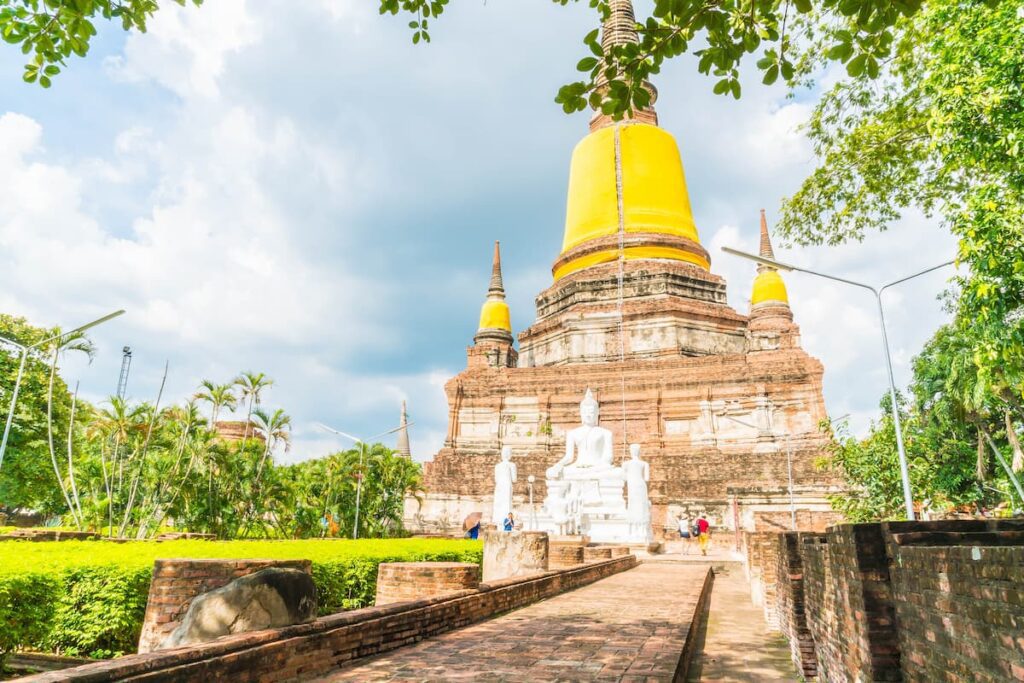
Four large royal chedis are decorated with colored ceramic tiles and are dedicated to the first four kings of the Chakri dynasty. The tourism service AsiaByLocals describes the white, yellow, green and blue decoration of this group of stupas.
The scale of the statue and the ceramic decoration of the chedis call for different ways of looking. In the main hall the eye takes in the large figure, while in the courtyard attention shifts to color and small tiling details. So a route that only goes to the Reclining Buddha leaves out a significant part of the artistic decoration.
Phra Ubosot is a separate temple hall of the complex, which should not be confused with the Reclining Buddha hall. When viewing the galleries, pay attention to images of the Buddha, murals and stone figures.
A convenient order for the walk:
- The Reclining Buddha hall.
- The royal chedis.
- The Phra Ubosot, if it is open to visitors.
- Galleries and courtyards with stone sculptures.
The decoration includes scenes from the “Ramakien,” the Thai version of the “Ramayana” epic. Chinese stone warriors and animals recall trade links: such figures were brought by ship as ballast.
Do not plan a route through the monastery’s residential area just to look for a quiet corner. To continue exploring temple architecture, you can choose other temples in Bangkok.
The History of Wat Pho and the Tradition of Spreading Knowledge
According to the travel site AsiaPositive, the temple was known as Wat Pho Tharam in its early history. This is evidence that it existed under its earlier name, not an exact founding date.
Royal reconstructions gradually changed the complex and expanded its significance. A separate thread of its history is the preservation and dissemination of knowledge through inscriptions and illustrations.
A document from the international association of Thai healing practices, the Thai Healing Alliance, links these inscriptions and illustrations to the work of King Rama III and Thai scholars of his time. Information about medicine and massage helped pass knowledge on to visitors, but the temple’s educational tradition should not be equated with a modern university.
In 1955, a school of traditional Thai medicine and massage opened within the complex. The temple’s official website calls it the first school of Thai medicine approved by the Ministry of Education of Thailand.
Here it is useful to distinguish between the history of knowledge and the history of an educational institution. The school continues a tradition linked to the temple, but this does not prove that massage itself was invented on this site.
Thai Massage at Wat Pho: School, Services and Prices
The grounds house a school of traditional Thai medicine and massage (Wat Pho Thai Traditional Medical and Massage School). You can add a massage to your visit, leaving it until after you have seen the halls and courtyards.
Published rates are listed on the temple’s official visiting page. Plan the massage as a separate service, without assuming it is included in the admission ticket.
As of October 2026
| Service | 30 minutes | 60 minutes | 120 minutes |
|---|---|---|---|
| Thai massage | 340 baht | 520 baht | 1,040 baht |
| Foot massage | 340 baht | 520 baht | 1,040 baht |
| Thai massage with balm | — | 680 baht | 1,360 baht |
| Thai massage with Phlai oil | — | 620 baht | 1,240 baht |
Check the current price before your visit. A dash means that no rate for that duration is listed in the table, not that the service is banned or unavailable.
For tourist groups and groups of 12 or more people, the school asks you to arrange the visit through the messaging app LINE, giving the contact (@watpo-chetawan), or through WhatsApp. This procedure does not mean that individual booking is unavailable.
Queues are possible at peak hours. Leave time for waiting and the treatment, especially if you plan to go on to the palace or the ferry next; the temple’s visiting hours should not be automatically taken as the schedule of the massage department.
The school also offers training courses. If study is the purpose of your trip, consider it separately from a tourist session: choosing a program, its length and the conditions for obtaining a certificate require a separate review of the school’s offer.
A massage on this route is a service and an introduction to a cultural tradition. Do not count on a promised therapeutic result just because the session takes place at a famous temple.
Wat Pho and Surroundings: A Route with the Palace and Wat Arun
After the temple, you can continue your walk through old Bangkok and then cross the river. The Grand Palace and Wat Arun (Temple of Dawn) are convenient to consider as the following separate stops, each with its own admission conditions.
One possible sequence:
- Wat Pho — the statue, chedis and galleries.
- The Grand Palace.
- Lunch and rest.
- Ferry crossing from Tha Tien to Wat Arun.
- Chinatown, if you still have the energy and desire to continue the day.
Details about visiting the Grand Palace and about visiting Wat Arun will help you choose sites according to their schedules. Being near one another does not mean a shared ticket or identical opening hours.
According to the transport reference ThailandBoat, as of October 2026, the ferry from Tha Tien to Wat Arun costs 5.5 baht per person one way, payment is by cash only. This information concerns a specific ferry, so the fare cannot be applied to boats running along the river or to other piers.
If you want to end the day in another district, a possible continuation is a walk through Bangkok’s Chinatown. Plan the trip there separately: do not base your route on a promise of a specific number of metro stops.
The Temple of the Reclining Buddha in Bangkok can be the main highlight of the day, with nearby sites as an add-on. If you want to study the murals in detail and add a massage, cut the rest of your program rather than trying to fit everything in tightly.
Frequently Asked Questions ❓
How much is admission to Wat Pho, and what is included in the ticket?
As of October 2026, the published admission fee is 300 baht. Children under 120 cm tall enter free; the discount wording does not include children of exactly that height. Do not treat the water bottle, the ticket contents and additional discounts as guaranteed conditions of your visit.
How do I get to Wat Pho by metro or river transport?
By metro, take the blue line to Sanam Chai station, then exit 1 toward Wat Pho. Exit 5 leads to Rajini Pier. When traveling by river, distinguish between the boat routes running along the river and the separate ferry between Tha Tien and Wat Arun: choose a service according to the current stop map.
How much time do I need to see the Temple of the Reclining Buddha?
The length of your visit depends on your pace and on whether you want to limit yourself to the statue or also see the chedis, galleries and courtyards. If you plan a massage, allow extra time for the treatment and possible waiting. Do not plan your next stop too tightly.
Can I get a Thai massage right at Wat Pho, and how much does it cost?
Yes, a school of traditional Thai medicine and massage operates at the temple. As of October 2026, the published rates for Thai massage and foot massage are 340 baht for 30 minutes and 520 baht for 60 minutes. For tourist groups and groups of 12 or more people, the school asks that visits be arranged through the contact channels it specifies.
What is the dress code at Wat Pho, and what if my clothing doesn't meet it?
Choose clothing that covers your shoulders and knees; take off your shoes before entering the temple hall. Prepare suitable clothing in advance, and do not count on being given a wrap as a guaranteed service. When visiting certain areas, follow the signs and requests from staff.
Can I combine a visit to Wat Pho with the Grand Palace and Wat Arun in one day?
This route works as an option for a self-guided walk: Wat Pho, then the Grand Palace, followed by a ferry from Tha Tien to Wat Arun. Being near one another does not mean a shared ticket or shared schedule. As of October 2026, the transport reference ThailandBoat lists the fare for this ferry as 5.5 baht per person one way, payable in cash only; check the current fare at the ticket window.
Conclusion
Wat Pho brings together the famous statue of the Reclining Buddha, royal chedis, galleries and a traditional massage school. For a self-guided visit, choose your transport, prepare clothing with covered shoulders and knees, and decide whether you want to add a massage to your walk. This will make it easier to divide your time between the main hall, the courtyards and nearby sights.
The palace and Wat Arun can be included in the continuation of your day, but leave room for rest and your own pace. Published rates and timetables may change. Plan your visit in advance, and let Wat Pho be the first stop of your day in old Bangkok, without having to hurry from one stop to the next.


Prepared by MyThai.online editorial team.