In this article:
What changed: Added a warning about calls in which scammers pose in sequence as staff of a phone company, police and a bank. Clarified SIM registration rules: face verification applies when registering a new subscriber and when replacing a SIM while keeping the number, and foreigners need the original passport.Updated: June 14, 2026
What changed: Added 4 online scam trends for 2026 (DES warning), AOC hotline 1441, SIM biometrics, quishing and fake TDAC websites.Updated: May 2, 2026
What changed: Added a section on fake MEA/PEA staff who knock on the door and demand cash. Genuine staff do not collect payments at homes. The relevance date was updated to May 2026.
Safety in Thailand starts with simple steps: check the terms before paying, keep your belongings under control and do not hand over your passport as collateral. Travel risks depend on the route, weather, chosen services and the specific situation. No guarantee can be given that nothing will go wrong, but a checklist prepared in advance helps you act more calmly.
This guide explains how to recognize pressure from a seller or a caller, verify the payee and protect access to money and documents. It also gathers first steps after a phone theft, a suspicious transfer and a lost passport. You don’t need to memorize everything: save the help contacts and agree with your travel companions on how to reach each other if a phone is lost.
Current as of the update date. Rules and conditions may change; check official warnings for your own route before traveling.
What to check and save before your trip
Prepare a backup way to get important information if your phone gets lost or stops working. A copy of your passport accessible only on that same phone will not help in such a situation. Keep backups separately and protect access to them.
Before departure, save:
- copies of documents and booking confirmations;
- contacts of your bank, insurer and your country’s consular service;
- your accommodation address and a way to contact the hotel;
- details of your insurance policy and the procedure for requesting help;
- emergency numbers;
- a backup way to contact travel companions or family.
Keep cash, cards and money access methods separate. Don’t keep all valuables together with your passport in a bag you carry every day. Check whether you can contact your bank without your usual phone.
The official guidance from the UK Foreign, Commonwealth and Development Office (FCDO) lists the following contacts:
| Service | Number |
|---|---|
| Tourist Police | 1155 |
| Police | 191 |
| Ambulance | 1669 |
| Fire service | 199 |
Additional recommendations are gathered in the guide to emergency help in Thailand. If there is an immediate threat, first try to reach a safe place: protecting property should not become a reason for a dangerous confrontation.
Tourist scams: “palace is closed”, tours and bookings
Near the Grand Palace in Bangkok, you may hear an offer: “Today it’s closed, but I can show you another place.” A travel blog (The Builder Log) describes a scheme in which a stranger reports a closure and suggests an alternative trip. It may include stops at shops in exchange for a commission.
A warning sign is a person who at the same time delivers unpleasant news and sells its “solution.” Don’t rush to get into the offered transport: check the information at the entrance or through the palace’s official channel. Even a friendly conversation does not confirm the other person’s authority.
The palace’s official website provides for daily visits and lists the ticket price 500 baht. A separate note: this is based on data as of the update date; check the current price. Daily visits on schedule do not rule out temporary closures.
For a tour or accommodation booking, check the offer before transferring money:
- find out who is selling the service and how to contact them independently of the correspondence;
- ask for a description of the route, accommodation or program;
- confirm the full price, additional costs and cancellation terms;
- match the payee with the seller and ask for an explanation of any discrepancies;
- save the terms of the offer and the payment confirmation.
Reviews are useful for checking, but they do not guarantee reliability. If you are pressed to transfer money and the service description changes when you ask questions, stop the payment. For accommodation, a separate useful resource is accommodation search, contract and deposit.
If the service turns out to be a scam, save correspondence, payment details and booking confirmation. Contact your bank and the police, and do not pay extra for promises to “return everything right away.”
Theft of phone, bag and money: how to protect your belongings
In a crowd, hold a closed bag in front of you and keep your phone out of your back pocket. Take with you only what you need and leave the rest in a suitable secure place. Don’t show how much cash you have when taking out money for a small purchase.
When walking along a road, carry your bag on the side farther from the roadway. If you stop to look at the route, first choose a spot where you won’t block traffic and can keep an eye on your surroundings. On the beach, don’t leave valuables unattended just because the whole group is going swimming together.
Safety in Thailand also includes preparing for losing your phone. Plan ahead how you will get your bank’s contacts, the hotel address and trip confirmations without this device. A travel companion can hold the accommodation address and the agreed meeting place, but you do not need to give them your banking passwords.
Useful to check before the trip:
- whether you have a backup copy of important documents;
- whether a backup communication channel is available;
- whether you know how to restrict access to a lost device and your accounts;
- whether you can contact your carrier and bank from another phone.
If something was stolen, do not chase the thief or try to get the property back by force. Move to a safe place, restrict access to money and communications, then save details of what happened to report to the police. Separately, write down which documents and devices are missing.
Night safety: drinks, bills and returning to the hotel
Don’t leave a drink unattended and don’t finish it if you are unsure what happened to it while you were away. Agree with your travel companions on how you will return and what to do if you lose each other. This is ordinary preparation, not a judgment of anyone’s appearance or intentions.
Before ordering, find out the cost of drinks, entry and additional services. If you are told “go in first, we’ll sort it out later,” ask to see the prices before you agree. A saved menu or messages can help clarify what the dispute is about.
Check the bill before paying: do the items match your order, and are the additional charges clear? Calmly ask for an explanation of any unclear amount, without accusations. If you are being pressured or not allowed to leave, avoid physical conflict and seek help.
For the ride back, choose a well-lit route and transport with clear trip terms. Don’t agree to a sudden change of destination or price without an explanation. When booking through an app, check the trip details against the vehicle and driver before getting in.
Fatigue is a good reason to pause before paying. Even after a pleasant evening, check the amount and the recipient of the transfer rather than confirming the transaction on autopilot. A victim is not to blame for someone else’s crime; these habits only help reduce the risk.
Police and local bans: how to act without conflict
The official guidance from the UK Foreign, Commonwealth and Development Office (FCDO) warns: possessing and using vapes is illegal. Don’t assume it is legal because the device is sold nearby or other people use it. Seeing a product offered for sale does not confirm that possessing it is legal.
If you are stopped by someone claiming to be a police officer, stay calm and polite. As a practical step, ask them to identify themselves, show their ID and explain the reason for the approach. Such a request helps clarify the situation but does not guarantee any particular response.
If you are demanded immediate payment:
- ask them to explain the basis for the demand and how it is documented;
- do not give out banking codes or open accounts on a stranger’s instructions;
- record the place and circumstances if it is safe to do so;
- if in doubt, contact the Tourist Police at the number 1155;
- if there is an immediate threat, call the police at the number 191.
Do not treat cash payment as independent evidence of fraud. A person’s authenticity and the basis for the demand should be assessed separately from the payment method. Do not try to resolve the dispute through threats or physical resistance.
The same caution is useful when a person visits and demands money on behalf of some organization. Contact that organization using a contact you found yourself, not a number the visitor dictated. Do not agree to an urgent transfer just because the person speaks confidently.
Digital safety: calls, QR codes, SIM cards and the arrival card
A suspicious link may arrive disguised as a message from a bank, hotel, delivery service or a fine notification. Instead of following the link in the message, open the organization’s usual channel yourself. A convincing name, photo, voice or video call does not replace independent verification.
A newspaper (Matichon) describes a sequential scheme: scammers pose as staff of a phone company, then of police and a bank. In a published warning to students, they advise ending the call immediately and not transferring money. This is a description of a specific scheme, not a ranking of incidents among tourists.
If you are passed between “agencies” and told to urgently save your money, end the call and verify the request independently. Do not use contacts that were dictated to you, and do not continue a transfer under the caller’s direction. If the money has already gone, contact your bank and save the details of the transaction.
Links, profiles and investment offers
Don’t send prepayment based only on an attractive profile or convincing correspondence. Verify the seller, what the service includes and the payment details separately. A promise of high returns with no risk is a reason to decline a hasty investment, not confirmation of a profitable opportunity.
Don’t share verification codes or install programs at the request of an unknown contact. If a message supposedly came from an acquaintance, contact them through another channel. A short pause is enough for a check; a genuine purchase should not require abandoning caution.
QR code check
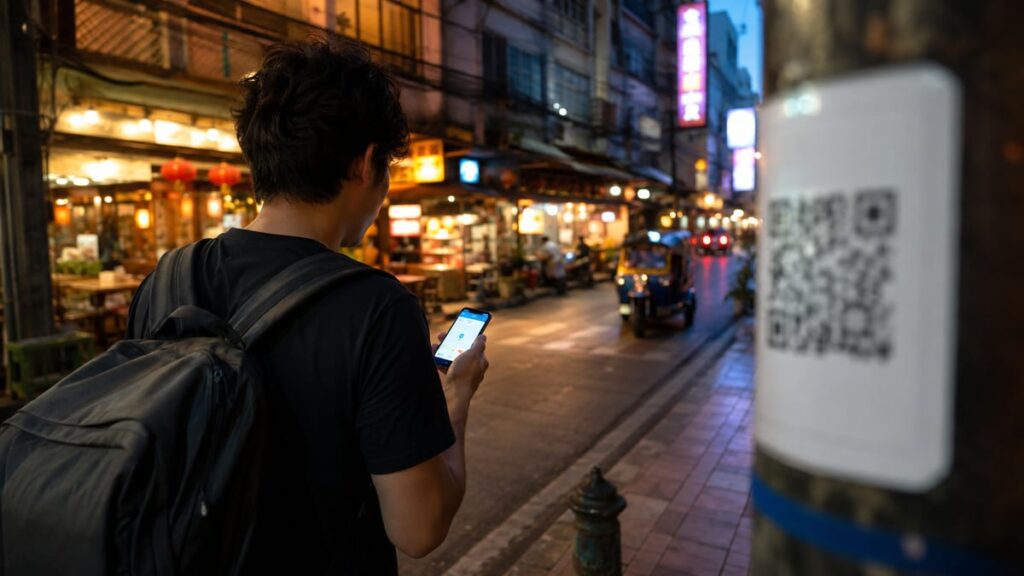
Before confirming a payment, check the recipient and the amount. If the name is unclear, ask a venue employee to confirm the payment details: the recipient does not necessarily match the sign literally, but any discrepancy should be explainable. A sticker placed over another code is a reason to stop and check the payment.
Check any fine notice independently, without opening the link you were sent. If after scanning you are asked to enter unusual information or install an app, do not continue the transaction. After a suspicious payment, keep the confirmation and notify your bank.
SIM registration and the original passport
Thailand’s telecom regulator describes the scope of face verification in an official statement (NBTC) on SIM card registration. Liveness Detection covers new prepaid and postpaid subscribers, as well as existing subscribers who replace a SIM while keeping their number. Foreigners need the original passport to register.
It is easy to confuse different procedures: presenting a document to an operator and leaving it with a rental operator as a deposit. Requiring the original passport for SIM registration does not mean you need to hand it over as a guarantee for a rental. Buy mobile service at an official operator’s store; details are given in mobile service and SIM cards in Thailand.
Digital arrival card
The absence of a fee is indicated in the official guide to the Digital Arrival Card. The digital arrival card (TDAC) is not a visa, and the information is entered in English. To file it yourself, go through the official website of the Thai immigration service.
A fee paid to an intermediary for help differs from a government fee and by itself does not prove fraud. Before paying, find out what service you are being sold and who receives your passport details. A claim that a mandatory fee is required for the official application should raise suspicion.
Cards, ATMs and money exchange: what to check before a transaction
The legal information portal (ThailandLaw) describes skimming: an overlay keypad can record the PIN, and a fake card reader can capture magnetic stripe data. This explains how data theft works, not how common it is.
Before using an ATM, inspect the keypad and the card slot. If you see suspicious overlays or parts that look foreign, choose a different ATM. Do not try to remove devices yourself or find out who installed them.
Cover your PIN entry and don’t accept help from a stranger who offers to enter it for you. After the transaction, keep the confirmation and check the result through your usual banking channel. If unfamiliar charges appear, contact your bank and discuss restricting access to your card.
Currency exchange arranged through messaging requires checking before you transfer:
- who your counterparty is and how to confirm their identity;
- what amount and currency you are sending and receiving;
- which fees have been agreed;
- whose payment details these are;
- how completion of the transaction is confirmed.
Do not transfer money to suddenly changed payment details without checking them again. Keep the agreed terms and confirmations: they help explain a dispute but do not guarantee a refund. A request to pay more to “unblock” money already sent is a reason to stop and contact your bank.
Safety in Thailand in money transactions depends on checking the terms and access to funds. Neither correspondence nor reviews by themselves confirm that a service is legitimate or that a transfer is secure.
Transport and rentals: taxis, motorbikes, jet skis and boats
Before getting into a taxi or tuk-tuk, agree on the route and payment method: meter, a pre-agreed amount, or the terms of an app booking. Find out whether additional costs are included in the quoted price. If the terms change as you are getting in, ask for an explanation before the trip starts.
A request to cancel the booking in the app does not in itself prove a scam. But after a cancellation, the arrangements may differ from the original ones, so evaluate the price and terms separately. If they are unclear to you, do not continue the ride out of habit.
Motorbikes and jet skis
The official guidance from the UK Foreign, Commonwealth and Development Office (FCDO) recommends not handing over your passport as a guarantee. Discuss a copy of the document and a cash deposit with the rental operator as possible alternatives. If no acceptable option is found, it is wiser to choose a different rental operator.
Before taking the vehicle:
- read the contract and the deposit terms;
- photograph and video the condition of the vehicle from all sides;
- save images of its identification markings, if they are accessible;
- ask them to note any visible scratches and damage;
- find out how claims are handled and how repair costs are calculated;
- get confirmation that the deposit was handed over.
Photos help compare the condition of the vehicle before and after rental, but do not guarantee a refund. If you are asked to pay for old damage, ask to see the basis for the charge and compare it with the contract and your photos. Keep correspondence, and if you are pressured, seek help.
A helmet is mandatory when riding a motorbike, according to UK Foreign, Commonwealth and Development Office (FCDO) guidance. Don’t choose a motorbike unless you are ready to ride it in local conditions; check document requirements and policy terms in advance. For a trip to Phuket, a useful resource is the regional detailed guide to renting a motorbike in Phuket, while the general topic is covered in road safety in Thailand.
Boats and ferries
Before boarding, assess how loaded the vessel is and whether a life jacket is available. It is better to refuse a clearly overloaded boat or a trip without an available life jacket. In bad weather, check departure conditions with the operator and do not treat other passengers’ composure as a sign of safety.
Natural risks: sea, weather and animals
On the beach, pay attention to flags, notices and lifeguard instructions. When a red flag is up, do not enter the water, even if other people are swimming nearby. Do not judge the sea’s safety only by how it looks from the shore.
Rip currents and jellyfish call for special attention to local warnings. Do not choose a swimming spot solely based on a beautiful photo or advice in an old review. Details are collected in the guide beach flags, currents and jellyfish.
Check the forecast and adjust plans in case of downpours or weather warnings. Do not bypass trail closures or continue a route just because you have already spent time getting there. Conditions can differ across regions of the country, so a single calendar is no substitute for a forecast for your destination.
Protect yourself from the sun: use suitable sun protection, a hat, and plan breaks in the shade. Carry water and do not delay resting if you feel unwell. Use insect repellent against mosquitoes and wear clothing that covers your skin.
Do not touch unfamiliar animals or try to approach them for a photo. Do not put your hands into dense vegetation or crevices, and check your shoes before putting them on. For an injury or worsening condition, seek medical help rather than relying on advice from travel chats.
What to do after theft, fraud or loss of your passport
First move to a safe place and assess whether emergency help is needed. Then restrict access to money, communications or documents that may have fallen into a stranger’s hands. Write down the circumstances while you still remember the details, and save evidence.
If you transferred money to a scammer
- Immediately report the suspicious transaction to your bank through its usual channel.
- Save the payee’s details, the receipt, correspondence and transfer information.
- Stop any further payments, including the promised “refund fee.”
- Report to the police and provide the information you have collected.
Contacting the bank does not guarantee that the recipient’s account will be frozen or the money returned. Do not continue talking with the scammer in exchange for a promise to fix everything. Act through your bank and the police, regardless of their instructions.
If you lost your card
- Contact your bank and restrict access to your card.
- Check recent transactions and report any unfamiliar charges.
- Save details of suspicious payments.
- If there are signs of theft or fraud, contact the police.
Do not give your codes to anyone who suddenly offers to help restore your card. Find the bank’s contact yourself or use the one you saved before the trip. For current expenses, a backup way of accessing money prepared in advance will be useful.
If your phone was stolen
- Do not chase the thief; find a safe place and a way to contact your loved ones.
- Contact your carrier through a channel you found independently.
- Restrict access to the device and important accounts using the means available to you.
- Notify your bank if the phone gave access to financial transactions.
- Report to the police, keeping details of the device and the circumstances of the theft.
If backup data was only on the stolen phone, ask relatives or the hotel for help restoring your communication. Do not give passwords to strangers under the pretext of searching for the device. Write down which steps you have already taken so you don’t lose track of the sequence.
If you lost your passport
Report to the police and contact your country’s consular service. Prepare an available copy of the document and trip details, then get instructions for your situation. Do not buy a promise to “restore your passport without applying” from a random intermediary.
If a rental operator is holding your passport
Ask for an explanation of the basis for withholding it and for the document to be returned, keeping the contract and correspondence. Do not try to take the passport back by force. If you are being pressured, contact the Tourist Police at the number 1155, and in case of an immediate threat, call the police at the number 191.
The official UK guidance mentions an app for online contact with the Thailand Tourist Police. It is available to tourists even without a Thai SIM card, but that does not mean it works without internet. Keep your insurer’s contacts handy too, and before the trip read, how to choose travel insurance.
Frequently Asked Questions ❓
Is it safe to travel to Thailand right now?
Assess a trip based on the specific route and current warnings. This guide helps reduce everyday risks: protect your belongings, check payments and sellers, don’t leave your passport as collateral, and save help contacts in advance. It does not guarantee that nothing will go wrong.
How do I recognize a scam call in Thailand?
Pressure to make an urgent transfer, and being passed from supposed staff of a phone company to police to a bank, are warning signs. A newspaper (Matichon) describes such a scheme in a warning to students. End the call and contact the organization that supposedly called you yourself.
What should I do if I already transferred money to scammers in Thailand?
Immediately report the suspicious transaction to your bank through its usual channel, and save the payee details, receipt and correspondence. Contact the police. No one can guarantee an account freeze or a refund.
How do I avoid falling for a fake QR code when paying?
Check the recipient’s name and the amount before confirming the payment. If the recipient is unclear, confirm the payment details with a venue employee; a suspicious sticker placed over another code is a reason to stop. Check any fine notification independently, without using the link you were sent.
Is it risky to fill out the digital arrival card (TDAC) online, and where is the correct place to do it?
Official application is available through the website of the Thai immigration service, and the guide to the digital arrival card (TDAC) states that no fee is required. The card is not a visa, and information is entered in English. A fee paid to an intermediary is not the same as a government fee and by itself does not prove fraud.
What should I do if a “police officer” stopped me and demands a cash fine?
Stay calm, ask the person to identify themselves and explain the basis for the demand. If in doubt, contact the Tourist Police at 1155, and in case of an immediate threat, contact the police at 191. Do not get into a physical confrontation, and do not treat the payment method as the only proof of the demand’s authenticity or legality.
Can I leave my passport as collateral and show it when buying a SIM card?
These are different procedures. The UK Foreign, Commonwealth and Development Office (FCDO) advises not handing your passport to a rental operator as a guarantee, while the Thai telecom regulator (NBTC) requires foreigners to present the original passport to register a SIM. Showing the document for registration does not mean it should be left as collateral.
What should I do if the rental operator demands payment for old damage?
Compare the claim with the photos, video, contract and the damage recorded when you received the vehicle. Ask for an explanation of the calculation, keep the correspondence, and do not get into a conflict. If you are being pressured, seek help from the Tourist Police; photos are useful as evidence but do not guarantee the outcome of the dispute.
Conclusion
Safety in Thailand is supported by habits that are easy to prepare in advance: check the terms before paying, protect access to money and save confirmations. Distinguish between showing your original passport for SIM registration and handing a document over as collateral to a rental operator. If you are pressured, stop the payment and verify the request independently; after an incident, start with personal safety and contact with your bank or the police.
Rules and conditions may change; official warnings in effect on the date of travel matter for your particular route. Save this guide, the help numbers and a backup way of communicating before departure. To prepare for specific situations, open other materials on safety in Thailand.
Prepared by MyThai.online editorial team.