In this article:
What changed: Added the food zones at ICONSIAM and EMSPHERE, Parkside Market and the first Thai branch of Blue Bottle Coffee. Hours are listed for the BTS Asok food court and Jay Fai restaurant, cash payment at Jay Fai restaurant, and rules for displaying the service charge. Meal costs are suggested to be estimated from each venue’s current menu.
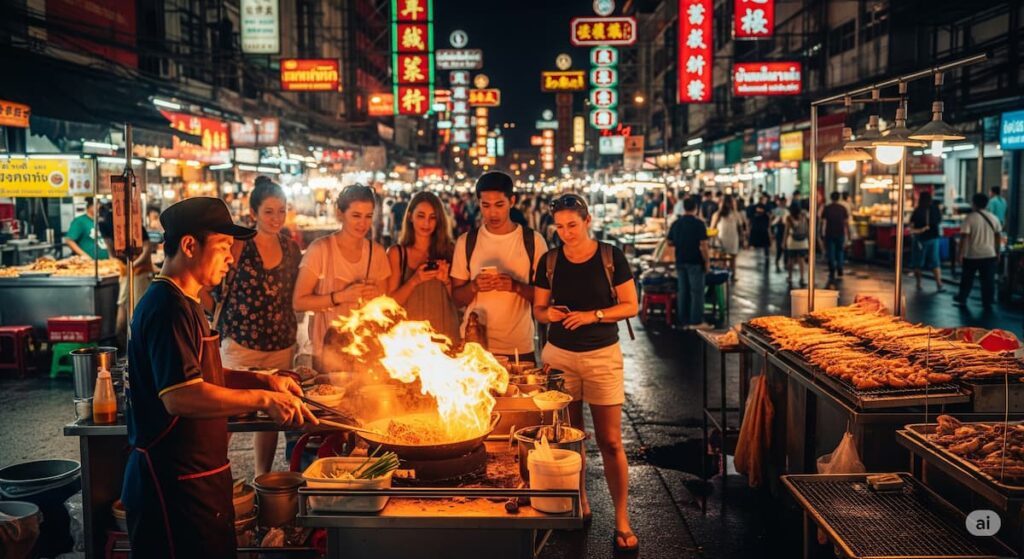
Food in Bangkok is a reason to pick a neighborhood to stroll through, drop into a food court or spend an evening at a restaurant. For a feel of the street scene, market rows are a good choice; for an indoor lunch, the food zones of shopping centers; for a specific dish, a dedicated venue. Start with a convenient neighborhood and the format you want: that makes it easier to find a suitable place without extra trips.
This guide will help you make sense of dish names, choose a stop for lunch and understand how to order. Prices depend on the dish, the portion and the venue, so it’s best to estimate costs from the current menu, including drinks and extra items.
Current as of the update date. Prices, hours and conditions may change; check the schedule of your chosen place before visiting. Payment methods vary, and a venue’s popularity or a comfortable space does not by itself guarantee sanitary safety.
Where to eat in Bangkok: street, food court or restaurant
Choose a format that suits your day. If you want to stroll and sample food along the way, start with the street; if you need an indoor lunch, consider a food court; if you’re interested in a specific venue, set aside time for a restaurant.
| Format | Who it suits | Setting | Ordering process | Payment | Example |
|---|---|---|---|---|---|
| Street stall | For those who combine food with a walk | Street, market rows or a small shop | Choose a dish and agree on the portion and price with the vendor | Clarify before cooking | Yaowarat |
| Food court | For those who want to choose dishes indoors | A shared food hall | Look at the vendors’ menus and figure out how to pay | Possible options: a food court card, vouchers or payment at the vendor | Food court at Asok BTS Station |
| Restaurant | For those who choose a single venue | Depends on the restaurant | Order from the menu and check for extra charges | Depends on the venue; Jay Fai accepts cash only | Jay Fai restaurant |
The format helps you choose the atmosphere, but it does not automatically determine the price or quality of the food. It’s better to compare a street order and a restaurant dinner by the contents of the whole purchase, not just the dish name. For an introduction to menus, see Thai cuisine for beginners.
You don’t need to pick one format for the whole trip. You can have lunch at a food court and then, in the evening, stroll among street vendors, depending on your mood and route.
What to try in Bangkok: dishes, desserts and drinks
Menu names help you get oriented but don’t replace a conversation with the vendor. Below are common dish variants: the ingredients, add-ons and spiciness of a particular portion may differ.
- Pad Thai. Stir-fried rice noodles with egg, peanuts and tamarind sauce. The shrimp version should be considered separately from the basic portion: the dish name alone doesn’t explain which add-ons are included in the order. According to a review Street Food Blog (as of October 2025), a basic street-food portion in Bangkok costs 40–70 ฿; premium add-ons are charged separately.
- Tom Yum Goong. A spicy, sour soup with shrimp, lemongrass, galangal and lime leaves. If you’re choosing it for its characteristic flavor, discuss how spicy you want it before it’s cooked. For tom yum with seafood at local street vendors, one source Offpath Thailand (as of September 2026) gives 60–80 ฿; the source does not single out a shrimp-only version.
- Som Tam. A green papaya salad, in its common version made with chili, garlic and fish sauce. Versions with salted egg or other add-ons may differ in ingredients. For local street vendors, the benchmark comes from Offpath Thailand (as of September 2026) — 40–60 ฿; prices are higher in tourist areas.
- Mango Sticky Rice. A dessert of mango and sticky rice with coconut milk. It’s a good choice for a sweet stop after a main dish or as a separate snack. According to Offpath Thailand (as of September 2026), at a local street vendor a portion costs 50–70 ฿.
- Pad Kra Pao. Meat stir-fried with Thai basil, chili and garlic, served with rice. A fried egg may accompany the order, so check whether it’s included in the item you choose.
- Khao Man Gai. Chicken with rice cooked in chicken broth. The dish suits anyone getting to know rice-based meals, if that’s the kind of meal you want right now. At the Go-Ang Pratunam 2 (Ratchadamri) branch, a regular portion costs 65 ฿ on the delivery menu checked in October 2026, on LINE MAN Wongnai; the menu’s update date is not given.
- Khao Soi. Curry noodle soup with coconut milk and crispy noodles on top. This is a dish from northern Thai cuisine that you can also look for in the capital.
- Boat Noodles / Kuay Teow Reua. Noodles in a rich, dark broth with meat and greens. It’s best to check the portion size with the vendor before deciding how much to order. According to a review Soles of a Nomad Travel (as of November 2025), a small bowl at a boat noodle alley by Victory Monument costs about 20 ฿; the author does not name a specific venue.
- Green Curry. A coconut curry; its common version is made with chicken, eggplant and basil. Discuss how spicy it is separately: the dish’s color does not replace an explanation of its flavor.
- Guay Jub. Rolls of rice noodles in a peppery broth; the common version includes pork offal. If certain ingredients aren’t suitable for you, find out what’s in it before ordering. For Nai Ek Roll Noodles on Yaowarat Road, 442, one source Cap Thaïlande gives 70–150 ฿ for guay jub, based on data collected in 2026; the publication date is not given.
For a snack, you can choose pork Moo Ping skewers, Chicken Satay or Banana Roti. For drinks, try Thai Iced Tea; it’s best to mention how sweet you want it in advance. At morning local markets, pork Moo Ping costs 10–15 ฿ per skewer, according to Offpath Thailand (as of September 2026). On Khao San Road and in Rambuttri, Banana Roti costs 40–70 ฿, according to Khaosanroad.com (as of March 2026). According to a review Street Food Blog (as of October 2025), street Thai iced tea costs 25–35 ฿.
Among the places to try these dishes are the dessert spotMae Vareeand the restaurantGo-Ang Chicken Rice. You can mark them on the map alongside the other stops, choosing mango sticky rice or chicken with rice accordingly. According to a trip report from April–May 2026 on Vocus, at Mae Varee a small serving of mango sticky rice costs 120 ฿, a large one 160 ฿.
Prices were checked on October 23, 2026, using the sources linked in the text. Next to each price, the month of the source’s data is given; if the source does not name it, the month the page was checked is given. Actual prices on the spot may differ.
Bangkok’s best neighborhoods for street food
The best neighborhood is the one that fits your route and the dish you want. Don’t cross the city just for the general promise of “it’s tastier here”: individual vendors differ in menus and visiting conditions.
Yaowarat Road suits an evening introduction to street food. The Tourism Authority of Thailand (TAT) describes dim sum, noodles, omelets and other dishes here; for more on the district itself, see Bangkok’s Chinatown. In Chinatown you can also mark the restaurant (T&K Seafood).
For the old city of Rattanakosin and Yaowarat, TAT recommends the blue MRT line. The publication lists Wat Mangkon MRT Station, Sam Yot MRT Station, Sanam Chai MRT Station and Itsaraphap MRT Station. Choose a station based on your specific stop: they are not equally close to every venue. For orientation, see a guide to getting around Bangkok.
You can consider other neighborhoods based on your interests:
- Neighborhood where you’ll find Victory Monument, an option for finding boat noodles.
- Khao San Road — for a stroll with snacks, roti and noodles.
- Pratunam — for combining market rows with a stop for chicken with rice.
- Silom — an option if you’re looking for lunch near the business district.
- Chatuchak Weekend Market — for combining food with a stroll between the market rows.
- Song Wat — for those interested in cafés and traditional noodle shops.
- Thong Lor — for choosing cafés and restaurants.
- Ari — for a stroll with stops for coffee, dessert or lunch.
These are points to help you choose, not trading schedules. For a broader search, see the roundup of Bangkok’s markets.
How much food costs in Bangkok: menus and the final bill
Food prices in Bangkok are best compared by specific orders. A dish with a drink, an extra portion of rice and dessert is a different purchase from a single item on the menu. For a dish from a local street vendor in a residential neighborhood, one source Offpath Thailand (as of September 2026) gives 40–70 ฿; this benchmark does not apply to tourist streets.
| Format | Where to check prices | What to check in the order | What payment terms to clarify |
|---|---|---|---|
| Street stall | On the menu, on the price tag or from the vendor | The portion, the chosen version, add-ons and drink | The total and the available payment method before cooking |
| Food court | On the chosen vendor’s menu | The main dish and separately charged items | Whether a food court card or vouchers are needed, and how to use any leftover balance |
| Restaurant | On the current menu | Dishes, drinks and extra charges | What the listed price includes and how the bill can be paid |
A service charge differs from voluntary tips. This is explained in a clarification from Thailand’s consumer protection agency. If a restaurant charges such a fee, the agency requires its amount to be clearly shown alongside dish prices.
Don’t apply one restaurant’s terms to another. Check the notes on the menu and, if the total is unclear, ask for the charges to be explained before ordering.
To compare venues, choose a similar purchase: a main dish, a drink and the add-ons you want. That makes it easier to estimate costs without a notional “average lunch,” which may not match your preferences at all. According to a review Street Food Blog (as of October 2025), a full meal of street food costs 100–200 ฿, though the contents of the order can vary. According to Destination Unpacked (as of August 2026), a full meal at a local restaurant costs 80–150 ฿.
Food courts, food halls and shopping centers
Bangkok’s food courts are convenient when you want to pick food indoors and combine lunch with other errands. But a shared hall, a restaurant zone and a food market may work under different rules: first work out which kind of place you’re in.
Food court at Asok station
The shopping center at BTS Asok lets you combine shopping with lunch. According to the complex’s official page, the food court is on the floor 5, decorated as San Francisco.
TAT points to direct access from Asok station and to the food court’s hours 10:00–22:00. This is the venue’s schedule, not a separate promise that every vendor is open; before visiting, we recommend checking the hours. For the main dish at Pier 21, Terminal 21 Asok, overview WhereBest labeled 2026 gives 40–80 ฿; the publication date is not given.
Other shopping centers
The options includeMBK Center,Siam ParagonandEmQuartier. Choose the venue near your other plans, and within it a specific vendor according to the menu. A mall’s overall reputation doesn’t explain what your order costs. The benchmark for a main dish at an ordinary mall’s food court is 50–120 ฿, according to a review WhereBest labeled 2026, without a publication date. According to a review Bangkok Spirit for mid-2026, a takeaway portion of mango sticky rice at a mall food hall costs 100–160 ฿; the publication date is not given.
If you plan to combine shopping and lunch, first look at shopping in Bangkok. This helps you pick a convenient complex and avoid a separate trip just for food.
Dusit Central Park
In the complexDusit Central Park, the Parkside Market food zone is worth a look. According to the complex’s operator (Central Pattana), it brings together venues from the Michelin Guide. That doesn’t mean each of them has a star.
The same operator reports Thailand’s first branch of Blue Bottle Coffee at Central Park. You can treat the café as a separate stop if that format interests you.
ICONSIAM: regional cuisine and restaurant zone
The ICONSIAM mall has the SOOKSIAM food zone. According to the complex’s official description, it brings together food from all 77 provinces of Thailand. Participants include permanent venues and ones that rotate.
The Veranda restaurant zone offers a different way to get to know the food. According to the complex’s official page, it has 10 restaurants and 10 more venues serving drinks and desserts.
These zones have different focuses: regional cuisine versus a selection of restaurants with dessert stops. So within one complex, you can choose based on interest in the dishes, not just on convenient location.
EMSPHERE: hours and visiting rules
In its official answers to visitors’ questions, the EMSPHERE mall lists the following conditions:
- Sunday through Thursday: 10:00 AM–10:00 PM.
- For the Gourmet Market & Food Hall food zone on Friday and Saturday: 10:00 AM–12:00 AM, until midnight.
- The first 2 hours of parking are free; for hours 3–6, the listed fee is 20 ฿ per hour.
- Pets are not allowed in the grocery market and food zones.
The food zone’s Friday and Saturday hours do not automatically apply to all tenants in the complex. Before visiting, we recommend checking the hours of your chosen place.
Food court card or vouchers
A possible payment process is to get a food court card or vouchers at the cashier and then use them at the vendors. Before topping up, find out how the balance is spent and whether an unused balance can be refunded; one food court’s terms should not be assumed for others.
Bangkok’s restaurants and Michelin Guide recommendations
A restaurant guide helps you choose venues, but its markings need to be told apart. Inclusion in the guide, the Bib Gourmand mark and a star are different statuses, which cannot be used as interchangeable names of an award.
According to a Michelin publication, the Thailand selection includes 137 venues with the Bib Gourmand mark, 13 of them new. According to TAT, the national guide for 2026 covers 468 venues and 11 destinations. All of these figures refer to the country, not just the capital.
The Jay Fai restaurant appears on the official list of starred venues. Hours from Wednesday through Saturday 09:00–19:30 and payment (cash only) are listed on the restaurant’s official listing in the Michelin Guide. TAT names Sam Yot on the blue MRT line as the nearest station; before your trip, we recommend checking the restaurant’s schedule. In a review Starredbill from October 2026, the price for crab omelet is given as 1,500 ฿, taken from the August 2025 menu.
The Potong and Wana Yook restaurants also appear on the official list of starred venues. For more options, see a roundup of Bangkok’s Michelin restaurants. Use it to help find a suitable place, and check the price of a specific dinner on its menu.
How to order food: spiciness, ingredients and payment
Start with the item you’ve chosen on the menu, then discuss the portion and any requests. Don’t expect the vendor to figure out what flavor you mean by the dish name.
You can organize the ordering process like this:
- Point to the dish you want and choose from the options offered.
- Discuss the ingredients that matter to you.
- Say how spicy or sweet you’d like it.
- Agree on the total and the payment method before cooking.
“Not spicy” (Mai pet) and “not sweet” (Mai wan) requests can be used to start a conversation. They don’t guarantee a particular result and don’t replace discussing the ingredients: the sauce, add-ons and base of the dish need separate attention.
If you need dishes without certain ingredients, explain this before ordering. For a more detailed look at such options, see a guide to vegetarian eating in Thailand. A dish’s name alone does not confirm the full ingredients of a particular portion.
Having a QR code does not confirm that you’ll be able to pay with it. Find out which payment method is available to you; for small purchases, it’s handy to have small bills. At Jay Fai restaurant, a separate confirmed condition applies: cash only.
A line may show visitors’ interest, but it does not prove that the food is safe. The same applies to popularity and air conditioning; for more detail, see the separate guide to food and water safety in Thailand.
How to combine food with a walk around Bangkok
Food in Bangkok fits well into a walk if you start with one neighborhood or complex. Below are options to choose from, not routes with fixed costs or guaranteed schedules for every stop.
An evening walk through Yaowarat
Choose this option for the street atmosphere and for getting to know individual vendors. You can start with a noodle shop’s menu, look at the dim sum or omelet options, and decide on the spot which order suits you.
You don’t need to turn the walk into a mandatory shopping list in advance. Leave room to choose a different dish or skip a stop if the menu doesn’t meet your expectations.
Lunch at Asok station
The Asok station food court suits the “shopping center and indoor food” scenario. First look at the menus of several vendors, then choose a dish and sort out the food court’s payment.
This option is convenient if lunch should be part of your visit to the complex. You don’t have to look for a separate restaurant just because it made a popular list.
Several formats at ICONSIAM
At ICONSIAM, you can choose regional cuisine in the SOOKSIAM zone or a restaurant stop in The Veranda zone. Decide what interests you more: getting to know a range of dishes, or visiting a specific restaurant and dessert spot.
When it rains, consider one of the indoor formats described above. The choice stays the same: the dish you want, a comfortable setting and a suitable menu.
Frequently Asked Questions ❓
How much does street food cost in Bangkok?
The cost depends on the dish, the portion and the vendor you choose. Check the current menu and agree on the price before ordering. When comparing options, consider the whole purchase, including drinks and extra items.
Is it safe to eat street food in Bangkok?
A stall’s popularity and a line by themselves don’t guarantee food safety. If the exact ingredients matter to you, discuss them with the vendor before ordering. For more information, see the separate guide to food and water safety.
Where is the best street food in Bangkok?
For an evening stroll, you can choose Yaowarat: TAT describes dim sum, noodles, omelets and other street food here. Your choice of place depends on the dish you want and your route. There is no single best neighborhood for all visitors.
Which Thai dishes should you try first in Bangkok?
You can start with Pad Thai, Tom Yum Goong, Som Tam or Mango Sticky Rice. If you want a rice dish, consider Pad Kra Pao or Khao Man Gai. Choose according to your preferences and discuss the spiciness and ingredients you want before ordering.
How do mall food courts differ from street food?
A food court lets you choose dishes indoors and combine lunch with a visit to the mall. Street food helps you get to know a neighborhood and individual vendors. Prices and payment methods differ; an air-conditioned space does not guarantee sanitary safety.
Where can you eat cheaply and well in Bangkok?
Compare the current menus of the street stalls and food courts you’re considering, taking into account the portion and the whole order. The Asok station food court can be considered as one option: it is located in a shopping center with direct access from the station. It’s a convenient starting point for choosing, without any promise of a specific price or superiority over other venues.
Conclusion
Food in Bangkok starts with a simple choice: which format suits you, which neighborhood you’ll be in and what dish you want to try. For street atmosphere, start with Yaowarat; for an indoor lunch, start with the food court at Asok station. If food zones inside complexes interest you, consider ICONSIAM and EMSPHERE.
You don’t need to fit all the places into one day: choose the option that fits naturally into your walk. Check the current menu, decide on the order and the payment method you can use. Prices, hours and venue conditions can change, so it’s best to build your plan around the place you’ve chosen while keeping the option to swap a stop.
Prepared by MyThai.online editorial team.