In this article:
What changed: Added dress requirements for the Grand Palace and the admission price for foreigners — 500 baht. Clarified that cannabis use is limited to medical purposes and requires a prescription from a specialist recognized in Thailand. Additional tips remain voluntary.
Etiquette in Thailand helps with some very practical questions: what to wear to a temple, how to greet people, how to calmly raise a mistake on the bill, and how to thank staff for service. Start with the basics: speak calmly, respect personal boundaries, follow the rules of each specific place, and ask permission before photographing people. Additional tips are voluntary, and dress requirements can differ even between temples.
You don’t need to memorize every detail of a greeting gesture in advance or fear an occasional awkward moment. It is more useful to understand the nature of each rule: a cultural recommendation helps you communicate respectfully, a condition of entry determines access to a specific site, and a legal restriction involves legal liability. Below we break down these differences using situations familiar to tourists, from a shared table to a visit to the palace complex.
Current as of the date this material was updated. Legal restrictions may change: before traveling, check official travel advisories and the requirements of Thai authorities.
Main rules of etiquette in Thailand: a short reference
Rules of conduct in Thailand are easier to remember through actions. This reference will help you get oriented before a walk, a temple visit, or paying for a service.
| Situation | What to do | Nature of the rule |
|---|---|---|
| Greeting | Greet people calmly; you can smile, nod, or do a wai | Cultural recommendation |
| Visiting a temple | Choose modest clothing, read the signs, and take off your shoes before the marked area | Cultural recommendation and conditions of the specific site |
| Touching | Don’t touch someone else’s head; consider the person’s consent and personal space | Cultural recommendation and respect for personal boundaries |
| Talking about the monarchy | Avoid insulting words and actions | Legal restriction |
| Paying for a service | Check the bill and the service charge; leave additional tips at your discretion | Payment terms and voluntary gratuity |
| Photography | Ask the person for consent and follow local restrictions | Respect for personal boundaries and conditions of the specific site |
A cultural mistake by itself does not automatically mean arrest. If you accidentally behave awkwardly, stop the action, apologize, and fix the situation. Legal prohibitions require separate attention: friendly communication does not replace compliance with them.
Respect for the monarchy: custom and legal restrictions
Here, cultural respect intersects with the law. Canada’s government travel advisory states that offensive words or actions toward the king or the royal family are illegal.
The Australian government travel advisory warns of imprisonment up to 15 years for insulting the monarchy or damaging its images. This is a warning about serious risk, not a prediction of punishment for a specific remark, photo, or post. Do not use royal images for offensive jokes, and do not assume that a private conversation or a social network rules out legal consequences.
In everyday situations, handle money with care. If a banknote falls, pick it up by hand without stepping on it; avoid deliberately damaging banknotes and images of the monarchy. These tips do not mean that simply crumpling a banknote automatically proves a crime.
When the anthem plays, stop talking and behave respectfully. If people around you stand, you may follow their example without turning the situation into a dispute or a show. Other practical questions before a trip are covered in guide to safety in Thailand.
Etiquette in temples and respect for Buddhist shrines
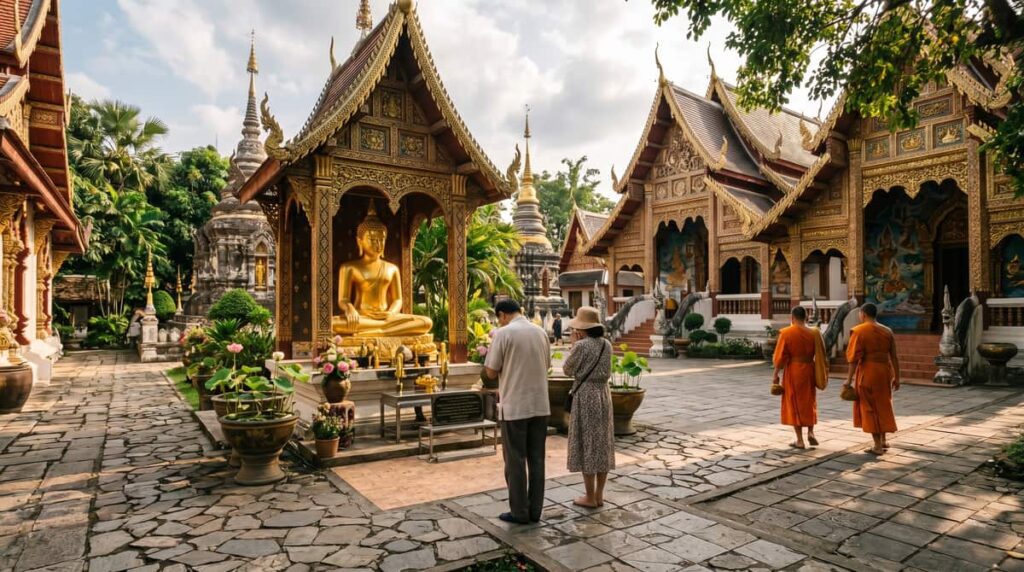
Covered shoulders and knees are a reliable choice for a temple visit. The tourist guide to traveler conduct recommends such clothing and removing shoes before entering temple buildings. At the same time, tourist material about visiting Thai temples allows skirts and shorts at many temples: requirements differ between sites.
In practice, this is easiest to see in clothing: an outfit acceptable at one temple may not meet the conditions of the palace complex. So follow the specific entrance and its signs, not only general advice from an acquaintance.
Visiting steps:
- Choose in advance modest clothing that suits the site you plan to visit.
- Before entering, read the signs about dress code, footwear, and photography.
- Take off your shoes before the marked temple area and leave them in the designated place.
- Step over the raised threshold: the government guide recommends not stepping on it.
- Inside, speak quietly, don’t disturb people who are praying, and don’t point the soles of your feet at shrines.
- Before photographing people, get their consent; follow the room’s restrictions separately.
The Grand Palace’s own requirements
The Grand Palace and Temple of the Emerald Buddha — a complex in Bangkok with its own visiting conditions. The map marks separately the Grand Palace and Temple of the Emerald Buddha (Wat Phra Kaew).
The list of unacceptable clothing is published on the official Grand Palace website:
- sleeveless clothing and vests;
- short and see-through tops;
- shorts;
- torn, tight, and cycling pants;
- miniskirts.
The official page lists the ticket price for foreigners as 500 baht — check the current price. It includes access to the Temple of the Emerald Buddha and the Queen Sirikit Museum of Textiles inside the complex. To prepare for the route, see the article about visiting the Grand Palace.
Monks, photos, and other temples
A cultural guide to responsible travel recommends that women avoid physical contact with monks and handing items directly to them. For handing something over, use a designated cloth or surface from which the monk can pick up the item. Do not photograph monks without their explicit permission.
If your next stop on the walk is Wat Arun temple in Bangkok also follow its signs. The location of Wat Arun temple is marked on the map. To prepare for your visit, see our article “Wat Arun temple in Bangkok”. Permission to photograph the grounds should not be automatically extended to interiors or people.
Wai greeting: how to say hello without awkwardness
Wai is a gesture with palms pressed together and a slight bow of the head. The tourist culture guide Thailand Routes explains that a higher position of the hands expresses greater respect. For a traveler, this is an introduction to the gesture, not a requirement to reproduce an exact scheme based on age and rank.
Don’t turn greeting into an exam. A smile, a slight nod, and a calm verbal greeting are practical options for everyday interactions. You can kindly respond to a hotel staff member, a seller, or a driver without trying to determine their place in the social hierarchy.
If you want to do a wai, it’s helpful to free your hands first. Don’t try to hold a drink and a phone while pressing your palms together: it’s enough to greet calmly and then continue the conversation. Copying a complex bow just because you saw someone else do it is also unnecessary.
For introductions and thanks, it helps to know basic Thai phrases. It’s better to start with a clear greeting and an attentive attitude toward the other person than to rush to show every gesture you’ve learned.
Head, feet, and personal boundaries: what to avoid
The cultural guide “Pattaya Turs” links the special attitude toward the head to local beliefs about its sacredness. It recommends not touching someone else’s head, including not patting children on the head or ruffling friends’ hair as a joke. One person’s reaction may differ, but avoiding such contact is simpler and more respectful.
The same guide advises not pointing the soles of your feet at people, images of the Buddha, or temple statues. When sitting across from someone, don’t raise your legs so that the soles face their face. In a temple, choose a position in which your feet are not pointed at a shrine.
If sitting on the floor is difficult for you, ask a staff member for a suitable place. Don’t endure pain or try to hold an uncomfortable posture just to look like you’re following custom. Respectful behavior can be combined with physical comfort.
The tourist cultural guide Asia King Travel describes handing over items with the right hand and, in a formal situation, with both hands. If you want to show special respect to an elder, hand over the item with both hands; this is a cultural preference, not a prohibition on using the left hand.
In line, leave space for other people and don’t push between them. Don’t step over a seated person or their belongings, and don’t use your foot to point in a direction. Before touching someone or taking a joint photo, it’s better to get their consent.
Saving face and restraint: how to handle a dispute
Saving face can be understood as the desire not to put the other person in an awkward position. The tourism authority recommends respectful and calm communication. This is a useful approach when there is a mistake in an order, an unclear charge, or a question about a service.
Instead of accusing, name the specific problem. Ask to see the item on the menu, to have a line on the bill explained, or to replace a dish you didn’t order. Where possible, discuss the situation directly with a staff member rather than making a complaint to the whole room.
These neutral phrases will work:
- “Please, let’s check the bill.”
- “I ordered a different dish.”
- “This offer doesn’t suit me.”
- “Please explain what this charge is for.”
- “Let’s call a staff member who can resolve the issue.”
A calm tone doesn’t require giving up a justified complaint. You have the right to disagree with a proposal, ask for an explanation, and end the conversation. You don’t need to smile through a threat or put up with deception for the sake of politeness.
If a dispute becomes dangerous, don’t try to continue it just to have the last word. Move to a safe place and seek help. According to the Australian government travel advisory, the tourist police number is — 1155.
If the awkwardness arose from your own mistake, calmly acknowledge it. It’s better to stick to a short apology and a corrected action than to spend a long time proving you had no ill intent.
Tips, bargaining, and paying bills
Additional tips are voluntary — that is how the tourism authority describes them. You may thank a staff member for good service, but you are not obliged to add money to every bill. It’s easier to decide after checking the charges.
Payment steps:
- Look at the total and the listed services.
- Find the service charge line.
- Ask about any unclear item before paying.
- Pay the agreed bill.
- Decide whether you want to leave an additional tip.
The specialized tourist guide Fan Club Thailand notes that expensive restaurants and rooftop bars often already include a 10% service charge. In that case, additional tips are not required unless you want to separately recognize the service. This describes certain establishments, not a rule for all cafes and restaurants.
For spas and massage, the tourist guide Radical Storage gives a voluntary guideline: 50–100 baht or 10–15% of the service cost. This is an example of a possible tip, not a mandatory rate or a calculation for each hour. Choose the amount according to your wishes, without turning the guideline into a debt.
Bargaining depends on the situation. At a market or a small souvenir shop, you can politely ask about a different price; if the offer doesn’t suit you, thank the seller and decline. In an establishment with a fixed menu, discuss your order and charges rather than asking for a discount after the meal.
Agree on the terms of a trip or service in advance. Don’t pressure the seller, and don’t take a refusal to lower the price as a personal insult: a calm “thank you, that doesn’t suit me” ends the conversation without awkwardness.
Table etiquette: shared dishes and utensils
If dishes are served on a shared table, take a small portion onto your own plate. Use the serving spoon if one is provided, and leave others a chance to try the food. Don’t immediately put all of the dish you like onto your plate.
Follow the utensils provided. If there is a spoon and fork in front of you, the fork is handy for pushing food onto the spoon; if chopsticks are brought, use them for the dish that suits them. If in doubt, ask the host or a staff member, rather than trying to guess an order that applies to everyone.
Consider the people sitting near you: offer to pass a shared dish, don’t reach across someone else’s plate, and don’t talk with your mouth full. As a guest, you can wait briefly for an invitation to start the meal. This is consideration for the hosts, not a universal requirement to wait for the oldest person.
Take only as much food as you’re ready to eat, especially from a shared dish. Between bites, rest your chopsticks on a holder or the edge of the dish rather than sticking them upright in rice. If you need to blow your nose, step away from the table without drawing extra attention.
To get to know the dishes in advance and choose your order more confidently, see Thai cuisine for beginners. Etiquette at the table in Thailand is easier to follow when you pay attention to your companions and to the way food is served.
Legal restrictions: cannabis, drones, and e-cigarettes
This section helps distinguish cultural advice from restrictions with possible legal liability. Foreign government travel advisories provide tourist warnings; they do not allow predicting the outcome of a specific case.
Cannabis
Cannabis use is described as restricted to medical purposes in the UK government travel advice on local laws. The Australian government travel advisory indicates the need for a prescription from a specialist recognized in Thailand.
Don’t treat a shop window as confirmation that a purchase is suitable for every tourist. For more on this topic — restrictions on the sale of medical cannabis · RU. Having a medical regime does not mean free use in all circumstances.
Drones
The specialized drone guide DroneTH describes mandatory registration of devices with a camera regardless of weight, and of devices without a camera weighing more than 2 kg. These are criteria from a specialized guide, which should not be taken as an official document from an aviation or telecommunications authority.
The British government travel advice links liability specifically to the absence of registration with the National Broadcasting and Telecommunications Commission (NBTC): 100,000 baht, five years in prison, or both penalties. Separately, the official Grand Palace website prohibits drone flights over its grounds.
Before flying, check current registration and permit conditions with the relevant authorities. Consider device registration and the permissibility of flying in your chosen location separately. For further details — rules for using drones in Thailand · RU.
E-cigarettes
A piece outlining tourist conduct rules, published by the news service Press Advantage, reports a ban on owning and using e-cigarettes for residents and visitors of Thailand. Do not treat another person’s use of a device as proof that it is legal. This warning covers e-cigarettes only and does not extend to all devices that look similar.
Photos and video
Ask for consent before photographing people. On the grounds of a site, follow the signs and staff instructions, separately checking the room’s restrictions and flash use. The ability to take a general shot does not mean a person has consented to a close-up.
Etiquette at festivals: Songkran and Loy Krathong
Songkran is the Thai New Year, celebrated April 13–15. During Songkran, respect a person’s wish not to take part in water games. Don’t splash those who refuse, are busy working, or are simply walking by. Don’t aim water at moving motorcyclists: road conditions require attention, and an unexpected splash creates a risk.
Don’t pick monks or elderly people as targets for play. Avoid a strong jet of water in the face, and don’t add ice to the water. If a person responds cautiously or tries to step away, reduce the force or stop the game; taking part on equal terms is not required.
Choose comfortable opaque clothing suitable for a wet crowd. While taking photos, don’t block the way or prevent people from leaving the water game. These tips relate to safety and respectful behavior, without treating every violation as a separate crime.
At Loy Krathong, don’t interfere with religious ceremonies, and ask permission before photographing people who are praying. For an evening temple visit, prepare modest clothing. When launching lanterns and doing other activities, follow the instructions of the organizers, and don’t assume that permission applies everywhere.
If your trip includes Chiang Mai, this map marker denotes the city, not a festival venue. Dates and programs are easiest to find through the calendar of events and holidays in Thailand.
Frequently Asked Questions ❓
Can you get a tattoo of the Buddha in Thailand?
For respectful treatment of religious images, it’s better to choose a different subject. Don’t assume that every such tattoo is automatically banned by law, or that every artist will necessarily refuse to do it.
What should you do if you accidentally violate Thai etiquette, for example by touching a child's head or pointing at a statue with your foot?
Stop the action, calmly apologize, and correct the situation. A sincere apology is a reasonable first step, but neither a smile nor a particular gesture guarantees that a conflict will end immediately.
Do you need to cover your knees in ordinary cafes and shopping centers, or only in temples?
Choose clothing according to the place you’re visiting and its rules. For a temple, covered shoulders and knees are more reliable, although shorts are acceptable at many temples; the Grand Palace publishes its own, stricter list of restrictions. Don’t automatically apply its dress code to every cafe or shop.
Is it mandatory to tip a waiter in Thailand?
Additional tips are voluntary. First check whether a service charge is included in the bill, then decide whether you want to separately thank the staff member.
Is it allowed to sunbathe topless on Thailand's beaches?
For beach relaxation, choose a swimsuit and consider the rules of the place. When leaving the beach for a shop, cafe, or other public building, cover up with clothing. This is practical advice on respectful behavior, not a universal legal answer for every beach.
What should you do if a homeowner or a business staff member asks you to take off your shoes?
Follow the request and leave your shoes in the designated place. In a temple, distinguish the complex grounds from the entrance to a building: follow the signs and staff instructions, not just the behavior of other visitors.
Can a foreigner actually be jailed for a social media post about the king?
Insulting the monarchy carries the risk of criminal liability. The Australian government travel advisory warns of imprisonment of up to 15 years. This is a serious travel warning, but it does not allow predicting the punishment for a specific post.
Conclusion
Etiquette in Thailand begins with attention to people and place: respect personal boundaries, speak calmly, choose clothing in advance, and follow the visiting conditions of the specific site. Before photographing, ask for consent; when paying, check the bill, and leave additional tips at your discretion. If you make a mistake, stop the action and apologize calmly.
Cultural recommendations, site dress codes, and legal restrictions require different approaches. Politeness helps with communication, but it does not guarantee the absence of conflicts or legal problems; legal restrictions and visiting conditions can change. Prepare your route, suitable clothing, and questions about the rules of the places you’ll visit in advance, so that it’s easier to focus on the journey itself during your trip.
Prepared by MyThai.online editorial team.