In this article:
What changed: The boat trip with the orange flag costs 19 baht. The river operator’s schedule has been in effect since October 6, 2026. An option for getting there via Itsaraphap metro station has been added.
Current as of publication
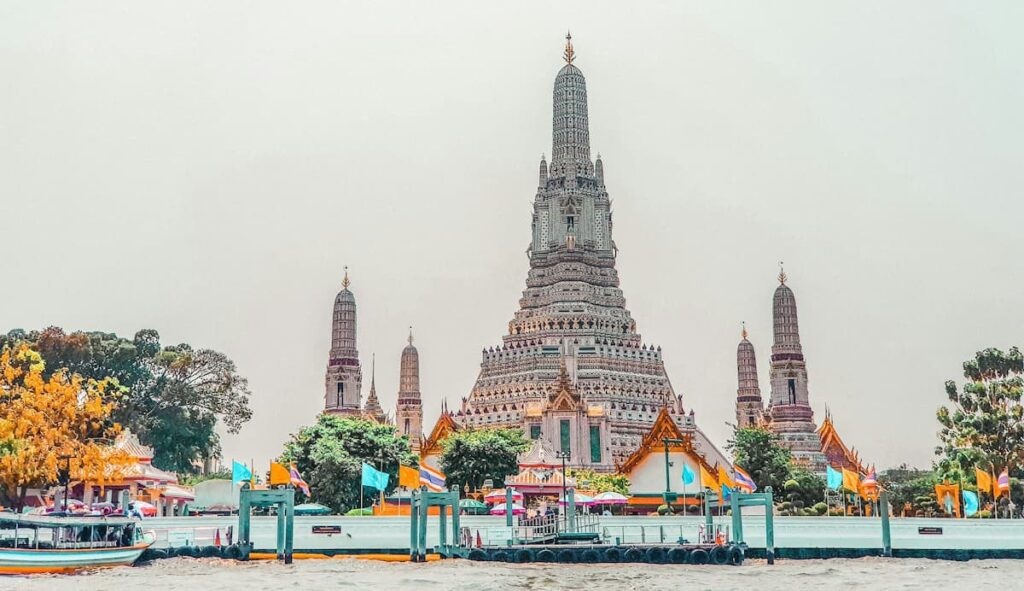
Wat Arun Temple in Bangkok (Wat Arun Ratchawararam) is a Buddhist temple on the west bank of the Chao Phraya, known for its central prang. As of October 2026, the Japan office of the Tourism Authority of Thailand (TAT) lists the visit 08:00–18:00 and admission ticket 200 baht. This information comes from the TAT information card, not a new announcement from the temple administration.
For a self-guided trip, choose the metro to the west bank, a route with a ferry crossing, or a river boat. Prepare clothing that covers your shoulders and knees, and plan your visit to the porcelain decoration and temple halls separately from the evening view across the river. Below we cover getting there, the stairs and nearby stops; to compare other Bangkok’s temples can be done before planning your route. Start with which bank suits your day better.
Opening hours and admission cost for Wat Arun
As of October 2026:
- Visiting hours: 08:00–18:00.
- Admission: 200 baht; confirm the current price.
- Central office phone: 02-891-2185.
This information is published on the official information card of the Tourism Authority of Thailand (TAT), which is maintained by its Japan office. The update date of the card itself is not stated, so use the price as a budget guideline.
Don’t leave the whole visit until the end of the day: the closing time of the grounds does not tell you when ticket sales or entry stop. If you are traveling with a child, ask the central office in advance about age conditions; free entry for all children does not follow from this card. You can also ask there about payment methods and what the ticket includes, if your plans depend on them.
Where Wat Arun is and how to get there
Wat Arun is located in the Bangkok Yai district, on the side of Thonburi. This is the west bank of the river. From the historic center on the opposite bank, you can get there by ferry from Tha Tien.
The Japan office of the Tourism Authority of Thailand (TAT) gives the address: (34 Arunamarin Rd., Wat Arun, BangkokYai, Bangkok 10600). For a self-guided approach, compare it with the map of Arun Amarin Road (Arunamarin Road).
| Option | Travel order | Cost | What to consider |
|---|---|---|---|
| Metro to the west bank | Take the Blue Line metro to Itsaraphap (MRT Itsaraphap), then walk to the temple | At the metro fare | The tourism authority calls it the nearest station; no ferry is needed |
| Metro and short ferry | Sanam Chai station (Sanam Chai), Exit 1, walk to Tha Tien, then cross the river | Metro ticket and separate ferry fare | Tha Tien Pier is on the Wat Pho side; check the fare and departures at the pier |
| Express boat | Choose a service to Wat Arun Pier according to the operator’s route map | The published fare for the orange line is 19 baht | Check the stops of the service you choose; this fare does not apply to the short ferry |
The tourist guide to trips in Asia (MyAsiaTrip) recommends about 10–15 minutes on foot from Sanam Chai toward Wat Pho and Tha Tien, a guide as of October 2026. The approach, ferry wait and crossing are separate parts of the trip, so don’t treat this time as the total for the whole route.
As of October 2026, the published flat fare for the orange boat is 19 baht; confirm the current price. Schedule on the official website of the river operator is in effect from October 6, 2026, Monday through Sunday and on public holidays. This is the date the schedule takes effect, not a confirmed date for introducing the fare.
If you are traveling via the Saphan Taksin station (BTS), plan a transfer to river transport. The search tag for Sathorn Pier helps you find the pier, but does not confirm its exact location or the stops of a specific line. The general transfers are explained in the guide to transport in Bangkok.
Dress code and behavior rules in the temple
The simplest outfit is light trousers or a long skirt and a top with sleeves. Choose clothes so that your shoulders and knees stay covered while walking, sitting, and climbing stairs.
To prepare for your visit:
- Choose opaque clothing without bare shoulders.
- Check the length of your skirt or trousers in advance.
- Don’t count on solving the clothing issue by renting at the entrance: discuss the availability and conditions of rental in advance.
The tourist guide to leisure in Bangkok (BangkokVacay) passes on a boat operator’s advice to choose trousers, skirts, or shorts below the knee and not to come in a tank top. So it cannot be claimed that all shorts are prohibited regardless of length; long trousers remain a clear option for preparation.
Wat Arun Temple in Bangkok is an active place of worship and rituals. Speak quietly, don’t disturb people praying, and choose the moment for photos so you don’t block the passage. Before your visit, it’s useful to read rules of etiquette in Thailand.
Architecture and what to see at Wat Arun
Start with the central prang of Wat Arun: its surface is covered with a mosaic of Chinese porcelain and glazed ceramics. The architectural description from Studio Matrx mentions fragments of plates, bowls, and tiles, shaped and fixed in plaster.
For a self-guided visit, pick out a few features:
- Porcelain decoration and shells. Look at the finish up close, then step back to see the overall pattern of the tower.
- The ordination hall — ubosot. At the ordination hall of Wat Arun Ubosot, the mythical giants Thotsakan and Sahatsadecha stand.
- Murals and sculptures. The tourist description of the temple mentions murals of the life of the Buddha inside the hall and old Chinese guardian figures on the grounds.
The tourist website about Wat Arun (wat-arun.com) links the porcelain in the decoration to ballast from Chinese trading ships. This is an explanation from a secondary source; it does not establish the origin of every mosaic fragment.
The Thailand Foundation calls this special prang form Prang Song Jomhae. Here it is interesting to change the scale of your view: from afar you look at the silhouette, up close at individual ceramic details. Don’t reduce the whole visit to photographing the tower: the hall and sculptures complement the visit.
Before your trip, you can watch a temple video. The footage helps you get a sense of the complex, but does not confirm the current accessibility of certain areas.
History and meaning of the Temple of the Dawn
The name of the Temple of the Dawn is linked to the Hindu god Aruna and the rising sun. The Tourism Authority of Thailand (TAT) explains this connection; its information card gives the name Wat Arun Ratchawararam.
According to the same authority’s description, the Emerald Buddha, brought from Vientiane, was once housed here. The official history of the Grand Palace reports that Rama I installed the relic in the royal chapel. The temple’s history is therefore also connected to the present Temple of the Emerald Buddha (Wat Phra Kaew).
A government source describes the Wat Arun prang as an outstanding example of Buddhist architecture of corn-shaped stupas. This architectural context helps you look at the tower more closely: its silhouette is part of the complex’s cultural significance, not just a backdrop for a photo.
Climbing the prang and access to the grounds
The tourist guide to Bangkok (BangkokAuthority) describes very steep steps and a terrace with views of the temple roofs, the river, and the opposite bank. However, a description of the stairs does not mean the climb is open on the day of your visit: follow the barriers and staff instructions.
If the stairs are open and you decide to climb, wear shoes with non-slip soles. Hold the handrail, especially when going down, and don’t rush for a photo. The decoration and temple sculptures can be planned separately from the climb.
For a visitor with limited mobility, the next step is to discuss in advance with the central office a suitable entrance and route around the grounds. Describe whether you need help moving around, a route without steps, or easy boarding of the boat. Don’t assume that the courtyard confirms access to all halls, restrooms, and river piers.
When to visit, where to take photos, and where to watch the sunset
For touring the grounds, you can choose the morning after opening. This is an option for organizing your day, with no promise of empty stairs or no lines; it is better to set the pace to suit your route.
According to the Asia travel guide (MyAsiaTrip) as of October 2026, the benchmarks are:
- 60–90 minutes — a regular visit.
- 90–120 minutes — a visit with a costume photo shoot.
These are the guide’s recommendations, not a required duration. If you want to look at the decoration, enter the hall, and take photos, divide your time among these activities.
For the evening panorama, look at Wat Arun from the opposite bank, from the Tha Tien side. Here you can frame the river and the whole silhouette of the complex, whereas inside it is easier to look at the details of the finish. Don’t confuse this scenario with visiting the grounds after the published closing time.
A costume photo shoot is a separate part of the plan. It is not the same as renting a wrap for suitable clothing: agree in advance with the provider on what the service includes and how the shoot is organized, without assuming special evening access to the temple.
What to see nearby and how to plan your route
On the opposite bank are Wat Pho, the Temple of the Reclining Buddha and the Grand Palace. They are convenient to view as neighboring stops in the historic center, linked to Wat Arun by the ferry from Tha Tien.
Wat Pho is located on Sanam Chai Road and Maha Rat Road, next to the palace. Its official website reports on daily visiting and the need for foreign visitors to buy an entrance ticket. You can find the temple on the map, and the palace complex — on the map.
Possible order for the day:
- The Grand Palace.
- Wat Pho.
- Walk to Tha Tien and cross by ferry.
- Wat Arun.
You can also start with Wat Arun and then cross to the other bank. Before choosing the order, check the conditions for visiting the palace separately; don’t estimate its last admission time from the schedules of nearby temples.
To continue your day, consider Bangkok’s Chinatown (Yaowarat) or Asiatique The Riverfront. These are separate options with their own transfer, not stops at the same distance from the temples.
Frequently Asked Questions ❓
How much is admission to Wat Arun?
The official information card of the Japan office of the Tourism Authority of Thailand (TAT) lists the cost as 200 baht. This is a published guide as of October 2026; check the current price before your visit. The conditions for free admission for children are not listed on this card, so it is best to ask the temple’s central office about the children’s rate in advance.
How do I get to Wat Arun by public transport?
You can take the Blue Line metro to Itsaraphap station on the west bank, or choose Sanam Chai station and a ferry from the Tha Tien pier. For the walk from Sanam Chai to Wat Pho and the pier, the tourist guide recommends allowing about 10–15 minutes on foot, a guide as of October 2026. The published fare for the express boat with the orange flag is 19 baht; check the current price. This is a separate service, and its fare cannot be applied to the short ferry across the river.
What is the dress code at Wat Arun?
Choose clothing that covers your shoulders and knees: light trousers or a long skirt and a top with sleeves. This is a practical recommendation for preparing to visit the temple. Find out in advance whether suitable clothing can be rented and on what terms, rather than counting on renting at the entrance.
When is the best time to visit Wat Arun?
For visiting the grounds, you can choose the morning after opening. According to the tourist guide as of October 2026, the benchmark for a regular visit is 60–90 minutes, and with a costume photo shoot 90–120 minutes; the actual duration depends on your plan. It is better to treat the evening view as a separate scenario from the opposite bank, taking into account the published closing time of the grounds.
Can you climb the prang at Wat Arun?
Tourist descriptions mention terraces and very steep steps, but you need to ask temple staff about the current accessibility of the stairs. Follow the barriers and instructions in place on the day of your visit. If climbing is permitted, wear shoes with non-slip soles and hold the handrail, especially when descending.
What to see near Wat Arun?
On the opposite bank are Wat Pho and the Grand Palace; there is a ferry crossing from Tha Tien between the banks. Chinatown and Asiatique The Riverfront can be chosen to continue your day. Plan these stops separately, taking into account travel time, queues, and the visiting conditions of each place.
Conclusion
Wat Arun Temple in Bangkok is easier to include in your route after choosing transport and nearby stops. Prepare clothing that covers your shoulders and knees, set aside time for the decoration and temple halls, and plan the evening panorama separately from the opposite bank. The internal links will help you put together your own order for visiting temples.
The tourist website about Wat Arun (wat-arun.com) warns about offers of cheap trips under the pretext that the temple is closed. If a stranger suggests changing your route for this reason, check the visiting schedule with staff before agreeing. Fares and access to certain parts of the complex may change; leave room in your plan to adjust the trip and sightseeing.


Prepared by MyThai.online editorial team.