In this article:
What changed: Exit No. 1 of Wat Mangkon station leads to Yaowarat, Exit No. 3 to Wat Mangkon temple. Wat Traimit: 08:00–17:00, published price 100 baht; Wat Mangkon: 07:00–18:00, free admission. The Vegetarian Festival at the Tai Sia Huk Jow Shrine and Sam Chin–Tri Mit Temple is announced for October 10–18, 2026.
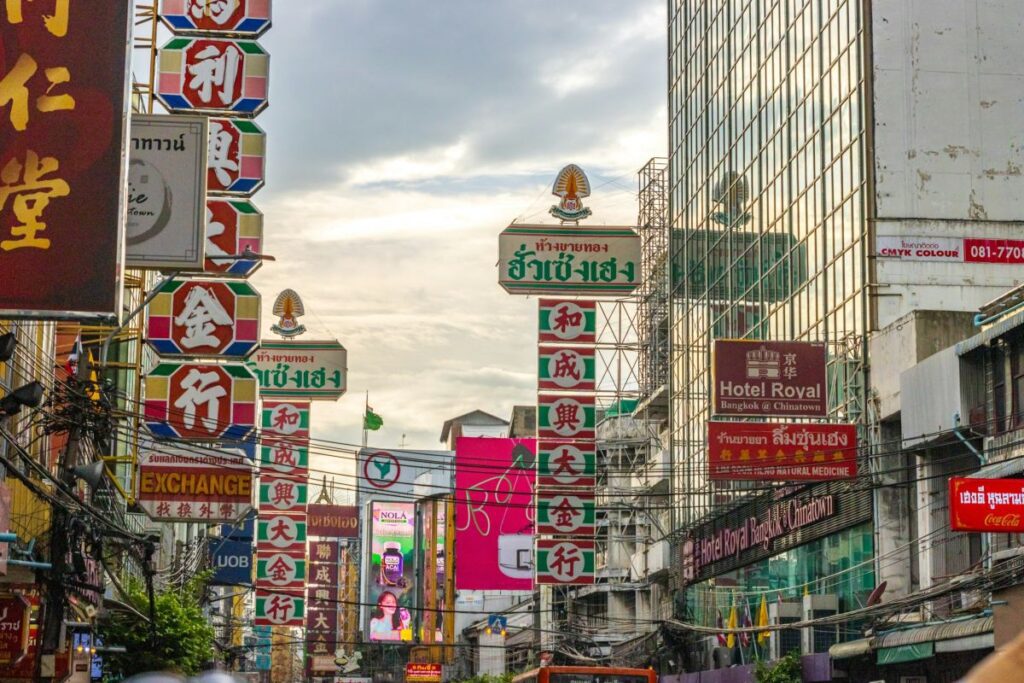
Bangkok’s Chinatown is easier to explore in parts: come during the day for temples and markets, and in the evening for street food. For a self-guided walk, Wat Mangkon metro station on the blue line of the subway (MRT) is convenient. If your main goal is the Golden Buddha at Wat Traimit, you can start from Hua Lamphong station.
The district has a historical basis: after the founding of the new capital of Siam, the Chinese community was resettled to the territory of what would become Yaowarat. Today you can combine cultural stops, shopping and dinner here without turning the walk into a race through the attractions.
Below are the metro exits, the published visiting conditions for the temples, map points and route options. Choose stops according to your interests: markets don’t have to take up the whole day, and the food walk can be left for a separate evening.
How to get to Chinatown in Bangkok
To enter the district, choose the blue line of the metro (MRT) and get off at MRT Wat Mangkon station, station code BL29. It is located on Charoen Krung Road in the center of Chinatown. The Tourism Authority of Thailand (TAT) describes the route from the station to the district as a short walk.
Choose the exit based on your first stop. As of October 2026, the metro operator (BEM) lists the following directions:
- Exit No. 1 — to Yaowarat, Plaengnam Road and Phadung Dao Road.
- Exit No. 3 — to Wat Mangkon Kamalawat temple.
To start at Wat Traimit, there is another option: Hua Lamphong MRT Station, code BL28, on the same blue line. According to the Tourism Authority of Thailand (TAT), the temple is about 10 minutes away on foot from there.
Ratchawong Pier can be saved as a separate landmark on the map. For choosing transport, use Bangkok’s transport guide, and for boat trips see the article river taxi in Bangkok.
Inside the district, plan walks between your chosen stops. First decide what you want to see, and only then choose the station: starting at a temple and starting for an evening dinner require different walking orders.
Attractions of Chinatown: what to see
The history of Bangkok’s Chinatown is tied to the resettlement of the community. According to the Thailand Foundation, after the founding of the new capital of Siam in 1782, Chinese residents were moved from the area of present-day Rattanakosin to the territory of what would become Yaowarat. This context helps you see the district as a place of life and trade, not only as an evening food destination.
To get to know the district, note the Chinatown Gate and the main street — Yaowarat Road. They can be used as landmarks between which you will choose stops. You don’t need to visit all the points in a row: the route works better when it is built around your own interests.
For the cultural part, the Tourism Authority of Thailand (TAT) names the Thian Fah Foundation / Guan-Yin Shrine and the Guan-U Shrine at the Old Market. These are additional stops for those interested in the district’s religious traditions.
Separately, save the Guan-Yin Shrine (San Chao Mae Guan Yin). Don’t mix it up with the shrine at the Thian Fah Foundation when searching for a route: a similar dedication does not yet mean the same destination.
If you want to continue exploring the capital beyond the district, see Bangkok’s attractions. For this walk, it is better to choose a few cultural stops and leave time for markets or dinner.
Chinatown Temples: Wat Traimit and Wat Mangkon
Temples give different reasons to visit. People go to Wat Traimit for the golden Buddha statue, while at Wat Mangkon Kamalawat you can see the coexistence of Buddhist, Taoist and Confucian shrines, as described by the Tourism Authority of Thailand (TAT).
As of October 2026, the Tourism Authority of Thailand (TAT) publishes the following hours and conditions:
| Temple | What to see | Published hours | Visiting conditions |
|---|---|---|---|
| Golden Buddha Temple — Wat Traimit | The golden Buddha statue | Daily, 08:00–17:00 | Published price — 100 baht |
| Wat Mangkon Kamalawat (Wat Mangkon Kamalawat) | Buddhist, Taoist and Confucian shrines | 07:00–18:00 | Free admission |
The hours and price for Wat Traimit are given on the official TAT page about Wat Traimit. Check the current price and what the ticket includes before your visit: the published amount does not show which halls or museum exhibits are included in the ticket.
The golden statue at Wat Traimit weighs 5.5 tons and was once covered in plaster. It is the combination of the golden statue and its former covering that makes this temple’s history unusual.
Wat Mangkon is worth choosing to get acquainted with the district’s religious life. The Buddhist, Taoist and Confucian shrines inside let you see the coexistence of different traditions during a single cultural stop.
It’s best to visit the temples before evening dinner. If you want to see both, go by each one’s hours separately, not by the general opening hours of Chinatown.
Yaowarat street food: what to try
The evening offerings in Yaowarat, as described by the Tourism Authority of Thailand (TAT), include dim sum, noodles, omelets and other street food. For a first introduction, you can start with these categories and choose dishes from the menu on site. You don’t need to make a mandatory list of orders in advance: it is more interesting to leave room for choice.
The Tourism Authority of Thailand (TAT) article on the cuisine explains the influence of Chinese migration: wok cooking techniques combined with Thai herbs. This is useful context for a food walk. It helps you see the dishes as the result of the interaction of traditions, rather than looking for a strict division into “Chinese” and “Thai.”
Navigation points for the walk can be saved in advance:
- Nai Ek eatery (Nai Ek Roll Noodles).
- Lim Lao Ngou eatery (Lim Lao Ngow).
- Hong Sieng Kong eatery (Hong Sieng Kong).
For a restaurant dinner, also consider Jok’s Kitchen. As of October 2026, its listing in the Michelin restaurant guide gives hours of 08:00–20:00 daily. Advance booking is required for the full set menu; this condition applies specifically to that order.
Don’t fill up at the first stop — leave room for the next dish. Small orders help you compare different options, and it’s better to discuss the composition of the chosen item with the seller before ordering.
For a wider choice, the guide to food in Bangkokwill be useful. A separate article will help you explore Bangkok’s Michelin restaurants, if you prefer a pre-planned restaurant evening.
Chinatown Markets: Sampeng, Talad Kao and Pahurat
The Sampeng trading lane (Sampeng Lane) is a wholesale market that the secondary guidebook (Visit Thailand) describes as narrow, mostly covered and crowded. Here they sell accessories, toys, fabrics and household goods. The guidebook recommends a morning visit.
For Sampeng, it helps to choose a goal in advance: look at the trading lane, search for fabrics or make small purchases. In the narrow passage it is easier to move without rushing and to stop in a way that leaves room for others. If you see something you need, discuss the price and quantity before paying.
The old Talad Kao market (Talad Kao) and the Pahurat market (Pahurat) can be noted as additional shopping stops. Choose them by interest and by their location relative to the other points, rather than for the sake of visiting every market.
The Thailand Foundation describes the general assortment of Yaowarat: Chinese products and snacks, clothing, medicinal herbs, incense and candles for ceremonies. This list refers to the district as a whole, so there is no need to look for the entire assortment at each individual market.
Take cash as a backup payment method, but don’t assume that cards are not accepted anywhere. Clarify the terms of a specific purchase with the seller.
To compare shopping places, see Bangkok’s markets. If shopping is the main goal of your trip, you may also find useful the article shopping in Bangkok.
When is the best time to visit Bangkok’s Chinatown
Bangkok’s Chinatown is easy to divide into a daytime and an evening visit. The secondary guidebook (Visit Thailand) recommends seeing temples, markets and gold shops during the day, and coming for street food after dark. This is a scenario for getting to know the district, not a single schedule.
As of October 2026, the same guidebook recommends coming for street food around 18:00–19:00 for a wide choice. Use this interval as a guide for starting your walk. Individual stalls and restaurants operate on their own schedules.
The district’s different activities are clearly visible at different times: the daytime walk is built around trade and cultural stops, and the evening walk around food. So trying to see everything only in the evening may leave the temple part outside your visit. And a daytime visit does not replace the food route after dark.
If you have one free day, start with the chosen temple, then walk through the market and take a break before dinner. If you only have the evening free, focus calmly on food — don’t try to fit the whole daytime program into it.
When choosing a day, don’t assume Monday is a general day off for the district. For a visit to a specific establishment, its own schedule matters, not the idea that all of Chinatown opens and closes at the same time.
Yaowarat festivals: dates and venues
As of October 2026, the Tourism Authority of Thailand (TAT) announces the Vegetarian Festival in Bangkok for October 10–18, 2026. The venues are the Tai Sia Huk Jow Shrine and Sam Chin–Tri Mit Temple.
The dates and venue names are given in the official TAT announcement. They refer to these places and do not set the schedule for all festival events in the city. To choose a specific ceremony, you need the program of the relevant venue.
The Tourism Authority of Thailand (TAT) also describes Wat Mangkon Kamalawat as a center of celebrations for Chinese New Year and the Vegetarian Festival. This explains the temple’s role in the life of the district, but by itself does not set the times of individual events. It is better to plan a festive walk around the chosen venue and add regular stops as you wish.
The secondary guidebook (Visit Thailand) notes yellow flags at vendors’ stalls and meatless versions of local dishes during the Vegetarian Festival. Such flags help you look for festival food. They do not replace checking the composition of a dish and do not give grounds to consider every order strictly vegan.
If the festival is the main reason for your visit, first choose the event, then the market or dinner. This way the cultural program won’t get lost among the other plans for the day.
Walking route: temples, markets and an evening dinner
Below is a suggested self-guided walk. It can be shortened to a temple and dinner, or expanded with shopping stops, without trying to visit all the marked places.
If you start at Wat Mangkon station:
- Choose Exit No. 3 to visit Wat Mangkon Kamalawat within the published hours.
- After the temple, head to the chosen market; for a shopping walk you can take Sampeng.
- Take a break and decide whether you need additional cultural stops.
- In the evening, return to Yaowarat for street food.
If you start with Wat Traimit:
- Get off at Hua Lamphong station. The Tourism Authority of Thailand (TAT) indicates about a 10-minute walk to the temple.
- Visit Wat Traimit within the published hours.
- Continue the walk through the chosen points of the district, adding a market or a shrine.
- Leave dinner for the evening; if you plan a restaurant visit with the full set menu, plan around the booking requirement.
The order of stops should change according to your priorities. If shopping matters more to you than temples, you can start with Sampeng in the morning, as the secondary guidebook (Visit Thailand) recommends, and put the temple next.
Don’t turn the list into obligations. For a food walk, it is enough to choose a convenient entrance to the district and a few order options; for a cultural route, it’s better to leave time to visit the temples calmly.
Near Yaowarat: Song Wat Road
Song Wat Road is suitable as an optional extension of the walk. The Tourism Authority of Thailand (TAT) directly notes that it is within walking distance of Yaowarat and recommends a visit for food, cafes and souvenir shopping.
Add Song Wat if you want a change of activity after the market, or a separate break for a cafe. You don’t need to make it a required part of the main route. You can decide after visiting the temple whether you want to continue the walk or save your energy for evening dinner.
When choosing stops here, it helps to define one goal: eat, have a coffee or look at souvenirs. This will help you avoid endless searching for “one more place” and keep the walk at a clear pace. Choose a specific establishment by its menu and your own preferences.
Song Wat can also be left for another day. If you already have a market, both temples and evening food planned, the extra street doesn’t have to become one more item on the list.
For a short visit, the core combination is enough: a cultural stop, a shopping lane and dinner. An extension near Yaowarat makes sense when it adds an activity you actually want to do.
Tips for tourists in Chinatown
Preparing for the walk is simple: comfortable shoes, water and a route without too dense a list of stops. Don’t expect to reach every marked place — leave room to take a break or finish earlier.
- Wear shoes you can walk in comfortably.
- Bring water and sun protection.
- Keep an eye on your phone and wallet in the crowd.
- Order small portions if you want to try different dishes.
- Discuss the ingredients of a dish and the payment terms before ordering.
For Wat Mangkon, the secondary guidebook (Visit Thailand) recommends speaking quietly, not disturbing people who are praying, and asking permission before taking photos. This is respectful visitor behavior. If you want to take a photo, first check whether you are interrupting someone else’s prayer.
Judge the weather separately from the schedule of attractions. In the Tourism Authority of Thailand (TAT) weather report for September 29, 2026 Chinatown, the Talat Noi district and Song Wat were noted as accessible to visitors. This dated information does not guarantee the conditions of a future trip.
If the weather interferes with a long walk, cut down the number of transitions and choose a main stop. You don’t have to move the whole route: you can set aside a temple visit, shopping or dinner separately. This approach gives you a choice instead of the need to fit everything on the list.
Frequently Asked Questions ❓
How do I get to Bangkok's Chinatown by metro?
Take the blue line of the MRT to Wat Mangkon station (BL29). For the direction to Yaowarat, the metro operator (BEM) lists Exit No. 1; for the Wat Mangkon Kamalawat temple, Exit No. 3. If you start at Wat Traimit, you can get off at Hua Lamphong station (BL28): the Tourism Authority of Thailand (TAT) gives about a 10-minute walk to the temple.
What should I try from the street food in Yaowarat?
In the evening, Yaowarat offers dim sum, noodles, omelets and other street food — a range described by the Tourism Authority of Thailand (TAT). To get to know different dishes, it’s convenient to order small portions. Check the composition of the chosen dish with the seller.
What time is best to go to Yaowarat for street food?
Choose the evening. As of October 2026, the secondary guidebook (Visit Thailand) recommends coming around 18:00–19:00 for a wide choice. This is a guideline for your walk: individual stalls and restaurants operate on their own schedules.
How much does a visit to Wat Traimit cost, and when is the temple open?
As of October 2026, the official page of the Tourism Authority of Thailand (TAT) lists a price of 100 baht and daily hours of 08:00–17:00. The page does not specify the contents of the ticket or separate rates for museum exhibits. Check the current price and which halls are included in the ticket before your visit.
Is visiting Wat Mangkon Kamalawat free?
The Tourism Authority of Thailand (TAT) lists free admission. As of October 2026, the published hours are 07:00–18:00. Inside are Buddhist, Taoist and Confucian shrines.
When is the Vegetarian Festival in Bangkok in October 2026?
The Tourism Authority of Thailand (TAT) announces the festival at the Tai Sia Huk Jow Shrine and Sam Chin–Tri Mit Temple for October 10–18, 2026. These dates refer to the listed venues. For other events and the schedule of individual ceremonies, check current announcements from the organizers.
Conclusion
Bangkok’s Chinatown is easier to plan around your interests: leave markets and temples for the day, and street food for the evening. For Wat Traimit, the Tourism Authority of Thailand (TAT) publishes a paid visit; for Wat Mangkon, it is free. The conditions of these temples differ. Save the points on the map and choose the stops you want to see, without the obligation to go through the whole list.
The Vegetarian Festival at the venues named by the Tourism Authority of Thailand (TAT) is announced for October 10–18, 2026 — this is a specific event, not permanent annual dates. For further planning, use Bangkok’s events guide. Prices and schedules may change, so leave some flexibility in your route and room to replace a stop.


Prepared by MyThai.online editorial team.