In this article:
What changed: Added information on the ingredients of pad Thai and WHO recommendations for storing cooked food. The food court section now includes an example from Bangkok: on the fifth floor, there are chicken rice and vegetarian food. The section on food costs explains how to check the menu, the service charge, and the final bill.
Thai cuisine for beginners starts with a simple order: chicken rice or fried rice with an add-on of your choice. Before cooking, discuss the chili, sauce, and ingredients, and ask the price of the portion. For a first meal, that is enough. You don’t have to try the whole menu at once.
Lack of spiciness, suitable ingredients, and food safety are separate questions. A mild soup may contain ingredients that don’t suit you, and asking to leave out the chili says nothing about how the food is stored. That’s why it’s better to choose a dish together with checking its ingredients and preparation.
Below you’ll find a selection of rice, noodle, soup, and dessert dishes, a card with phrases for ordering, an explanation of how the bill is calculated, and recommendations for handling food. You’ll be able to choose a first meal and understand what questions to ask at the counter. Accurate as of publication. Prices, recipes, and service terms may change.
Where to start: dishes for a first try
If you’re deciding what to try in Thailand, start by choosing the base: rice, noodles, or soup. Then sort out the add-ons and the sauce. It’s handy to save the names together with their Latin spelling so you can point to the right dish on the menu.
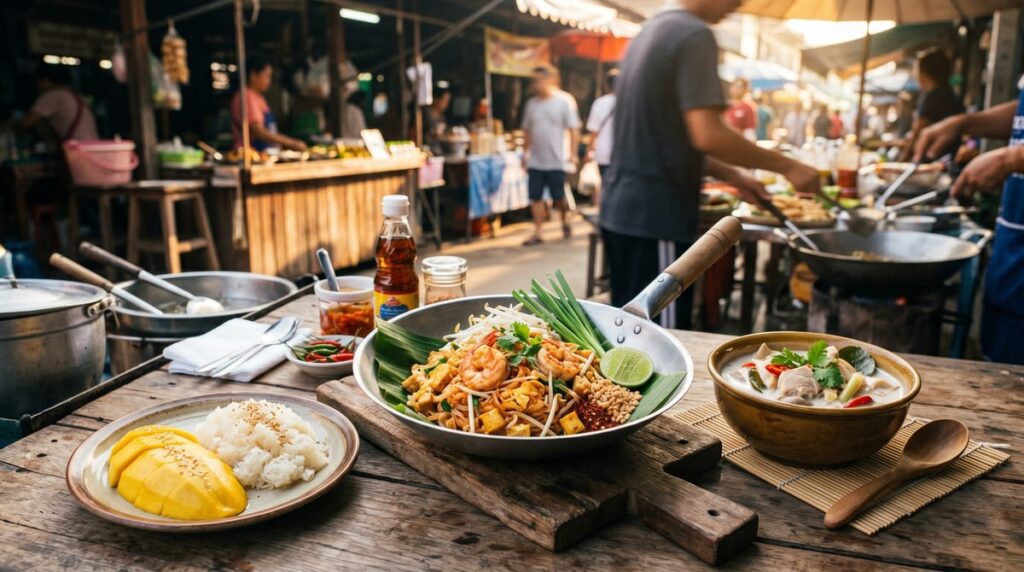
The table lists options for getting to know the cuisine. The descriptions help you understand what to ask when ordering; the ingredients of a specific portion should be discussed separately.
| Dish name and Latin spelling | Ingredients from the dish description | Taste, if described | What to check when ordering |
|---|---|---|---|
| Pad Thai | Rice noodles, tofu, sprouts, and eggs. The PRD description lists dried shrimp; Yandex Travel mentions shrimp or chicken, peanuts, and tamarind sauce | — | Which shrimp, sauces, and add-ons are included in the portion, and whether the ingredients can be changed |
| Khao Man Gai | Chicken rice | — | Which sauce is served and whether it can be provided separately |
| Tom Kha Gai | Coconut milk, chicken, mushrooms, galangal | Mild, creamy | Whether there is chili and which ingredients make up the soup base |
| Khao Phat | Fried rice | — | Which add-ons are available and which sauces are used |
| Massaman curry | Vegetables, meat, peanuts, coconut milk | — | Which meat is used, whether there are peanuts, and whether the spiciness can be changed |
| Mango Sticky Rice | Sticky rice, coconut milk, sugar, mango slices | — | What the portion includes and how it is served |
| Tom Yum | The soup description names broth, chili, and lime | Spicy and sour | Which version is offered and whether the spiciness can be reduced |
| Som Tam | An option for getting to know the cuisine; ask the vendor about the ingredients | — | Which ingredients and dressing are used |
Pad Thai illustrates a clear difference between descriptions: the Thai government portal (PRD) lists dried shrimp, while Yandex Travel mentions peanuts and versions with shrimp or chicken. The name is the same, but questions about ingredients remain. Checking the recipe doesn’t end with picking a single add-on.
For your next try, consider the northern soup Khao Soi: coconut broth with curry, meat, and egg noodles. Other options are pad see ew, wide rice noodles with soy sauce, meat, Chinese broccoli, and garlic, or Thai omelet khai jiao. The omelet is usually cooked in a wok; the description notes a fluffy center, crispy edges, and various fillings.
Thai cuisine for beginners doesn’t require a set tasting route. Choose the dishes whose ingredients are clear to you, and leave the rest for your next meal. To continue getting to know the cuisine, see the section food and markets in Thailand.
How to order food and ask for less spiciness
To learn how to order food that isn’t spicy in Thailand, start with the short phrase “mai phet.” It means “not spicy,” not the literal “without chili pepper.” Tell them your preference before cooking and ask whether the chosen dish can be changed.
The pronunciation in the card is approximate. If speaking is awkward, show the Thai spelling on your phone. This lets you convey the request without trying to reproduce unfamiliar sounds.
| What you want to say | Thai spelling | Approximate pronunciation |
|---|---|---|
| Not spicy | ไม่เผ็ด | mai phet |
| Please, not spicy: a man’s request | ขอไม่เผ็ดครับ | kho mai phet khrap |
| Please, not spicy: a woman’s request | ขอไม่เผ็ดค่ะ | kho mai phet kha |
| Polite particle used by men | ครับ | khrap |
| Polite particle used by women | ค่ะ / คะ | ka |
The particles “khrap” and “ka” are part of polite conversational language. For ordering, you can use the ready-made request as a whole, without composing a long sentence yourself.
The conversation at the counter follows a simple order:
- Point to the dish you’ve chosen and name the add-on you want.
- Tell them your preferences for spiciness and ingredients.
- Ask whether the sauce can be served separately.
- If the base is already prepared, ask whether its spiciness can be changed.
- Find out the price of the portion and add-ons, then confirm your order.
Serving the sauce separately is a request that depends on the dish. If the base can’t be changed, ask them to suggest another option with clear ingredients. There’s no need to rush: it’s better to agree before ordering than to deal with a portion that has already been served.
For other situations, you may find useful a phrasebook for a trip to Thailand.
For vegans and vegetarians: what to check about ingredients
A request for “no meat” doesn’t describe the whole dish. For example, pad Thai descriptions include eggs, dried shrimp, and peanuts, even though the noticeable ingredients are noodles and tofu. Check not only the main add-on but also the sauce, broth, and dressing.
A language school describes “Jay” (เจ) as strict vegetarian cuisine that excludes meat, seafood, eggs, dairy products, and some strongly scented vegetables. For such an order, it recommends the phrase อาหารเจ. The term “Mungsawirat” is used for vegetarian food.
Before ordering, ask about the specific portion:
- Are there any fish ingredients in the sauce?
- What is the broth made with?
- Do they add eggs?
- Do they use dairy products?
- Do they include peanuts, shrimp, or other foods that don’t suit you?
- Can the dish be prepared while taking into account all the restrictions you’ve listed?
The name of the cuisine helps start the conversation, but it doesn’t replace an answer about ingredients. A request to leave out peanuts also says nothing about eggs, shrimp, or sauce: each ingredient that matters to you needs to be discussed separately.
If you have a food allergy, don’t assume that removing one ingredient guarantees a suitable dish. Tell the staff about your restriction and ask whether the establishment can accommodate it. If the answer is unclear, choose another option. Discuss individual medical restrictions with a doctor before your trip.
For more on choosing places and ordering, see the article vegetarian and vegan food in Thailand.
Food prices: menu, bill, and total
Food prices in Thailand are more useful to compare based on your own order: the dish you choose, the portion size, and the add-ons. Check the price on the menu or ask the vendor before cooking. If a price is listed for the basic version, find out how much the add-on you want costs.
A benchmark for October 2026. According to Numbeo, a crowdsourced price aggregator, lunch at an inexpensive café across the country averages about 100 baht (range 50–200 baht). These are averages of user estimates across all cities, not the price of a specific place. For tips on keeping food costs under control, see the guide “how to save money in Thailand”.
Use this short check to calculate the total:
- Find the price of your chosen portion in baht.
- Ask whether sauces and add-ons are included in the stated amount.
- Find out whether there is a service charge and how it appears in the price.
- Find out where and when you pay for your order.
- Compare the dishes, add-ons, and total with the bill.
You can photograph the menu page you’re ordering from. If the bill differs from what you expected, calmly ask for an explanation of the specific item. It’s easier to compare options by the total cost of the same order, not by the price of one base dish.
Tips and the service charge are different things. In a historical explanation from the Revenue Department of Thailand, a service charge is mentioned that was more often 10%. This is a historical description, which does not confirm a single current rate for restaurants.
So don’t add a universal percentage in advance. First read the menu’s terms and check the bill, then decide separately about tipping.
Where to eat: street stalls, food courts, restaurants, and shops
Choose the format that suits your plans: ordering quickly at a counter, reading the menu at your leisure, or buying packaged food. For a first meal, a clear ordering process and the chance to discuss ingredients matter more than the familiar name of the format.
| Format | What to check before ordering |
|---|---|
| Street stall | Whether there is a menu or clear prices, whether ingredients can be discussed, where you pay, and whether there is seating |
| Food court | What dishes the counters offer, how seating works, and how you pay for your order |
| Restaurant | Dish ingredients, the cost of add-ons, service terms, and how the final bill is calculated |
| Shop | Packaging information, storage conditions, opening hours, and the range available |
In a food court, prepayment by card or with vouchers is possible. Before choosing dishes, ask at the cashier how to pay at the counters and what to do with any remaining balance. Don’t assume that one food court’s system applies to the others.
An example to start with is a food court in Bangkok on the fifth floor in the San Francisco zone. The operator lists a vegetarian counter and a Khao Man Gai vendor, which serves chicken rice. This information is published on the food court’s official page.
For a shop option, consider the Tops daily chain, which the operator (Central Food Retail) lists among its brands. Check the opening hours and food selection at the specific store: the chain name does not describe what’s in each display.
The format of an establishment alone does not guarantee food safety. Air conditioning, décor, or a wide selection don’t replace attention to preparation and storage. To find options in the region you need, open the food guide to Bangkok or the food guide to Phuket.
Table manners: spoon, fork, and chopsticks
Thai table manners are easiest to learn through the purpose of each utensil. The tourism portal TAGTHAi describes the spoon and fork as a standard pair: you use the fork to push food onto the spoon, which you eat from. In a regional guide, the spoon is held in the right hand and the fork in the left.
Try this method with your chosen dish. A spoon is convenient for taking a portion, and a fork helps gather it. You don’t need to memorize a long set of rules for your first meal.
With chopsticks, follow the utensils offered with the specific dish. If they’re hard to use, ask for a spoon or fork. There’s no need to decide in advance that all noodles require chopsticks and that every other dish requires a strictly defined pair of utensils.
The main thing is to eat calmly and use whatever is comfortable. Other habits of communication and behavior are covered in a separate article on etiquette in Thailand.
Street food safety: preparation and storage
When choosing food, follow WHO principles: cleanliness, separating raw and cooked food, thorough cooking, safe storage temperatures, and safe water and ingredients. They apply to handling food regardless of whether it is prepared on the street or indoors.
When choosing a stall, look for these signs that you can see:
- The cleanliness of dishes, utensils, and the preparation area.
- Separation of raw and cooked food.
- How the chosen dish is prepared and served.
- Storage conditions for portions cooked in advance.
- The source of the water and ice, if it is known.
A line by itself doesn’t answer these questions. The shape of ice doesn’t prove it is safe either: if its origin is unclear, you can choose a drink without ice. For water, consider bottled water in sealed packaging.
Storage recommendations are given in the WHO fact sheet on food safety:
- Do not leave cooked food at room temperature for longer than two hours.
- Keep cooked food hot, above 60°C.
- For refrigerated storage, use a temperature guideline below 5°C.
These are WHO recommendations, not measurements taken at a particular vendor. Tourists don’t need to check portions with a thermometer: pay attention to preparation and storage, and if conditions are unclear, choose a different option.
If you take food with you, plan ahead for when you’ll eat it and where you can store it. Wash your hands before eating. These steps help reduce the risk but do not give a full guarantee; discuss individual medical restrictions with a doctor.
Frequently Asked Questions ❓
Which dishes should I start with if I'm afraid of spicy food?
Consider chicken rice or fried rice with an add-on of your choice. Pad Thai, Tom Kha, and massaman can also be included when getting to know the cuisine, after discussing the chili, sauce, and ingredients. A dish’s name doesn’t guarantee the absence of spiciness or of ingredients that don’t suit you.
How do you say “not spicy” in Thai?
“Mai phet” means “not spicy,” and in Thai it is ไม่เผ็ด. A polite request: “kho mai phet khrap” or “kho mai phet kha.” The pronunciation is approximate; you can show the phrase on your phone and separately ask whether the chosen dish can be changed.
How do I find out the cost of a street lunch in Thailand?
Check the price of your chosen portion on the menu or with the vendor before ordering. Separately, ask about the cost of add-ons and the payment terms. To compare options, use the total cost of your own order.
Is it safe to eat street food in Thailand?
It’s worth assessing preparation, storage, cleanliness, and the separation of raw and cooked food. A line at a stall alone does not guarantee safety. WHO recommends not leaving cooked food at room temperature for longer than two hours; discuss individual medical restrictions with a doctor.
Do I need to tip at Thai restaurants?
Check the menu terms and the bill: tips and the service charge are separate items. A historical explanation from the Revenue Department of Thailand mentions a service charge that was more often 10%, but this does not confirm a single rate for all restaurants now. Don’t calculate the total using a universal percentage.
How do I order vegan food in Thailand?
The term “Jay” refers to strict vegetarian cuisine that excludes meat, seafood, eggs, and dairy products. For an ordinary vegetarian order, “Mungsawirat” is used. Check the ingredients of the specific dish: a request to remove one ingredient doesn’t describe the others.
Do Thai people eat with a fork, a spoon, or chopsticks?
For many dishes, a spoon and fork are used: you use the fork to push food onto the spoon. In the common arrangement, the spoon is in the right hand and the fork in the left. Follow the utensils offered with the specific dish, and if needed, ask for a utensil that is comfortable for you.
Conclusion
Thai cuisine for beginners becomes easier to understand when ordering follows a simple sequence: choose a dish, discuss spiciness and ingredients, and find out the price and payment terms. Start with chicken rice or fried rice, then try noodles, soups, and curries according to your preferences.
A mild taste does not replace checking dietary restrictions and preparation conditions. Prices, recipes, and service terms may change, so discuss the specific portion you’re ordering. Save the phrase card on your phone, and before your next meal, go to the regional food guide from the section on choosing places. You don’t need to master the entire menu at once. A clear first order is enough.
Prepared by MyThai.online editorial team.