In this article:
What’s changed: Seasonal jay menu offerings have been added at MBK shopping center: the Food Legends food court, Tops and Donki stores. The vegetarian stall at the Pier21 food court in Terminal 21 Asok shopping center has been included. Phrases for ordering without meat, egg and fish sauce have been added.
Eating vegetarian in Thailand is easier if you look for specialized plant-based kitchens, places marked with the “jay” sign, and separate vegetarian stalls at food courts. At an ordinary establishment, explain your restrictions before ordering: a vegetable-sounding dish name does not reveal the ingredients of the sauce, dressing or paste. Start with a suitable kitchen, then discuss the specific item.
If you are vegan, specifically say that you avoid eggs and dairy. If eggs and dairy are fine for you, say so too: your restrictions may differ from jay rules. The yellow flag helps you find the right stall, but it does not replace a conversation about the ingredients of the food you choose.
Below are local labels, phone phrases, dish examples and eating options in Bangkok, stores and on trips. For getting to know the names and flavors, a useful resource is Thai cuisine for beginners: with it, it’s easier to read menus and ask questions.
Jay and mangsawirat: how to understand food labels
“Jay” (เจ) is a strict plant-based tradition linked to Chinese Buddhist culture. It excludes meat, dairy products and eggs, as well as pungent plants, including garlic and onions. So jay and ordinary vegan eating are close, but their ingredient restrictions differ.
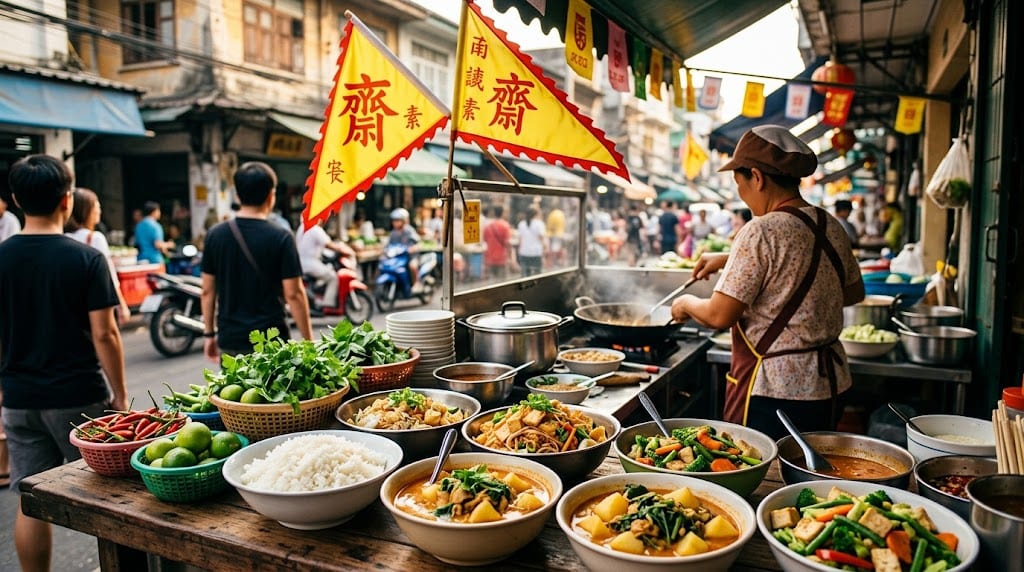
Look for this landmark — yellow flags with red lettering. In the official description of the festival tradition, they mark places serving jay food. When you see this marking, ask about the dish you choose, especially if you have additional restrictions.
“Mangsawirat” (มังสวิรัติ) is a label for vegetarian food. Don’t take it as confirmation that there are no animal products at all: discuss eggs, dairy and sauces. For a vegetarian who eats eggs and dairy, and for a vegan, the suitable ingredients will be different.
Here’s an easy way to remember it: jay helps you choose where to look, and talking about ingredients helps you choose the food. You don’t need to explain your whole diet in a long speech. Name the foods you avoid and ask for confirmation that they are not in the specific item.
Hidden animal ingredients in Thai dishes
Vegetables on the plate do not answer the question about ingredients. Fish sauce can appear even in a dish that looks vegetarian, so you need to check what the food is seasoned with as well. The absence of visible pieces of meat explains very little here.
When choosing a dish, pay attention to the following ingredients:
- Fish sauce — nam pla. Ask whether it is added during cooking.
- Shrimp paste — kapi. Discuss whether it is in the paste or dressing.
- Oyster sauce — nam man hoi. Check the sauce of the chosen vegetable dish or noodles.
Not all recipes have the same ingredients. For Pad Thai, discuss the sauce and egg; for Som Tam, the dressing; for curry, the paste. Asking to leave out the meat does not answer these questions, even if most of the dish is vegetables.
A separate issue is cooking in shared cookware. In a kitchen, one pan may be used for meat and vegetable dishes; ask about this if such contact is unacceptable to you. If you have an allergy, a standard request for “no meat” cannot be taken as confirmation of safety.
General questions about storage, cooking and choosing water are covered in the guide to food and water safety. Here, the goal is to understand the ingredients before the kitchen starts cooking.
How to order without meat, egg or fish sauce
You can start the conversation with the phrase “gin jay,” which means you eat strictly plant-based food. Then list the restrictions that apply to your order. Don’t assume that asking to leave out meat will automatically exclude fish sauce, egg or dairy.
The transliteration here helps you remember the pronunciation, and you can show the Thai text to staff. Save the table on your phone so you don’t have to type phrases at the counter.
| What to exclude | Pronunciation guide | Thai script |
|---|---|---|
| Fish sauce | mai sai nam pla | ไม่ใส่น้ำปลา |
| Egg | mai sai khai | ไม่ใส่ไข่ |
| Meat | mai sai nuea sat | ไม่ใส่เนื้อสัตว์ |
Card for your phone
ไม่ใส่น้ำปลา — without fish sauce
ไม่ใส่ไข่ — without egg
ไม่ใส่เนื้อสัตว์ — do not add meat
Show the relevant lines together with the menu item you chose. If you also avoid dairy, discuss it separately: the card lists only the restrictions written on it. Sauces and pastes also need a separate question about ingredients.
Don’t rush to confirm your order until the answer is clear. If the dish can’t be made with your restrictions, ask for another item to be suggested. It’s better to find out in advance whether a substitution is possible than to assume it from the name of the dish.
For talking outside the kitchen, you may need the basic Thai phrases. For ordering food, keep a short card on hand: it’s easier to show and discuss.
Which dishes to choose and what to ask before ordering
Pad Thai, som tam and curry can be considered when choosing food, but the name of a dish does not confirm its plant-based ingredients. First find out the ingredients, then ask whether a version suitable for you can be made. The decision depends on the specific kitchen and the item you choose.
| Dish | What to ask | What to request when ordering |
|---|---|---|
| Pad Thai | Is there fish sauce and egg? | Can it be made without fish sauce and, if needed, without egg? |
| Som Tam | What goes into the dressing | Can the dressing be made without the animal ingredients you avoid? |
| Curry | What’s in the paste, and is there shrimp paste? | Is there a suitable paste, or another dish without it? |
Tofu in the name doesn’t settle questions about the sauce and other additives either. Judge the whole dish, not just its main ingredient. For a vegetarian, egg may be acceptable; for a vegan, it isn’t: explain your specific restrictions.
If the cook offers a substitution, ask what will change in the ingredients. If the ingredient can’t be replaced, move on to another item. Whether a dish can be adapted is a question for the kitchen, not a service you can assume is available by default.
Where to eat in Bangkok: restaurants and food court stalls
Plant-based restaurant cuisine (Broccoli Revolution)
The restaurant Broccoli Revolution Sukhumvit 49 describes its menu as plant-based. This format may be worth considering if you want to start your search with a specialized cuisine. Discuss additional restrictions when choosing a dish.
The operator’s published schedule lists dine-in service from 8.00 to 21.00, last order — at 20.45. Before visiting, we recommend checking current hours with the operator. Don’t apply this schedule to other places.
Another option for your search is the Veganerie chain. Check the branch you choose and its menu before your trip: the chain’s name alone does not confirm the status of a specific outlet or the availability of the item you need.
Individual stalls in shopping centers
The Terminal 21 Asok shopping center houses the Pier21 Food Court. The operator’s list includes a vegetarian stall “มังสวิรัติ” listed on the official page of the Pier21 food court. The food court itself offers a variety of food; the operator describes prices as affordable, with no numerical price list.
The MBK Center shopping center published seasonal jay offerings. In the Food Legends zone on floor 6, the stall “ระเบียงบุญ” and SALAD CLUB are listed. They are presented in the festival selection on the official MBK website.
The difference is already clear from these examples: one food court’s operator lists a separate vegetarian stall, while another shopping center publishes a seasonal selection. Neither makes the whole food court plant-based. Vegetarian eating in Thailand requires attention to the stall and dish you choose, not just the name of the shopping center.
What to check in stores and when ordering delivery
7-Eleven stores can be considered for finding a snack. The author of the Hey Roseanne blog described vegan bao with vegetable and mushroom fillings, as well as with a plant-based meat substitute. The same author wrote about vegan “fish” sandwiches.
These are examples of the author’s observations, not a promise that the products are currently available. Check the ingredients on the specific package, even if the product looks like one you know. For basil rice and kimbap, the same approach applies: the name does not confirm the absence of animal ingredients.
When buying ready-made food:
- read the ingredients on the package you choose;
- compare the ingredients with your restrictions;
- check sauces and additives;
- if the ingredients are unclear, choose a different product or ask for help with translation.
The MBK shopping center’s seasonal selection includes the Tops store on floor (G) and the Donki store on floor 2. They are listed in the festival selection on the official MBK website. The store’s participation applies to the seasonal offerings and does not confirm the plant-based makeup of the entire range.
Use this simple sequence for delivery:
- Choose the place and the specific item.
- Check the ingredients of the sauce, paste and additives.
- Pass on your restrictions before confirming the order.
- Find out whether the kitchen can meet them.
Don’t rely only on a photo or the word “vegetable.” If the ingredients remain unclear, choose an item the place can explain.
Apps for finding vegan food
To find places and reviews, you can use the HappyCow app. Mark options near your future accommodation in advance so you already know where to start after arriving. Compare the information about the places you choose and check how recent the reviews are.
Save not only the restaurant’s name but also its location on the map. Keep a translator and your restrictions card at hand: the app helps you find candidates, while you discuss the order’s ingredients with the place. The map will help with your route, and Thai phrases are for talking at the counter.
Choose places that fit your requirements. A vegetarian establishment and a kitchen that describes its menu as plant-based may suit different visitors. Even a good review does not answer the question about the ingredients of your specific item.
It’s useful to have a backup option nearby. If the chosen place is closed or there is no suitable dish, you can continue your search without rushing. A saved list helps you prepare, but it does not replace information about the place’s hours and menu.
Eating in Chiang Mai and outside tourist areas
Chiang Mai can be considered a separate destination for a trip with plant-based eating. Start with where you’re staying: find suitable places nearby and look at their menus. For getting to know local formats, a useful resource is food guide to Chiang Mai.
Among accommodation options, you could consider Green Tiger House and Away Chiang Mai Thapae Resort. Before booking, discuss meals and what the breakfast includes. Don’t treat a hotel’s name as confirmation of a fully vegan menu.
For trips outside tourist areas, plan your meals along the route:
- find places near your stops in advance;
- save their locations and operating details;
- keep your restrictions card easy to reach without a long search;
- use the yellow jay marking as a guide;
- discuss the ingredients of the dish you choose.
It’s better to prepare for a specific stop than to judge an entire province as convenient or inconvenient for vegans. Eating conditions depend on the place and kitchen you choose. The same approach is useful in a large city too, if your accommodation is far from places you know.
Vegetarian festival in Phuket: food and dates
The vegetarian festival in Phuket is also known as the Nine Emperor Gods Festival. It is a religious and cultural tradition with processions and rituals; participants wear white clothing. Treat what is happening with respect for the faith and the community’s rules.
According to an official article from the Ministry of Foreign Affairs of Thailand, the traditional duration is — nine days and nine nights. The festival diet excludes meat, seafood and dairy products. These restrictions apply to participants in the tradition, and suitable food is offered by participating stalls.
According to Thaiger, the festival in Phuket is scheduled for the period from October 10 to October 18. Dates remain a preliminary guide: check the organizers’ schedule before your trip. This is a calendar report from the publication, separate from the official description of the tradition’s duration.
For visitors looking for food, a useful landmark is yellow flags with red lettering. They help you spot participating stalls, but they don’t mean the entire island or every restaurant switches to jay. Discuss the ingredients of your selected item on the spot.
Don’t carry over the festival offerings to a place’s regular menu after the event ends. If you’re traveling for the food and the cultural program, plan them separately. The event context is covered in a separate article about the Phuket vegetarian festival · RU.
Frequently Asked Questions ❓
What does “jay” (เจ) mean in Thailand?
It is a strict plant-based tradition that excludes meat, dairy products and eggs, with additional restrictions on pungent plants, including garlic and onions. Yellow flags with red lettering are used to find food. Discuss the ingredients of a specific dish when ordering.
How is jay different from ordinary vegetarianism?
Jay has additional restrictions, including on garlic and onions. If eggs or dairy work for you, explain this when ordering; if you are vegan, list the ingredients you avoid. The label “mangsawirat” does not confirm the absence of all animal products.
What hidden animal ingredients are found in Thai food?
Pay attention to fish sauce, shrimp paste and oyster sauce. Fish sauce may be present even in a dish that looks vegetarian. Before ordering, discuss the sauce, dressing and paste of the item you choose.
How do you ask for a dish without fish sauce?
Say “mai sai nam pla” or show “ไม่ใส่น้ำปลา.” To leave out egg, use “ไม่ใส่ไข่,” and for meat, “ไม่ใส่เนื้อสัตว์.” These are separate requests: leaving out meat does not replace checking the sauce’s ingredients.
Where can a vegan eat in Bangkok?
The restaurant Broccoli Revolution describes its menu as plant-based. On the Pier21 food court page at the Terminal 21 Asok shopping center, there is a vegetarian stall “มังสวิรัติ,” and MBK has published a seasonal jay selection. Choose a specific stall and check the ingredients of the dish.
When is the vegetarian festival in Phuket?
Thaiger lists the period from October 10 to October 18 as a calendar guide. The traditional duration is nine days and nine nights, according to an article from the Ministry of Foreign Affairs of Thailand. The dates remain preliminary: check the organizers’ schedule before your trip.
Which app helps find vegan food?
To find places and reviews, you can use the HappyCow app. Mark options near your accommodation in advance and check recent information about them. Also save your restrictions card for ordering.
Conclusion
Vegetarian eating in Thailand is easier to start with a clear sequence: find a suitable place, explain your restrictions, and discuss the ingredients of the specific dish. A dish’s name, tofu in the ingredients, or a yellow flag help with searching, but they don’t answer all questions about sauces and additives. Distinguish between a permanent menu and temporary festival offerings.
Save the ordering phrases on your phone and mark eating options near your accommodation. For trips, prepare places near stops along your route, and for purchases, check the specific package. Menus, product ranges and schedules can change. To keep exploring local cuisine, see the hub food and markets of Thailand.
Prepared by MyThai.online editorial team.