In this article:
What changed: Added the Naka Market schedule: weekends 16:00–22:00, weekday street food 16:00–21:00. The guide now includes the dates of the Phuket Vegetarian Festival, October 10–18, and cooking classes at the Blue Elephant restaurant.
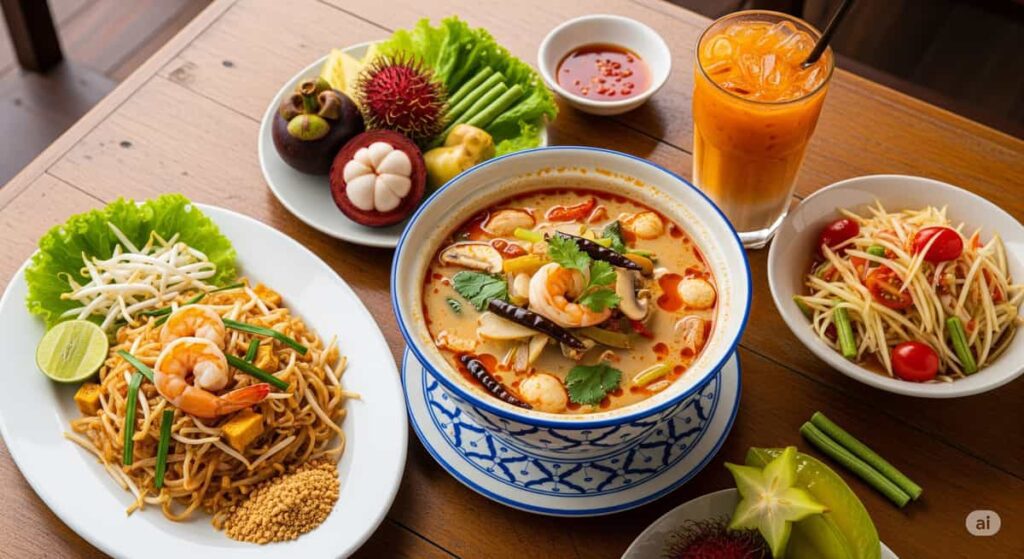
Food in Phuket is a good way to get to know the island through its local dishes. Start with moo hong, braised pork in sauce, and the cool dessert o-aew; for something sweet, roti with the filling of your choice works well. Choose a venue for your purpose: a food stall for a quick snack, a market for a stroll with several orders, or a café or restaurant for a separate dinner.
Below you’ll find descriptions of dishes, market schedules with their sources, a plan for buying seafood, and examples of restaurant offers. If you want to do more than taste Thai food and also cook it yourself, consider a cooking class. This approach helps you build a food outing around your day and interests, without a required list of “best” places.
Current as of publication; conditions may change. The article’s update date does not mean that all published prices are valid now. Confirm current prices before ordering.
Local Dishes in Phuket: What to Try First
To get to know the local cuisine, start with moo hong and o-aew. These dishes differ in composition: braised pork for a main order, and a dessert with jelly and ice. Choose what suits your appetite and dietary restrictions. According to a review Destination Thailand (data as of October 2026), at the Sunday market Lard Yai, moo hong costs 60–80 ฿ and o-aew costs 30–40 ฿.
The encyclopedic description of Phuket cuisine (Wikipedia) calls moo hong a braised pork dish. The ingredients listed include soy sauce, sugar, garlic, pepper, and coriander roots. This composition helps you understand the character of the dish, but does not establish a required recipe for every establishment.
| Dish | Description | What to confirm when ordering |
|---|---|---|
| Moo Hong | Braised pork; the recipe description includes soy sauce, sugar, garlic, pepper, and coriander roots | Sauce ingredients, portion size, and whether a side is served separately |
| O-Aew | Dessert with jelly, red beans, ice, and sweet red syrup | Which components are included in the serving, and whether the amount of syrup can be changed |
One detail to note: for o-aew, the red part described is the syrup, not the jelly itself. So it’s not wise to rely only on the dessert’s color in a photo. It’s better to check the name and ingredients with the seller.
If the names are still unfamiliar, a useful resource is Thai food for beginners. Don’t try to taste everything at once: choose a main dish and keep dessert as a separate order. That makes it easier to decide what you want to have again.
Prices were checked on October 23, 2026, using the sources linked in the text. Next to each price, the month of the source’s data is given; if the source does not name it, the month the page was checked is given. Actual prices on the spot may differ.
Street Food, Food Courts, and Quick Snacks
Street food in Phuket suits different needs. At a stall you can grab a snack, at a market you can compare several options, and at a food court you can choose dishes from different vendors. Decide in advance whether you need a small order on the go or a full meal stop. According to a review Phuket Wealth Travel (data as of October 2026), pad thai with chicken from food stalls and night markets costs 60–100 ฿; a review ToPhuket (data as of July 2026) gives a benchmark of 60–90 ฿ for fried rice at street and local eateries, without specifying what the portion includes.
For a sweet snack, consider roti. A travel review (WTP Travel) describes them as thin pancakes with Indian and Muslim influences; the fillings named include banana, chocolate spread, and condensed milk. Choose the filling separately: the name roti alone does not confirm a vegan composition. According to a review Destination Thailand (data as of October 2026), roti with egg and banana at the market on Ranong Road in Phuket Town costs 20–50 ฿.
Som Tum is a green papaya salad. The description in the same review lists tomatoes, peanuts, chili, lime, and fish sauce. Even a dish that looks vegetable-based calls for asking about the sauce if you avoid animal ingredients.
The Naka operator also gives examples of satay, mango with sticky rice, fried dumplings, and spring rolls. Use them as ideas for choosing, not as a promise of each stall’s full range. Published prices are covered separately below. A separate benchmark for buying fruit: according to a review of the 2025–2026 season Tisland Travel, mango costs 30–60 ฿ per kilogram; the review’s publication date is not stated.
Before paying, ask what the order includes and how big the portion is. If you are buying several dishes, check the cost of drinks and add-ons separately. Don’t complicate your first snack: a clear list of ingredients is more useful than a long list of unfamiliar names. According to a review ToPhuket (data as of July 2026), a fruit shake costs 40–60 ฿, and according to observations Eve Phuket in September 2026, a dish at the Central Phuket Festival food court costs 60–150 ฿.
Phuket Night Markets: Where to Go and When to Visit
Choose a market based on your travel day, then compare locations. Naka has separate schedules for the weekend market and weekday street food. You can combine a Sunday stroll with Phuket Old Town.
| Name | District or street | Format | Days and hours | Schedule source |
|---|---|---|---|---|
| Naka Weekend Market | Street Wirat Hong Yok Road, Mueang Phuket | Weekend market; separately, weekday street food | Saturday–Sunday: 16:00–22:00; Monday–Friday: 16:00–21:00 for street food | Operator’s page |
| Sunday walking street on Thalang | Thalang Road, Old Town | Sunday street market | Sunday, approximately 16:00–22:00 | Review (Rawai) |
| Chillva Market | Phuket Town | Evening market | Monday–Saturday: 17:00–23:00; Sunday — closed | Review (Rawai) |
| Malin Plaza market in Patong | Patong | Market | Hours are not listed in the table | No schedule is given here |
The split between weekdays and weekends is published on the Naka Market operator’s page. According to the schedule on the operator’s page; check current opening hours before your trip. More details about visiting are in the guide to Naka Market.
The Sunday market is also known as Sunday Walking Street / Lard Yai. Hours for it and for Chillva are based on the Rawai review; check the current schedule before your trip. The approximate nature of the Sunday hours remains: this is not a promise that every vendor will be open for the entire stated period.
Bring cash in small bills and leave time to choose your food. If you want to combine a market visit with exploring the area, a good option is a walk through the Old Town of Phuket Town. Don’t tie your whole evening to one specific dish: it’s better to choose the order on the spot.
Seafood: How to Arrange the Purchase and Cooking
When buying seafood yourself, discuss the product and the cooking separately. The purchase price does not mean that cooking is already paid for. Before the order is handed to the kitchen, agree on the payment method and what will appear on the final bill.
A review of Banzaan Market on a tourist site (Now Phuket) describes a food court where purchased seafood is cooked. For the Rawai Seafood Market a video on YouTube shows a different scenario: purchases are passed to restaurants through a passageway. The general principle is the same: the terms are discussed both with the seller of the product and with the person who will cook it.
Ordering steps can be arranged like this:
- Choose the product. Point to the specific fish or seafood you want to buy and agree on the quantity.
- Find out the unit of pricing. Ask whether the price refers to weight, to a single item, or to the whole selected product.
- Agree on the weight and the cost. Get a clear total for the purchase before paying, not just the price per unit.
- Discuss the cooking. Name the cooking method you want and find out how the kitchen’s fee is calculated.
- Check the add-ons. Ask separately about sauces, side dishes, drinks, and other components of the order.
- Review the whole order. Repeat the agreed contents and the cost of the purchase, cooking, and add-ons.
Don’t apply one seller’s rate to a neighboring restaurant. If the product is bought in one place and cooked in another, first make sure the kitchen accepts such an order. This helps agree on terms but does not guarantee freshness, safety, or savings.
For a trip to Rawai or Patong, plan the route there and back in advance. Options are covered in the guide on how to get around Phuket. Plan a seafood-buying trip as a separate outing if you are interested in the buying process itself.
Phuket Restaurants: Local Cuisine and Dinner with a Program
Choose a restaurant for a specific evening: are you interested in the food, the venue, or a separate activity? Dinner and a cooking class are different ways of visiting. If you need an entertainment program, find out whether it is available before booking.
Mor Mu Dong
Mor Mu Dong restaurant is located among mangroves, according to the description in the MICHELIN Guide. The address given by the publisher in Chalong: (9/4 Mu 3, Soi Pa Lai, Chao Fa Road, Chalong). Use the address and map when planning your visit.
The same publisher’s article about restaurants in Phuket mentions the stuffed fish pla tu yat sai. This is an idea to ask about on the menu, not a promise that it is always available. If you are going for a specific dish, discuss it with the restaurant before your visit.
Blue Elephant
Blue Elephant Phuket restaurant is located at its official address (96 Krabi Road, Talat Nuea, Mueang Phuket). The venue’s page describes its Sino-Portuguese architecture and gives the general opening hours of the premises: daily, 09:00–22:30. These hours do not set the serving time for each menu or the start time of a class.
Dinner at the restaurant here can be considered separately from the cooking school. Published menu offers and additional charges are covered in the pricing section. The terms of the class are in the next section.
To compare places, save the maps: Raya Restaurant, Tu Kab Khao restaurant and Ka Jok See restaurant. The map helps you find the place, but it does not itself confirm the menu, program, or hours. A more detailed selection is covered in the article Phuket restaurants in the MICHELIN Guide.
Cooking Classes at Blue Elephant
You can continue getting to know Phuket’s food in a cooking class. According to the official page of the Blue Elephant school, the program includes preparing four or five dishes in half a day. The morning program includes a visit to a market.
This is a separate option: you choose a class, not just a table for dinner. The market visit belongs to the morning program and does not have to be carried over to every class. The general hours of the restaurant venue also do not replace the class schedule.
When booking, ask:
- What program is available on the day you choose?
- Which dishes will participants cook?
- Is the market visit included in the class you choose?
- What language is the class taught in?
- What are the cost, start time, and participation terms?
- Can your dietary restrictions be accommodated?
The answers will help you decide whether the class suits your group and your plans for the day. If your main interest is cooking, plan your trip around the school’s program. If you just want to try the dishes, choose a restaurant order.
Don’t estimate the cost of a class from the restaurant menu price. A cooking class has its own set of services, which should be discussed when booking. The same applies to children’s participation, transfers, and other terms: don’t assume they are included automatically.
Food Prices in Phuket: Benchmarks and What’s on the Bill
To estimate costs, compare specific offers. The table below shows published examples from the Naka operator and a restaurant menu. These amounts cannot be used to work out a total daily budget or an average check for the island. For a general benchmark, a review Phuket Expat Guide (data as of June 2026) puts a full street food meal at 30–100 ฿, and ToPhuket (data as of July 2026) puts a full local lunch at a street or local eatery at 70–120 ฿.
| Venue | Dish or offer | Stated price | Additional charges | Note on validity |
|---|---|---|---|---|
| Naka | Satay | 20–30 baht | Discuss the order contents with the seller | The update date of the price page is not stated |
| Naka | Mango with sticky rice | 50–60 baht | Discuss the order contents with the seller | The update date of the price page is not stated |
| Naka | Fried dumplings or spring rolls | Under 40 baht | Discuss the order contents with the seller | The update date of the price page is not stated |
| Blue Elephant | Three-course menu | 1,080 baht ++ | Service charge 10% and government tax 7% per the document | Whether the offer is still current has not been confirmed |
| Blue Elephant | Le Voyage menu | 2,600 baht ++ per person | Service charge 10% and government tax 7% per the document | Whether the offer is still current has not been confirmed |
For Naka, these are examples from the operator’s page, not a single rate for all stalls. According to the operator’s page, the date of the price update is not stated, so check current prices. When comparing, ask which portion the price refers to and what it includes. Other benchmarks are given by Phuket Expat Guide (data as of May 2026): lunch at a local Thai restaurant costs 80–160 ฿ per person, a meal at a mid-range international restaurant costs 350–600 ฿ per person, and drinks are charged separately.
Blue Elephant’s offers are published in the menu on the official Blue Elephant website. The document is posted on the official website; it has not been confirmed that these prices are still current, so check current prices. The notation ++ remains: the amounts listed should not be read as the final price including all charges.
The document lists a service charge 10% and government tax 7%. These are the terms of this restaurant’s menu; they cannot be applied to every café or stall. New final totals are not calculated here.
Before paying, check the bill’s contents: dishes, drinks, add-ons, and charges. If you are choosing between offers, compare orders with the same contents. The price of a single dish and the price of a menu per person answer different questions. According to a review Phuket Wealth Travel (data as of October 2026), tom yum with shrimp at beach cafés in Patong and Kata costs 220–380 ฿.
Review ToPhuket (data as of July 2026) puts a three-course dinner at a fine-dining restaurant at 1,500–3,000 ฿, and Phuket VIP Tour (data as of August 2026) puts a daily food budget at local eateries at 400–600 ฿ per person.
How to Order Food: Spice Level, Ingredients, and Restrictions
When choosing food in Phuket, talk through the specific order. The name of a dish helps you find your way, but it does not replace an answer about ingredients. This is especially true for sauces, fillings, and add-ons.
Som Tum is a good example. A travel review (WTP Travel) lists green papaya, tomatoes, peanuts, chili, lime, and fish sauce among its ingredients. So a vegetable base for the salad does not confirm the absence of animal ingredients or peanuts.
A short list of questions for staff:
- How spicy is the dish?
- Can it be made without chili or with less?
- Which ingredients are in the main part and the sauce?
- What is in the filling and topping?
- Can a specific ingredient be left out?
- Which add-ons are charged separately?
After asking about spiciness from the list above, ask staff to confirm the agreed version. The request itself to make the dish without chili or with less does not confirm that the order was changed. Ask staff to repeat which version they accepted.
If you have dietary restrictions, name the specific ingredients you want excluded. Don’t replace that conversation with a general question like “is this vegetable-based?” For roti, discuss the dough, the cooking method, and the filling separately, not just whether there is banana.
For a snack, choose a hot dish cooked in front of you, and bottled water to drink. Avoid cut fruit without packaging if storage conditions raise doubts. At the same time, a line, hot serving, and the shape of the ice do not guarantee the absence of risk.
Detailed questions are covered in the guide on food and water safety in Thailand. Here the task is simpler: agree on ingredients, spiciness, and price before the order is prepared.
Phuket Vegetarian Festival: Dates and Food Choices
According to the Tourism Authority of Thailand, the main period of the Phuket Vegetarian Festival is: October 10–18. Street processions are scheduled for October 11–18. These ranges refer to the festival program and do not set the operating hours of all vendor stalls.
If you want to combine a cultural outing with food, plan these tasks separately. The procession dates help you choose a day to attend the program, while the ingredients and availability of dishes are discussed with vendors. Don’t treat the festival period as a general meal schedule.
When choosing a dish, ask about the main ingredients, the sauce, and add-ons. The name or appearance does not confirm the absence of animal ingredients. If a particular product matters to you, name it directly and find out whether the order can be changed.
The same approach is useful outside the festival. For everyday choices, a useful resource is vegetarian food in Thailand. Don’t limit yourself to asking about meat: discuss the full composition of the dish you choose.
The festival can be part of your trip, but it is not a required condition for getting to know the cuisine. Choose a suitable day for the cultural program, and plan your meals separately. This makes it easier to stay flexible if the dish you want is not available from the vendor you choose.
Frequently Asked Questions ❓
How much does food cost in Phuket?
The Naka operator gives examples: satay — 20–30 baht, mango with sticky rice — 50–60 baht, fried dumplings or spring rolls — under 40 baht. The price update date is not stated. In Blue Elephant’s online menu, a three-course menu is listed for 1,080 baht ++; whether the offer is still current has not been confirmed. Confirm the cost of your order and any additional charges before paying.
What dishes should I try in Phuket?
Start with moo hong, braised pork, and o-aew with jelly, red beans, ice, and syrup. For a snack, consider roti with the filling of your choice. Discuss the ingredients and availability with the specific seller.
How do I choose an affordable place to eat in Phuket?
Compare the cost of a specific order at stalls, markets, and cafés, including portion size and add-ons. For weekday street food at Naka, the operator lists Monday–Friday, 16:00–21:00. Before your trip, check whether this schedule still applies.
Is it safe to eat street food in Phuket?
The safety of a specific order cannot be guaranteed. If you have dietary restrictions, discuss the ingredients and sauces with the seller. Detailed questions about choosing food and water are covered in a separate guide on our site about food and water safety in Thailand.
Which night market in Phuket should I choose?
The choice depends on your travel day and where you are staying. For the Naka weekend market, the operator lists Saturday and Sunday, 16:00–22:00. The Sunday market on Thalang and Chillva are other options; their schedules here are based on the Rawai review and should be checked before your trip.
When is the Phuket Vegetarian Festival held?
According to the Tourism Authority of Thailand, the main period is October 10–18, and street processions are October 11–18. These dates refer to the festival program, not to the operating hours of all food vendors. Discuss the ingredients of the dish you choose separately.
Conclusion
Food in Phuket helps you build an outing around your interests. To start, choose a local dish, then a market that suits your travel day, or a café for a separate order. A restaurant is good for a planned dinner, and a cooking class is for learning how food is prepared.
Published price examples do not set a total food budget: compare the contents of a specific order and any additional charges. Menus, schedules, and ordering terms can change, so leave room to adjust your plans.
Choose a suitable place and combine your food stop with a walk through the Old Town. To continue your route, see Phuket’s sights and leave time for what interests you most.
Prepared by MyThai.online editorial team.