In this article:
What has changed: Added AIS tourist package prices: 499 ฿ for 8 days, 1,199 ฿ for 30 days and 49 ฿ for one day, as well as Bangkok river boat fares. Updated visa information following changes that took effect on September 15, 2026, and clarified the tax threshold for length of stay — 180 days per tax year.
Saving money in Thailand is a matter of total cost: compare housing together with trips, food with additional charges, communications with the package validity period, and currency exchange with fees. Choose offers that fit your route and length of stay, not just the attractive price in the listing. This approach will help tourists, winter residents and expats, although their sets of expenses will differ.
Start with a personal list of expenses and decide what comfort is essential for you: a separate room, a kitchen, convenient transport or the ability to work via mobile internet. Then compare options with identical terms and keep a reserve for unexpected expenses. Below is the order of such a comparison and rate examples for specific services, which should not be applied to the whole country.
Current as of publication. Prices and conditions may change; visa and tax rules depend on the traveler’s situation.
How much living in Thailand costs and where to start saving
To understand how to save money in Thailand, first separate everyday expenses from the money needed to start the trip. Rent, food and communications are regular expenses; an international flight is a separate item. The refundable deposit also requires money at move-in, although it should not automatically be counted as a final cost.
Draw up a budget for living in Thailand based on your length of stay. For a short trip, count expenses for the whole route; for a long stay, count regular payments and, separately, initial purchases. If you plan to move around, add the cost of travel between places of stay: a low room price does not reveal the cost of the whole trip.
| Expense category | What’s included | What to compare |
|---|---|---|
| Housing | Accommodation, utilities, cleaning | Full price for the same dates |
| Food | Cafes, groceries, drinks | Portions, contents of the purchase, final bill |
| Transport | Everyday trips and moves | Entire route with transfers |
| Communications | Internet, calls, renewal | Package duration and terms |
| Payments | Exchange, withdrawal, conversion | Final amount after fees |
| Leisure | Excursions, shopping, visits | Included services and surcharges |
| Reserve | Unexpected expenses | Access to money when needed |
A couple’s budget should not be estimated by simply doubling a single traveler’s budget. The room and some trips may be shared, while food, tickets and communications packages should be calculated based on actual need. A detailed guide, “cost of living in Thailand” will help you break down expense categories.
After arrival, compare your plan with actual payments. This will show where the problem lies: in the price, or in how often you buy things or make trips that you did not account for at first.
Housing: area, lease term and full rental cost
Compare a hotel, guesthouse, hostel and an apartment with a kitchen according to how you like to travel. A short visit may suit accommodation with a ready set of services, while a long stay may suit housing where it is convenient to cook and work. A shared room and a separate apartment offer different levels of privacy, so comparing only the nightly price helps little.
Rental benchmark for October 2026. According to Numbeo, a crowdsourced price aggregator, a one-bedroom apartment in the city center averages about 15,800 ฿ per month nationwide (range 8,000–28,000 ฿), and outside the center about 9,800 ฿ (5,000–18,000 ฿). These are average user estimates across all cities, not the price of a specific district.
Start with the area and your usual routes. Look at how you will get to work, the beach, shops or places for walks, and include these trips in your calculation. A lower rent may lose its appeal if you have to pay for transport for every outing.
Before booking or signing a lease, collect the full cost:
- accommodation for the chosen dates;
- electricity and water, including how they are billed;
- internet and cleaning;
- initial payments;
- deposit, grounds for deductions and refund conditions;
- conditions for cancellation or early departure.
Compare the same term and the same set of services. If internet is included in one offer but paid separately in another, add it before choosing. Assess the kitchen against your plans: it is useful if you actually intend to cook.
Discuss the lease term, price and included services with the owner. Compare a direct offer with one through an agent: there is no guaranteed discount or advantage to any particular way of searching. Do not sign a longer lease just for a promised benefit if your plans may still change.
A separate guide renting accommodation in Thailand will help you look more closely at choosing housing and at questions to ask before moving in.
Food and groceries: local cafes, markets and hidden charges
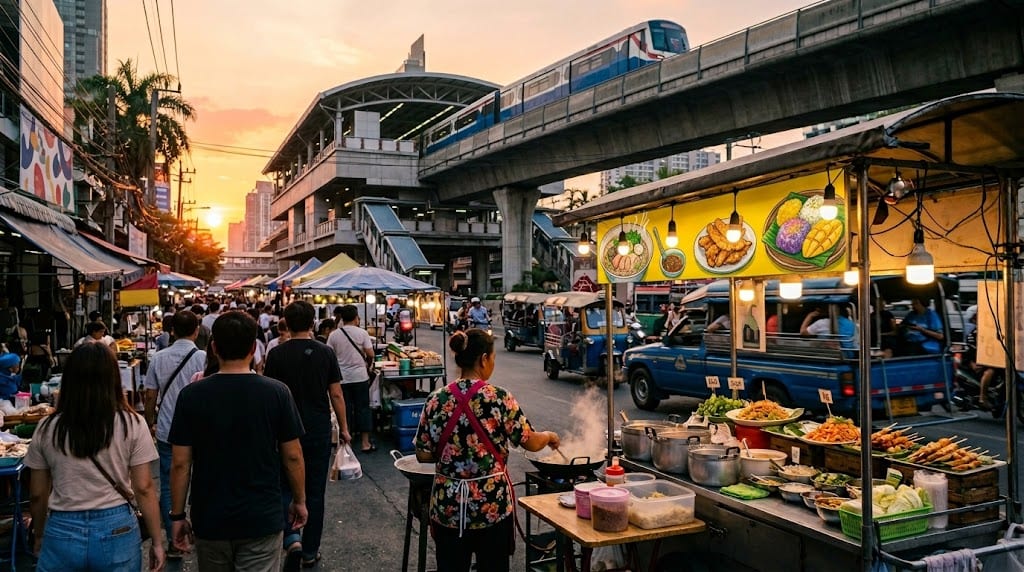
Street stalls, local cafes, food courts and restaurants should be compared by what you get for the final amount. Look at the dish’s ingredients, portion size and the cost of a drink if you plan to order one. The difference between service formats alone does not prove a separate price for foreigners.
Food benchmark for October 2026. According to the same aggregator (Numbeo), lunch at an inexpensive cafe averages about 100 ฿ nationwide (range 50–200 ฿), and dinner for two at a mid-range restaurant about 900 ฿ (600–2,500 ฿). These are average user estimates across all cities, not the price of a specific establishment.
Start with the menu near your accommodation and your usual routes. A long trip for a cheap meal adds transport costs and time. For regular meals, it is more convenient to choose a few suitable places than to look for the lowest price across the whole city each time.
Before ordering, check whether the “++” designation is present and what it means at the specific establishment. The menu price may differ from the amount to pay, if additional charges apply. Ask for them to be explained in advance, and do not assume a universal size of service charge or tax.
For groceries, compare identical purchases at a market and at a supermarket. Consider the package weight, the edible portion, and whether you will be able to use the products before you leave. A large quantity brings no savings if part of the purchase goes unused.
Cooking for yourself also requires calculation. Add the products that are not in the apartment, and estimate how many meals you will actually cook at home. For a short visit, stocking up may prove inconvenient, even if individual ingredients look inexpensive.
Do not judge the quality and safety of food by its price. Choose a dish with suitable ingredients and preparation conditions, and compare the final bill only among acceptable options.
Transport: fixed-route trips, metro and river boats
Count the route from door to door: the main ride, transfers, and the trip to the stop or pier. Compare fixed-route transport with a private ride for the whole group of travelers. Luggage, number of passengers and ease of transfers can change the choice.
If you are considering a songthaew, distinguish between a fixed-route ride and a private hire. Agree on the ride format and payment before boarding. When comparing the metro, boat and taxi, also consider the return trip, so that savings on one segment do not hide a more expensive route overall.
The river boat operator (Chao Phraya Express Boat) publishes the following fares based on October 2026 data:
| Service and operator | Price | Route section | Restriction |
|---|---|---|---|
| Orange flag, river boats (Chao Phraya Express Boat) | 18 ฿ | Ride along the line | Fare for the specific line |
| Yellow flag, river boats (Chao Phraya Express Boat) | 23 ฿ | Ride along the line | Fare for the specific line |
| Green-yellow flag, river boats (Chao Phraya Express Boat) | 16 ฿ | Pak Kret — Nonthaburi | Price depends on the section |
| Green-yellow flag, river boats (Chao Phraya Express Boat) | 23 ฿ | Nonthaburi — Sathorn | Price depends on the section |
| Green-yellow flag, river boats (Chao Phraya Express Boat) | 35 ฿ | Pak Kret — Sathorn | Price depends on the section |
| Red flag, river boats (Chao Phraya Express Boat) | Listed price 32 ฿; regular price 50 ฿ | Ride along the line | The regular price is shown next to the offer |
For the red flag, check the current fare with the operator. Its information lists Oriental Pier as closed for repairs due to damage: do not plan to board there without confirming availability.
The BTS elevated metro has separate terms for the Xtreme Savings package. As of October 2026, adult users are charged for an additional section 25 ฿ instead of the usual 27–45 ฿, and the maximum cost with an additional section is 65 ฿. These are the package terms, not a universal price for a trip; for choosing routes, see the guide transport in Bangkok.
Communications: how to compare tourist and local packages
Choose a communications plan based on your length of stay and needs: navigation, messaging, calls or work. The name “tourist” or “local” does not determine the benefit without comparing terms. First check whether a suitable package is available to you.
Tourist offers from AIS based on October 2026 data:
| Service | Operator | Price | Validity period | Restriction |
|---|---|---|---|---|
| Tourist offer | AIS | 499 ฿ | 8 days | Specific tourist product |
| Tourist offer | AIS | 1 199 ฿ | 30 days | Not a universal monthly connectivity price |
| Tourist offer | AIS | 49 ฿ | One day | Not a monthly plan |
Verify current cost and terms on the official AIS operator website. The 49 ฿ offer is designed for one day, while the 1,199 ฿ price applies to a specific tourist product. They cannot be compared as interchangeable monthly plans.
Look at the data allowance, speed, included calls and renewal procedure. Separately check whether speed changes after the package’s data allowance is used up. If you need internet for work, assess the tethering terms for other devices, where these are stated in the offer.
Here is a notable point: the cheapest package in the table is valid for a shorter period than the others. Therefore, a low starting price does not yet answer the question of costs for the whole stay. Do not choose by price tag without checking the validity period.
To keep using the tourist SIM card (AIS Tourist SIM) after 60 days from activation requires repeat identity verification. Details on choosing a connection are covered in the guide mobile phone service and internet in Thailand.
Finance: currency exchange, cash withdrawals and fees
Compare not only the rate but also the amount in baht you receive after all charges. When exchanging, ask for the total for the same starting amount at different places. The location of an exchange bureau at the airport or in the city alone does not determine whether an offer is advantageous.
Before your trip, check with your bank and payment service whether your card or other payment method is accepted. Separately clarify the terms for purchases and for cash withdrawals: these are different operations. Do not build a budget on the assumption that a particular card, wallet or payment method will definitely work.
When withdrawing cash, compare:
- the operator fee shown by the ATM;
- the issuing bank’s fee;
- conversion terms;
- the available transaction amount;
- your actual need for cash.
Withdrawing less often makes sense with a fixed fee, when repeated transactions add the same charge each time. But a large amount requires safe storage, so this advice does not mean “withdraw the maximum.” Choose the amount of cash based on your immediate expenses and your bank’s own terms.
If the screen offers conversion options, make sure you understand who sets the rate and how the final debit is calculated. It is better to clarify unclear terms before confirming the transaction. Save the payment details so you can compare expected costs with actual ones.
More details currency exchange in Thailand is covered in a separate article. For long-term residence, you may want to see the guide bank account in Thailand for foreigners, but the possibility of opening one and the terms of service should be assessed for your situation.
Medicine and Insurance: how to compare costs without risk
For a planned procedure, request a cost estimate before booking. Compare the composition of services, additional tests and the specialist’s qualifications, not just the starting price. If offers differ in content, first find out what you specifically need.
Ask whether the consultation, the procedure itself and follow-up care, if it is provided, are included. Find out what additional costs are possible and what they depend on. An estimate helps plan your money but by itself does not confirm the quality of care.
Do not delay necessary treatment for the sake of a lower price. It is not possible to declare in advance that a local clinic and an international hospital are equivalent based on cost or format alone. The choice of medical care should match the person’s condition and the specialist’s recommendations.
We recommend considering insurance as protection against unforeseen expenses. Before buying, read the policy terms:
- the deductible and how it is applied;
- exclusions from coverage;
- coverage for intended activities, including scooter rides;
- procedure for seeking assistance;
- conditions for payment or reimbursement of expenses.
A policy with an attractive price may not suit your plans. If you plan to ride a scooter, do not treat the mere existence of insurance as confirmation of coverage for related incidents: check the terms of the specific contract.
Guide travel insurance in Thailand will help you prepare to compare offers. A recommendation to take out a policy does not mean a general legal requirement for every traveler.
Taxes and visas: changes that affect the budget
The permitted length of stay affects the choice of housing, tickets and lease term. Therefore, clarify visa questions before making non-refundable payments. Do not assume that the conditions of a previous trip automatically apply to the next one.
Revised visa measures took effect September 15, 2026. The previous visa-exempt scheme with stays of up to 60 days has been canceled; the scheme for up to 30 days is provided for in an official statement from the Public Relations Department of Thailand. This message does not establish here the applicability of the scheme to a specific nationality, including a Russian passport.
Before booking, we recommend checking the rules for your nationality and purpose of travel in an official visa source. Do not build an extension of stay into your plans as a settled matter. The rental term and cancellation conditions should match your confirmed plan.
For long-term residence there is also a tax part of the budget. The Thai-language notice from the Revenue Department of Thailand indicates a cumulative stay reaching 180 days per tax year, when describing the status of a person present in the country. This refers to the total stay, not only to a continuous trip.
The English-language notice from the same department links the taxation of foreign-source income to the part of it that is brought into Thailand. However, this wording does not disclose the full set of current conditions and exceptions, so an individual tax amount cannot be derived from it. For further analysis, see the material tax system of Thailand for expats.
Entertainment, shopping and excursions without unnecessary spending
Budget leisure in Thailand can be built around walks, markets, parks, beaches, temples and viewpoints. But not all sites are free, and access to certain places may vary. Before going, compare the cost of the visit with the round-trip cost of getting there.
For an excursion, compare the program, not just the price on the cover. Check whether transfers, entrance tickets, meals and a guide in a suitable language are included. Also check the cancellation terms and the list of additional payments.
A lower starting price does not prove a lower final cost. If you have to pay separately for transport and tickets, add them before comparing. When visiting independently, account for the same cost items and the time spent organizing the route.
For purchases, compare identical goods by size, configuration and quality. A market, a small shop or a shopping center cannot be declared the cheapest format for the whole country. If you negotiate the price with a seller, assess the final offer, not the amount of the promised discount.
Decide in advance which purchases you really need. A souvenir with an attractive price tag remains an expense if you did not plan to buy it. With limited luggage, also consider whether it will be convenient to carry the purchase home.
How can you save money on experiences in Thailand? Choose activities based on your interests and group nearby places within your route. This way you can compare several suitable leisure options without unnecessary trips or impulse purchases.
Frequently Asked Questions ❓
How much money per month do you need to live modestly in Thailand?
Draw up a budget based on your length of stay and lifestyle: separately count housing, food, trips, communications and other regular expenses. Flights, initial payments and the refundable deposit should be counted separately. There is no single monthly amount that suits all travelers.
How can a foreigner choose a good-value metro fare?
Compare the terms of the specific line and program with your route. On BTS, under the Xtreme Savings package, the additional section costs adults 25 ฿ instead of the usual 27–45 ฿, and the maximum cost with it is 65 ฿. These are the terms of the package, not the price of every trip.
Where is the cheapest place to eat without sacrificing quality?
Compare local cafes, street stalls and food courts by menu, portions and the final bill. Check additional charges before ordering. A low price alone does not confirm the quality or safety of food, and one dining format cannot be declared the cheapest across the entire country.
How can you save on renting accommodation?
Compare housing together with utility payments and travel costs, and discuss the lease term and deposit conditions. Compare offers for the same dates and with the same set of services. A longer lease can be discussed with the owner, but it does not guarantee a fixed discount.
Which ATM charges the lowest fee for cash withdrawals?
The answer depends on the card and the banks involved in the transaction. Compare the ATM operator’s fee with the issuing bank’s fee and conversion terms. With a fixed fee, frequent small withdrawals can increase costs; choose the amount based on your need for cash and its safe storage.
What should you NOT skimp on in Thailand?
Do not postpone necessary medical care for the sake of a lower price, and do not choose treatment based on cost alone. For planned procedures, compare the composition of services and the estimate. When choosing insurance, check the deductible, exclusions and coverage for your activities: a recommendation to take out a policy does not mean a legal obligation for every traveler.
Is a tourist or local SIM card more cost-effective for a long stay?
Compare specific packages with suitable terms and the same validity period. As of October 2026, AIS tourist offers cost 499 ฿ for 8 days and 1,199 ฿ for 30 days; the offer for 49 ฿ is designed for one day. To keep using the AIS Tourist SIM after 60 days from activation, repeat identity verification is required. A local package does not automatically become more advantageous just because of its name.
Conclusion
Saving money in Thailand is easier when you compare all expenses: housing together with transport, food by the final bill, communications for the length of your stay, and payments after fees. First choose the level of comfort you need, then compare offers with identical terms. Assess medical care and insurance coverage separately from the search for the lowest price.
Pricing examples refer to specific products, lines and conditions, so do not use them as a general price for a service across the country. Prices, service availability, and visa and tax conditions may change, and the applicability of rules depends on your situation. Draw up a personal list of expenses, set aside initial payments and a reserve, then check which offers suit your route.
Prepared by MyThai.online editorial team.