In this article:
What changed: The composition of Phuket’s O Tao was corrected: it is a dish with oysters, taro, egg and a soft batter. Added the ingredients of the Thai sauce for Khao Man Gai and the dates of the Phuket Vegetarian Festival — October 9–18, 2026.
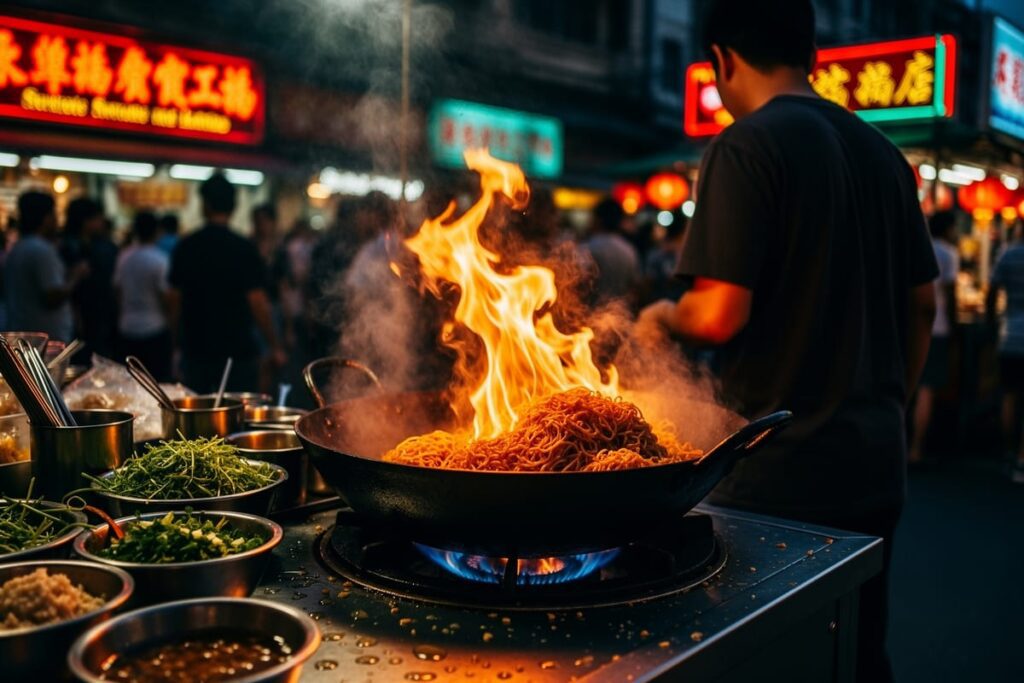
Chinese influence on Thai cuisine is easiest to recognize through the wok, noodles, soy products and local versions of familiar dishes. For a first introduction, Khao Man Gai (chicken with rice) and Pad See Ew (noodles with dark soy sauce) are good choices. They let you compare different cooking methods and understand the role the sauce plays in the dish.
Chinese migrants helped spread cooking techniques and ingredients that became part of Thai food. But the presence of noodles or a wok alone does not explain the origin of every recipe: a dish’s history is better considered separately from its ingredients.
This guide will help you choose food for a walk around Bangkok, make sense of popular dish names, and get acquainted with the culinary heritage of Phuket. We start with clear differences between dishes, then move on to neighborhoods, seasonal events and questions to ask before ordering.
How Chinese communities influenced Thai cuisine
Culinary exchange involves not only recipes but also familiar ways of cooking. The local publication Hua Hin Today describes how Chinese migrants helped spread stir-frying in a wok, deep-frying, various kinds of noodles, fermented soybean paste, soy sauces and tofu. This explains the influence through migration, not a claim that every product on the list belongs exclusively to Chinese cuisine.
Different Chinese traditions are best considered through specific examples. The MICHELIN gastronomy guide links the origin of Khao Man Gai to Hainan in China. In Phuket’s culinary heritage, a Thai government department highlights the Hokkien Chinese component alongside Peranakan, Malay and southern Thai influences.
Here it is useful to distinguish the history of a recipe and the spread of a cooking technique. The Hainan roots of chicken with rice are a claim about one specific dish. Frying noodles with soy sauce shows the link between techniques and ingredients, but on its own does not name the place where the recipe originated.
Therefore, Chinese influence on Thai cuisine is better understood as a combination of several traditions. To get to know it, there is no need to look for a single source in every plate: it is far more interesting to notice how common ingredients get different combinations and presentations.
Wok, noodles and soy products: techniques and ingredients
In Thai cooking, the wok helps show the link between the tool and the cooking method. The Bangkok Thai Cooking Academy describes it as a Chinese tool and links stir-frying over high heat to a Chinese technique. For visitors, this is a useful tip: look not only at the name of the dish but also at how it is cooked.
Stir-frying and deep-frying are different ways of processing food. In the first, the ingredients are tossed while frying; in the second, they are cooked in deep oil. The local publication Hua Hin Today links the spread of both methods to Chinese communities.
However, the influence is not limited to frying. An academic publication on Chinese food in Thailand links immigration to a variety of cooking methods, including boiling, braising, steaming and frying. This does not mean that local people did not know similar methods before migration.
The following ingredients are especially useful to know:
- Soy sauces: dark soy sauce is included in the description of Pad See Ew.
- Fermented soybeans: used in the described Thai sauce for Khao Man Gai.
- Tofu: included in one version of Pad Thai described by the culture and travel magazine Smithsonian.
- Noodles: their width and combination with the sauce help tell dishes apart.
If the names are still confusing, start with the material Thai food for beginners. Then compare specific dishes: this makes it easier to connect unfamiliar ingredients with what you order.
Thai-Chinese dishes: what to choose for a first try
Khao Man Gai, Pad See Ew and Pad Thai show different sides of culinary exchange. Chicken with rice has a geographic connection named in its source, while the noodle dishes let you compare frying technique and sauce compositions. A shared technique does not make them the same in origin or taste.
| Name | Dish description according to the source | Chinese basis or connection | Features of the Thai version |
|---|---|---|---|
| Khao Man Gai | Chicken with rice; the MICHELIN gastronomy guide describes the Thai sauce separately | The guide links its origin to Hainan in China | Sauce with fermented soybeans, vinegar, ginger, sugar, dark soy sauce and green chili |
| Pad See Ew | Noodles, usually wide sen yai, are fried with dark soy sauce | An example of frying noodles with soy sauce; no separate Chinese prototype is specified | The described composition helps identify the dish but does not establish how it differs from a Chinese version |
| Pad Thai | Thin flat rice noodles with garlic, preserved radish, dried shrimp and tofu | The culture and travel magazine Smithsonian treats the dish as an example of Thai-Chinese cuisine | Sauce of fish sauce, tamarind and palm sugar; a combination of sour, salty and sweet |
For Khao Man Gai, pay attention to the sauce. The composition described by the MICHELIN gastronomy guide shows the local version more specifically than the general definition “chicken with rice.” Before ordering, you can ask whether the sauce is served separately, so you can compare the dish with and without it.
Pad See Ew and Pad Thai are convenient to try for comparing noodles. The first description focuses on wide sen yai noodles and dark soy sauce; the second on thin flat rice noodles and a different combination of seasonings. The Thailand Foundation describes traditional Pad Thai through sour, salty and sweet flavors.
Here is a simple observation: in both dishes the noodles are fried, but the sauce compositions differ. So the word “fried” alone does not help you choose between them; it is more useful to look at the ingredients. For further familiarization, check out the food guide to Bangkok.
Yaowarat: how to plan a food walk
Yaowarat Road is the place to explore the food of Bangkok Chinatown. Plan your walk around choosing food, rather than expecting the dish you want to be available from every vendor. Whether a dish is available and the ordering terms depend on the specific stall.
You can start without a complicated route:
- Look over the offerings and menu before choosing a place.
- Find a familiar name from the table and compare its description with what the vendor offers.
- Ask about the ingredients, how the sauce is served, and the price of the portion you choose.
- Place your order, and for the next dish choose a different combination of ingredients or cooking method.
Don’t rush to order based on a single photo. If you want to compare Pad See Ew and Pad Thai, first find out which noodles and which sauce are used in the options you choose. This gives a clearer comparison than choosing by the general name “noodles.”
The independent guidebook Out Thailand gives a preliminary benchmark 50–150 baht per dish, according to data as of July 2026. This is the guidebook’s estimate, not a single price list for all stalls: check the current cost before ordering. Do not calculate the price of every dish or the whole walk from this range.
Details about the area and transport are collected in a separate article: Bangkok’s Chinatown. Check the opening hours of the vendor you choose separately: the neighborhood has no shared schedule for all food stalls.
Beyond Bangkok: Phuket, Hat Yai and Northern Thailand
Phuket: Hokkien noodles and O Tao
Chinese influence on Thai cuisine in Phuket coexists with other traditions. Hokkien Chinese, Peranakan, Malay and southern Thai influences are listed in a publication by a government department on Phuket’s gastronomy. In 2015, Phuket received the status of UNESCO Creative City of Gastronomy.
For getting acquainted, the publication names Hokkien noodles and O Tao. O Tao is a dish with oysters, soft batter, taro and egg. Do not confuse it with braised pork with tofu: that is a different description of its ingredients.
You can combine a cultural walk with Phuket Old Town. The Tourism Authority of Thailand links its development to the prosperity of tin mining. To choose food, use Phuket food guide, and for a broader cultural introduction, see the article on Chinese heritage in Thailand.
Hat Yai: coexisting culinary traditions
The Tourism Authority of Thailand describes the population of Hat Yai through the coexistence of Chinese, Malay and Thai communities. This helps to understand the city’s cultural diversity but does not determine the composition of each dish.
When choosing food, look at the menu of the specific establishment. Do not apply to the whole city assumptions about uniform spiciness, portion sizes or a single serving time.
Northern Thailand: one version of the origin of Khao Soi
For getting to know the north, Khao Soi is an interesting choice. The MICHELIN gastronomy guide gives a version of its origin from the Chinese province of Yunnan.
This is an attributed version of the dish’s history. It does not allow automatically assigning a separate Chinese or Thai origin to each of its components.
Vegetarian festivals in October: dates for a food walk
The seasonal information below is presented according to data as of October 2026. It helps you choose when to travel, but it does not replace menus or vendors’ opening hours.
According to an announcement from a Thai government department, the Phuket Vegetarian Festival takes place from October 9–18, 2026. The Go Teng pole-raising ceremony is scheduled for October 9 at 17:09 local time. Night processions are named as a new feature of the announced program.
This information is published in the official program of the Phuket Vegetarian Festival. The overall festival period and the time of a separate ceremony are different reference points; neither indicates food-selling hours. The event schedule may change.
According to a report in The Nation, the main festival on Yaowarat also runs October 9–18, 2026. If you combine your walk with the festival, choose the event and the place for food separately. For ordering, questions about the dish’s ingredients and price remain useful.
How to read a menu and ask about a dish’s ingredients
The name helps identify the dish but does not replace a description of its recipe. Ingredient lists from gastronomy publications are useful as a starting point for a conversation with the vendor. The described version does not mean that all establishments use the same recipe.
On concrete examples, it looks like this:
- Khao Man Gai: ask about the sauce. In the description from the MICHELIN gastronomy guide, it contains fermented soybeans, vinegar, ginger, sugar, dark soy sauce and green chili.
- O Tao: check whether it contains oysters, egg, taro and batter; this is the exact composition given in the government publication about Phuket.
- Pad Thai: the version from the culture and travel magazine Smithsonian includes dried shrimp and tofu, and the sauce uses fish sauce, tamarind and palm sugar.
- Pad See Ew: check the type of noodles and sauce; the MICHELIN gastronomy guide usually describes wide sen yai with dark soy sauce.
Before ordering, ask which ingredients are used in the portion you choose, how spicy the dish is, and whether the sauce can be served on the side. It is better to find out whether you can change the composition or the serving before cooking. Do not assume that serving the sauce separately is a standard service.
It is easier to start with the name and a clear question about one component than to try to work out the whole composition from appearance. Comparing specific options will help you understand your preferences and choose your next dish more consciously.
Frequently Asked Questions ❓
Which Thai dishes have Chinese origins?
For Khao Man Gai, the MICHELIN gastronomy guide points to Hainan roots in China. The culture and travel magazine Smithsonian treats Pad Thai as an example of Thai-Chinese cuisine, while Pad See Ew shows the use of frying noodles with dark soy sauce. General culinary influence and the origin of a specific recipe should be distinguished.
How does Thai cuisine differ from Chinese cuisine?
Both cuisines are diverse, so the differences cannot be reduced to one set of ingredients. A clear example of a Thai version is the sauce for Khao Man Gai, made with fermented soybeans, vinegar, ginger and chili. In the described version of Pad Thai, the sauce combines fish sauce, tamarind and palm sugar, and the Thailand Foundation notes the combination of sour, salty and sweet flavors.
Where in Bangkok can you try Thai-Chinese food?
For a food walk, you can choose Yaowarat, Bangkok’s Chinatown. Before ordering, compare menus, ingredients and prices. Details about the area and transport are in a separate guide to the Chinatown.
Where does Khao Man Gai come from, and what is special about its Thai sauce?
The MICHELIN gastronomy guide links the origin of Khao Man Gai to Hainan in China. The described Thai sauce uses fermented soybeans, vinegar, ginger, sugar, dark soy sauce and green chili. This is a useful example for getting to know the local version of the dish.
How are noodles connected to Chinese influence on Thai cuisine?
The local publication Hua Hin Today links the spread of different kinds of noodles in Thailand to Chinese migrants. In Pad See Ew, the MICHELIN gastronomy guide describes frying noodles with dark soy sauce, and in Pad Thai the culture and travel magazine Smithsonian notes rice noodles with a sauce of fish sauce, tamarind and palm sugar. These examples show the use of common culinary elements in different dishes.
What should I try in Phuket to get to know its Chinese heritage?
A publication of the Thai government department names Hokkien noodles and O Tao. O Tao is described as a Phuket dish with oysters, soft batter, taro and egg. The island’s culinary heritage combines Hokkien Chinese, Peranakan, Malay and southern Thai influences.
Conclusion
Chinese influence on Thai cuisine is easiest to recognize through cooking techniques, ingredients and local versions of dishes. Start with Khao Man Gai or Pad See Ew: compare the base of the dish, the sauce composition and your own impressions. Then you can continue exploring in Phuket, where Hokkien noodles and O Tao show another side of the culinary heritage.
For such a walk, you don’t need a long list of must-order dishes. Choose what interests you, check the ingredients and price, and consider a recipe’s history separately from how it is cooked. Before going further into street food, read the article food and water safety in Thailand: it will help you prepare for choosing food on your trip.
Prepared by MyThai.online editorial team.