In this article:
What changed: Added recommendations on storing food after floods. Clarified the conditions for choosing drinking water and ice, the use of oral rehydration solutions, and signs that require seeing a doctor: diarrhea lasting more than 3 days, blood in the stool, or vomiting that prevents keeping fluids down.Updated: June 14, 2026
What changed: 2026 update: Clean Food Good Taste and SHA certificates, safe factory-made ice, water prices, a first-aid kit for food poisoning, and a requirement for sanitation training for staff.
Food and water safety in Thailand starts with clear choices: pick drinking water from a known source and fully cooked food that is served hot. Eat ice only if you are reasonably sure the water it was made from is safe. Also pay attention to food storage, how clean the dishes are, and how the finished dish is handled.
Current as of the update date shown at the top of this article. Conditions may change, and this article helps you plan your trip but does not replace medical advice. Blood in the stool, or vomiting that prevents you from keeping fluids down, requires seeing a doctor without waiting several days.
Below is a quick guide for cafes, street stalls, hotel breakfasts, and cooking for yourself. A broader look at health risks in Thailand will help you prepare for other situations on your trip.
Which water to drink in Thailand and how much it costs
There is no single answer for every tap in the country. The metropolitan water utility (MWA) states that its water is suitable for drinking in Bangkok, Nonthaburi, and Samut Prakan. This position applies to the utility’s water within its service area.
At the same time, the utility recommends regularly cleaning and maintaining storage tanks and related equipment. The quality of the supplied water and the condition of a specific building’s system are separate questions. If you know nothing about the tanks and equipment in your accommodation, a cautious everyday choice is bottled water or drinking water from a known source.
| Situation | What to consider |
|---|---|
| Drinking | Water source, packaging condition, and storage conditions |
| Brushing teeth | If the quality of the water at your accommodation is unknown, you can choose the same drinking water |
| Washing fruit | Use water you are confident is safe |
| Preparing drinks | Check the source of any added water and ice |
A water vending machine alone does not confirm the water’s quality. Before using it, check the cleanliness of the filling point, information about the supplier, and maintenance; your own container must also be clean.
Check prices on the spot: the price of a specific pack in a shop or the vending machine’s rate. Compare offers by volume, and for a long stay, ask about the supplier’s terms and plan how to store water at home. A low price does not replace these checks.
Is ice in drinks safe
Tube ice with a hole, cubes, or crushed ice: how it looks does not answer the main question. The shape of the ice does not confirm the safety of the original water. So don’t choose a drink based only on the familiar “tubes”.
According to the Thai Food and Drug Administration, the basic standard GMP 420 applies to ice production. Producing food-grade ice requires stricter control than producing ice not intended for consumption. But production requirements do not let you judge a specific serving in a glass by its appearance.
The United States Centers for Disease Control and Prevention (CDC) recommend avoiding ice unless you are reasonably sure it was made from safe water. Ask where the ice came from, and check how it is stored and added to the drink.
If the answer is unclear, it’s simpler to order without ice. This applies not only to water and tea, but also to cocktails, fresh juices, and smoothies: added ice remains part of the drink.
Street food: how to choose a stall and a dish
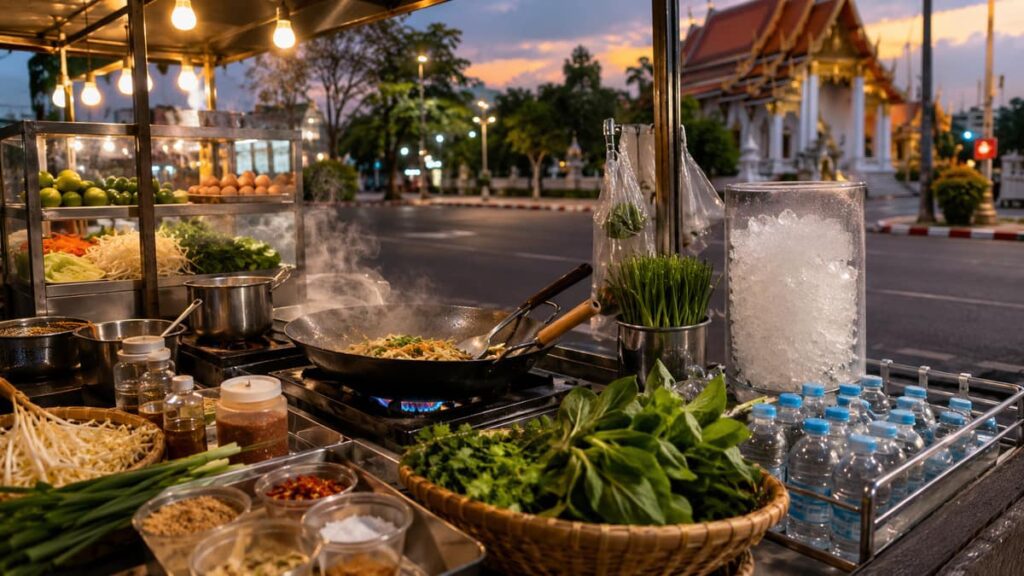
Judge a specific stall, a street food counter, rather than street food as a whole. The main guideline from the CDC: food that is fully cooked and served hot. A dish’s name or a stall’s popularity alone proves nothing.
Before ordering, watch how the stall works:
- Whether the chosen dish is cooked before serving and served hot.
- Whether the work surface, plates, and utensils are clean.
- How they handle raw ingredients and cooked food, and whether they use separate utensils.
- Where pre-prepared dishes are kept and whether they are protected from contamination.
- How the cook handles dishes and the finished portion after cooking.
In travelers’ discussions on Reddit, crowds and fast customer turnover are cited as everyday indicators of food quality and freshness. This is an additional observation, not a medical check. You can spot a line right away, but it won’t tell you how ingredients were stored before the stall opened.
Also take your time with open sauces and condiments. If you doubt the cleanliness of the container or the freshness of its contents, ask for a fresh portion or choose a sealed packet. For dishes prepared in advance, ask when they were made and how they were stored.
To help you choose dishes and learn about local cuisine, see the guide to food in Bangkok and food in Phuket. Still, check conditions at each place when you visit.
Restaurants and cafes: hygiene and sanitation signs
Having a dining room, a menu, and waiters does not automatically make a restaurant safer than a street stall. Look at the cleanliness of dishes, tables, and work surfaces, and if you can see the kitchen, look at how food is handled. For a hot dish, the same guideline still applies: thorough cooking and hot serving.
Thailand’s restaurant hygiene signs need careful reading. The departmental document provides for ending the use of the former signs it lists, but allows a transitional exception: a former sign may be used until the current certification expires. So the presence of an old sign alone does not show its current status.
A sign does not guarantee the safety of every portion. If you decide to rely on a certificate, check its expiration date, but keep assessing the actual conditions. A sign does not replace clean dishes and careful food handling.
You don’t need to investigate before lunch. If a plate is dirty, ready-to-eat food sits next to raw food, or staff cannot explain how the chosen dish is stored, it is sensible to decline the order. A beautiful interior does not resolve these questions.
Fruit, vegetables, smoothies, and fresh produce
When choosing fruit, it helps to start with a question: can you peel it yourself? Mango, bananas, and mangosteen let you do this before eating. But a peel does not cancel the need to pay attention to the cleanliness of your hands, knife, and dishes.
For pre-cut fruit, ask when it was cut and how it was stored. Check whether the knife and work surface are clean, what water is used to wash the produce, and where the pieces are placed after cutting. Preparing food in front of the customer does not guarantee safety, although it lets you see part of the process.
For raw vegetables, herbs, and salads, the same questions apply. If you prepare food yourself, use water you are confident is safe for washing, and clean utensils. Don’t assume that a regular rinse will remove all contamination.
With fresh juices or smoothies, assess more than the fruit. Ask what water is added, where the ice comes from, and how glasses and equipment are washed. A drink without ice can be a cautious choice when the source of the ice is unknown, but the question about the added water remains.
If the seller cannot explain how the drink is prepared, you can choose another option. Here, a few clear questions are more useful than trying to judge quality by the color of the juice or how appealing the display looks.
Seafood: cooking and storage
When choosing fish, shrimp, or other seafood, check how it is stored before cooking. Pay attention to refrigeration, the tidiness of the display, and how products are handled; ask whether the chosen portion will be cooked before serving. Seafood left out in the heat without clear storage conditions is a reason to decline your order.
Appearance and smell may raise doubts, but they are not a test for the absence of harmful microorganisms. A normal smell does not confirm safety. Likewise, ice on display does not answer all questions about storage.
The key guideline is thorough heat treatment and hot serving. It applies to a seaside restaurant, a market, and a small cafe alike. Don’t rely only on assurances that the seafood is “very fresh”.
Raw oysters, sashimi, and other lightly cooked dishes call for a cautious choice regardless of how sensitive your stomach is. If you are unsure about storage and preparation conditions, choose a fully cooked hot option or another dish.
Buffets, food to take away, and eating after a flood
Judge a hotel buffet by the conditions you can see right now. Are the plates and serving utensils clean, how is the food laid out, where are cold foods kept, and are hot dishes served hot? The buffet format itself does not confirm that the food is safe.
If a dish has been on the serving line for a long time and the storage conditions are unclear, ask staff about its preparation. Don’t judge only by the breakfast hours or the number of guests. For fully cooked food, the principle of hot serving still applies.
Plan how to store food for an excursion before you buy it:
- Find out when the dish was prepared.
- Ask how it is meant to be stored before eating.
- Take clean containers that close.
- Don’t treat a sealed package as proof of suitable transport conditions.
Eating after a flood is a separate situation. As noted in the recommendations of Thailand’s Ministry of Public Health, health risks remain after the water recedes. Food prepared in advance should be kept in clean containers with tightly closed lids.
A lid protects the contents but does not replace the other storage conditions. This warning applies to the situation after a flood and does not mean the situation is the same in all parts of the country.
What to do with diarrhea and vomiting
With diarrhea and vomiting, attention should go to replacing lost fluids. Rehydration for diarrhea is not a way to make a diagnosis and does not replace medical care. Don’t automatically attribute symptoms to unfamiliar food or “adapting to local microflora”.
For significant fluid loss, the CDC recommends oral rehydration solution (ORS). Its purpose is to replace fluids and salts. The Bangkok Hospital Chiang Mai clinic also describes such solutions as a way to replace fluid lost through diarrhea or vomiting.
Practical steps:
- Explain your symptoms to the pharmacist and ask for an oral rehydration product.
- Read the instructions for the exact package you choose.
- To prepare the solution, use safe water in the amount specified by the manufacturer.
- Don’t replace the instructions with a one-size-fits-all plan from the internet.
Dosage and dilution must match the specific product. If the instructions are unclear, ask the pharmacist to explain them; don’t guess the amount of water or number of sachets. For help with buying, see medicines and pharmacies in Thailand.
The CDC does not recommend antimotility drugs as the only treatment for bloody diarrhea or diarrhea with fever. Don’t put together your own treatment plan from antibiotics and over-the-counter products. If vomiting prevents you from keeping fluids down, pharmacy advice is not enough — you need a doctor.
When to see a doctor and how to arrange help
Blood in the stool and being unable to keep down the fluids you drink are each reason on their own to see a doctor. Don’t wait for these symptoms to continue for several days first. When you seek care, describe your symptoms rather than a suspected diagnosis.
Specific signs are listed in the CDC’s guidance on when to see a doctor:
- Bloody diarrhea.
- Frequent vomiting that prevents keeping fluids down.
- Diarrhea lasting more than 3 days.
The last criterion does not allow waiting if there is blood in the stool or vomiting that prevents you from keeping fluids down. If your condition worsens, don’t postpone a medical evaluation for a scheduled excursion or an attempt to find a different over-the-counter remedy.
To arrange help, prepare your accommodation address, your insurance policy details, and a description of your symptoms. Write down when they started, whether you can keep fluids down, and whether there is blood in the stool. This information will help you explain the situation to a doctor or an insurance company representative.
Before you travel, understand how your travel insurance in Thailand works: how to file a claim and how payment is handled depend on the terms of your policy. Practical steps for an urgent situation are described in emergency assistance in Thailand. Don’t expect every clinic to see patients equally quickly.
Phone 1422 — information line of the Department of Disease Control. This is not an ambulance number, and calling for reference information must not replace necessary medical care.
Frequently Asked Questions ❓
Is it safe to drink tap water in Thailand?
There is no single answer for every tap in the country. The metropolitan utility (MWA) states that its water is suitable for drinking in Bangkok, Nonthaburi, and Samut Prakan, and recommends maintaining tanks and equipment. If the condition of your accommodation’s system is unknown, a cautious choice is bottled water or drinking water from a known source.
Is ice in drinks and cafes safe?
The shape and the central hole do not confirm that a serving is safe. The CDC recommends eating ice only when you are reasonably sure it was made from safe water. If the origin is unknown, order the drink without it.
Is it dangerous to eat street food in Thailand?
Judge the specific stall and how it handles food. The guideline is food that is fully cooked and served hot, clean dishes, and clear storage conditions. A line of customers can be an additional observation, but it is not a guarantee that there is no infection.
What should you pack in a first-aid kit for food poisoning?
To replace lost fluids, it’s useful to have an oral rehydration product (ORS) and to use it according to the instructions on the specific package. A first-aid kit does not replace a doctor for blood in the stool or vomiting that prevents you from keeping fluids down.
How much does drinking water cost in Thailand?
Check the price of the package you choose in a shop or the rate of a specific vending machine, and compare costs by volume. For a long stay, ask about the supplier’s terms. The price and the presence of a vending machine do not replace attention to the water’s source and storage.
How do you know a place can be trusted?
Look at how clean the dishes and work area are, and how food is prepared and stored. A sanitation sign does not guarantee the safety of every portion. The departmental document provides for ending the use of the former sanitation signs it lists, with a transitional exception until the current certification expires.
Conclusion
Food and water safety in Thailand comes down to simple habits: choosing water from a known source, eating fully cooked hot food, and paying attention to storage and hygiene. The shape of the ice, a line of customers, and a sanitation sign may draw attention, but they do not provide a universal guarantee.
If there is blood in the stool or vomiting that prevents you from keeping fluids down, see a doctor without waiting several days. Diarrhea lasting more than 3 days is a separate reason for medical evaluation. Recommendations and local conditions may change; this article does not replace medical advice. Save this quick guide before your trip so the questions to ask a seller and the signs that call for help are at hand.
Prepared by MyThai.online editorial team.