In this article:
What has changed: Added the dates of the Phuket Vegetarian Festival, October 9–18, 2026, and new night processions. Expanded the story of Pad Thai as a combination of a Chinese ingredient, a dish from Korat, and Thai flavors.
Chinese heritage in Thailand can be recognized in cooking methods, the layout of trading houses, temple decor and family festivals. This guide will help you notice specific connections: how the Chinese basis of a noodle dish differs from its Thai version, why a temple can have different names, and how trading history can be read in city neighborhoods.
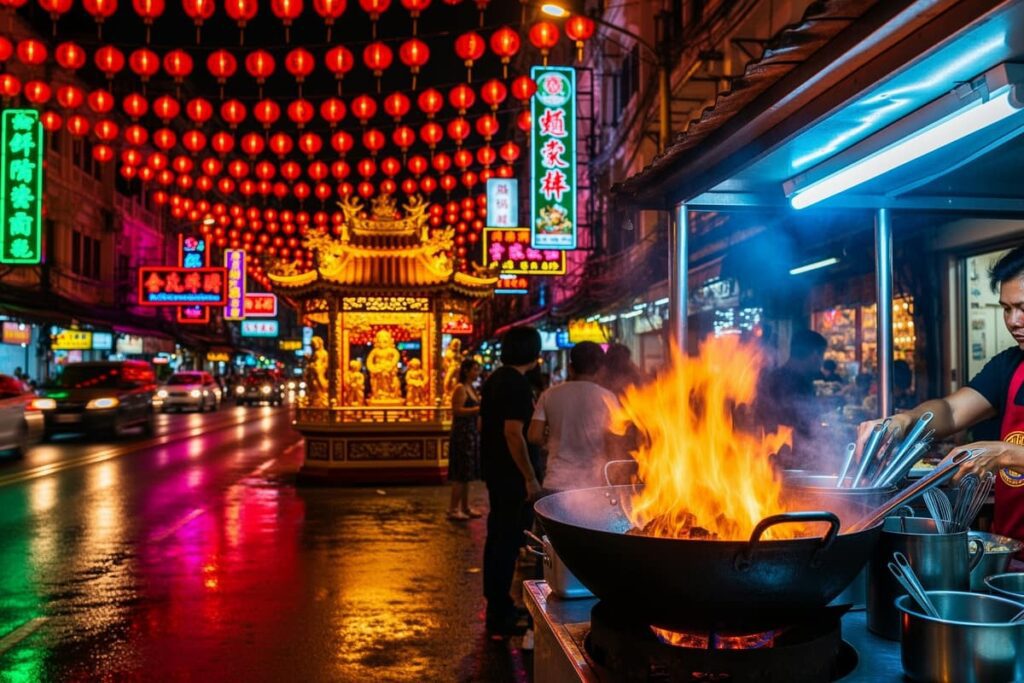
“Woks and Wats” is a convenient image for introducing the topic through cuisine and religious architecture. But behind it stand also migration, family customs and the development of trade, which cannot be reduced to red lanterns or familiar dish names.
You can start in Bangkok, then continue to Phuket, Songkhla and Chiang Mai. Below you will find historical context, examples of local adaptation, and landmarks for exploring on your own, as well as the announced dates of the upcoming Phuket Vegetarian Festival.
History of Chinese communities: migration, trade and integration
The history of Chinese communities is linked to trade contacts and migration, and their incorporation into Thai everyday life happened gradually. Shops, family cooking and religious customs let you see different sides of this process. At the same time, preserving traditions and adopting local habits could happen together.
A publication from the Lee Kuan Yew School of Public Policy at the National University of Singapore gives a historical estimate: between 1825 and 1910 the Chinese population of Thailand grew from 230,000 to 792,000 people. These numbers show the scale of community growth in the past. They cannot be used to answer a question about the current share of the population.
City history also calls for distinguishing between events. According to an academic publication from Atlantis Press, construction of Yaowarat Road began in 1892 in an area already densely populated by Chinese. The road’s opening and the formation of the community were different stages: the street did not create the neighborhood from scratch.
Integration was not free of conflict. An academic study of Chinese-language education reports that in 1918 a law on schools introduced strict requirements for the qualifications of heads and teachers of Chinese schools. This is an example of historical restrictions, not a description of current rules.
Chinese heritage in Thailand is therefore better viewed through specific community stories. Lineage, family language and customary rites do not necessarily coincide, and a Thai-looking name alone proves nothing. For a traveler, it is more useful to notice traces of cultural exchange than to try to determine the origin of every person you meet.
Cuisine: wok, noodles and Thai adaptation
It is easiest to start with food. The wok and noodles give clear examples of how Chinese influence on Thai cuisine shows up through tools, methods and ingredients. However, the origin of a cooking method does not yet determine the origin of the finished dish.
An encyclopedic overview of Thai cuisine links the Chinese tradition to deep-frying, quick stir-frying and steaming. For the reader, these are distinct cooking techniques that can be observed at a food stall. Some dishes are cooked in a wok, others by steaming, but this does not lead to a single label for all of Thai cuisine.
The story of Pad Thai shows local adaptation especially well. As explained in the Thailand Foundation’s article on Pad Thai, the dish appeared in the 1930s and resulted from the development of Thai flavors based on a Chinese ingredient and a dish from Korat. Here the ingredient, the technique and the finished recipe are different parts of the story.
| Dish or ingredient | Confirmed connection to Chinese cuisine | What to distinguish |
|---|---|---|
| Pad Thai | A Chinese ingredient combined with a dish from Korat and Thai flavors | A borrowed base does not make the finished dish simply Chinese |
| Ba Mee | Wheat noodles, comparable to Chinese egg noodles | The type of noodle and the recipe for serving it are different things |
| Certain Kuai Tiao variants | Described in the MICHELIN Guide review as Thai variations of Chinese recipes | The conclusion applies to the variants considered, not to all noodles |
| Khao Soi | The MICHELIN Guide links the dish’s origin to the province of Yunnan | The history of the dish does not prove the origin of the seller or the district |
For a culinary introduction, separate the questions: what the noodles are made of, how they are cooked, and how the recipe took shape. Comparing Ba Mee with Chinese egg noodles concerns the product itself, while the story of Pad Thai concerns a combination of culinary foundations. So the same technique used by different cooks does not yet mean the same history of the dishes. This distinction helps you choose food for its flavor, rather than looking for a single national origin for every order.
A food walk can also include khao man gai, dim sum, and jok, a rice porridge. These are familiar examples for comparing different dishes and ways of serving them. There is no need to assign them all to a single category of origin in advance.
Bangkok Chinatown is a good place to get acquainted with food. To help choose your walking route, see the guide to Bangkok’s Chinatown. In short, look beyond the name of a dish: the cooking method often tells another part of its story.
Temples and architecture: how traditions meet
Temples and shrines are better considered individually, not divided into groups by wall color or the presence of dragons. A decorative detail may point to cultural influence, but does not explain the whole religious tradition of the structure. The same applies to architecture: different sources of inspiration can combine in one building.
Wat Mangkon Kamalawat is a Chinese-Buddhist temple in Bangkok, founded as a Mahayana temple. Its former name was Wat Leng Noei Yi. This is one temple with several names, so there is no need to include them in your itinerary as separate sights.
Chinese styles also influenced Thai architecture. An encyclopedic overview links this influence under Rama III to trade and diplomacy; buildings in the Chinese style were called “keng” or “keng chin.” This refers to a specific historical context, not a single origin of all temple forms.
Another example is the temple of Wat Arun. Its prang decoration uses shells and fragments of porcelain that once served as ballast on ships from China. If you plan a visit to Wat Arun, take a close look at this decoration.
This makes for an interesting link: trading history survives not only in shops but also in temple decoration. Material transported on ships acquired a new role in architecture. Such an example helps you see cultural exchange without attributing the whole structure to a single tradition.
A separate topic for a walk is shophouses, buildings with a commercial space and a residential part. They can be viewed in the historic districts of Phuket and Songkhla. But declaring all facades to be the heritage of the Chinese community alone would be an oversimplification.
Festivals and family customs: what survives today
Chinese New Year links family gatherings and public celebrations. Yaowarat remains a familiar landmark for travelers, but the city’s program is not obliged to be limited to this district. Specific venues relate to a particular celebration.
For example, in the Tourism Authority of Thailand (TAT) announcement about Chinese New Year 2026, the main program was tied to the Siam Paragon shopping center. This is an example of how festival venues were allocated for a past event. It does not set the venue or schedule of the next festival.
As of October 2026,
the Government Public Relations Department of Thailand reported on the program in the official announcement of the Phuket Vegetarian Festival. The following details are useful for planning your trip:
- The Phuket Vegetarian Festival is scheduled for October 9–18, 2026.
- A new feature of the program is night processions.
- The ceremony of raising the ritual pole, Go Teng, is scheduled for October 9 at 17:09.
The announced range applies to this year’s festival. It should not be turned into a rule about a fixed annual duration. For choosing other events, a useful resource is the calendar of events and festivals in Thailand.
The Vegetarian Festival is associated with dietary restrictions and religious rituals. To get to know the culture, it is enough to watch the processions and understand their ritual meaning. Practices that carry a risk of injury do not require visitors’ participation.
The family side of traditions is less visible on a tourist walk. Ancestor veneration, paper offerings during the Hungry Ghost Festival, and red money envelopes, ang pao, help continue the conversation about heritage beyond temples. These customs cannot be automatically attributed to all residents of Thailand: family practices may vary.
Trade and business: from city shops to large companies
Trading districts reveal the link between migration and the layout of the city. In an analytical report from WIEGO, an international organization that studies informal employment, Chinese migrants are named pioneers of ground-level retail in Bangkok, whereas Thai traders preferred floating markets. This is a historical observation, not a description of contemporary ethnic groups.
On an everyday level, the trading house is of interest: the shop and the home are combined in one building. This format helps you view the street as both a place of work and a place of family life. But the origin of the owners or the structure of their business cannot be determined from the facade.
The corporate history of Chia Tai states that the company was founded in 1921 on Songsawat Road in the Yaowarat district. The company links the start of its own history and of the Charoen Pokphand Group to this original business. This is a specific link between the company and the trading district.
Another example is the Central Group, whose history traces back to Tiang Chirathivat. The company combines retail, real estate and hotel business. Its corporate history is not a basis for drawing conclusions about the family’s ethnic origin.
You can continue the walk through Sampheng and Phahurat. Treat them as different trading districts, paying attention to the shops and how the space is organized. There is no need to attribute all this organization to Chinese guilds.
Corporate histories and urban districts operate on different scales. The story of an enterprise on Songsawat Road lets you trace the beginning of a specific business, while the profile of the Central Group shows a combination of several areas of activity. Neither example describes all entrepreneurs in the country. If you are interested in the connection between trade and culture, compare a company’s history with the place where it began, without turning a single case into an explanation of the entire economy.
Where to see Chinese heritage in Thailand
For a first acquaintance, choose a district where you can combine food, architecture and commercial life. You don’t have to turn the walk into a list of sights: it’s better to linger at a few clear examples. Sino-Thai culture reveals itself through details and their connections.
In Bangkok, start at Wat Mangkon MRT station and continue exploring Yaowarat. If you are interested in evening street food, come after sunset. This is a suggestion for a walk, not a promise of a single schedule for all vendors.
In Phuket, the landmark is Phuket Old Town. Include Thalang Road in your route, looking at the trading houses and facades. The Thai Hua Museum will help you continue learning about the history of the island’s Chinese community.
Songkhla Old Town is worth seeing more broadly than just its Chinese heritage. The Tourism Authority of Thailand (TAT) describes Songkhla as a place where Thai, Chinese and Malay populations mix. For an architectural walk, keep this landmark in mind: Nakhon Nok Road.
In Chiang Mai, Warorot Market can be a standalone stop on your route. View it through its goods and everyday trade. The Yunnan history of khao soi does not prove the origin of this market’s vendors.
| Place | What to pay attention to | Where to go for details |
|---|---|---|
| Yaowarat | Noodles, trading houses, the link between the street and temple life | To the Chinatown guide in the cuisine section |
| Phuket Old Town | Shophouses, Thalang Road, Thai Hua Museum | a walk through Phuket Old Town |
| Songkhla Old Town | Trading houses and mixed cultural context | Food and Songkhla Old Town |
| Warorot Market | Range of goods and daily life at the market | To the market description above |
Frequently Asked Questions ❓
What share of Thailand's population has Chinese roots?
The current share depends on who is counted: ethnic Chinese, people with Chinese ancestors, or families who keep certain traditions. These categories cannot be combined into a single percentage. Historical estimates explain the development of communities but do not show today’s share of the population.
Which Thai dishes have Chinese origins?
It is more accurate to speak of Chinese influence and local adaptation. Ba Mee is comparable to Chinese egg noodles, and certain Kuai Tiao variants are described as Thai variations of Chinese recipes. Pad Thai combines a Chinese ingredient, a dish from Korat and Thai flavors.
How do Chinese temples in Thailand differ from Thai ones?
The differences depend on the specific structure and religious tradition; a color scheme is not enough to identify a temple. Wat Mangkon Kamalawat is a Chinese-Buddhist Mahayana temple, also known as Wat Leng Noei Yi. Chinese influence can also be seen in Thai wats, for example in the porcelain decoration of Wat Arun.
When is Chinese New Year celebrated in Thailand?
For dates and the program of the next celebration, you need a current schedule. Yaowarat should not be considered the only venue: in the Tourism Authority of Thailand (TAT) announcement about the 2026 celebration, the main program was tied to the Siam Paragon shopping center. This announcement does not set the schedule of the next festival.
Where is the best place to see Chinese heritage in Thailand?
For a first introduction, Yaowarat is a good choice: here you can combine food, trading life and a temple visit. Phuket Old Town and Songkhla will help you continue exploring trading houses and local culture. Warorot Market is a separate stop on a walk around Chiang Mai, without assumptions about the origins of its vendors.
When will the Phuket Vegetarian Festival take place in 2026?
As of October 2026, the Government Public Relations Department of Thailand announced the festival for October 9–18, 2026. A new feature of the program is night processions. The raising of the Go Teng ritual pole is scheduled for October 9 at 17:09.
Conclusion
Chinese heritage in Thailand is revealed through specific connections: borrowed cooking methods, the local history of Pad Thai, temple porcelain, family customs and trading houses. These examples show how cultural foundations find new uses. They help us understand everyday life without generalizing about the origins of all dishes, buildings or companies.
For independent exploration, start with Yaowarat or Phuket Old Town. Choose what interests you more, whether food, architecture or trading streets, and use the relevant guide from the sections above. Don’t try to cover everything in one walk: comparing a dish, a facade and a temple detail will give you more understanding than a long list of stops.
Prepared by MyThai.online editorial team.