In this article:
What changed: A new bus line, No. 8580, has been added from the airport to Rawai via the bypass road: the fare is 40–120 baht, and operating hours are 05:45–20:00. Information about bus payment and about advance booking and canceling trips through the app has been expanded.Updated: October 25, 2026
What changed: The driving documents section has been expanded: the government list now also includes licenses from ASEAN countries. For the airport bus to the city, the published fare of 100 baht and payment in cash or by QR code have been added; the cost of intermediate trips depends on distance.Updated: October 7, 2026
What changed: The beach bus (Smart Bus) directly connects the west coast beaches. Last departures: airport → Rawai — 23:30, Rawai → airport — 19:30, Phuket Town → Patong — 20:00, Patong → Phuket Town — 21:00. Contactless payment with payment network cards (Visa, Mastercard, JCB) is available; children under six ride free with a paying adult. The Airport Bus ends at the bus station (Terminal 1).
Choose transport in Phuket based on your address, luggage, group size, and return trip. A bus is convenient when your destination is along its route; a taxi or transfer helps you reach a specific hotel. For several stops, consider a car with a driver or a self-drive rental. A vacation without a motorbike is perfectly possible.
Current as of November 2026. A separate line from the airport to Rawai via the bypass road has appeared. It runs a different route from the coastal bus through the western beaches: a shared final stop does not mean a shared route.
Start with the table below, then check the direction, payment, and the walk to your accommodation. If you have not chosen a hotel yet, see the guide to Phuket’s beaches: location affects daily costs and evening returns. Schedules, fares, document requirements, and insurance terms may change.
Which transport to choose in Phuket
First, determine your addresses and return time. Then compare the price per passenger or per car, luggage space, and the distance from drop-off to your hotel. Prices in the table are based on data as of November 2026.
| Option | Suitable route | Cost and pricing unit | Luggage and the walk | Return restrictions |
|---|---|---|---|---|
| Beach bus | Airport and western beaches to Rawai | 100 baht per passenger per trip | Check luggage space and the walk from the stop | Need the timetable for your own direction |
| City line | Bus station — Patong | 50 baht per passenger | Tied to the route and its stops | Choose your return pickup point in advance |
| New line No. 8580 | Airport — bypass road — Rawai | 40–120 baht per passenger, depending on distance | Match the route to your accommodation address | Published operating hours — 05:45–20:00 |
| Airport bus to the city | Airport — Phuket Town | 100 baht per passenger to the city | Factor in onward travel from the bus station | Do not carry over the timetables of other buses |
| Songthaew | Local trips between town and the beaches | Agree on the fare before boarding | Discuss where luggage will go | Agree on how to get back |
| Free shuttle | City loop through the Old Town | Free | Suitable if your route matches | Check whether a return trip is possible |
| Taxi | To a specific address | Price of the chosen booking per car | Choose capacity for passengers and luggage | Allow time for the car to arrive |
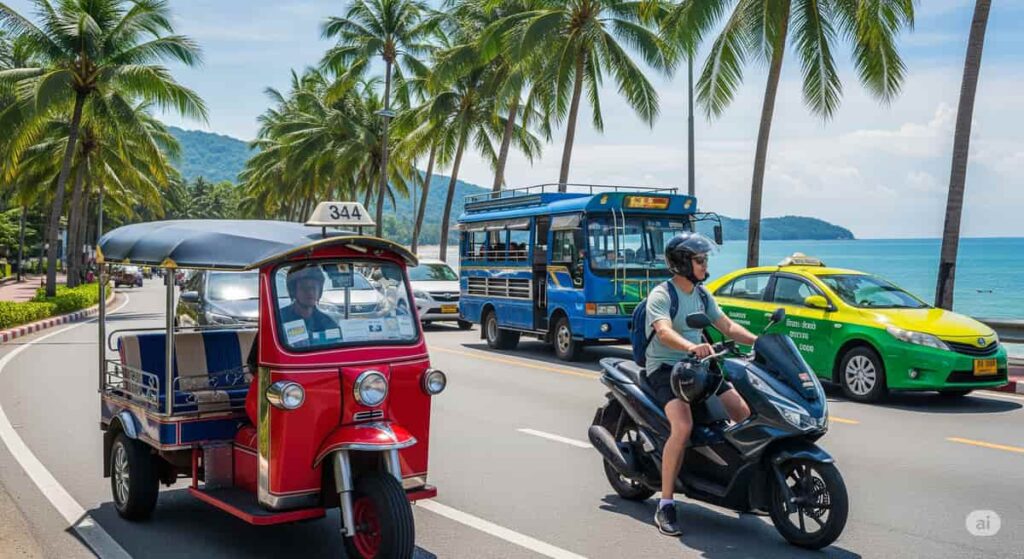
| Tuk-tuk | Agreed route | Negotiated trip price | Discuss luggage and stops | Arrange the return separately |
| Motorbike | Self-drive trips | Rental offer for the period you need | Check whether luggage can be carried | Arrange the return with the rental company |
| Car | Family, group, several stops | Offer with deposit and liability terms | Check the trunk and parking | Factor in the return location and time |
A ticket per person and a full-day rental are different costs. To compare options, put together a full trip plan: pickup, stops, waiting, parking, and the return also affect the choice.
Buses to beaches and the city (Phuket Smart Bus): routes, prices, and payment
The coastal bus of the operator (Phuket Smart Bus) connects the airport and Rawai. It runs along the west coast and passes through Bang Tao (Bang Tao), Surin (Surin Beach), Kamala, Patong, Karon, and Kata Beach. From Patong, you can get there without a required transfer in town.
According to data as of November 2026, the operator publishes these terms:
- Beach line — 100 baht per passenger per trip, a fixed fare.
- City line between the bus station and Patong — 50 baht per passenger.
- Children under 6 ride free with a paying adult.
Consider the city line for trips between town and Patong. If your reference point is Phuket Town or Cherngtalay, check the exact address against the route: a map of the area does not show the boarding point.
The operator lists contactless cards of payment systems (Visa, Mastercard, JCB). QR payment is described for Thai banking apps; operation with a specific Russian card or a foreign app is not guaranteed. These terms by themselves do not mean that the transport card (Rabbit Card) is being cancelled.
There is a useful detail: the fixed beach fare does not depend on the length of the chosen section. So on a short trip, it is especially noticeable how convenient the stops are relative to your addresses.
New electric bus from the airport to Rawai: route No. 8580
Line No. 8580 began operating on November 2, 2026. It connects the airport with Rawai via the Chaloem Phrakiat Rama IX Road. The information was published in a statement from the Public Relations Department of Thailand.
According to data as of November 2026:
- The fare depends on distance and is 40–120 baht.
- Published operating hours — 05:45–20:00.
- 16 scheduled trips are listed.
- The line has 10 electric buses; the route is about 51 km long.
This is a separate route to Rawai via the bypass road. If you need Patong, choose by the coastal route, not only by the final stop “Rawai”.
Operating hours do not specify the exact last departure from each end or whether your stop is on the route. The total number of listed trips does not show how they are distributed by direction or the service frequency.
How to get from Phuket’s airport to your hotel
For a trip from the airport (Phuket International Airport). First, determine where you will stay. The coastal line suits the western beaches, the new line No. 8580 suits its own route via the bypass road to Rawai, and the airport bus suits trips to the city. A taxi or hotel transfer is the usual choice for a trip to a specific address.
According to data as of November 2026, the airport bus operator (Airport Bus) publishes the fare to the city 100 baht per passenger. The final stop is the bus station (Terminal 1). The airport administration specifies that fares are calculated by distance, so the fare to the city should not be treated as a single flat rate for every intermediate stretch.
| Operator | Payment methods | What to consider |
|---|---|---|
| Beach and city lines of the operator (Phuket Smart Bus) | Contactless cards (Visa, Mastercard, JCB); QR via a Thai banking app | Support for a payment system does not guarantee that a specific card will work |
| Airport Bus | Cash or QR code | A QR code does not mean compatibility with every banking app |
The bus station and the airport’s passenger terminal are different facilities. For example, the city bus station should not be confused with the arrival point. There are international and domestic passenger terminals.
When ordering a car, agree on the meeting point, capacity, and drop-off address. For a shared transfer, discuss waiting for other passengers and where suitcases go: a price without these terms helps little in comparing offers.
Songthaews: trips between the city and the beaches
A songthaew is local transport with passenger benches under a roof, usually built on a truck. You can consider it for a daytime trip between town and the beach if you are willing to fit in with its departure time.
Before boarding, tell the driver the beach, find out the fare, and discuss luggage. At the same time, decide how to get back: planning a return to a flight based on an approximate interval is risky.
Useful landmarks for getting oriented in town include Ranong Road Market and the location of the bus station (Terminal 1). The presence of these places on a map does not confirm that the songthaew you need departs from each of them.
The trip is easy to combine with a walk around Phuket Old Town adds variety to a beach day. For the walking part, a useful map of the area. However, these songthaew details do not apply to the coastal bus, which connects the western beaches directly.
Free city bus (Dragon Line) and other city routes
According to the Tourism Authority of Thailand (TAT), the electric city shuttle (Dragon Line) runs free of charge on a loop route through the Old Town. It is useful when its direction matches your walk and cuts down on walking.
Do not confuse it with the city line of the bus operator (Phuket Smart Bus) to Patong or the new line No. 8580. These services have different routes and trip conditions; free travel on the city loop does not extend to other buses.
If you plan to visit the Central Festival shopping center, use a map to determine the address. Check the route to it against your chosen transport separately: the shopping center’s location does not confirm a shuttle stop nearby.
Taxi apps (Grab and Bolt): cost and booking
Before ordering, have a working phone connection, your account login, and your accommodation address ready. Make sure you can contact the driver, especially if the meeting point differs from the building entrance.
Order of booking a car:
- Enter the exact pickup and destination addresses.
- Choose a vehicle size that suits your passengers and luggage.
- Check the vehicle category, price, and payment terms.
- Check the meeting point and the route to it.
- If you cancel, compare a new offer or another carrier.
In ride-hailing apps (Grab, Bolt), compare the same addresses and times. No single service can be promised a permanent price advantage; the details are explained in the guide “how to compare apps and extra charges for a trip».
According to the service’s published terms (Grab), advance booking is available from 90 days to 75 minutes before the trip. Free cancellation is described at least 1 hour before pickup, and later if the driver has not yet accepted the booking. For certain categories and airport trips, check the terms of the selected service.
In short, booking helps organize your departure, but it does not guarantee that a car will be available or that there will be no delays. For a trip to the airport, allow extra time for pickup and the drive.
Tuk-tuks: how to agree on a trip
Phuket tuk-tuks are small passenger vehicles with an open body that can be found in Patong, Kata, and Karon. Show the driver the exact address and agree on the fare before boarding.
Discuss in advance:
- Whether the amount covers the entire trip.
- Whether passengers and luggage will fit.
- Whether you need intermediate stops.
- Whether waiting time is included.
- How to arrange the return trip.
If an offer does not suit you, politely decline and compare another. There is no mandatory haggling or universal rule for lowering the initial price.
A return trip requires a separate agreement. A convenient pickup now does not guarantee the same option in the evening, and the agreed fare for the outbound trip does not include the return automatically.
Motorbike rental: cost, inspection, and deposit
Renting a motorbike in Phuket suits travelers with experience and the documents required for the chosen vehicle. Compare offers for the specific period together with the deposit, liability for damage, and return terms.
We recommend not leaving your original passport as a deposit. This is practical advice: agree on the form of security, proof of the amount paid, and how it will be returned before payment.
When you pick up the motorbike:
- Inspect the body, tires, lights, and overall mechanical condition.
- Photograph any damage and the odometer reading.
- Show any defects to the rental company and record them together.
- Agree on the place, time, and procedure for the return.
- Keep the contract, photos, and correspondence.
You can send the photos to the rental company in a messaging app to keep a record of the discussion. They help at return but do not replace an inspection of the technical condition or the liability terms.
If you have never ridden a scooter, do not start learning with a trip around the island. Left-side traffic, turns, and wet pavement require skill; for a vacation, you can choose a vehicle with a driver. To help you prepare, see the detailed guide to renting a motorbike in Phuket.
Car rental: trips with children and groups
A car helps combine several stops and carry family luggage without being tied to a bus route. Compare self-drive and a car with a driver across the whole day’s plan, including parking, waiting, and the return.
Before paying, agree with the rental company on:
- Which driving documents they accept.
- Which identity document you need to show.
- How the deposit is paid and when it is returned.
- How damage and liability for it are documented.
- Where and in what condition the car is returned.
For a family, discuss a child seat, the number of passengers, and luggage in advance. For a passenger with limited mobility, it is useful to arrange boarding and transport of a stroller: suitable capacity and accessibility cannot be assumed from the vehicle category alone.
If you need a car rental, compare the same contract terms. Check parking near your accommodation and the places you plan to visit, and if left-side driving is unfamiliar, do not overload the first route. For a busy day, a car with a driver can take some of the logistics off your hands.
Driving documents, insurance, and safety
The published list names the international driving permit under the Geneva Convention of 1949 and driving licenses of other ASEAN countries. They are listed in the government guidance on driving documents. This list does not give a complete answer about all options for Russian documents or the recognition of other conventions.
To ride a motorcycle, you need a valid motorcycle license. A rental company handing over a motorbike does not in itself confirm your right to ride, so check in advance whether your documents apply.
Treat vehicle insurance and travel medical insurance as separate. In the rental contract, check liability for damage and terms of use; in the medical policy, check treatment coverage for trips on the chosen vehicle.
The government travel advisory (Smartraveller) warns about a possible lack of insurance coverage if documents are unsuitable. This does not automatically mean that every insurer will refuse to provide coverage: the terms are set by the specific contract.
Check the vehicle’s technical condition, registration, and insurance. Wear seatbelts in a car; for a motorcycle, get helmets for the driver and passenger. Additional recommendations are collected in the guideto road safety in Thailand».
Save these numbers:
- 1669 — emergency medical assistance and rescue services.
- 191 — police.
- 1155 — tourist police.
These numbers will be useful to both the driver and the passenger. Keep them together with your accommodation address.
Piers, ferries, and island trips
For a sea trip, distinguish between a separate ticket, a boat rental, and a guided tour with an itinerary. A ferry, a speedboat, and a longtail are different options; a longtail is a wooden boat with a motor on a long shaft.
Destinations include — Phi Phi (Phi Phi Islands), the Similan Islands and the James Bond Island. Choose the type of boat, departure point, and service package based on the specific trip.
Maps of Rassada Pier and Chalong Pier will help you plan the land route. Check the pier you need in your booking confirmation: there is no single departure point for all sea routes.
Separately, confirm whether hotel pickup is included and how you will get back after drop-off. Useful for preparation: the article “how to plan a trip to Phi Phi”. Tour boats should not be treated as regular water taxis between beaches.
How to plan a return trip in the evening
For evening transport in Phuket, choose based on direction and boarding point. A late departure in one direction does not establish a return schedule.
For the new bus line No. 8580, operating hours have been published as of November 2026 05:45–20:00. The end of the line’s service does not determine the time the bus passes an intermediate stop, and it does not apply to other buses.
Practical scenarios as of November 2026:
| Trip | Suitable route | Fare per passenger |
|---|---|---|
| Airport → Patong | Coastal bus toward Rawai | 100 baht |
| Patong → Kata | Same coastal line toward Rawai | 100 baht |
| City → Patong | City line | 50 baht |
Before you leave, check the timetable for your direction and the return pickup point. Save your hotel’s address, charge your phone, and keep some cash on hand for trips where cash is accepted.
If the bus does not fit your schedule, arrange a backup taxi. Do not count on an immediate pickup; for a flight, allow extra time for the journey and for getting ready to leave.
Related articles:
Frequently Asked Questions ❓
How much does the bus (Smart Bus) cost in Phuket?
As of November 2026, the beach line costs 100 baht per trip, and the city line to Patong costs 50 baht. The operator lists contactless cards from payment systems (Visa, Mastercard, JCB), and describes QR payment for Thai banking apps. Children under 6 ride free with a paying adult.
How do I get from Phuket's airport to Patong without changing in town?
The coastal bus goes through Patong on its way to Rawai; the published fixed fare is 100 baht per trip. Choose it based on where your hotel is, your luggage, and your return route. The new line via the bypass road is a different route, and it cannot be considered a replacement for the beach bus to Patong.
How is the new bus line to Rawai different from the beach bus?
Bus line No. 8580 connects the airport and Rawai via Chaloem Phrakiat Rama IX Road. As of November 2026, the fare is 40–120 baht depending on distance, and the published operating hours are 05:45–20:00. The coastal line runs through the western beaches and costs 100 baht per trip.
Do I need an international driving permit to rent a motorbike in Phuket?
To ride a motorcycle, you need a valid motorcycle license; a rental company handing over a bike does not by itself confirm your right to ride. The government guidance lists the International Driving Permit under the 1949 Geneva Convention and driving licenses issued by other ASEAN countries. These options do not cover every possible case, so check in advance whether your documents apply and review your policy terms: unsuitable licenses may affect insurance coverage.
Do buses run between Phuket's beaches?
Yes, the coastal line connects Bang Tao, Surin, Kamala, Patong, Karon, Kata, and Rawai. You can travel between Patong and Kata without a required change in town. When choosing a trip, consider the direction and the walk from the stop to your destination.
Tuk-tuk or taxi via app (Grab) — which to choose?
Compare the total cost, pickup location, luggage, stops, and return trip. With a tuk-tuk driver, agree on the route and price before boarding; in the app, check the vehicle category and payment terms. No option can be guaranteed to be consistently cheaper.
What time does transport in Phuket run until?
There is no single closing time. For the new bus line No. 8580, published operating hours are 05:45–20:00 as of November 2026. They do not set the schedule for other buses or the time a bus passes an intermediate stop. Before your trip, check the timetable for your direction, and for a late return, plan a backup option.
Conclusion
Choose transport in Phuket based on route, luggage, and group size. For self-driving, add documents, experience, and insurance terms to these criteria. The coastal bus and the new line to Rawai take different routes: a shared terminus does not make them interchangeable for getting to your hotel.
Compare taxi and rental costs for each specific offer, including pickup, stops, deposit, and liability. Plan your return trip at the same time as your departure: where to catch a ride, how to walk from your drop-off point, and what to use instead of a bus if needed. Schedules, fares, document requirements, and insurance terms may change. Save this guide so that trip options and emergency contacts are at hand.
Prepared by MyThai.online editorial team.