In this article:
What changed: Added information about the round-the-clock operation of the 1669 medical hotline nationwide and the free call to 191, according to the Bangkok Police Center. The guide separates the free state emergency service, private ambulance services, and hospital treatment costs.Updated: September 29, 2026
What has changed: The 1155 hotline operates around the clock and supports eight languages; the 1669 hotline is part of the nationwide network and is free. Hospital treatment is usually paid, and you must present your passport to receive assistance.
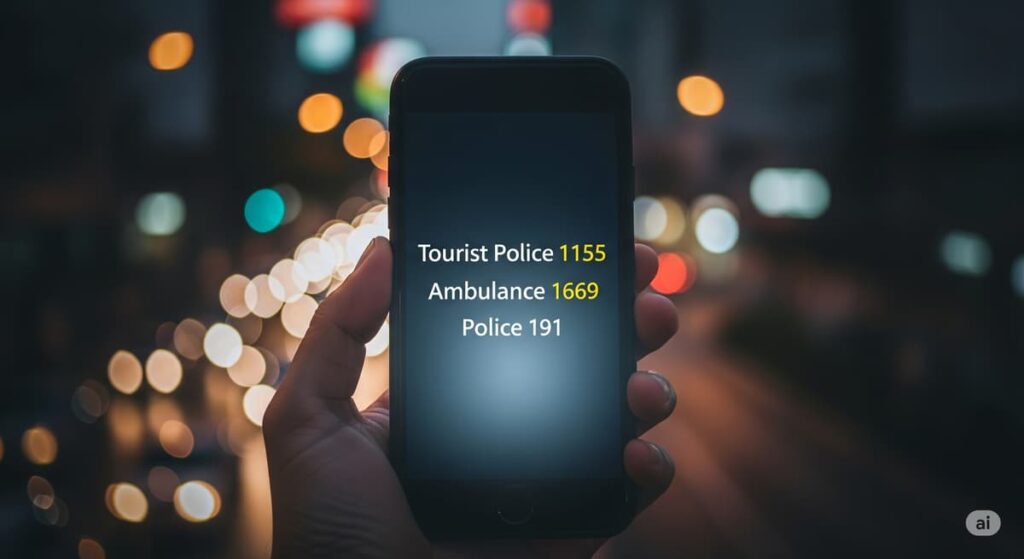
Emergency assistance in Thailand begins with choosing the right service: 1669 — ambulance, 191 — police, 1155 — tourist police, 199 — fire service. In an urgent threat, call for help right away: searching for your passport or arranging things with your insurer must not delay the call.
This guide will help you convey the location of an incident, explain what happened, and leave a way to be reached. It also explains how the free state emergency service differs from private ambulance services and why costs for treatment may arise after arrival at the hospital.
If you plan to drive a car or motorbike, read in advance the article on road safety in Thailand. Save the numbers with clear labels and prepare a short card with your address: in a stressful situation, it is easier to open it than to remember everything.
Current as of publication. Contact details and conditions may change; check them with official sources.
Emergency numbers in Thailand: ambulance, police, and fire service
The main emergency numbers in Thailand are listed in an official guide from the UK Foreign, Commonwealth and Development Office (FCDO). Choose the contact based on the help you need now.
| Situation | Number | Service |
|---|---|---|
| Urgent medical help needed | 1669 | Ambulance |
| Need to contact the police | 191 | Police |
| Tourist help needed | 1155 | Tourist Police |
| A fire has broken out | 199 | Fire service |
The UK Foreign, Commonwealth and Development Office (FCDO) describes the state emergency medical service as free. The Bangkok Police Center separately notes that calls to 191 are free. These details do not allow any conclusion about the cost of calls to 1155 and 199.
Note the difference: a free call, a free emergency service, and paying for hospital treatment are separate issues. The number in the table helps you choose a service but does not determine the terms of all later services.
Don’t save contacts as just a string of digits. Labels such as “ambulance,” “police,” “tourist police,” and “fire service” will help you quickly find the right number, including for someone helping you make the call.
How to call for help and what to tell the dispatcher
Emergency help in Thailand requires a clear description of the location and the incident. Don’t try to tell the whole story at once: start with where help is needed and what happened.
You can keep the following steps next to the table:
- Choose the service based on the type of incident.
- State the location: the street, lane, nearest landmark, or coordinates from a map service (Google Maps).
- Briefly explain what happened: for example, a traffic accident, fire, or assault.
- Leave a phone number for callbacks, so they can reach you for clarification.
The Bangkok Police Center’s guide recommends giving address details and a callback number. For a medical call, also describe the symptoms and state your name. This advice appears in a summary of recommendations from the National Institute of Emergency Medicine of Thailand (NIEMS) in a tourist reference guide; it is a practical tip, not a mandatory legal protocol.
Fill in a short card in advance:
I am at…
Nearest landmark…
What happened…
My callback number…
For a medical call, add your name and a description of your symptoms. Your residential address is useful if help is needed there; if the incident happens elsewhere, give your actual location.
If you saw a suspect, describe their appearance, clothing, vehicle, and direction of travel. Pass on only what you observed yourself: guesses can confuse the message. If you don’t know a detail, say so.
Ambulance 1669: how the service works and transport to hospital
The ambulance number in Thailand is 1669. According to the Thai government portal, the emergency medical hotline operates across the country, around the clock. This describes the service’s coverage area and operating hours, not a promise of the same arrival time in every location.
The UK Foreign, Commonwealth and Development Office (FCDO) describes the state emergency medical service as free and says it takes patients to the nearest available hospital. The phrase “nearest available” does not mean the patient will necessarily be taken to a hospital of their choice.
It is useful to distinguish between several types of help:
- State emergency medical service — call 1669.
- Private ambulance — a separate service from a hospital or other provider; check the terms of dispatch and payment with the provider.
- Inter-hospital transfer — transport between facilities, the terms of which must be discussed separately.
Private hospitals may have their own ambulances. If you are considering this option, ask the provider about the terms of dispatch and payment, without assuming they apply to the state service.
Do not count on a universal waiting time, and do not choose an option just because it promises faster arrival. During a medical call, describe the situation and follow the dispatcher’s instructions. Additional information is collected in the guide on health and medical care in Thailand.
Medical care: costs, passport, and insurance
A free state emergency service does not mean free treatment. The official guide from the United States Department of State explicitly states that medical care in Thailand is not free. Costs may depend on the hospital, the patient’s condition, and the services provided, so there is no single price for an emergency visit.
The guide from the UK Foreign, Commonwealth and Development Office (FCDO) states that a passport must be presented at state and private hospitals. This requirement is described in the official FCDO guide on medical care in Thailand. If you do not have the document with you, tell the staff; do not delay urgent care to obtain it.
If you have insurance, contact your insurance company without delaying medical care. The policy itself does not confirm that the insurer will pay every expense, that the hospital will bill the insurer directly, or that no advance payment will be needed.
Before your trip, it is useful to find out:
- Which contact to use to notify the insurer of a medical visit.
- What coverage terms your policy provides.
- How to discuss payment for services with the hospital and the insurer.
Don’t apply another traveler’s experience to your own insurance: policy terms can differ. Keep your policy details and the company’s contact close at hand so you can find them quickly when you need them. For preparation, see the article on travel insurance in Thailand.
Tourist Police 1155: interpretation and the app
According to the Thailand Public Relations Department, the Tourist Police hotline 1155 operates around the clock and supports eight languages. Availability of a Russian-speaking or English-speaking operator on every call is not guaranteed.
If a state hospital does not provide interpretation assistance, the UK Foreign, Commonwealth and Development Office (FCDO) recommends requesting help through 1155. This is an opportunity to seek support, not a guarantee that an interpreter will be provided in every situation.
A separate channel is the Tourist Police app (Thailand Tourist Police). It supports five languages:
- English.
- Chinese.
- Japanese.
- Korean.
- Russian.
Information about the app and multilingual phone support is published on the official Thai government portal. Another government page states that the app is free to download for mobile platforms (iOS, Android, Huawei).
It is easy to confuse two options here: Russian is among the app’s languages, but that does not confirm that Russian will be available on every phone call. A prepared card with your address and a description of the incident will be useful regardless of which channel you use. Do not delay an urgent call to install the app or get familiar with it.
Traffic accidents, crime, and fire: local services and consular assistance
Choose the contact based on the help you need on the spot. A single incident may require several services, so describing the situation matters more than trying to reduce everything to one number.
- Traffic accident with injuries: for urgent medical help, call 1669. To contact the police, use 191.
- Crime: the police number in Thailand is 191. Give the location and briefly describe the incident.
- Fire: contact the fire service at 199. If medical help is needed, use 1669.
- Tourist assistance: an additional contact is the Tourist Police at 1155.
Do not delay your call to take photos, look for documents, or check insurance coverage. If you witnessed a crime, pass on the details you observed, including a description of the suspect and the direction they were moving.
For urgent contact with the Russian Embassy in Thailand, there is a duty phone line +66-90-40-33-645. It is published by the Consular Department of the Russian Ministry of Foreign Affairs. Save this contact separately from local numbers: contacting the Russian diplomatic mission does not replace calling an ambulance, the police, or the fire service.
Do not expect the embassy to intervene automatically in the work of local services. To prepare for your trip, read the guide on safety in Thailand, and in an incident, start with the contact that matches the immediate problem.
Thai phrases for asking for help
For language preparation, use the phrasebook basic Thai phrases. Also prepare a card with your address, a nearby landmark, a description of the incident, and a callback number that you can show to someone nearby.
You don’t need to memorize a long text. It is more practical to keep the information on separate lines: where you are, what help you need, and which number to reach you at. If you prepare a Thai translation, ask a fluent speaker to check its meaning.
For the address part, you can write in advance the name of your place of residence and the nearest landmark. Fill in the description of the incident according to the circumstances: a card prepared in advance should not make you pass on details that do not match the situation.
If it is hard to say the address, show it to someone nearby and ask them to help make the call. Don’t guess the pronunciation or replace a clear description with a set of unfamiliar phrases.
The card is for communication, not self-treatment. For a medical call, describe your symptoms in your own words and follow the instructions of the dispatcher or medical professional.
What to prepare before your trip and save on your phone
So that emergency help in Thailand starts with a clear request, gather the necessary information in one place. A short note with labels is more convenient than a long chat where you have to search separately for the address and the insurance contact.
Save:
- Numbers 1669, 191, 1155, and 199 with the names of the services.
- Russian Embassy duty phone: +66-90-40-33-645.
- Your residential address and nearest landmark.
- Callback phone number.
- Insurance company contact and policy details.
- Completed emergency request card.
Take a photo of the table of numbers or save the guide so it can be opened quickly. Check that the address is your place of residence; if you move, update the card.
Store passport and medical information in a secure place. Don’t put them together with relatives’ contacts in open notes, and don’t show strangers more personal information than is needed for the request.
If the call does not connect or it is hard to explain yourself, ask someone nearby to help you contact the service. Don’t assume that short numbers will work from every foreign SIM card. Questions about connection and phone preparation are covered in the guide on mobile service in Thailand.
Frequently Asked Questions ❓
Which number should I call for emergency medical help?
For emergency medical assistance, call 1669. According to the Thailand government portal, the medical hotline operates across the country around the clock. Other key contacts: 191 — police, 1155 — Tourist Police, 199 — fire service.
Is the 1669 service free?
The UK Foreign, Commonwealth and Development Office (FCDO) describes the state emergency medical service as free. This does not mean hospital treatment is free. Private ambulance services and other medical services should be considered separately, without assuming the same payment terms.
What should I tell the dispatcher?
State the location of the incident: the street, lane, nearest landmark, or coordinates from a map service (Google Maps). Briefly explain what happened and leave a callback phone number. For a medical call, describe the symptoms and state your name.
What should I do if I don’t speak Thai?
The Tourist Police at 1155 supports eight languages, but availability of a Russian-speaking or English-speaking operator on every call is not guaranteed. Russian is on the list of languages in the Tourist Police app. If a state hospital did not provide interpretation help, the UK Foreign, Commonwealth and Development Office (FCDO) recommends requesting assistance through 1155; the availability of an interpreter in every situation is not guaranteed.
Is emergency treatment at a hospital free?
A free state emergency service does not mean free treatment: the official guide from the United States Department of State explicitly states that medical care in Thailand is not free. The cost depends on the services provided; check payment terms with the hospital and your insurer. If you have insurance, contact your insurer without delaying urgent care.
Do I need to show my passport at a hospital?
The UK Foreign, Commonwealth and Development Office (FCDO) guide states that a passport must be presented at state and private hospitals. If you do not have the document with you, tell the hospital staff; do not delay urgent care to obtain it.
How do I contact the Russian Embassy in an emergency?
The duty phone number of the Russian Embassy in Thailand is +66-90-40-33-645. It is published by the Consular Department of the Russian Ministry of Foreign Affairs. Save the Russian diplomatic mission’s contact separately from the numbers of local emergency services.
Conclusion
Save this guide and fill in your personal request card in advance: address, nearest landmark, and callback phone number. If an incident happens outside your place of residence, replace the address with your actual location and briefly describe what help you need. This is simple preparation that is best done before your trip.
Local services, the tourist police, and the embassy handle different tasks. A free state emergency medical service also does not mean free hospital treatment or the same terms for private transport. Keep your insurer’s contact at hand, but do not delay an urgent call to arrange payment.
Contact details and service terms may change. This article helps you prepare for a request but does not replace the instructions of a dispatcher or medical professional.
Prepared by MyThai.online editorial team.