In this article:
What changed: The rules for bringing in regular and controlled medications have been separated: regular medications, up to a 30-day supply; psychotropic medications of permitted categories, up to 30 days with a prescription or certificate, and for 31–90 days, with prior permission. For narcotic medications of permitted categories, a supply of up to 90 days is allowed with permission from the Thai Food and Drug Administration (Thai FDA). Added prices of products at the Boots pharmacy chain in baht, information on the dengue vaccine, and a recommendation to apply repellent after sunscreen.
Current as of September 2026
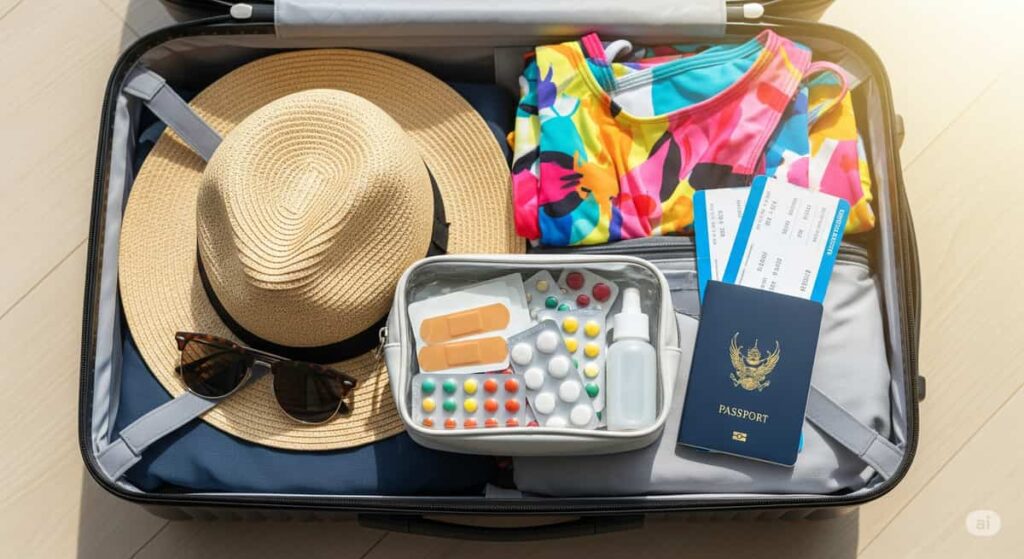
A first-aid kit for Thailand consists of individual medications for ongoing treatment and a compact set that will come in handy at the start of the trip: a thermometer, dressings, a suitable antiseptic, rehydration salts, sunscreen, and repellent. Plan other purchases by active ingredient, dosage, and form of the medication, not just by the familiar brand name. Don’t count on finding the package you need right after arrival.
The permitted supply depends on the category of the medication: regular and controlled medications are subject to different limits, documents, and permits. First check the category, then pack your bag, especially if you take medications regularly or are traveling for a long time.
Read more about health risks in Thailand in a separate article. Here is a checklist for packing, examples of local prices, and the limits of what a travel kit can do. This information does not replace medical advice; conditions may change.
What to bring from home, buy locally, and check in advance
Split the kit into essentials needed right after arrival and purchases you can arrange later. Prepare ongoing treatment in advance, agreeing on the supply with the import rules. A product listing in an online catalog confirms the seller’s offer, but not availability at the selected branch.
| Category | Bring from home | Buy locally | What to check in advance |
|---|---|---|---|
| Ongoing medications | Prescribed medications and medical documents | Only a pre-agreed option for continuing treatment | The substance category, permitted supply, need for a permit |
| Thermometer | Your familiar electronic thermometer | Possible purchase at a pharmacy | Working condition and ease of use |
| Dressings | Adhesive bandages, sterile gauze, gauze pads | Possible restocking of the kit | Bandage sizes, package integrity |
| Antiseptic | A suitable product in convenient packaging | Possible purchase after discussion with a pharmacist | Purpose and method of use |
| Allergy medications | An individually selected medication | Possible purchase by active ingredient | Dosage, form, and restrictions |
| Rehydration salts | Packaged oral rehydration salts (ORS) | Possible purchase at a pharmacy | Instructions for preparing the solution |
| Sun protection | A product for the start of the trip | Possible purchase of a suitable product | Protection parameters and application rules |
| Repellent | A product for protection against bites | Possible purchase by ingredients | Active ingredient and instructions |
| Fever reducer | A medication chosen with your restrictions in mind | Paracetamol is listed in the catalog of the Boots pharmacy chain | A suitable form and availability of the specific product |
This is a basis for packing, not a mandatory list of medications for every traveler. Compare it with your prescriptions and travel plans, then save it to your phone. For other packing, use the general travel packing checklist. Extra medications “just in case” do not make the kit more useful.
Basic first-aid kit: medications and supplies
Start with what has already been agreed upon for you with your doctor. The names below help you discuss the contents of the kit, but they do not replace choosing a medication or set a treatment regimen. A familiar product also needs to be checked for restrictions.
- For pain and fever: paracetamol or another suitable medication. Ibuprofen can be discussed as an individual option, but if dengue is possible, it should not be taken until the diagnosis is ruled out because of the risk of bleeding; see the section on mosquitoes for details.
- For allergies: for example, cetirizine or loratadine, if this choice has been agreed upon for you. Take into account the appropriate form of the medication and the instructions.
- For the digestive tract: rehydration salts and individually chosen products. Sorbents do not replace fluid replacement; loperamide, enzymes, and antispasmodics should not be turned into a mandatory set.
- For minor injuries: a suitable antiseptic, adhesive bandages, sterile gauze, and gauze pads.
- For monitoring your condition: an electronic thermometer that you know how to use.
If you use activated charcoal, another sorbent, or drotaverine, discuss whether you need this medication on the trip and in which situations to use it. Do not add enzymes to every unfamiliar meal just because they appear on travel lists.
Keep prescription medications as a separate item. Their quantity depends on both the prescription and the permitted import amount, so the advice “bring a supply for the whole trip” does not suit every situation.
Rules for bringing in regular and controlled medications
Rules for bringing medications into Thailand depend on the category of the active ingredient. As of September 2026, the Thai Food and Drug Administration (Thai FDA) specifies a personal-use supply of regular medications of up to 30 days. Separate conditions apply to permitted controlled categories.
| Category | Permitted supply | Documents and permit |
|---|---|---|
| Regular medications | Up to 30 days of personal use | The category of each medication is checked separately; requirements for controlled lists cannot be automatically applied to all medications |
| Psychotropic medications in Schedules II, III, and IV | Up to 30 days of prescribed treatment | A prescription or certificate from the doctor who prescribed the treatment |
| Psychotropic medications in Schedules II, III, and IV | For 31–90 days of prescribed use | Prior permission from the Thai Food and Drug Administration (Thai FDA) |
| Medications containing narcotic substances in Schedules II and III | Up to 90 days of prescribed use | Permission from the Thai Food and Drug Administration (Thai FDA) |
| Psychotropic substances in Category I | Import prohibited | A prescription does not lift the ban |
For cases requiring permission, the online application is submitted at least 15 days before the trip. Conditions for controlled medications are set out in the guidance of the Thai Food and Drug Administration (Thai FDA).
It is easier to prepare step by step:
- Identify the active ingredient of each medication by its packaging and purpose.
- Determine its category under the import rules.
- Calculate the supply based on the prescribed use, comparing it with the permitted limit.
- Prepare a medical document if it is required for this category.
- Obtain a permit if the planned import is not allowed without one.
A certificate by itself does not permit importing an unlimited quantity. If the duration of treatment goes beyond the applicable category, agree on the next steps with your doctor in advance. The article’s update date does not mean these rules took effect specifically in September.
How to find a medication in a Thai pharmacy and how much purchases cost
INN — International Nonproprietary Name — helps you search for a medication by its active ingredient. For example, paracetamol, ibuprofen, and cetirizine can be named to the pharmacist instead of a single Russian brand name. Also show the packaging and the prescribed use.
To choose a purchase, prepare:
- the name of the active ingredient;
- the dosage;
- the dosage form;
- your doctor’s prescription, if the medication is part of ongoing treatment;
- information about individual restrictions.
The same active ingredient does not confirm full interchangeability. Do not agree to a replacement based only on a similar name or purpose. For more on searching, see the article medicines and pharmacies in Thailand.
Below are prices for specific products in the online catalog of the Boots Thailand pharmacy chain, as of September 2026. Check current prices; the dosage in the table describes the product, not a dosing recommendation for the reader.
| Product | Package | Price |
|---|---|---|
| Bella Paracetamol, 500 mg | 10 tablets | 15 ฿ |
| Tempra Fizz Paracetamol, 500 mg | 12 units | 125 ฿ |
| Golden Cup Balm | 22 g bottle | 56 ฿ |
Even products containing paracetamol in this catalog differ in packaging and price. So comparing only the name of the active ingredient is not enough: look at the specific product. The price of the balm says nothing about its therapeutic effect.
For your search, you can consider the Boots and Fascino pharmacy chains or a local pharmacy. Check the availability of the product you need, opening hours, and purchase conditions at the chosen branch. A single schedule and identical range for all pharmacies is not assumed here.
Diarrhea and dehydration: rehydration salts and the limits of self-treatment
In the digestive kit, start with oral rehydration salts (ORS). The United States Centers for Disease Control and Prevention (CDC) describes a solution prepared from packaged salts. Mix it according to the instructions for the specific product, without changing the proportions on your own.
A sorbent or a product to ease symptoms does not replace rehydration. Activated charcoal, other sorbents, loperamide, enzymes, and antispasmodics can be discussed with a doctor as individual options, but a universal regimen for any diarrhea does not apply here. Do not try to choose treatment based only on what happens to be in your bag.
Taking probiotics prophylactically before the trip should not be considered mandatory. There is not enough data to recommend them for preventing traveler’s diarrhea. For most travelers, the risks of prophylactic antibiotic use outweigh the potential benefits. This is stated in the recommendations of the United States Centers for Disease Control and Prevention (CDC).
If there is blood in the stool, severe pain, dehydration, or worsening condition, seek medical care. Do not wait for a certain number of days to pass or for your temperature to reach a specific number. A first-aid kit does not make such symptoms safe to self-treat.
Complete your trip preparation by reading about food and water safety. This is a separate part of planning: buying digestive products does not replace caution with food and water.
Mosquitoes, dengue, and sun: protection and important limitations
Mosquito protection is needed not only at sunset. According to the UK National Health Service (NHS), mosquitoes that transmit dengue bite during the daytime. It also states that a vaccine that helps protect against dengue exists; whether to use it is discussed individually with a doctor.
When choosing a repellent, check the ingredients and instructions. The United States Centers for Disease Control and Prevention (CDC) lists the active ingredient DEET; icaridin is called picaridin in American terminology. Choose the concentration and method of application for the specific product, without a universal range for everyone.
If you use both sunscreen and repellent, apply repellent after sunscreen. This is a recommendation of the United States Centers for Disease Control and Prevention (CDC). Products with permethrin must not be applied directly to the skin.
Pack sunscreen for the start of the trip. The UK National Health Service (NHS) recommends a product with an SPF of at least 30 with UVA protection of at least 4 stars; SPF 50+ gives the strongest UVB protection. Reapply it every 2 hours and after swimming. Aftersun products are a separate item: panthenol or aloe gel can be discussed with a pharmacist, without assuming that every product suits every skin injury.
For sunburn, the UK National Health Service (NHS) does not recommend applying ice or ice packs to the skin. For care after bites, also choose a product according to its purpose: for example, discuss calamine or a suitable gel, without assuming they work equally well.
If dengue is suspected, do not take aspirin or ibuprofen until the diagnosis is ruled out: they can increase the risk of bleeding. Seek medical care rather than choosing treatment from a list of fever reducers.
Dressings, minor injuries, and skin care
For minor injuries, set aside a separate kit: adhesive bandages of suitable sizes, sterile gauze, gauze pads, and an antiseptic. Waterproof bandages can be included depending on your travel plans. Check that packages are intact before packing so the kit is ready to use.
If you take antiseptic wipes, check what the specific product is intended for. A hand sanitizer should not automatically be considered suitable for a wound. Chlorhexidine, miramistin, or the antiseptic sold under the trade name Betadine can be discussed with a pharmacist, but should not be considered fully interchangeable.
An antibiotic ointment is not needed for every skin injury. If a doctor previously recommended such a product to you, keep its prescription and usage restrictions. Buying a familiar package does not by itself confirm that it is suitable for a new injury.
A marine injury is a reason to seek medical care. After a cut from coral or contact with a jellyfish, do not try to replace assessment of your condition with a universal regimen from a travel list. If the injury worsens, inflammation increases, or the wound requires more serious treatment, a first-aid kit may not be enough.
First-aid kit for a child and ongoing treatment
When assembling a first-aid kit for Thailand for a child, rely on agreed prescriptions. Prepare a suitable medication form, a measuring device, and saved information about the medication. General adult recommendations and dosages cannot simply be transferred to a child’s kit.
Before the trip, check:
- which medications are truly needed by a child or a person on ongoing treatment;
- whether the chosen dosage form is suitable;
- whether there is an instruction and a clear purpose;
- whether the measuring device matches the product being used;
- whether the active ingredient, dosage, and information for the doctor have been saved;
- which import category applies to each medication.
Do not add preventive medications before the flight just on the advice of a travel blog. If such medications are needed for health reasons, discuss them separately with a doctor. A children’s kit is not a scaled-down copy of an adult’s.
For ongoing treatment, agree on both the medical plan and the permitted supply. A long trip does not automatically allow exceeding the import limit. If local purchase or replacement is needed, prepare for it in advance: the ability to find a similar name does not guarantee continuation of prescribed treatment.
How to pack and store medications in heat
Original packaging helps identify the medication, dosage, and dosage form. Keep it together with the instructions, especially for ongoing treatment. This is a practical way to identify medications, not a uniform customs requirement for every product.
Prepare the kit step by step:
- Check the expiration date of each medication.
- Read its storage conditions.
- Make sure the name and dosage remain legible.
- Protect packages from damage and leaks.
- Keep medical documents so they can be found together with information about the medication.
Do not set a general temperature regime for the whole kit at random. If a medication requires special conditions, agree on an individual plan for transport and storage with a doctor or pharmacist in advance. Suitable packaging and the way to maintain temperature depend on the specific medication.
Plan how to split medications between carry-on and checked baggage based on your needs on the journey and the carrier’s rules. There is no single requirement to put all medications in carry-on luggage. After arrival, choose a storage place according to the instructions, not just a convenient shelf in your room.
Medical care and checking insurance
A first-aid kit helps you prepare for minor everyday situations, but does not replace medical care. Before the trip, review the policy terms, exclusions, and claims procedure. If you plan motorbiking, diving, rock climbing, or other active recreation, separately check the relevant coverage.
It is useful to do in advance:
- save the assistance service’s number and the available ways to contact it;
- download the insurer’s app, if you plan to use it;
- have access to your policy and insurance card;
- learn the procedure for approving planned care;
- understand which documents you will need to file a claim.
A preliminary call should not delay emergency care. The procedure for dealing with the insurer depends on the specific policy, so the universal condition “no payment without a call” cannot be applied. Checking coverage is also not the same as a promise of payment.
For example, the hospital operator Samitivej asks for a copy of the insurance card and a photo ID to be sent to its insurance department. This is an example of one operator’s procedure, not a rule for all clinics. Preparing documents does not confirm payment for every medical service.
If you do not have a policy yet, see how to choose travel insurance. Compare the terms with your trip and ongoing treatment, and save the contacts before departure.
Frequently Asked Questions ❓
Can you bring medications into Thailand?
Yes, but the rules depend on the category of the medication. For regular medications, the Thai Food and Drug Administration (Thai FDA) specifies a personal-use supply of up to 30 days. Separate conditions apply to controlled medications; importing psychotropic substances in Category I is prohibited.
Are antibiotics sold without a prescription in Thailand?
The dispensing rules for a specific antibiotic should be checked with a pharmacist. Being able to buy it does not mean the medication is suitable for self-treatment. Do not take antibiotics prophylactically “just in case”: according to the United States Centers for Disease Control and Prevention (CDC), for most travelers the risks outweigh the potential benefits.
How much medication can I bring to Thailand?
For regular medications, the supply is up to 30 days. Psychotropic medications in permitted Schedules II, III, and IV can be brought in for up to 30 days with a prescription or certificate; a supply for 31–90 days requires prior permission. For narcotic medications in Schedules II and III, a supply of up to 90 days is allowed with permission from the Thai Food and Drug Administration (Thai FDA); the application is submitted at least 15 days before the trip.
Are familiar Russian-market medications available in Thailand?
Search for a medication by its active ingredient, not just by its Russian brand name. Show the pharmacist the packaging and the prescription with the dosage and dosage form. Do not count in advance on a specific brand or an exact substitute being available.
Is insurance required for a trip to Thailand?
Check insurance requirements for your basis of entry. To plan medical care, review the policy terms, exclusions, and claims procedure. Having an insurance card by itself does not confirm payment for a specific service.
Where can I find pharmacies in Thailand?
You can go to a local pharmacy or check the needed branch of a pharmacy chain. The Boots online catalog lists individual products and prices, but availability at the chosen branch should be checked separately. Do not plan your necessary medications on the assumption that they are sold in every store.
Conclusion
A first-aid kit for Thailand should match your treatment and plans, not someone else’s long list. Prepare ongoing medications in a permitted amount, a compact kit for the start of the trip, and information for searching for purchases by INN. Save the checklist, medical prescriptions, and assistance contacts so they are accessible on the road.
For situations where the travel kit is not enough, keep the guide to emergency care in Thailand. Do not delay seeking help in order to choose a medication yourself or to arrange insurance approval. This information does not replace a doctor’s consultation, and import rules, product ranges, and prices may change. Let your first-aid kit remain a prepared supply rather than the main plan for your vacation.
Sources
- Samitivej Hospital — Hospital in Bangkok, Thailand
- United States Centers for Disease Control — Avoid bug bites | Travelers' Health | CDC
- Ministry of Public Health of Thailand — FDA THAI: Food and Drug Administration, Thailand
- Embassy of Thailand in Moscow — Importing medicines into Thailand
- United States Centers for Disease Control — Travelers’ Diarrhea
- Ministry of Public Health of Thailand — FDA THAI: Food and Drug Administration, Thailand
- United States Centers for Disease Control — Travel Health Kits
Prepared by MyThai.online editorial team.