In this article:
What has changed: Entry rules have been updated: from September 15, 2026, visa-free entry for Russian citizens is up to 30 days, and TDAC submission deadlines have been clarified. Added rules on importing medicines under Thai FDA regulations, new CAAT rules for power banks, penalties for importing vapes, and cash declaration thresholds.
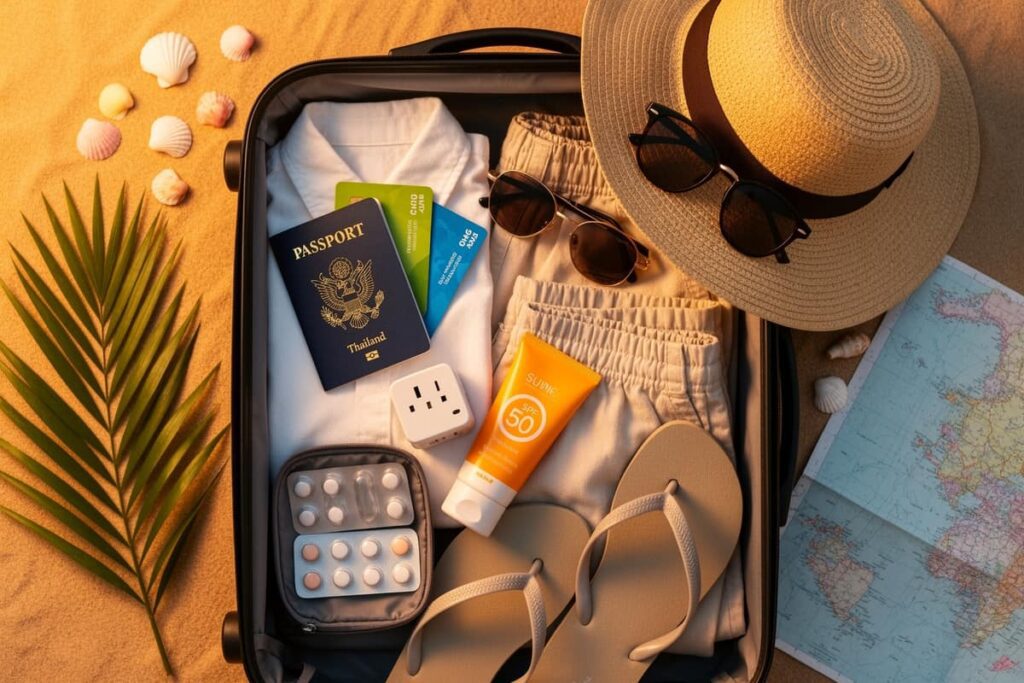
What to bring to Thailand is a question that’s easier to answer in four blocks: documents and money, light clothing, a basic first-aid kit, and a universal adapter. Plus a short but critical list of what you must NOT bring — vapes, e-cigarettes, and psychotropic medicines without FDA permission. This checklist is designed for first-time tourists on a 1–2 week trip and for new expats planning a long-term stay.
Current as of late September 2026. Entry rules, import regulations, customs limits, and fine amounts change from time to time. Before flying, check official sources: Immigration Bureau Thailand (tdac.immigration.go.th), Customs Department Thailand (customs.go.th), FDA MOPH (permitfortraveler.fda.moph.go.th) and the Thai embassy in your departure country.
The main principle of packing: what’s essential, what’s useful, and what’s unnecessary
Thailand is hot year-round at 28–34 °C, with high humidity. That changes the whole logic of packing: warm clothes aren’t needed, heavy shoes aren’t needed, and a large supply of household products is even less necessary.
The main principle is simple. Pack only what you can’t get locally or what you critically need on the first day. Documents, bank cards, prescription medicines, and a plug adapter: without these, your first day in the country turns into a quest. But shampoo, shower gel, a simple T-shirt, and basic fever reducers are easier to buy in Thailand, at any 7-Eleven or Boots/Watsons.
There’s also a psychological bonus: your suitcase comes home not “stuffed to the brim” but full of souvenirs and local clothing, which works noticeably better in a tropical climate than what you brought from home. If this is your first trip, take a look at the complete first-time traveler’s checklist for Thailand — it covers the basic steps from airport transfer to SIM card. This guide is about the suitcase itself and what shouldn’t end up in it.
One more thought, which we’ll return to in the last section: half of the “must-have” items on old checklists are no longer needed in 2026. Pharmacies and shops in tourist areas cover almost all everyday needs.
Documents and visa formalities
This is the strictest section. Without the right documents, you may simply not be allowed onto the plane.
The first and most basic — a passport valid for at least 6 months at the time of entry into Thailand. If your passport expires sooner, renew it before departure — airlines won’t make any exceptions here.
Second — the Thailand Digital Arrival Card (TDAC). According to the Thailand Immigration Bureau, filling out the TDAC is mandatory for foreigners at all entry points — airports, land borders, and seaports. Specific exemptions and the current list of applicable categories are in the FAQ on the official portal. Submission is free and available only through one source — tdac.immigration.go.th. You can submit the card within 3 days before arrival, including the day you arrive. You can fix a mistake via “Update Arrival Card,” but your name, passport number, nationality, and date of birth cannot be changed — in that case, you submit a new card. Any third-party “aggregators” that charge a fee are scams. For a detailed walkthrough with screenshots, see our guide how to fill out the TDAC before you fly, and the original source is — the official TDAC portal of the Thailand Immigration Bureau.
Third — a return ticket and a hotel reservation for the first nights. Immigration officers may ask for printouts. This is not guaranteed, but having them on hand is standard practice.
Visa. Visa-free entry for citizens of Russia, Ukraine and Kazakhstan · RU remains available, but since September 15, 2026, the 60-day visa-free stay has been canceled. Russians and Kazakhs may stay in the country for up to 30 days under bilateral agreements with Thailand, while Ukrainians get up to 30 days under the general visa-exemption scheme, which now covers 60 countries and territories. Those who entered before September 15 keep the stay previously granted to them. No more than two visa-exempt entries via a land border per calendar year. For longer trips — applying for a Thai tourist visa, DTV, or Retirement Visa.
A separate note on scooters. According to independent travel guides, renting and legally riding a scooter in Thailand requires an international driving permit (IDP) with an open “A” category. Without an IDP, a fine and an insurer’s refusal to pay out after a road accident are possible. For details, check the Department of Land Transport Thailand website or your insurance provider.
Insurance policy among your documents
Instructions for the Thailand Digital Arrival Card (TDAC) do not provide for entering insurance policy details. In the published list of documents for a tourist visa at the Thai Embassy in Moscow (updated September 12, 2026), medical insurance is not listed.
If you have a policy, keep it with your documents: a printout in your carry-on and a file on your phone that opens offline. Write down the assistance hotline number separately and follow the procedure for requesting help specified in the policy. For what to check in a policy before buying one, see the guide travel insurance for Thailand.
Checked against the cited pages on October 4, 2026; before your trip, verify against official sources. The publisher, MyThai, does not hold an insurance agent or broker license. This material is for informational purposes only.
And finally. Make copies of all your documents — paper copies in your suitcase and scans in the cloud (Google Drive, iCloud). It takes 10 minutes before departure, but it makes life much easier if your passport is lost or stolen.
Money and bank cards
Money logistics in Thailand is a separate topic, because Russian bank cards don’t work there, and Thai banks are cautious about non-residents. For a full breakdown, see the guide how to pay in Thailand in 2026 · RU. Here is a short “what to bring” checklist.
The basic logic is simple.
- Minimum two cards from different banks and payment systems — Visa + MasterCard or Visa + UnionPay. If one gets blocked or a shop won’t accept a particular system, you have a backup.
- A little cash in USD or EUR for emergencies — for the airport transfer, if your card doesn’t work. Naming a specific amount is pointless: it depends on your habits; some people get by with 200 dollars, others need more.
- A card statement or proof of available funds. According to the news aggregator MICE Travel Advisor (April 2026), at the border you may be asked for the equivalent of 20,000 baht per person. The text of an official Immigration Bureau rule is not available in open sources — the exact amount and form of proof (cash, cards, statement) may vary. Before flying, check the requirements on the website of the Thai embassy in your departure country.
There’s one practical point about ATMs that’s rarely mentioned.
Thai ATMs charge a fixed fee per transaction on foreign cards — usually around 220 baht, though at some banks it’s slightly higher. The fee doesn’t depend on whether you withdraw 1,000 baht or 15,000 baht. That means three withdrawals of 5,000 baht each cost you a loss of about 660 baht, while a single 15,000-baht withdrawal costs the same ~220. Plan ahead: one large withdrawal beats three small ones. Check the exact current fee on the ATM screen before you confirm — it’s shown before the money is debited.
Thai bank accounts are usually not opened for non-resident tourists: an account requires a local address and, as a rule, a work permit. That means the mobile apps of Thai banks (PromptPay, K Plus, SCB Easy, and others) are unavailable to most tourists. For a short trip, this isn’t a problem: cards from your home bank and cash cover everything you need.
Clothing and footwear: what works in a tropical climate
There are two pieces of news, and both are good. First, you hardly need warm clothes at all. Second, simple clothing is cheap and easy to buy on the spot in Thailand.
A basic packing list for a 7–14 day trip.
- Light T-shirts and tank tops made of natural fabrics (cotton, linen) — 5–7 pcs. Synthetics at +33 °C become torture.
- Shorts or light pants — 2–3 pcs.
- Long pants or a skirt below the knee + a shirt with sleeves — for temples, air-conditioned restaurants, and evening walks.
- Swimsuit or swim trunks — 1–2 pcs.
- Closed shoes (sneakers, loafers) — for the city, excursions, and temples.
- Light sandals and flip-flops — for the beach and the hotel.
- A light windbreaker or rain jacket — for the rainy season and sudden downpours at any time of year.
- A light sweater or cardigan — air conditioning in shopping malls and buses runs at full blast.
Temples are a separate topic. Covered shoulders and knees — a mandatory requirement at any functioning temple. At the Royal Grand Palace (Bangkok), the dress code is the strictest: men in shorts and women in skirts above the knee won’t be let in, and guards check this at the entrance. Shoe requirements differ between temples — some accept light sandals with a heel strap, others expect closed shoes. The general practice is the same: you take your shoes off right before the entrance. If you’re going on a one-day tour of several temples, wear things that are easy to take off.
What NOT to bring. Warm sweaters, jackets, and jeans — too hot, heavy, and uncomfortable. Too many shoes: two pairs (closed + sandals) are enough for almost everyone. Long jeans only make sense in one scenario: if you’re traveling to the mountains of Chiang Mai in winter, where evenings can be +18 °C. For the southern islands and Bangkok, jeans are just extra weight.
Travel first-aid kit: what to bring
The main medical problem for tourists in Thailand isn’t snakes or malaria, but digestion. Spicy food, new gut bacteria, ice made from unfamiliar water, and plenty of seafood. That’s why the stomach determines the core of the first-aid kit.
The minimum list includes:
- absorbents and anti-diarrhea medicines available without a prescription (activated charcoal, Enterosgel, Smecta, loperamide);
- digestive enzymes;
- fever reducer and painkiller (paracetamol, ibuprofen);
- antihistamines — for allergies and insect bite reactions;
- antiseptic and bandages for minor cuts and chafing;
- remedies for runny nose and sore throat (sudden shifts from +33 °C to a cold air conditioner often cause colds);
- your personal prescription medicines in original packaging + a copy of the prescription in English.
For an expanded list and a breakdown of “what to buy in Thailand” — see the guide expanded first-aid kit list and what to buy locally.
Now the critical part. Medicines with narcotic or psychotropic effects are a separate matter. According to Thailand’s FDA (Ministry of Public Health, MOPH), medicines containing psychotropic substances (some antidepressants, sleeping pills, and sedatives) may be brought in for up to 30 days of use, with a medical certificate or doctor’s prescription. A supply for 31–90 days is allowed only with permission from the Thai FDA. Medicines containing narcotic substances (some strong painkillers) may be brought in only with permission, with a supply of up to 90 days. The permit application is submitted online no later than 15 days before the trip. Carry regular medicines in their original packaging, with a supply of no more than 30 days. Before flying, be sure to check the FDA MOPH guide for travelers bringing medicines into the country.
Ignoring these rules is dangerous. This isn’t an area where you can hope it’ll be fine — this is about the law, and the consequences can be criminal. If your medication falls into a gray area, it’s better to write to the FDA through the form on the portal and get an answer in advance.
Cosmetics and hygiene products
The principle here is simple: bring what directly protects your health and what you’re attached to. The rest is easier to buy locally.
What’s important to bring.
- Sunscreen SPF 30–50+ for the body and separately for the face. This isn’t something you can “just buy on arrival” — local creams often contain whitening ingredients, which can cause unexpected reactions in European skin and a less-than-ideal tan.
- After-sun or aloe gel — in case of burns in the first few days.
- Mosquito repellent — especially for jungle trips, tours, and evening walks by the water.
- Lip balm or lipstick with SPF — lips burn faster than you’d think.
- Deodorant, shampoo, and shower gel in small sizes. If you’re not attached to a particular brand, it’s cheaper to buy in Thailand.
- Feminine hygiene products — the range in Thailand is a bit different, so bring your usual supply for the first few days.
An important technical point: carry-on liquids are limited to 100 ml containers, all fitting in one clear bag. Large bottles go only in checked luggage, and it’s even better to decant into travel containers.
Electronics, gadgets, and connectivity
Thailand uses sockets of types A, B, C, and O with a voltage of 220–230 V. Modern chargers for phones, laptops, and cameras are usually rated for 100–240 V — no separate transformer is needed, only a plug adapter. You can check right on the charger: if it says 100-240V, you’re all set.
Electronics checklist.
- A universal adapter — 1–2 per family.
- A power bank for your phone. Important: a power bank — carry-on only, it is not allowed to be checked in. Under the rules of the Civil Aviation Authority of Thailand (CAAT), no more than two power banks per passenger, with a capacity of up to 100 Wh; from 100 to 160 Wh only with airline approval. During the flight, keep the power bank with you or under the seat, not in the overhead bin, and don’t use it to charge your phone on board.
- Chargers and cables for all your devices (plus one spare cable — they get lost with alarming regularity).
- Headphones.
- A camera or action camera — optional, if you like.
Connectivity and internet are a separate topic. Thai operators TrueMove H, AIS, and DTAC sell tourist SIM packages right at the airports, and eSIM options are also available for modern smartphones. Plans and terms change often — check current prices and data limits with the operators or in our guide Thai SIM, eSIM, and operator plans.
By the way, paper guidebooks and printouts are needed less and less — but if you’re going trekking or to islands with unreliable internet, it’s worth downloading offline maps in Maps.me or Google Maps in advance, while you’re still at home.
Small everyday items and a beach kit
This is the category where everyone has their own habits. Here are common items that work for almost everyone.
- A microfiber towel — dries quickly, weighs little, and is handy for the beach and for traveling between places.
- A mask and snorkel — if you plan to snorkel and don’t want to pay for rentals every day.
- A dry bag for your phone — for the beach, boats, and kayaks.
- A folding umbrella — for the rainy season, downpours at any time of year, and protection from the blazing sun.
- Sunglasses with a UV filter.
- A hat, cap, or sun hat — sunstroke on the first day happens to newcomers more often than you’d think.
- A scarf or light shawl — to cover shoulders in a temple, to wrap around your neck on an air-conditioned bus, and for women in case of an unplanned visit to a religious site.
- A small backpack or waist bag — for documents and money in busy places like night markets.
All of this together takes up very little space, but it saves a lot of time and nerves in the first few days. The microfiber towel and dry bag in particular are two things tourists most often wish they’d brought.
What is strictly prohibited from entering Thailand
This section is worth reading carefully. Here, it’s not “not advisable” but “you could be arrested.”
1. Electronic cigarettes and vapes. According to the official position of the Royal Thai Embassy (Royal Thai Embassy Stockholm), importing, selling, storing, and using electronic cigarettes in Thailand is prohibited. In the embassy’s wording, violators “may be arrested and subjected to imprisonment or a fine several times the value of the illegal item.” Importing carries up to 10 years in prison or a fine five times the value of the goods (or both), and the vape itself will be confiscated. Do not bring a vape into Thailand. Details are in the official warning from the Thai embassy about the ban on electronic cigarettes.
2. Prescription medicines with narcotic or psychotropic effects — without FDA permission This was already covered in the first-aid section. Before flying, a mandatory check on the FDA MOPH portal (permitfortraveler.fda.moph.go.th). Without permission — criminal liability.
3. Narcotics and psychotropic substances. Governed by the Narcotics Act B.E. 2522 (1979). Criminal liability — up to life imprisonment for serious offenses. This isn’t a country where it makes sense to test the limits.
4. Exceeding duty-free limits on alcohol and tobacco. If you choose the “green” channel and excess is found — confiscation and a fine. Exact figures are in the next section.
The list of prohibited goods and the fine amounts are revised from time to time. Before flying, check current rules on the websites of the Customs Department Thailand, FDA MOPH, and the Thai embassy in your departure country.
Customs rules: alcohol, tobacco, cash
This section is based on an official source — the website of the Thai Customs Department (customs.go.th). The figures are accurate, but here’s the standard caveat: customs limits, declaration forms, and duty amounts are revised from time to time. Before flying, check the current version on the Thai Customs Department website — duty-free import rules.
What one adult tourist may bring in duty-free.
- Cigarettes — up to 200 OR tobacco products — up to 250 g OR all types combined — up to 250 g. Exceeding this limit means confiscation and a fine if you choose the “green” channel at the exit. Important detail: use the phrase “200 cigarettes,” not “1 carton” — cartons from different manufacturers may contain different quantities, and the limit is counted in individual cigarettes.
- Alcoholic beverages — up to 1 liter per person. Exceeding the limit — confiscation and a fine.
- Personal items — with a total value of up to 20,000 baht without a declaration (Green Channel). Above 20,000 baht and up to 200,000 baht — a flat-rate duty applies, and you go through the Red Channel.
Gifts and souvenirs of a commercial nature (for example, a package of identical items “for sale”) may be subject to duty even within the personal allowance; check the specific thresholds on customs.go.th.
Cash is a separate matter. Under Bank of Thailand rules, on arrival you must declare foreign currency in an amount more than 15,000 US dollars (or the equivalent in another currency) and Thai baht — more than 450,000 baht. The declaration is submitted in the Red Channel.
And the main customs rule: if you’re unsure, go through the Red Channel and declare. A declaration takes 5–10 minutes, while trying to pass through the green channel with excess means confiscation, a fine, and a seriously ruined first day of your vacation.
What NOT to bring: what’s cheaper to buy locally
This is a contrast section. If you’re flying for the first time, it’s tempting to stuff your suitcase “just in case.” Half of these items you can leave at home.
- Towels — available in any hotel, plus you’ve already bought a microfiber towel for the beach.
- Large quantities of shampoo, shower gel, and soap — sold practically everywhere, from 7-Eleven to Big C.
- Simple T-shirts and shorts — they’re cheap in Thailand, and local clothing works better in a tropical climate. Many tourists buy a couple of T-shirts right in their first few days.
- Winter shoes and a jacket — not needed at all. The exception is a winter trip to the mountains of Chiang Mai.
- A big first-aid kit for every ailment — basic fever reducers, antiseptics, face masks, and bandages are available at every 7-Eleven and at the Boots and Watsons pharmacy chains.
- An iron and an electric razor — available in most hotels.
- A hair dryer — usually available in hotels too. If you’re renting a condo long-term without hotel amenities, it may be worth bringing one.
- Large supplies of water and snacks — everything is cheap, a bottle of water costs next to nothing, and fruit at the markets is an attraction in itself.
The principle isn’t “don’t bring these under any circumstances,” but simpler: if you’re not attached to a particular brand, it’s cheaper to buy here. This lightens your suitcase, frees up room for souvenirs and clothes that have won you over in Thailand, and makes the trip home more comfortable.
Frequently Asked Questions ❓
What main document do I need to enter Thailand in 2026?
A passport valid for at least 6 months on the date of entry, plus a completed Thailand Digital Arrival Card (TDAC) through the official portal of the Immigration Bureau (tdac.immigration.go.th). Without a TDAC, you may not be allowed to board. TDAC can be submitted free of charge within 3 days before arrival. Visa-free entry applies to Russians, Ukrainians and Kazakhs — from September 15, 2026, for up to 30 days.
How much money do I need to show at the border?
At the border, an immigration officer may selectively ask for proof of funds — cash or a card statement. A specific benchmark amount is discussed from time to time in news reports, but no published official Immigration Bureau act has been found in open sources. Before flying, check the current requirements on the website of the Thai embassy in your departure country — it lists the recommended minimum at the time of entry.
Can I bring a vape or e-cigarette into Thailand?
No — the Thai embassy officially warns that importing, storing, selling, and using e-cigarettes in Thailand is prohibited. According to the embassy’s wording, violators face arrest with a prison term or a fine several times the value of the device. Importing carries up to 10 years in prison or a fine five times the value of the goods, or both.
What clothing should I bring for visiting temples?
Covered clothing: shoulders and knees must be covered. Shorts, miniskirts, and tank tops won’t be allowed into the Royal Grand Palace or most major temples. Bring long pants or a skirt below the knee and a shirt with sleeves; women should also bring a light scarf or shawl for the shoulders. Before entering any temple, you remove your shoes; requirements for closed shoes at the entrance vary by temple, so check on site. The Grand Palace rules are stricter.
What must I include in my first-aid kit?
Absorbents, digestive enzymes, anti-diarrhea medicine (loperamide), a fever reducer, antihistamines, antiseptic with bandages, and sunscreen SPF 30–50+. Personal prescription medicines — in original packaging with a copy of the prescription in English.
Can I bring prescription medicines?
Regular prescription medicines — yes, in original packaging with the prescription. The supply of regular medicines should be no more than 30 days. Medicines with psychotropic substances — up to 30 days with a medical certificate or doctor’s prescription; for 31–90 days, Thai FDA permission is required. Medicines with narcotic substances — only with permission, with a supply of up to 90 days. The permit application is submitted online no later than 15 days before the trip.
What adapter do I need for sockets in Thailand?
A universal one — Thailand uses type A, B, C, and O sockets with a voltage of 220–230 V. Modern chargers for phones and laptops work across this range without a transformer, but you still need a physical plug adapter.
Conclusion
What to bring to Thailand in 2026 comes down to four core blocks: documents and the TDAC; two bank cards from different systems plus a cash reserve; light, modest clothing for temples and a basic beach kit; and a minimal first-aid kit with absorbents, anti-diarrhea medicine, and SPF 30–50+. Plus a universal plug adapter.
The main rule is not to bring what’s cheaper to buy locally: towels, basic cosmetics, simple clothing, household products. And most importantly: don’t try to bring in vapes or psychotropic medicines without FDA permission — this area is tightly regulated, and the conditions change from time to time.
Before flying, check this list against the current TDAC and Thai FDA rules — the regulations are updated from time to time. And be sure to read the complete first-time traveler’s checklist for Thailand and expanded first-aid kit list and what to buy locally.
Prepared by MyThai.online editorial team.