In this article:
What’s changed: An updated food area opened at Naka Market with extra seating and improved walkways. From March 11, 2026, the Krungsri bank fee for cash withdrawals with foreign cards is 350 baht for Mastercard-network cards and 250 baht for Visa-network cards per transaction.
It’s easier to plan shopping in Phuket starting from what you want to buy: choose a shopping mall for brand-name stores, a market for souvenirs and an evening stroll, and a supermarket for packaged food and everyday goods. Then look at your area of stay and the day of the week. A gift trip can be combined with a walk and dinner, without turning it into a required tour of the whole island.
This guide helps you choose a venue, make sense of schedules, check product quality and prepare documents for a VAT refund. It covers Naka’s clothing stalls and food areas separately, since they run on different schedules. For general tips on shopping in Thailand will come in handy if you are continuing your trip beyond Phuket.
Current as of the update date. Schedules and financial terms may change; specific hours, bank fees and the tax refund procedure are given below.
Where to shop in Phuket: quick picks by task
First decide what you want to buy and whether you are willing to travel to another area for it. For a small gift, you can start with venues near your hotel; for a specific expensive purchase, choose the store and its service terms in advance. The format of a market or shopping mall alone does not indicate quality or value.
| Goal | Venue | Area | What to look for | Details |
|---|---|---|---|---|
| Browse stores in a shopping complex | Central Phuket | Wichit | Clothing, accessories, items from your list | The Floresta and Festival buildings are connected by a walkway |
| Combine shopping and groceries | Jungceylon | Patong | Goods in shops, groceries at the hypermarket | The complex and the hypermarket have different opening hours |
| Choose souvenirs and handicrafts | Naka Market | Phuket | Clothing, souvenirs, handmade goods | Clothing stalls operate on weekends |
| Combine shopping with a city walk | Lard Yai Sunday market | Old Town | Gifts from market stalls | Plan your visit as part of a walk |
| Find a venue near your hotel | Malin Plaza and the OTOP market | Patong | Souvenirs and small purchases | Compare offers from specific sellers |
| Stroll through a shopping district | Boat Avenue | Bang Tao | Shops that suit your list | You can combine shopping with dinner |
For food, choose clear packaging and ingredients; for clothing, check the material and fit. If you plan to claim a VAT refund, check whether the store takes part in the program before paying.
Phuket’s shopping malls: which one to choose
Shopping complex in Wichit (Central Phuket)
Central Phuket is open daily from 10:00 to 22:00. The operator says it has more than 800 stores; this is the complex’s own description, not a promise that a particular item is available in a specific store (official website of the complex).
The Floresta and Festival buildings are connected by a walkway on the second floor. You can include both in one trip, depending on where the stores you need are located.
The complex’s homepage announces that the luxury zone will be doubled in size in the fourth quarter of 2026. This is an announcement, not confirmation that it has opened: do not plan your route based on the new section already being open.
Shopping center in Patong (Jungceylon)
Jungceylon is open daily from 11:00 to 22:00. The Big C hypermarket at the complex is open from 09:00 to 23:00 (official complex schedule).
The complex is divided into four zones: “The Jungle,” “The Bay,” “The Botanica” and “The Garden.” The last one has public seating areas, dessert cafes, juice bars and temporary retail stalls. The tourist desk offers currency exchange, storage locker rental and information about the complex.
Note that the mall and hypermarket hours do not match. A morning grocery run can be planned separately from visiting the other stores; you don’t need to wait for the whole complex to open for this.
Shopping district in Bang Tao (Boat Avenue)
Boat Avenue is a good choice for shopping in the Bang Tao area. It works well if you want to combine visiting shops with a walk and dinner, rather than devoting a whole day to a large complex.
Small complex in Phuket Town (Limelight Avenue)
You can include Limelight Avenue in a city route. For a specific purchase, go by the offer of the store you choose, without expecting the range of a large mall.
Outlet in Phuket (Premium Outlet Phuket)
Premium Outlet is a separate venue, not a building of Central Phuket. If you are going for a bargain, compare the price of the specific item, its condition and the sale terms; the word “outlet” in the name does not promise a discount on its own.
Phuket’s markets: range, days and hours
Naka Market and separate food areas
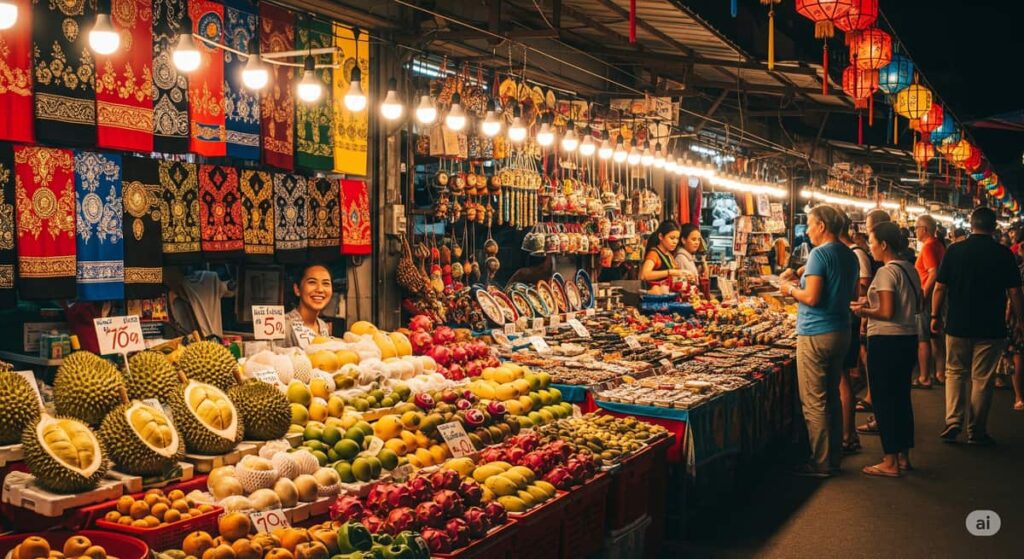
Naka Market is a good place to find souvenirs, handmade goods, trendy clothing and secondhand items; these are the categories the operator lists. In its descriptions, the weekend clothing market, the food center and weekday street food have different schedules.
The operator lists the following hours and venue details:
| Venue | Days and hours | What to know before you go |
|---|---|---|
| Naka clothing stalls | Saturday and Sunday, starting at 16:00 | The operator’s info page gives closing time as 22:00, and the sale page gives 23:00; entry is free |
| Naka Food Center | Daily, 07:00–21:00 | This schedule does not apply to the clothing stalls |
| Naka weekday street food | Monday–Friday, 16:00–21:00 | A separate page lists more than 48 food stalls |
| Updated Naka food area | The operator announced the opening | Added seating, improved walkways, expanded selection of food vendors |
Don’t count on the clothing stalls closing late: the operator’s pages disagree. For planning your route, it’s more reliable to rely on the opening time, which the pages agree on.
Most of the market is under a roof. The address on the operator’s info page is given as Virat Hong Yok Street, and for planning your trip, you will find the detailed guide to Naka Market.
Other markets and fairs
You can include Sunday Walking Street / Lard Yai in a route through the Old Town. On the map, find the pedestrian market and set aside time for a stroll, browsing the stalls and choosing gifts.
Chillva Market is another option for a city route. Malin Plaza and the OTOP Market are convenient options in Patong: start by browsing the stalls and comparing offers.
The market at Karon Temple, according to a travel blog about Phuket, runs on Tuesdays and Fridays. This is a third-party description of the days; exact hours are not given here.
Save Phuket Indie Market as an option for a craft fair in Phuket Town. For smaller venues, don’t apply one market’s schedule to neighboring stalls.
By the way, you can easily combine shopping with dinner. Look ahead of time at what to try in Phuket, so you can choose food by interest rather than just by the nearest stall.
Shopping near your hotel: Patong, Bang Tao and Karon
Shopping in Phuket can be organized without a separate day on the road. Start with your area of stay and your shopping list, and add a more distant venue only if it solves a specific need: a particular store, a gift or a walk.
- Patong: Jungceylon is for shopping at the stores and the hypermarket; Malin Plaza and the OTOP market are for browsing stalls and small purchases.
- Bang Tao: Boat Avenue is a shopping district option that can be combined with dinner.
- Karon: the temple market is an option for shopping in your own area, taking visiting days into account.
- Phuket Town: markets and small shops can be included in a city route, instead of a separate trip for each souvenir.
If you want to see the city, a walk through the Old Town of Phuket Town will help you link shopping with other stops. Don’t overload your route: leave time to look at the goods and to eat without rushing.
First choose the venue, then how you will get there. Compare transport options in Phuket, including taxis, ride-hailing apps and songthaews, depending on your route. For bulky purchases, plan the return trip before paying.
What to bring from Phuket and how to check a purchase
Choose a gift based on who will use it. Textiles, food, cosmetics and jewelry each need different checks; attractive packaging does not replace information about the material, ingredients and seller.
| What to buy | What to check | How to prepare for transport |
|---|---|---|
| Silk and textiles: scarves, shawls, pillowcases | Labeled composition, material, seams, care instructions | Fold and protect from moisture and dirt |
| Pearl jewelry | Product description, seller information, documents and receipt | Protect from damage, keep documents separate |
| Cosmetics and coconut oil | Ingredients, expiration date, manufacturer, package integrity | Check the seal and the rules for carrying liquids |
| Balms | Labeling, ingredients, expiration date | Keep in packaging with a readable label |
| Spices, curry pastes and sauces | Ingredients, manufacturer, expiration date | Choose sealed packaging, check import rules |
| Wooden items | Material, quality of finish, dimensions and weight | Protect protruding parts, check dimensions against your luggage allowance |
| OTOP handicraft souvenirs | Material and information about the maker | Choose packaging suited to the item’s fragility |
| Electronics, if they are on your shopping list | Included accessories, model description, receipt and warranty terms | Keep documents and follow the airline’s rules |
A certificate alone does not guarantee that the pearls are genuine. Ask for a clear product description and compare it with what you are buying. For cosmetics and balms, do not take a promise of therapeutic effects as proof of quality.
Luxury shopping is also possible on the island: the official directory of Central Phuket lists 15 brands, including fashion and jewelry houses (Dior, Gucci, Hermès, Louis Vuitton, Prada, Tiffany & Co.). Compare the specific offer and the store’s terms.
For an expensive purchase, it’s useful to read in advance, how to reduce the risk of fraud when buying. Keep the receipt and your correspondence with the seller if it specifies the material, included items or service terms.
Assess large wooden items before paying: a nice piece may be hard to fit into luggage. Check the airline’s rules and the destination country’s rules for the item you choose; permission to carry one gift does not automatically extend to the others.
Prices and bargaining: how to discuss the cost
At Naka’s clothing stalls, the operator allows prices to be negotiated. Food and drinks there are sold at fixed prices; this rule should not be applied to all vendors at other markets.
For a calm negotiation, a simple sequence is enough:
- Compare identical items: material, size, included accessories and condition.
- Inspect the item before discussing the price; check the seams, fastenings and packaging.
- Ask the seller whether bargaining is possible.
- Name the amount you are willing to pay for this purchase.
- If you can’t reach an agreement, thank the seller and keep looking.
There is no universal percentage to start bargaining with. A low price helps little if you are comparing different materials or missed a defect. In stores with fixed prices, go by the price tag and the announced promotion terms.
The Naka sale page announces discounts 30–50% on select clothing items and souvenirs from June to October. The year of the promotion is not stated in the announcement, so this is not a guarantee of a current discount on the item you choose.
Before paying, ask for the final total. Don’t add extra purchases just for a discount: first assess whether you need them and whether they are of suitable quality.
Payment for purchases: cash, cards and ATM fees
Payment methods depend on the seller. Ask in advance about paying by card, and keep some cash in baht for purchases where your preferred method is not available. Don’t assume that every foreign card will work at every store.
In the official fee schedule of the bank (Krungsri), effective from March 11, 2026, the following cash withdrawal fees are listed:
| Foreign card | Fee per transaction |
|---|---|
| Mastercard-network card | 350 baht |
| Visa-network card | 250 baht |
This is the rate of one particular bank. It does not describe the cost of withdrawals at all ATMs in Thailand. The bank that issued your card may also charge its own fees; their amount depends on its terms.
Before confirming a transaction, read the fee amount on the screen. Separately, estimate how much cash you need for planned purchases so you don’t withdraw money after every stall.
Agree on the payment method before the item is packed. If the seller accepts only an option that is inconvenient for you, you can choose another shop without making a hasty decision about the purchase.
How to Get a VAT Refund
The VAT refund starts at the store. The order and thresholds are listed in the VAT refund terms on the website of the Revenue Department of Thailand.
- Choose a store that displays the program sign (VAT REFUND FOR TOURISTS). Participation does not automatically follow from a store’s location in a shopping mall.
- Buy goods worth at least 2,000 baht including VAT in one day at one store. Do not combine purchases from different stores to meet this requirement.
- On the day of purchase, show your passport and ask for form P.P.10 with the original tax invoices. Keep the entire set of documents.
- Take the goods out of Thailand with you within 60 days of the purchase date.
- If the total value of purchases is 20,000 baht or more, present the goods, form P.P.10 and the original tax invoices to customs before check-in for your flight.
- Submit the refund request on the day of departure. The authority specifies the VAT refund counter at the international airport, as well as the option of mailing documents.
Check your documents already at the store. If there is a discount, the price after the discount must be shown, including VAT; the product description must clearly name the item type, not consist only of a code.
For expensive purchases, the authority specifically highlights:
- Listed categories valued at 40,000 baht or more per item: jewelry, gold items, watches, eyewear, pens, phones, laptops and tablets, bags, wallets and belts. Suitcases are excluded from this list.
- Carry-on items valued at 100,000 baht or more per item.
Do not extend this list by analogy to any expensive item. Before filing a refund, check the current terms of the Revenue Department: financial rules may change.
Do not expect to automatically get the full VAT rate back. Keeping receipts, meeting the export deadline and filling out documents correctly are needed for the procedure, but they do not replace the program’s other conditions.
Frequently Asked Questions ❓
Where is the best shopping in Phuket: in malls or at markets?
The choice depends on what you are buying. Shopping malls are convenient for brand-name stores and purchases at fixed prices; markets are good for souvenirs, textiles, handicrafts and dinner. For packaged food and everyday goods, you can choose a supermarket. Compare specific products and the seller’s terms, not just the format of the venue.
Can you bargain at Phuket's markets?
At Naka Market, the operator allows prices on goods to be negotiated, but food and drinks are sold at fixed prices. With other sellers, first ask whether bargaining is possible. Compare the quality and price of identical items, then offer a price that suits you.
What should I bring back from Phuket as a gift?
Options from this guide include textiles and silk, packaged spices and sauces, coconut oil, cosmetics, handicraft souvenirs and pearl jewelry. Before buying, check the ingredients, material, expiration date and manufacturer information, and for jewelry, ask for a product description and a receipt. Whether an item can be taken on your trip depends on the product, your luggage and the country of arrival.
How do I get a VAT Refund?
Shop at a store that displays the program sign (VAT REFUND FOR TOURISTS): the minimum amount is 2,000 baht including VAT in one day at one store. On the day of purchase, show your passport and get form P.P.10 with the original tax invoices. You must take the goods out of Thailand with you within 60 days of the purchase date; if the total value is 20,000 baht or more, present the goods and documents to customs before check-in for your flight. Do not expect to get the full VAT rate back automatically.
Which markets are open every day?
The Naka operator separately lists the Food Center as open daily from 07:00 to 21:00; this schedule does not apply to the weekend clothing stalls. The Naka Weekend Market itself operates on Saturdays and Sundays from 16:00, and the operator’s pages differ on closing times. Check other venues’ schedules before your trip.
Can terms and schedules change?
Yes. Schedules and financial terms can change. Before your trip, check the schedule of the venue you choose, and before filing a VAT refund, check the terms of the Revenue Department.
Conclusion
Plan shopping in Phuket around what you want to buy, the area and the day of your visit. For shops, choose a shopping mall; for souvenirs and a stroll, a market; for packaged food, a supermarket. You can start with venues near your hotel and combine a trip into the city with other stops.
Before paying, check the material, composition and condition of the item. Keep receipts, and for the VAT refund, keep the form and original tax invoices; don’t leave preparing documents until the airport. Schedules, product ranges, bank fees and VAT refund terms may change.
Save this guide and plan your own shopping route. If you want to continue your evening after shopping, check out where to go in the evening in Phuket.
Prepared by MyThai.online editorial team.