In this article:
What changed: Updated information on tickets and opening hours: admission to Doi Suthep is 30 ฿, the cable car is 50 ฿ per person, and admission to Chedi Luang is 50 ฿, according to TAT’s published data. Added the admission price for Wat Umong (20 ฿), its opening hours, and a description of the murals in Vihan Lai Kham.
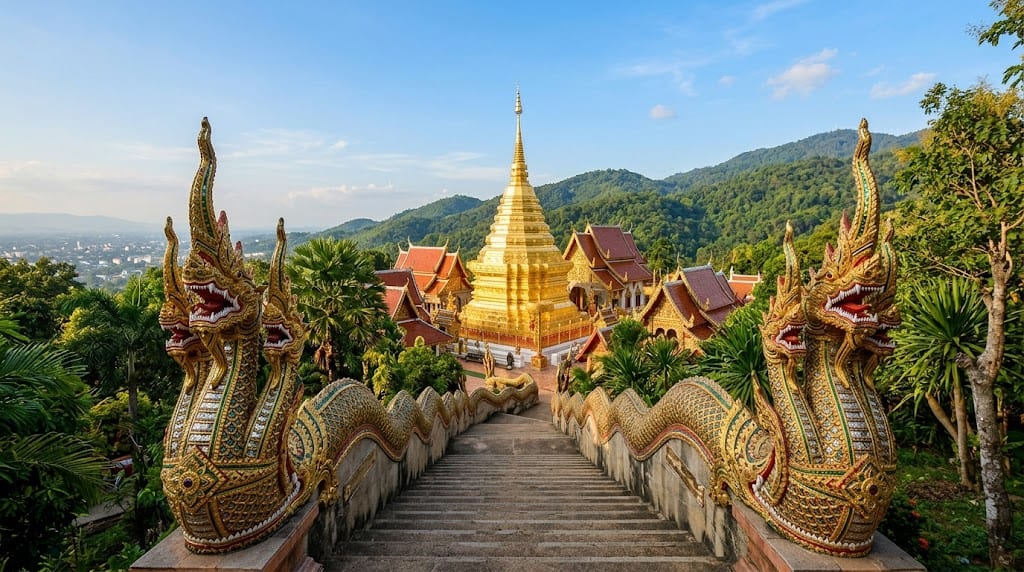
It is easy to choose Chiang Mai’s temples based on what you want to see. Doi Suthep is a mountain temple with a staircase and a golden chedi, which is a Buddhist stupa; Chedi Luang offers a look at a partly ruined stupa; Phra Singh features wood carving and the murals of Vihan Lai Kham, a temple hall. For a first trip, we suggest starting with these stops and leaving additional visits for free time.
You can combine the mountain trip with a walk through the Old City, or spread the visits over different days. The choice depends on your stamina, transport, and interest in architecture; there is no mandatory itinerary. Below is a comparison of the temples, published prices and hours, how to arrange a deal with a driver, and clothing recommendations. We will also look separately at the cable car: its schedule differs from the opening hours of Doi Suthep itself, and what the ticket includes requires attention.
Which Chiang Mai temples to choose for a first trip
Start with the experience you are willing to set aside time for. For a trip up the mountain, Doi Suthep is a good choice; to get acquainted with a ruined stupa, Chedi Luang; and for a close look at wood carvings and paintings, Phra Singh.
| Temple | Main impression | Planning considerations |
|---|---|---|
| Wat Phra That Doi Suthep | Golden chedi and mountain location | Transport from the city is needed; from the parking area, you can choose the stairs or the cable car |
| Wat Chedi Luang | Partly ruined Buddhist stupa | You can include it in a city walk and look at the preserved part of the structure |
| Wat Phra Singh | Carvings and murals of Vihan Lai Kham | Better to leave time to calmly look at the hall and the wall scenes |
You do not have to start with the mountain if temple art interests you more. Phra Singh and Chedi Luang can form the basis of a separate walk, while Doi Suthep can be left for a separate outing.
The practical difference is already noticeable when preparing: for the mountain temple, you need to plan the return, while on a city walk it is easier to change the order of stops. Answers to questions about neighborhoods and transport can be found in the Chiang Mai guide. Use it for the general trip plan, and the temple details for choosing specific visits.
Tickets and opening hours according to published TAT data
Prices and hours below are based on published data from the Japan office of the Tourism Authority of Thailand (TAT Japan). This information covers temple admission and the operation of the cable car; transport from the city is paid separately, by arrangement with the driver.
| Temple or service | Price according to the Tourism Authority of Thailand (TAT Japan) | Published hours |
|---|---|---|
| Doi Suthep | 30 ฿ | 05:00–21:00 |
| Doi Suthep cable car | 50 ฿ per person | Approximately 06:00–18:00 |
| Wat Chedi Luang | 50 ฿ | 08:00–22:00 |
| Wat Phra Singh | 50 ฿ | 07:00–22:00 |
| Wat Umong | 20 ฿ | 05:00–20:00 |
Based on published data from the Japan office of the Tourism Authority of Thailand (TAT Japan). Check current prices at the ticket counter and opening hours before your trip.
Information about the mountain temple and the cable car is provided on the Doi Suthep page of the Tourism Authority of Thailand. Do not automatically add together the admission and the cable car: the fare description does not clarify whether the temple ticket is included in the cost of the ride.
General opening hours for the complex also do not guarantee that every hall is open until closing time. If you plan to arrive early in the morning or in the evening, check the temple’s hours against the cable car schedule especially carefully. The table does not break down prices by visitors’ nationality or age.
Wat Phra That Doi Suthep: stairs, golden chedi, and legend
Wat Phra That Doi Suthep is located about 15 km west of the city, according to the Japan office of the Tourism Authority of Thailand (TAT Japan). On the trip, it helps to distinguish between the road to the parking area and the final climb to the temple. The staircase begins only after the driving part of the route.
The official listing gives 306 steps. The alternative to climbing on foot is a funicular, or cable car: the Tourism Authority of Thailand describes both ways of reaching the temple from the parking area. Choose according to your stamina and preferences, without needing to climb the stairs just to have a “full” visit.
The main landmark is the golden chedi, 24 meters tall according to the Tourism Authority of Thailand. Here you can begin getting to know the temple from the stupa, then move on to the details of the surrounding architecture. At the same time, the presence of a cable car alone does not confirm that all areas are accessible to people with limited mobility.
The site is associated with the legend of a white elephant. According to a government publication, the animal carried a relic, climbed the mountain, and died there, marking the spot for the shrine. This is a religious legend; it should not be taken as an exact historical dating of the temple’s founding.
For an independent trip, the key thing is to choose how you will go up and to arrange the return in advance. That way, you won’t have to end the visit by hurriedly searching for transport.
How to get to Doi Suthep and arrange the return trip
For this trip, people use songthaews, which are passenger trucks with benches in the back. The local tourism guide (Visit Thailand) names the Chiang Mai Zoo on Huay Kaew Road as one of the landmarks for boarding transport to Doi Suthep. This is a landmark for finding a vehicle, not a promise of departure at a specific time.
Before boarding, discuss the whole trip, including the descent from the mountain. The same guide recommends agreeing in advance on the price, the return, and how long the driver will wait, so it is best not to limit the conversation to asking how much it costs to get to the temple.
- Choose a shared ride with other passengers or a private vehicle.
- Name the temple and confirm the drop-off point.
- Confirm whether the price is quoted per person or for the whole vehicle.
- Discuss whether the return trip to the city is included.
- If the driver will wait, agree on how long the wait will be.
- Agree on a meeting point, and only then get in.
A price per seat and a price for the whole vehicle are different terms. Repeat the agreement in your own words so that both sides understand the payment and the return trip in the same way. This is especially useful when you are choosing between a shared and a private trip.
Do not leave the return to an unspoken “we’ll sort it out later.” If you are paying only for the trip to the temple, decide separately how you will get back down. And if you agree on a round trip, make sure the wait is actually included in the terms you discussed.
Wat Chedi Luang: the story of a ruined stupa
Wat Chedi Luang is of interest above all for its partly ruined chedi, a Buddhist stupa. The listing from the Japan office of the Tourism Authority of Thailand (TAT Japan) gives 1391 as the year the temple was founded. This date should not automatically be taken as the year the entire structure was completed.
According to the same listing, the upper part of the stupa was destroyed in an earthquake in 1545. Its surviving appearance helps explain why this temple differs from Doi Suthep: here, attention is drawn to a structure missing its upper part. A visit can be built around its shape and the volume that has survived.
For a first look, it is enough to understand what you are seeing and why the stupa looks the way it does. You do not need to start with a long historical summary: a brief context about the earthquake already makes the walk more meaningful. Then you can calmly examine the structure without trying to fit the visit into a rigid schedule.
If you continue getting to know Thai sacred sites in the capital, add to your plans the temple of Wat Arun in Bangkok. There is a separate guide to it that will help you prepare for your next visit.
Wat Phra Singh: architecture and Lai Kham murals
Wat Phra Singh We suggest choosing it if you are interested in wood carving and temple painting. The main highlight for this visit is Vihan Lai Kham. The Japan office of the Tourism Authority of Thailand (TAT Japan) highlights its wood carvings and wall paintings in the Lanna style.
Start with the decorative details, then move on to the hall’s walls. This order helps you look at the architecture and painting separately, rather than settling for a general view from the entrance. Here it is more useful to leave time for a close look than to add one more stop to a packed route.
The state cultural database (SAC) describes the placement of the scenes: on the north wall, “Suwan Hong,” and on the south wall, “The Golden Conch”. These names give concrete reference points for getting to know the paintings. It is better to look for them by the building’s own compass directions, rather than by which wall happens to be on your right.
The difference from the previous temples is clearly visible in what draws attention: at Doi Suthep and Chedi Luang, you can begin with the stupa, while here you start with carving and wall painting. So the city walk does not have to be seen as a repeat of what you have already seen.
Additional temples: Wat Umong and Wat Suan Dok
Wat Umong is a good additional visit if you are interested in a calm natural setting. The Japan office of the Tourism Authority of Thailand (TAT Japan) also reports that tourists can take part in meditation programs. This is a separate interest, which can be placed ahead of extending a standard sightseeing walk.
According to published data from the Japan office of the Tourism Authority of Thailand (TAT Japan), admission costs 20 ฿, and hours are 05:00–20:00. Check current conditions before your visit; the temple’s general hours do not replace the schedule of the meditation program. The possibility of taking part should not be understood as an activity available at any time without prior arrangement.
Wat Suan Dok can be kept among the additional stops and located via the map link. It is not necessary to add it to the day of the mountain trip and the city walk. If the main visits already take up enough time, move this temple to another day; the route will not be incomplete because of it.
Dress code and rules of conduct in temples
Chiang Mai’s temples are visited with respect for religious practice. The main recommendations on clothing and behavior are set out in the official guidance from the Tourism Authority of Thailand.
For clothing, the guidance offers the following options:
- Men: a top with sleeves, and trousers or shorts that cover the knees.
- Women: a skirt below the knee and a top with sleeves, without thin straps.
It is easier to choose suitable clothing before you leave. That way you won’t have to count on finding a replacement for an open top or short shorts at the entrance. It is convenient to plan for covered shoulders and knees for the entire temple walk.
Shoes are removed before entering the temple building. Outside, there are shelves or special spots where you can leave them. This rule does not mean that you have to go barefoot throughout the entire outer grounds.
If you sit in front of a Buddha image, do not point your feet toward it. Choose a position in which your feet face away from it, and keep this in mind when you change posture. Simple attentiveness here helps you avoid a disrespectful gesture.
According to the guidance, women may not touch a monk or his robes. To hand over an item, you can set it down and let the monk take it himself, or have a man pass it to him. For a broader overview of etiquette in Thailand will also be useful beyond temples.
How to plan a one-day temple route
We suggest this sequence: the mountain trip, the return to the city, then the city temples. This is an option for independent planning, not a tour with a guaranteed duration. Leave room to shorten the program if the road, waiting for transport, or sightseeing takes longer than you expected.
- Start with Doi Suthep, discussing the return with the driver in advance.
- After descending, take a break in the city.
- Continue getting to know the Chedi Luang stupa.
- Finish the main program with the carvings and murals of Phra Singh.
For a break, see the article on food in Chiang Mai. It is better to plan for it in advance than to try to move from one visit to the next without stopping. An independent route is convenient precisely because you can stop and change your plans.
If you do not want to combine the mountain with a city walk, start with Chedi Luang and Phra Singh. The trip to Doi Suthep can be moved to another day, and additional temples can be left for a separate interest. Choose a program you can manage: the number of stops does not determine the quality of the experience.
Take suitable clothing, comfortable shoes, and small cash. The tourism guide for independent travel advises small bills for transport and the temple fee: in the morning on the mountain, change may be limited. This is a practical reason to prepare your money before you set out.
The local guide to Doi Suthep also warns that it is cooler on the mountain than in the city. In the cool season, an extra layer of clothing that is easy to remove later may come in handy in the morning. More about seasonal conditions is covered in winter in northern Thailand, and for choosing dates, see the guide to when to visit Thailand.
Frequently Asked Questions ❓
How much does admission to Chiang Mai's temples cost?
According to published data from the Japan office of the Tourism Authority of Thailand (TAT Japan), Doi Suthep costs 30 ฿, the cable car 50 ฿ per person, Chedi Luang and Phra Singh 50 ฿ each, and Wat Umong 20 ฿. It is not explained whether the temple ticket is included in the cost of the cable car. Check current prices at the ticket counter.
How do I get to Doi Suthep from central Chiang Mai?
You can use a songthaew; the local guide names the zoo as one of the boarding landmarks, as described in the section on transport. Before the trip, agree on the route, the price per person or per vehicle, the driver’s waiting time, and the return. Do not assume the return trip is included without an agreement.
What is the dress code at Chiang Mai's temples?
The Tourism Authority of Thailand recommends a top with sleeves and covered knees: men should wear trousers or suitable shorts, and women a skirt below the knee. Shoes are removed before entering the temple building. It is best to prepare suitable clothing in advance.
How many steps are on the Doi Suthep staircase, and is there a funicular?
The Japan office of the Tourism Authority of Thailand (TAT Japan) lists 306 steps. According to its published data, the cable car costs 50 ฿ per person and operates approximately from 06:00 to 18:00. The presence of a cable car does not mean that all areas of the complex are accessible.
Which Chiang Mai temples should I see first?
For a first trip, we suggest Doi Suthep with its golden chedi, Chedi Luang with its partly ruined stupa, and Phra Singh with its Lai Kham murals. If you are interested in the natural surroundings and meditation practice, add Wat Umong. This is a recommendation to help you choose, not a required list.
What rules for interacting with monks are important for women?
According to the Tourism Authority of Thailand’s guidance, women may not touch a monk or his robes. An item can be set down and the monk can pick it up himself, or a man can pass it along. Handing it directly from hand to hand is not appropriate.
Conclusion
Chiang Mai’s temples offer different impressions: Doi Suthep is a mountain temple with a golden chedi, Chedi Luang is the story of a ruined stupa, and Phra Singh features wood carving and paintings. Choose whichever interests you more, and leave time for the journey, a break, and a calm visit. It is best to arrange the return from the mountain before boarding.
Published prices and hours may change, and the availability of individual halls can differ from the complex’s general schedule. So do not build your whole day around visiting a specific hall right before closing. Plan your main stops, and move additional temples to another day if needed: the city walk and the mountain trip can be separated without losing the main impressions.
Prepared by MyThai.online editorial team.