In this article:
What’s changed: A half-day visit to Elephant Nature Park costs 2,500 baht, and the full-day program (SkyWalk) costs 3,500 baht. Added information about the center’s new viewing platforms and recommendations for careful climbing at Bua Tong Waterfall.
The destinations around Chiang Mai suit different kinds of trips: choose Doi Inthanon for mountain views and walks, and a stop in the park or a separate trip to Bua Tong for waterfalls. If you want to see elephants, compare the observation programs of the centers. For a trip to Pai, consider an overnight stay so that the whole route doesn’t depend on the return drive.
This guide will help you choose a destination based on your interests, physical load and way of getting around. It will be useful both for those ready to travel independently and for travelers who prefer a tour or a car with a driver. Bua Tong and Doi Inthanon should not be treated as neighboring stops on a short walk: combining them requires a specific program.
Start with the main experience that makes you leave the city. Then choose transport, stops and how you’ll return. This order helps you compare costs and leaves time for the places themselves, instead of trying to cover everything at once.
Where to go from Chiang Mai: how to choose a destination
If you’re deciding what to see near Chiang Mai, start with the type of trip. Mountain walks, climbing waterfall cascades and observing animals require different preparation, even when an operator offers them in one tour.
| Destination | Experience | Recommended format | Transport | Overnight stay |
|---|---|---|---|---|
| Doi Inthanon | Summit, pagodas, walking trails | Set aside a separate day | Tour, car with a driver, or your own transport | For a day trip out of the city, plan the return |
| Wachirathan and Mae Ya | Waterfalls on a national park trip | Choose stops to fit the main route | Transport for a park trip | Depends on the overall plan |
| Bua Tong | Limestone cascades | Self-guided destination | Organized trip or car | Plan according to the program |
| Elephant center | Observing animals | A specific half-day or full-day program | Operator transfer if included, or separate transport | Based on the chosen program |
| Pai | Mountain town and trips around it | Consider a trip with an overnight stay | Carrier’s bus or car | We recommend considering |
A separate day for the park and an overnight stay in Pai: planning guidance, not a fixed duration for each route. Don’t automatically add the elephant center or Bua Tong to your trip: first compare the stops and the return journey.
If you’re traveling as a group, discuss in advance how much activity you want. Some want a hiking trail, others pagodas and stops at waterfalls; it’s better to take these preferences into account before choosing a program. Make a short list of must-see places and separately note optional ones: this will make it easier to agree on a route without rushing.
If you’re still getting to know the city, it will help to read a guide to Chiang Mai. First plan city walks and outings, then choose a program outside the center.
Doi Inthanon: summit, pagodas and walking trails
The Doi Inthanon National Park lets you plan a trip around its summit, royal pagodas or a walking trail. According to an unofficial guidebook, Doi Inthanon Summit reaches 2,565 meters — the highest point in Thailand.
Twin Royal Chedis can be chosen as a separate stop. When planning, distinguish between visiting the pagodas, the summit and the walk: ask the organizer which stops are included and how much time is allotted to each.
Trails aren’t interchangeable either. Unofficial guidebooks describe them this way:
- Ang Ka Nature Trail can be walked without a guide.
- Kew Mae Pan Nature Trail — according to an unofficial guidebook, you need to hire a local guide to walk it. The trail has a seasonal schedule.
- Pha Dok Siew Nature Trail requires a local guide; its length is 2.6 km, and it ends at the village of Mae Klang Luang (Mae Klang Luang Village).
For guided trails, the blog gives a reference rate of 200–220 baht per group. This is information from a guidebook, not the official rate of the park administration; check the current cost of a guide and the visiting conditions before you go.
For a separate trip to Doi Suthep see the article Chiang Mai’s Temples and Doi Suthep. Another self-guided destination is Chiang Mai’s coffee farms: a visit to a farm should be arranged separately.
Wachirathan, Mae Ya and Bua Tong waterfalls: what to choose
Wachirathan Waterfall and Mae Ya Waterfall should be considered together with a trip around Doi Inthanon. Wachirathan suits a waterfall stop in a park program, but a trip to Mae Ya should be arranged with your driver or organizer in advance.
According to an unofficial guidebook, Mae Ya has its own checkpoint, and a paid entrance ticket is valid for the entire national park. Keep your ticket after paying and show it at the next checkpoint. When comparing tours, check whether this specific waterfall is included: the general promise “we’ll visit waterfalls” does not reveal the route.
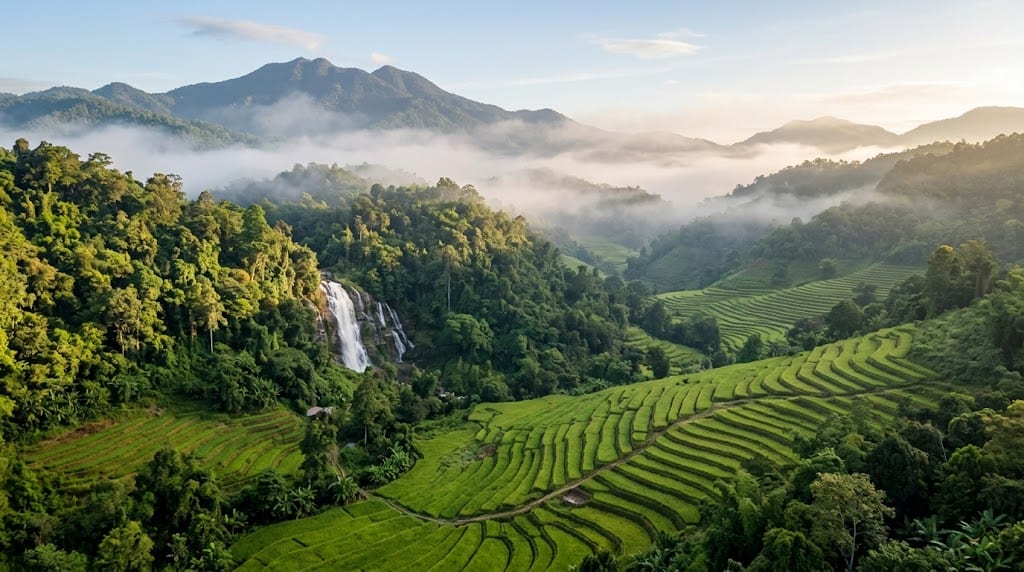
Bua Tong Sticky Waterfall is a self-guided day-trip option. It is located in the tambon of Mae Ho Phra, in the Mae Taeng district of Chiang Mai Province.
The limestone surface gives good grip, and climbing the cascades is recommended with care, as noted in the description of Bua Tong on the provincial administration’s website. Good grip does not mean slipping is impossible. Don’t make climbing a required part of your visit: you can choose a stop for the view if moving along with the crowd doesn’t suit you.
Put simply, choose a waterfall based on what you want to do there. For Bua Tong, plan transport and the return trip separately; don’t treat it as a short add-on to every park trip.
Elephant centers: programs, prices and observation without contact
If you’re looking for ethical elephant sanctuaries, look at specific activities. For observation without forced contact, avoid programs with riding, shows and bathing with visitors. Separately, find out whether touching and close hand-feeding are part of the program: the word “ethical” in advertising doesn’t answer these questions.
Elephant Nature Park offers a choice between half-day visits and a full-day program (SkyWalk). The latter includes the Hands Off observation project; the center also reports new viewing platforms being built. Programs and rates are published on the center’s official website.
ChangChill offers a full day or a half day. According to the operator, visitors watch elephants move through the valley, feed, bathe and interact with one another. In such a description, animals bathing does not mean tourists take part.
Elephant center EVE79 Elephant Sanctuary states an observation format without riding, elephant bathing or shows. Below are the operators’ rates; check the current cost of your chosen program.
| Operator | Program | Adult rate | Child rate | Known services and format | What to check |
|---|---|---|---|---|---|
| Elephant Nature Park | Morning or afternoon half-day visit | 2,500 baht | 50% of the adult rate for children aged 3 to 11 | Half-day program | Activities, meals, transfer |
| Elephant Nature Park | Full day (SkyWalk) | 3,500 baht | 50% of the adult rate for children aged 3 to 11 | Hands Off observation project, viewing platforms | Program contents and transport |
| ChangChill | Full day or half day | Check the cost with the operator | Check the cost with the operator | Observing elephants in the valley | Rates, age requirements, included services |
| EVE79 | Half day | 1,800 baht | 1,200 baht for children aged 4 to 12 | Observation; transfer to and from central Chiang Mai | Meeting point, meals |
| EVE79 | Full day | 2,500 baht | 1,800 baht per child | Observation; transfer to and from central Chiang Mai | Age requirements for the full day, program contents |
The difference is already visible in the table: the full-day and half-day prices apply to different programs. Transfer is listed explicitly for only one operator, so it cannot be automatically assumed for the others. Statements from the centers do not replace an independent assessment of animal welfare.
For a family trip, also look at the format of the child rate. At Elephant Nature Park, it is given as a share of the adult rate, while at the EVE79 center it is listed as separate amounts. Age conditions also need to be matched to the chosen program: the label “child ticket” alone does not explain who it is for or which services it covers.
Pai: route, sights and overnight stay
Pai Choose Pai if you want to continue your trip in the mountain town and explore the places around it. Consider an overnight stay: it lets you plan arrival, walks and the return separately, rather than squeezing them into a packed trip out of Chiang Mai.
The route is served by the carrier Prempracha. It suggests first choosing a route and checking the current timetable, then going to a separate booking site. The preparation order is simple:
- Choose the Chiang Mai — Pai route and a suitable departure.
- Check the conditions of the selected trip and go on to booking.
- Compare the station name and departure time with your confirmation.
- Coordinate the return trip with your accommodation and stops.
The carrier warns that schedules, fares, stops and conditions may change. Therefore, check the details for your specific trip. Arcade Bus Station can serve as a transport information point, but take the boarding station from your booking confirmation.
For walks, add these places to your plan:
- Pai Canyon — a walk among ridges of red earth with valley views.
- Kho Ku So Bamboo Bridge — a footpath over rice fields.
- Wat Phra That Mae Yen — an option for visiting the temple and enjoying the panoramic view.
The road to Pai requires considering how well you tolerate mountain routes. Choose suitable transport and don’t tie your entire rest to driving yourself if it will be tiring. Don’t try to see everything at once: leave some stops for the next day.
Tham Lod Cave: an extra trip from Pai
Visiting Tham Lod Cave can be considered a continuation of your trip from Pai. Plan it as a separate outing rather than a required stop between town walks. First decide whether you want to add one more route and how you’ll get back.
Before the trip, clarify the route’s availability, how guiding is organized, whether travel by raft is possible, and what the payment covers. It’s helpful to ask the organizer specific questions:
- What route is offered and what will visitors see?
- How is the guiding arranged?
- Is a raft provided, and is it included in the program?
- What is paid separately, and for what unit: per person, per group or per service?
- Where does the visit end, and how does the return trip work?
Ask for the cost for your group size, not just the general advertised price. Don’t add separate charges for access, guiding and the raft to your budget until you understand the conditions for each.
Also agree on who is responsible for getting from your accommodation to the start of the visit, and for the return trip. Don’t treat an offer of a cave tour as a promise of a full excursion out of Pai. If you book transport and the visit separately, compare the meeting point and how the route ends.
If Pai is already full of walks, you can leave the cave for another trip. It’s better to choose it deliberately than to add it just to tick it off the map and then rush to the return trip.
How to plan trips and calculate costs
The areas around Chiang Mai can be explored without driving yourself. An organized tour is convenient for its ready-made program, a car with a driver offers coordinated stops, and your own transport gives you the flexibility to change plans. The choice depends on how much you need flexibility and help with organization.
Check what the tour includes: the park, pagodas, guiding, meals, transfer and the return trip. Don’t count them as included by default. For a car with a driver, list the stops in advance, discuss waiting time during walks and the return point.
An unofficial guidebook to Doi Inthanon says there is no public transport between the trail starts. For getting around, it suggests your own transport, a private driver or a tour. Therefore transport to the park and movement within it should be arranged separately.
The EVE79 elephant center includes a round-trip transfer from central Chiang Mai in every booking. The operator lists a morning pickup between 7:00 and 7:30 and a midday one between 12:00 and 12:30. These conditions apply only to it; for other programs, check transport separately.
Build your budget by expense category:
- the trip from the city and the return;
- transfers between stops;
- entrance tickets and a separate visit to pagodas;
- guiding on the chosen trail;
- the elephant center program;
- meals and water, if not included;
- accommodation in Pai;
- additional services for the cave route.
Next to each amount, note who or what it is charged for. The group cost of a guide and the per-visitor rate are different expenses; don’t compare them as equivalent trip prices.
To compare offers, it helps to divide your notes into included services and separate payments. Next to meals, tickets and guiding, leave space for the organizer’s answer: the absence of a service in the description doesn’t yet explain how it is paid for. This way you can compare programs by the same cost items and avoid counting twice what is already paid as part of the tour. Separately note expenses that depend on group size or the chosen stops.
If you plan to drive yourself, study road safety in Thailand. For meals before departure or after your return, see the article where to eat in Chiang Mai.
When to go and what to pack
When choosing a season, separate general weather expectations from the availability of a specific trail. An unofficial guidebook describes the annual closure of Kew Mae Pan as running roughly from June 1 to October 31 and reopening on November 1. This is a general calendar guide, not confirmation that the trail will be open on the day of your trip.
The same guidebook describes Pha Dok Siew and Ang Ka as year-round in suitable weather. Before setting out, check the actual availability of the trail you have chosen. If the walk doesn’t go ahead, discuss a replacement among the available stops with the organizer, without expecting the program to change automatically.
For a trip into the mountains, the guidebook recommends this set:
- sturdy footwear for walking;
- a warm layer of clothing;
- cash;
- water;
- a snack;
- insect repellent.
According to the guidebook, there are no ATMs in the park. Prepare cash in advance, especially if guiding and tickets are paid separately. A warm layer will be useful for the mountain part of the trip; for more on preparation, see the cool season in northern Thailand.
If your travel dates are still open, check when is the best time to visit Thailand. Once you’ve chosen a season, return to a specific program: the calendar helps you plan the trip, while the possibility of walking a trail depends on visiting conditions.
Frequently Asked Questions ❓
How much does entry to Doi Inthanon National Park cost?
Before setting out, check the current entrance fee and the separate cost of visiting the Twin Royal Chedis. If you’re going with a tour, ask the organizer which tickets are included in the program.
How do I get from Chiang Mai to Pai, and how long does it take?
The route is served by the carrier Prempracha. Choose a route and the current timetable with the carrier, and check the station name and departure time against your booking confirmation. Fares and trip conditions can change; confirm the exact travel time for the departure you choose.
Which elephant center should I choose for observation without forced contact?
Compare specific activities: riding, shows, bathing with visitors and observation conditions. At Elephant Nature Park, half-day programs cost 2,500 baht and the full-day program (SkyWalk) costs 3,500 baht; it includes the Hands Off observation project.
ChangChill describes observing elephants moving freely, while EVE79 states a format without riding, bathing or shows. Check the current cost of your chosen program. Operators’ statements do not replace an independent assessment of the conditions for keeping animals.
What is Bua Tong’s “sticky waterfall”, and can you climb it?
The provincial administration describes a limestone surface with good grip and the possibility of climbing the cascades carefully. This is not a guarantee against slipping. Bua Tong is located in Mae Taeng district; plan it as a separate destination and check visiting conditions in advance.
Can you see the areas around Chiang Mai without driving yourself?
You can choose an organized tour or a car with a driver. Compare the route, included services and the return trip. If you’re considering driving yourself, separately review the requirements in the article on road safety in Thailand.
How much does a visit to Tham Lod Cave cost?
Before the trip, check current rates and the units of payment. Ask what is paid separately: access, guiding and the raft if the route includes one. Ask for the cost for your group size.
Conclusion
The areas around Chiang Mai are easier to plan around your main interest. For mountains and walks, choose Doi Inthanon; for a waterfall trip, choose stops in the park or a separate trip to Bua Tong. Compare elephant centers by observation conditions, and treat Pai as a trip with a possible overnight stay and extra outings.
Choose a destination, then the transport and a specific program. Agree on stops, included services and the return trip before booking, especially if you’re combining different activities. You don’t have to cover the whole list: a route with time to spare lets you stroll calmly and not rush between points. Rates and route availability can change, so tie your final plan to the trip you choose.
Prepared by MyThai.online editorial team.