In this article:
What changed: Added the forecast for the north on November 4 and the period from November 5 to November 7, 2026, the lantern festival program (CAD) and ticket purchase conditions. The 50% refund window at the ticketing platform (FaceTicket) ended on October 24, 2026: from October 25, 2026, ticket cancellations are non-refundable.Updated: October 20, 2026
What changed: The cool season is expected to begin around the third week of October and end around mid-February, with the coldest period expected from late December to early February. The FaceTicket ticketing platform offers a 50% refund for canceled tickets to the CAD lantern festival from September 24 to October 24, 2026. The ticket seller (Royal Silk Holidays) states that purchases are non-refundable.Updated: October 5, 2026
What changed: The cool season’s dates have been clarified: from mid-October to mid-February. Details have been added about the paid CAD festival: from November 24 to November 25, tickets of 4,900–15,900 baht, and a non-refundable condition. The section on PM2.5 air pollution has been updated.
Winter in northern Thailand requires different preparation for a city walk, a sunrise at a summit and an overnight stay in the mountains. First choose your base and transport, then pack clothing for the coldest part of the route. For the city, dressing in layers works well; for a mountain morning and sleep, you will need a separate set.
People travel to the north for temples, markets, mountain valleys, blossoms and coffee. Do not build the whole vacation around a single sunrise: fog, flowers and trail access cannot be promised in advance. Keep a program that will still be interesting without the expected natural phenomenon.
A seasonal forecast describes expectations for a long period, while the weather for your upcoming trip is shown by a separate forecast for the chosen place. The name of a season alone does not promise dry days or coolness everywhere.
Current as of November 2026. Weather and conditions may change; before a mountain trip, check access, return transport and air quality.
When the cool season starts and what the forecast says for November
According to the climate description from the Thai Meteorological Department (TMD), winter falls roughly from mid-October to mid-February. This is general seasonality, not a report on the weather of a specific day.
Expectations for the season are set out in the Thai Meteorological Department’s seasonal forecast dated October 9. It expected the season to start around the third week of October and end around mid-February; the forecast does not confirm an official start of the season.
| Period | What the forecast indicates | How to account for this on your trip |
|---|---|---|
| Start of season | Expected around the third week of October | Do not count on cooling happening everywhere at once |
| The coldest stretch | Expected from late December to early February | Prepare clothing for sunrise and a mountain overnight stay |
| End of season | Expected around mid-February | Choose the program according to your own dates |
As of November 2026
On November 4, 2026 the Thai Meteorological Department (TMD) forecasts isolated thunderstorms with gusty winds for the north. Regional minimums — 21–24 °C, maximums — 33–36 °C; this is not the temperature at a specific summit.
Thunderstorms are forecast from November 5 to November 7, 2026. From November 5 to November 6, 2026, gusty winds, hail and locally heavy rain are also expected. This forecast applies to the stated days, not to all of November.
The document dated October 9 scheduled a revision for the last week of October. The promise of a revision itself does not mean an update has been published. If you are still choosing a region and dates, the article when to travel to Thailand can help you compare trip options.
How cold it gets in the city, the valley and on the mountain peak
The Tourism Authority of Thailand (TAT) describes cooler weather in Chiang Mai from November to February as a period of more comfortable walks. But the city forecast cannot be applied to a valley or a high-mountain site.
| Area | Clothing | Overnight stay conditions | Forecast to check |
|---|---|---|---|
| Chiang Mai city areas | Layers of clothing, a sweater or fleece within reach | Equipment in the room you choose | For the city and your walking time |
| Pai and valley trips | A warm layer, a jacket, sleepwear | Hot water, a blanket, windows that close | For accommodation and stops |
| High-altitude sites | Warm jacket, long pants, closed shoes | Conditions of the specific accommodation | For the mountain site you choose |
As of November 2026, the seasonal forecast from October 9 expected the average minimum temperature in the upper part of the country to be at 22,0–23,0 °C, about 2 °C above normal. This is an averaged figure of minimum temperatures over a large area. It does not describe daytime heat or the weather on a particular night.
Seasonal minimums around 10–12 °C were forecast mainly for the far north of the Northern and Northeastern regions. They cannot be assigned to a specific city, valley or summit.
For peaks and ridges, the forecast projects cold and very cold conditions with possible frost. This creates a useful distinction: the season may be expected to be warmer than normal, but preparation for strong cold in the mountains is still necessary. In winter in northern Thailand, it is best to choose clothing for the coldest section of the route.
Where to go: Chiang Mai, Chiang Rai, Pai and Mae Hong Son
Choose a base based on your interests and willingness to move between places. City walks, valleys and mountain stops require different planning; you do not need to include every direction in one vacation.
Chiang Mai
Chiang Mai Old City, temples and evening markets let you alternate cultural sightseeing with local food. This base is convenient if you do not want to change accommodation every day.
Keep Nimmanhaemin for cafes, galleries and restaurants. In winter, Chiang Mai can be combined with separate trips out of town, chosen according to your stamina and interests.
Chiang Rai
In Chiang Rai, save Wat Rong Khun, Wat Rong Suea Ten and Baan Dam Museum to your shortlist. Choose the sites that interest you rather than trying to see the whole list.
Treat Mae Salong and its tea plantations as a separate mountain trip. First arrange transport and the return, then link it with your city program.
Pai
For a nature program, Pai Canyon, hot springs and the bamboo bridge over the rice fields are good options. Choose the specific hot springs and bridge in advance: general names do not identify a single stop.
The Tourism Authority of Thailand (TAT) describes dense morning fog over the rice fields of Pai in winter. This is a possible scene, not a promise for every morning. When choosing accommodation, consider hot water and a warm blanket.
Mae Hong Son
In Mae Hong Son, keep a walk around Chong Kham Lake. Plan the Tham Lot cave as a separate trip around the province.
The lake and the cave are not nearby points on a city walk. To continue the mountain route, first decide where you will stay and how you will get around.
Doi Inthanon: trails, visits and costs
In Doi Inthanon National Park, you can put together a program of mountain views, waterfalls and walks. The height of the Doi Inthanon summit, according to the Tourism Authority of Thailand (TAT), is — 2,565 m.
The selection includes the King and Queen Pagodas, Wachirathan Waterfall and Mae Klang Waterfall. Forest walks and the Kew Mae Pan trail are separate options for your program.
The Tourism Authority of Thailand (TAT) links the comfort of day hikes and camping in the north with the lower temperatures and humidity of the cool season. This does not confirm that trails are currently open and does not cancel the need to prepare for nighttime cold.
Break down the costs by component:
- Transport to the sites and back.
- Admission to the site being visited.
- Additional sites.
- Guide service, if the program includes it.
- Overnight stay when accommodation is in the mountains.
Before paying, confirm the availability of stops, the price and what the service includes. Visits to the pagodas, the trail and the waterfall are not necessarily included in one offer; mentioning a guide alone does not make hiring one mandatory.
Agree on the return and a replacement for a closed site. Find an alternative with the help of Chiang Mai surroundings: choose based on the content of the walk and visiting conditions, not just on the photo.
Blossoms, the sea of clouds and coffee plantations
Winter in northern Thailand suits trips planned around blossoms, sunrise views and coffee. It is better to keep these interests separate: a date that suits one experience does not guarantee the others.
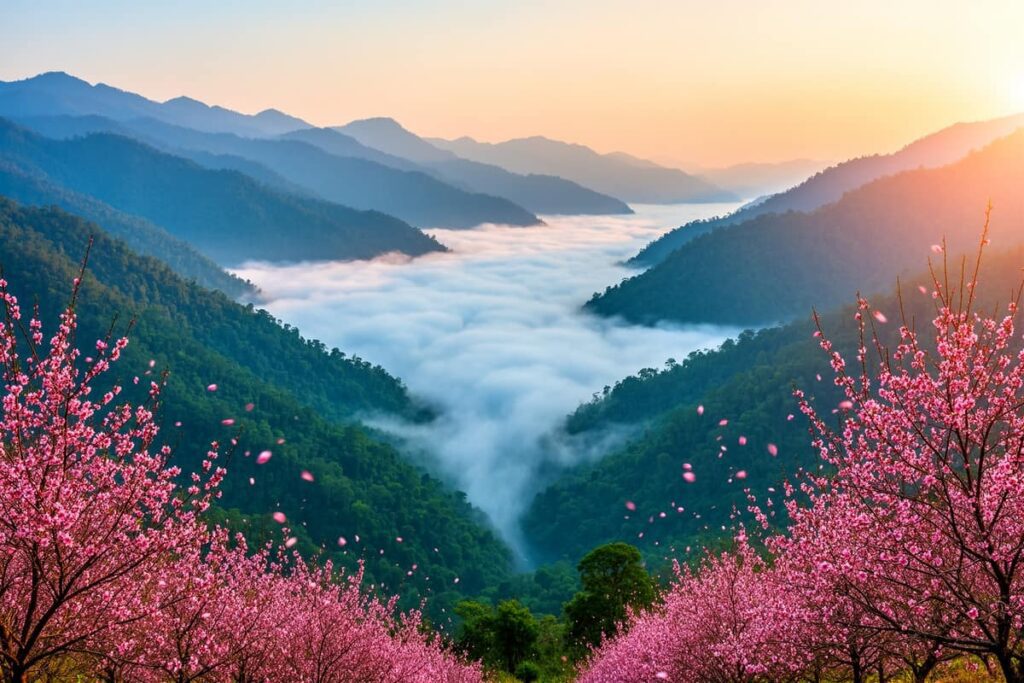
The Tourism Authority of Thailand (TAT) describes the flowering of various plants in the north from December to February. The agency links the pink slopes of January to the Himalayan cherry. This is a seasonal description, not a calendar for a specific place.
To look for “Thai sakura”, consider Khun Chang Khian and Doi Ang Khang. Check the condition of the trees for your chosen trip, keeping an alternative walk as a backup.
Yellow flower fields are a different story: for them, save Doi Mae U-kho in Khun Yuam district. Do not tie your trip to an expected peak without information on the state of the fields.
“Sea of clouds” is a view from above of a valley filled with fog. For sunrise, you can consider Mon Cham or Doi Inthanon, but an early start does not guarantee the visibility you need.
For coffee trips, keep Doi Chaang, Doi Tung and the plantations around Mae Salong in your list. Just choose the format in advance: a café with a view and a plantation visit are different programs. If the place itself interests you, the absence of fog will not make the trip pointless.
Cool-season festivals and the paid CAD lantern festival
Loy Krathong, Yi Peng, the Chiang Mai Flower Festival, strawberry fairs and mountain races are different reasons to travel. Choosing an event is easier with Chiang Mai event listings.
The paid CAD lantern festival is a separate commercial event. Its schedule does not determine the dates of the entire city Yi Peng program, and the ticket price is not a fee for the city festival.
As of November 2026
The paid CAD lantern festival is listed from November 24 to November 25, 2026. Published prices vary by seller and by offer line:
| Seller | What price range is published |
|---|---|
| Ticket seller (Royal Silk Holidays) | 4,900–15,900 baht |
| Ticketing platform (FaceTicket), regular prices | 4,900–15,900 baht |
| Ticketing platform (FaceTicket), November 24, 2026 offer line | from 4,880 to 15,880 baht |
Prices are given as of November 2026; confirm the current price. A published price does not confirm that seats are available.
Refunds and preparing for your visit
At the ticketing platform (FaceTicket) from October 25, 2026, cancellations are processed without a refund. The earlier partial refund window has already ended.
| Seller | Published cancellation terms |
|---|---|
| Ticket seller (Royal Silk Holidays) | Tickets are non-refundable |
| Ticketing platform (FaceTicket) | From October 25, 2026, no refunds are available |
| Ticketing platform (FaceTicket), ended refund window | A 50% refund was provided for cancellations from September 24, 2026 to October 24, 2026 |
These are the terms of the respective sellers, not a single rule for all tickets. Put simply, before you pay, compare the full purchase terms, what the ticket includes and how transport is arranged.
The program offered by the ticketing platform (FaceTicket) includes a simultaneous lantern launch. The platform also recommends bringing an ID card or passport in case your name needs to be checked against the ticket. This is a recommendation for a specific offer; it and the launch program cannot be carried over to all city festivals.
What to wear for the city, a mountain sunrise and an overnight stay
The main rule is layered clothing, which can be adjusted depending on conditions. For the city, keep an extra layer close at hand, and prepare your mountain set before you set out.
| Scenario | What to prepare | What to plan separately |
|---|---|---|
| City walk | Fleece or sweater, long pants, comfortable shoes | An extra layer for the evening return |
| Mountain sunrise | A warm layer, a windbreaker or a light down jacket depending on conditions, long pants, closed shoes | Protection against possible severe cold |
| Mountain overnight stay | A warm layer, a jacket, separate sleepwear | A blanket, hot water, room equipment |
Include sunscreen in your kit for daytime trips. Choose footwear to suit the surface and the nature of the walk: a city street and a forest trail require different preparation.
Do not set a universal time for when to put your jacket on or take it off. For sunrise, place warm clothes where you can reach them right away rather than deep in your luggage. Prepare sleepwear separately.
Before booking, ask the owner or administrator of the chosen accommodation:
- Is there hot water?
- Do they provide a warm blanket?
- Do the windows close?
- How is the specific room you choose equipped?
Do not assume heating is guaranteed, and do not carry over the equipment of one room to the whole accommodation. General photos do not answer questions about your overnight stay.
Supplement the checklist of what to take with you to Thailand with items for the mountain part of the route. It is more convenient to pack sets for different scenarios than to look for one set for the whole vacation.
Transport, accommodation and remote work
From Bangkok to Chiang Mai, you can fly, take the train or go by bus. Compare the convenience of departure, arrival and check-in, then link the main transfer with mountain trips.
Check these in sequence:
- Where the trip ends.
- How to get from the arrival point to your accommodation.
- Whether the arrival time suits check-in.
- How the next trip is arranged.
- Who provides return transport after a mountain walk.
A trip without your own motorbike can be arranged by car with a driver. Agree on stops, the meeting point, the return and what to do if the trail is closed. Do not assume that every summit has suitable regular public transport.
If you are considering a rental, match the route to your mountain driving experience. If you are not confident, choose a driver or other transport. The article road trip in Thailand can help you prepare the driving part of your trip.
It is best to book accommodation and key transfers in advance, especially if your plans depend on an event or a specific property. There is no single mandatory deadline for all trips: first lock in the core of the route, then add stops.
Chiang Mai can be considered as a base for remote work. Before booking, check the connectivity, whether there is a suitable desk and whether you can work calmly in the chosen space. A beautiful view from the room says nothing about how comfortable calls will be.
Article Chiang Mai for digital nomads can help you plan this format. Schedule work days and mountain walks separately, so that a change in your trip does not interfere with essential tasks.
Before a mountain trip: forecast, air, road and backup plan
Check more than just the temperature. Trail access, the road, overnight stays and air pollution also determine your itinerary.
Go through these checks in order:
- Destination forecast. Check conditions at your chosen stop, especially in the morning and at night.
- Trail access. Find out whether the walk is open and what visitor conditions apply.
- Road and return trip. Arrange transport, stops and the way back to your accommodation.
- Overnight stay setup. Check hot water, blankets and room conditions.
- Air quality. Check current readings for your travel area.
- Ability to change the plan. Arrange an alternative stop or cancel outdoor activity.
Thailand’s Meteorological Department (TMD) seasonal forecast allows for dense fog in many places in December and January, and frost on the peaks in some periods. These are possibilities, not a guarantee of the scenery. If visibility is poor, reconsider the mountain trip with your driver.
Thailand’s Public Relations Department (PRD) in its official air pollution advisory recommends checking pollution levels through the AIR4THAI monitoring app or the agency’s website. The red level is labeled as hazardous: the agency recommends avoiding outdoor activity.
Fog and air pollution are different phenomena. Check the place and date of measurement, and do not apply one station’s reading to the whole north. Particle concentrations and the air quality index also should not be compared as identical numbers; to make sense of this, see the guide to air quality in Thailand.
Your backup plan depends on why things changed. A closed trail can be replaced with an accessible program that takes weather and air into account. At a red pollution level, an outdoor market is not a universal substitute: the recommendation to avoid outdoor activity still applies.
Related articles:
Frequently Asked Questions ❓
Does real cold weather happen in Thailand?
Yes. Thailand’s Meteorological Department (TMD) seasonal forecast calls for cold and very cold conditions on peaks and mountain ridges, with possible frost. Dawn and overnight stays require separate preparation: regional readings do not replace the forecast for the specific peak you choose.
When is the best time to visit northern Thailand?
According to Thailand’s Meteorological Department (TMD) climate overview, the cool season falls roughly between mid-October and mid-February. In the October 9 forecast, the start was expected around the third week of October and the end around mid-February; the coldest stretch is from late December to early February. These are expectations, not confirmation of the official start of the season, so choose your dates based on your route, events and air quality.
Do I need warm clothing for a trip to northern Thailand?
Take a warm layer and a jacket for mountains, dawn trips and cool overnight stays. In town, layering works well. Before booking mountain accommodation, check whether the room you choose has hot water and warm blankets.
Where can I see “Thai sakura” blossoms?
You could consider Khun Chang Khian and Doi Ang Khang. The Tourism Authority of Thailand (TAT) describes January blooming of Himalayan cherry on northern slopes, but this does not guarantee blooming trees at a specific spot on the day of your visit. Check conditions at your chosen site and keep an alternative plan.
What is the “sea of clouds,” and where can I see it?
This is called the view of a valley filled with fog, seen from a viewpoint above it. You can consider Mon Cham and Doi Inthanon. The view depends on weather and visibility: a dawn trip does not guarantee fog, and the fog itself does not confirm good air quality.
Conclusion
For travelers, winter in northern Thailand starts with choosing a city base and manageable day trips. Pack clothes for the coldest part of your route, check room conditions and arrange your return transport. Keep a backup plan: blooms, fog and access to your chosen trail cannot be guaranteed.
Weather, access to sites, event schedules, prices and purchase terms may change. For weather, use forecasts from Thailand’s Meteorological Department (TMD); for air pollution, use official readings and recommendations from Thailand’s Public Relations Department (PRD). Start with a convenient base, then add mountain stops based on your interests and travel conditions. To choose one, see our guide to Chiang Mai.
Prepared by MyThai.online editorial team.