In this article:
What changed: Admission to Wat Mahathat — 80 ฿. The Chatuchak minibus terminal is located in front of the northern Mo Chit bus terminal. Added rules for visiting historical ruins and additional stops for a self-guided trip.
The Ayutthaya guide helps you choose the road from Bangkok, transport between monuments, and a manageable program for the day. You can get there by train, minivan, car with a driver, or tour. For a self-guided visit, start with a limited list of temples, plan a break, and decide how you will return.
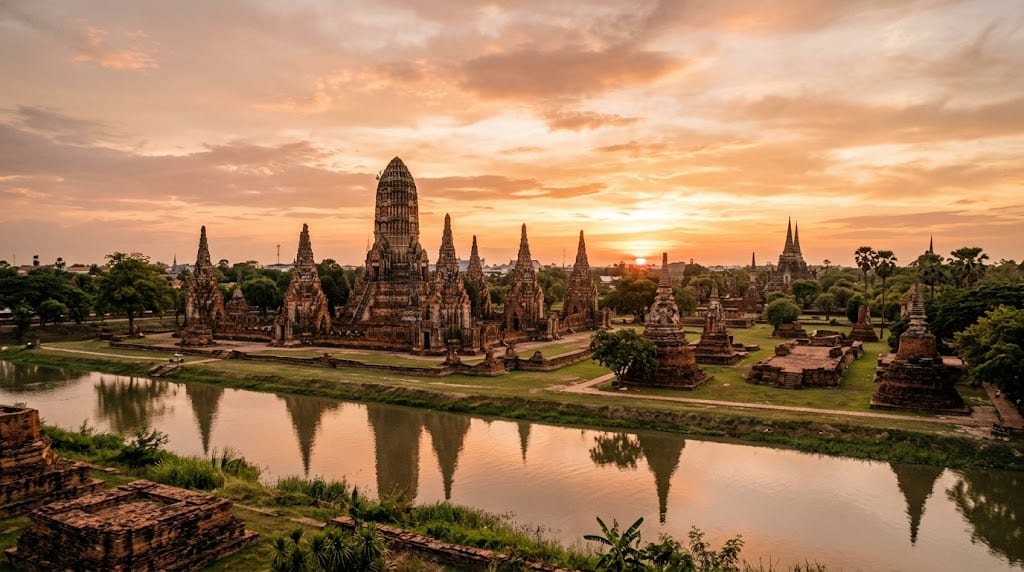
According to the Tourism Authority of Thailand (TAT), Ayutthaya is located 86 km north of Bangkok, and the historical park is a UNESCO World Heritage Site. Ayutthaya City Island is surrounded by the Chao Phraya River, Pa Sak River, and Lopburi River. Distance does not mean the same travel time from every hotel: local transfers add to the intercity trip.
Below we look at choosing stops, costs, and preparing for a walk. Details about visiting the monuments can be found in the companion guide to the temples. Fees and visiting conditions may change.
Current as of the update date
How to Get from Bangkok to Ayutthaya
Compare the whole route: from your accommodation to the departure point, waiting time, the intercity trip, and the transfer to the first temple. For the first leg, see the article about how to get around Bangkok. Buying a ticket to Ayutthaya only solves part of the logistics.
| Format | Departure | What to consider | Cost and its status |
|---|---|---|---|
| Train | Station of the chosen train | Carriage class, timetable, transfer after arrival | The ticket price per passenger depends on the chosen train |
| Minivan | Terminal or operator’s boarding point | Drop-off and return pickup location | The ticket service (SiamTickets) lists the carrier’s minivan (Win 91 Ayutthaya) for 150 ฿; details below |
| Taxi or car with driver | Agreed meeting point | Waiting time, stops, toll roads, and return | Offer for a car; the scope of services is arranged separately |
| Tour | Group meeting point | Itinerary, guiding, and included services | Package price; admission and meals should not be considered included unless described in the booking |
Train: choosing the station and ticket
The old guide from the Tourism Authority of Thailand (TAT) describes departures from Hua Lamphong Railway Station and from Krung Thep Aphiwat. Choose the station based on the specific train, not just on its proximity to your hotel.
Check the departure station, cost, and trip duration for the selected train. Compare the available carriage classes and ticket conditions: the old third-class fare is not suitable for calculating the current budget.
Minivan: the Mo Chit terminal and departures from Khao San
The Tourism Authority of Thailand (TAT) guide places the Minibus Station Chatuchak in front of the northern Mo Chit bus terminal, not inside it. The northern Mo Chit Bus Terminal itself and the minibus terminal should not be treated as one boarding point.
The ticket service (SiamTickets) lists the carrier’s minivan (Win 91 Ayutthaya) for 150 ฿. The same service describes departures by the companies Mama Travel and Tour and Tara Tour and Travel from the Khao San Road area. These departure points belong to the named companies, not to all minivans.
Taxi and car with driver
If you value comfort and the freedom to stop, consider a private car or taxi. A one-time transfer and a car with waiting time are different services, so list the transfers you need in advance.
In the booking, separately agree on the car cost, waiting time at the temples, toll roads, and the return to Bangkok. Specify where the trip ends: the price of delivery to the first monument does not describe the whole day.
Tour and river trip
A tour suits you if you want to hand over route and transfer planning to the organizer. Check whether the offer includes guiding, tickets, lunch, and the return trip.
A provincial tourism page describes local boat trips on hotel boats, restaurant boats, and longtail boats. These are boat trips in Ayutthaya; a river cruise back to Bangkok must be specified separately in the operator’s program.
How to get from the station and travel between temples
Ayutthaya Railway Station is located outside the historical island, on the eastern bank of the Pa Sak. After arrival, you still have to get to the first monument. Choose a land transfer in advance so that the start of your walk does not depend on the ferry’s operation.
The provincial page lists the main stands for tourist tuk-tuks near the station and major monuments. With a driver, you can discuss a separate transfer or the sequence of stops with waiting time. Agree on the route and price before boarding, including where the trip ends.
To talk with the driver, prepare a short list:
- the first temple and the next stops;
- where the driver will wait after the visit;
- whether waiting time is included in the offer;
- where to take you after the last temple.
A bicycle can be considered for a route that suits your fitness and the weather. Before renting, assess the chosen stops, bicycle return conditions, and the option to skip long transfers. There is no universal solution here: a bicycle is convenient for independent movement, while a tuk-tuk reduces the strain between monuments.
A simple guideline: choose the program first, then the transport. If an outlying temple becomes a required part of the day, include its transfer in the arrangement rather than leaving it to a random decision after the walk.
What to see in Ayutthaya on a first visit
With the Ayutthaya Historical Park, it is convenient to get acquainted by visiting selected monuments. Don’t turn the first visit into a contest over the number of temples: each place has its own distinctive features.
Wat Mahathat: the Buddha head in tree roots
In Wat Mahathat the head of a Buddha entwined in tree roots is located. If you want to see this image in particular, include the temple in your main program.
Wat Ratchaburana: the temple opposite Mahathat
Wat Ratchaburana is located opposite Mahathat. The provincial page describes visiting the inner chamber of the main prang and the former treasury; this description does not guarantee access inside on the day of your visit.
Wat Phra Si Sanphet: the royal palace temple
Wat Phra Si Sanphet served as a royal palace temple. There were no residential quarters for monks here, so its historical role differs from that of a working monastery.
Wat Chaiwatthanaram: a separate stop outside the island
Wat Chaiwatthanaram is located opposite the southwestern part of the historical island. Treat it as a separate stop with transport arranged in advance, not a required extension of every walk.
Wat Yai Chai Mongkhon: a working monastery
Wat Yai Chai Mongkhon is known for the province’s largest pagoda, and monks live inside. Here, exploring historical structures coexists with active religious life.
The difference is already evident from the temples’ purposes: Phra Si Sanphet served the royal palace, while monks live at Yai Chai Mongkhon. So choose stops based on your interest, not only on how similar the ruins look in photos. For details on visiting, open the detailed guide to Ayutthaya’s temples; for comparing cultural routes, see the temples of Chiang Mai.
One-day route in Ayutthaya
For a first visit, we suggest a sequence of stops without a rigid schedule. This is a selection scheme, not a promise to get through the entire list: the duration of sightseeing and transfers depends on your transport and pace.
- Arrival. Get to the first monument by the chosen method.
- Mahathat. Start with the temple where the Buddha head is in tree roots.
- Ratchaburana. Continue sightseeing with the temple opposite.
- Phra Si Sanphet. Add the royal temple if the program remains comfortable.
- Break. Leave time for eating and resting.
- Chaiwatthanaram. Include a separate stop if you have time and transport.
- Return. Finish the route with a transfer to the agreed pickup point.
The shortened program: Mahathat, Ratchaburana, and a break. It keeps the introduction to the temple ruins and leaves more freedom for the return trip. You don’t have to add the next site just because it’s on the list.
In this Ayutthaya guide, outlying stops remain a choice, not an obligation. Before an additional transfer, assess the weather, your well-being, and the return conditions. If sightseeing becomes tiring, ending the visit after a break is a normal decision.
For a group, agree on mandatory and optional places before departure. If you are traveling with children or someone has difficulty walking for long periods, use the shortened program and arrange transport between stops. It is better to name a particular temple as a priority in advance; then it won’t need to be added at the end of the day at the expense of rest or the return trip.
Temple tickets and trip budget
Admission to Wat Mahathat is listed for 80 ฿ on the official Wat Mahathat page at the Japan office of the Tourism Authority of Thailand (TAT Japan). Check the current price. This is the price for a single temple, not for the entire historical park.
| Expense | Amount | Status |
|---|---|---|
| Admission to Wat Mahathat | 80 ฿ | Price on the official attraction listing |
| Bangkok — Ayutthaya ticket from the seller (Busaba) | 100 ฿ | Seller’s offer; price check noted October 3, 2026 |
| Carrier’s minivan (Win 91 Ayutthaya) from the service (SiamTickets) | 150 ฿ | Seller’s offer |
| Combined ticket from the old guide of the Tourism Authority of Thailand (TAT) | 220 ฿ | Historical information: a validity period of 30 days is described; current terms are not established |
The seller’s notice (Busaba) indicates a price check, not the date of a fare change. Seller offers do not add up to a single fare set by carriers: compare specific tickets and boarding points. For the combined ticket from the old guide, the current price, the list of sites, and the validity period are not confirmed, so savings should not be calculated from it.
Take cash as a backup payment method. This is useful preparation, but it does not mean that every temple accepts only cash or that there are no online sales.
For your budget, split costs by trip format:
- Self-guided: round-trip travel, local transport, admission to selected temples, food.
- Group with a driver: car, waiting time, toll roads, return trip, admission, and meals.
- Tour: package price and anything the operator did not include in its description.
Comparison is more useful if the cost breakdown is the same. A per-passenger ticket cannot be directly compared with a car offer that includes waiting time. Also separate the cost of transport from the admission fee: booking a car alone does not describe the terms of entry to the temples.
When to go, what to bring, and how to behave in temples
Choose the date based on the forecast, route availability, and how you handle walking. For general trip planning, see the seasons and choosing travel dates in Thailand. Even with a good forecast, leave room to shorten the program.
Pack for walking and visiting temples:
- water;
- sun protection;
- rain protection;
- comfortable shoes;
- light clothing covering shoulders and knees;
- a shawl or pareo;
- cash.
Covered shoulders and knees are a recommendation for preparing for a temple visit. A light shawl is convenient to carry so you can add to your clothing on site. Don’t assume the dress requirements are the same at every site.
Official restrictions are set out in the provincial agency’s notice on rules for visiting ruins. You must not touch areas marked with warnings about fragility. Bringing weapons, explosives, flammable materials, and dangerous chemical substances onto monument grounds is prohibited.
For the offensive behavior, disrespect toward religion or culture, or disturbing other visitors described in the notice, the provincial agency specifies imprisonment for up to 1 month and a fine of up to 10 000 ฿. This notice should not be interpreted as a fine for every clothing violation. General rules of etiquette in Thailand will help you prepare for visiting religious sites.
Availability of certain roads, ferry crossings, and monuments during floods as of the update date is not confirmed. Before departure, check the conditions of your chosen route and official announcements. If the needed transfer is unavailable, replace a stop or shorten the program instead of building your trip on the assumption that a ferry is running.
What to see besides the main temples and where to take a break
If you want to diversify your day, choose an additional place of interest to you. A village, a boat museum, and a market offer different themes for getting to know Ayutthaya. You don’t need to include all of them in a one-day program.
The Portuguese Village adds the theme of foreign communities. According to the provincial page, the Portuguese arrived in the city in 1511 and were the first Europeans in Ayutthaya. Choose this stop if the city’s history of ties with other countries interests you more than an extra temple.
The Thai Boat Museum displays historic boats, almost all of which can still be used. The museum offers a different theme for sightseeing: the boats themselves, not temple structures. Don’t replace this stop with a boat ride: these are different activities.
The Ayothaya Floating Market is described as having stalls with food, souvenirs, local goods, and handicrafts. Consider the market an optional addition, taking into account its place in your program and the return trip.
It’s best to plan a meal break regardless of whether you visit the market. Choose a stop that doesn’t require an extra transfer and suits your group. Don’t treat lunch as a reward for finishing the whole list of temples.
To learn about dishes and ordering, read, what to try and how to order Thai food. The name of a dish alone does not make it a local specialty of Ayutthaya. For a short trip, it is more useful to choose a suitable place to rest than to attempt a separate food-focused program.
How to plan the return to Bangkok
Determine the return trip before leaving Bangkok. For a self-guided trip, choose the departure and boarding point; for a car, agree on waiting time and the final destination; for a tour, read the return conditions. The last temple must fit within this arrangement.
Save the details you’ll need after the visit:
- return boarding point;
- terms of the selected ticket;
- how to get from the last stop;
- arrangement for the driver’s waiting time;
- carrier or organizer contact.
Don’t assume you must return from the same point where you were dropped off. For a specific ticket or booking, it’s better to determine the boarding point in advance. This is especially useful if, after the central temples, you’re going to a separate stop outside the island.
With a car on waiting time, specify not only when the program ends but also the address in Bangkok where you need to be returned. If plans change, discuss an additional stop before the transfer. This lets you agree on services instead of understanding the price of the booking differently.
A tour with a river segment is possible if the operator offers such a program. A local boat trip does not automatically replace return transport. Don’t tie a self-guided route to a sunset cruise, evening lighting, or a ferry crossing without confirmed conditions for the specific trip.
Frequently Asked Questions ❓
How long does it take to get from Bangkok to Ayutthaya?
The duration depends on the chosen train, departure point, and road conditions. Go by the timetable for the specific service. Add to the intercity leg the trip to the station or terminal, waiting time, and the transfer to the first temple.
What is the cheapest way to get there?
Without the price of a specific train, you can’t confidently name the cheapest option. The seller (Busaba) shows a ticket for 100 ฿ with a price check note dated October 3, 2026, and the service (SiamTickets) shows the carrier’s minivan (Win 91 Ayutthaya) for 150 ฿. These are separate offers; compare them together with the costs of getting to the departure point and after drop-off.
Can you visit Ayutthaya in a single day?
For a one-day trip, choose a limited program of temples with a break and a carefully planned return. Don’t try to visit every site on the list. With complicated transfers or uncomfortable weather, shorten the program.
How much is admission to the temples in Ayutthaya?
The Japan office of the Tourism Authority of Thailand (TAT Japan) lists admission to Wat Mahathat at 80 ฿; check the current price. This is the price for a single temple. The old guide describes a combined ticket for 220 ฿ valid for 30 days; however, its current terms are not established.
When is the best time to go to Ayutthaya?
Choose a date based on the forecast and the availability of the chosen roads and monuments. Plan breaks in advance and the option to shorten the walk. A particular time of year does not guarantee comfortable weather on the day of your trip.
What is the best way to get around Ayutthaya itself?
A bicycle can be considered for a manageable route in suitable weather, and a tuk-tuk for transfers between monuments. The provincial page lists the main tuk-tuk stands near the railway station and major monuments. Agree on cost, stops, and waiting time before your trip.
Conclusion
This Ayutthaya guide helps you plan a trip around your interests and abilities. For a self-guided day, choose a limited route and plan local transfers and a break. If you prefer a car or a tour, agree in advance on the return trip and the scope of services, including any separate fee for visiting sites.
Fares, visiting conditions, and route availability may change, so keep your program flexible. Choosing stops is helped by the detailed guide to Ayutthaya’s temples. For continuing the cultural program, open the article about the Grand Palace in Bangkok and save the palace complex on the map (Grand Palace). It’s better to leave an optional temple for your next visit than to skip rest and complicate the return trip.
Prepared by MyThai.online editorial team.