In this article:
What has changed: Tickets for foreigners: separate — 80 ฿, combined — 300 ฿ for seven sites. From August 9, 2026, the Bangkok Connex railway service operates in an updated format: it serves Krung Thep Aphiwat station daily; additional ticket purchase channels are the D-Ticket electronic ticket system and 1690.
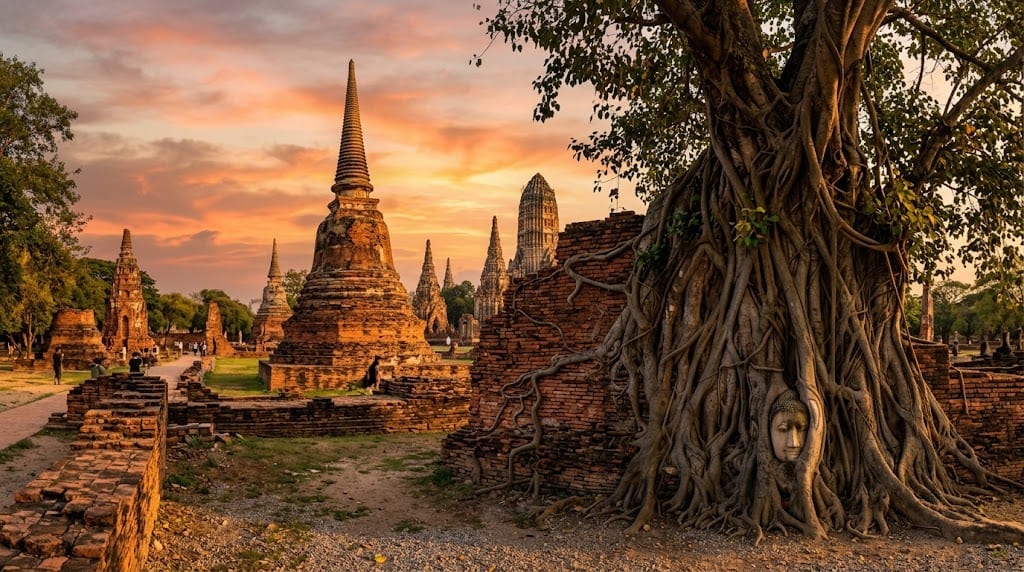
The temples of Ayutthaya are best explored starting with Wat Mahathat, Wat Phra Si Sanphet and Wat Chaiwatthanaram. The Buddha head in the tree roots, the royal stupas, and the temple complex by the river each give a different impression and help you plan an independent trip from Bangkok. Choose additional stops by your interests, leaving time for rest and the return trip.
Ayutthaya was founded in 1350 and destroyed by the Burmese army in 1767 — UNESCO gives these dates. Today, it is best to plan a trip to its monuments as a series of separate visits: choose the complexes, sort out the tickets, and decide how to get between them. Below are the main sites, the published fares, transport options, and the suggested order of visits.
Current at the time of publication. Fares and visiting conditions may change; the historical information and practical advice will help you prepare but do not replace the announcements of each specific site.
Which Ayutthaya temples to see first
For a first visit, we suggest a core route of complexes with different main features. Mahathat suits those who want to see the Buddha head in the roots, Phra Si Sanphet offers a chance to get to know a royal temple, and Chaiwatthanaram is for seeing the architecture by the river.
| Temple | Main feature | Role in the route | Ticket and hours information |
|---|---|---|---|
| Mahathat | Buddha head in the tree roots | Starting stop | Included in the Fine Arts Department’s combined ticket |
| Phra Si Sanphet | Three large Sri Lankan-style stupas | Introduction to a royal temple | Included in the combined ticket |
| Chaiwatthanaram | Central prang and location by the river | Evening stop | Included in the combined ticket; the Tourism Authority of Thailand’s listing gives 08:00–18:00 |
According to UNESCO, historic Ayutthaya was inscribed on the World Heritage List in 1991. The site covers 289 hectares: these are the boundaries of the heritage site, not the whole island.
These stops have different focuses, so the route is not about repeating similar views. You can choose architecture, sculpture or the history of the royal court, and leave more time for what interests you most. Questions about accommodation and getting to know the city beyond the temples are covered in a guide to Ayutthaya.
Wat Mahathat: Buddha head in the tree roots
Wat Mahathat is recognized by the Buddha head entwined with tree roots. The provincial tourist guide highlights exactly this detail. Start with it, but leave time to explore the temple ruins too: the trip does not have to be limited to the familiar shot.
For photos, we suggest sitting down or leaning in slightly next to the Buddha image. This is advice on respectful behavior; you can choose your angle without touching the sculpture or the roots. Do not block other visitors’ view.
The complex also has a museum extension. The provincial guide reports that finds from the 1956 restoration, including Buddha images, amulets and gold ornaments, are displayed at the Chao Sam Phraya National Museum.
If you are interested in objects found during the restoration, the museum can be visited separately from the main temple route. Do not add it automatically to an already busy day; it is better to decide in advance what you want to focus on.
Wat Phra Si Sanphet: royal temple and three stupas
Wat Phra Si Sanphet served as a temple of the royal palace. According to the provincial guide, there were no residential quarters for monks here. Royal court purpose helps you see how this complex differs from a working monastery.
The main visual feature is three large Sri Lankan-style stupas. Try to look at them together first, then examine each one separately: this way the visit is tied to the architecture, not just to finding a spot for a photo.
The provincial guide compares the complex’s purpose to that of the Temple of the Emerald Buddha (Wat Phra Kaew). This is a parallel between royal shrines, which does not mean the same appearance or the same visiting rules.
To continue the topic, see the royal palace complex in Bangkok (Grand Palace). Here it helps to compare the role of a temple beside a palace, without expecting the monuments to be fully alike.
Wat Chaiwatthanaram: architecture and sunset by the river
Wat Chaiwatthanaram was built in 1630 under King Prasat Thong — this dating is given by the Princess Maha Chakri Sirindhorn Anthropology Center. According to the Tourism Authority of Thailand, the king built the temple on the western side of the Chao Phraya River in memory of his late mother.
The central prang symbolizes Mount Meru. This is a religious image in the architecture of the complex. The Tourism Authority of Thailand also notes a resemblance to Angkor Wat, and it presents the construction as commemorating a military victory only as one version.
For the route, we suggest leaving this complex for the evening: the tourism authority highlights its evening views. Just do not turn the sunset into a promise of a night visit. An evening visit needs to fit within the opening hours, and do not assume in advance that there will be permanent lighting or that you can walk through all the galleries.
Plan time both for the visit itself and for the return. If you want to continue exploring Bangkok’s temples, read separately about the Wat Arun temple (Wat Arun).
Other temples: Ratchaburana, Lokayasutharam and Yai Chai Mongkhon
Choose additional stops based on what you want to see. They complement the main route, but you do not need to include all the complexes in one day.
Wat Ratchaburana
Wat Ratchaburana is of interest for its crypt, which UNESCO mentions. The existence of a crypt does not mean the descent is open to visitors on the day of your trip. Plan the visit without requiring a trip to the underground part.
Wat Lokayasutharam
Main feature Wat Lokayasutharam — a reclining Buddha 42 meters long, according to the provincial guide. We suggest this stop for those interested in sculpture. It shifts the focus of the trip after seeing the stupas and temple ruins.
Wat Yai Chai Mongkhon
Wat Yai Chai Mongkhon combines historic structures with a working monastery where monks live. The provincial guide confirms this. Choose it if you want to see a place where the historic complex remains part of monastic life, and allow separate time for it.
Tickets and opening hours of the temples
Fares for foreigners are published in the Fine Arts Department’s announcement. Separate ticket — 80 ฿ per person, combined ticket — 300 ฿ per person. These are the published fares; the date of any change is not stated here.
The combined ticket includes seven sites:
- Mahathat;
- Ratchaburana;
- Wat Phra Ram;
- Phra Si Sanphet with the Ancient Royal Palace;
- Chaiwatthanaram;
- Wat Maheyong;
- Wat Kudi Dao.
Choose your ticket based on the stops you plan to visit, rather than building your route around everything the ticket covers. Lokayasutharam and Yai Chai Mongkhon are not named in this list. The validity period and re-entry conditions are not specified in the notice.
The Tourism Authority of Thailand’s listing for Chaiwatthanaram gives opening hours 08:00–18:00. These hours apply to one specific temple; they do not set a general schedule for the park or confirm when the ticket office is open.
Before your trip, confirm current prices and check the schedules of the sites you plan to visit. A city walk and entry to a specific monument are different parts of the trip; the existence of walking areas does not mean free access to all the temple complexes.
How to get from Bangkok and choose a departure station
The Bangkok Connex railway service has been operating in an updated format since August 9, 2026 — in the source, this is August 9, 2569 in the Buddhist calendar. The route has been extended to the Krung Thep Aphiwat Central Terminal, with daily service.
Additional ticket purchase channels include the D-Ticket electronic ticket system and the 1690 information line. These changes are described in the official announcement about the railway service update.
Choose your departure station based on the train. According to the transport guide, most long-distance trains depart from Krung Thep Aphiwat, while ordinary slow third-class trains continue to run from Hua Lamphong Railway Station. So naming the destination alone is not enough.
The preparation order is simple:
- Choose the train to Ayutthaya and the return train.
- Take the departure station from the details of the specific train.
- Decide how to get to the station and how much time to allow before departure.
- Match your last temple stop with the return trip.
Minivans and organized tours are alternatives to the train. Compare them by convenience for your trip, without assuming that one option is always faster than the other. For the trip to the station, a helpful resource is the guide to transport in Bangkok.
How to get around between the temples and plan a route
The Ayutthaya Railway Station is on the far side of the Pa Sak River from the historical park. The tourist guide describes a passenger ferry to the historic Ayutthaya City Island. Do not build your whole day on the assumption that the ferry will definitely be operating, especially during flooding.
For getting around, we suggest a bicycle or a tuk-tuk. Choose a bicycle if physical activity is comfortable for you and the weather is suitable; choose a tuk-tuk if you want to cut down on moving around on your own. Agree on the price and conditions of the trip before you start.
You can plan a route through the temples of Ayutthaya like this:
- Start with Mahathat and the Buddha head in the roots.
- Continue to Ratchaburana, without counting on a required descent into the crypt.
- See the royal temple Phra Si Sanphet.
- Add Lokayasutharam to see the reclining Buddha.
- End the visit at Chaiwatthanaram, if there is time before closing and the return trip.
This is a suggested plan, not a standard for sightseeing. A shortened version is Mahathat, Phra Si Sanphet and Chaiwatthanaram; add other stops depending on how you feel. Do not try to fit in everything.
Allow time to rest between visits and leave a buffer for the trip to the station. If you stay longer at a complex you enjoy, drop the next optional stop; this keeps your trip at a comfortable pace.
Clothing, visiting rules and trip preparation
For the trip, we recommend clothing that covers your shoulders and knees, plus a light scarf or sarong. Avoid overly revealing clothing; check the footwear and clothing requirements against the instructions at each specific shrine. Before entering a working shrine, check whether you need to take off your shoes.
Open ruins and a working monastery may have different visiting conditions. General advice on respectful behavior is collected in the article on etiquette in Thailand.
Separately, confirmed prohibitions apply on the grounds of the monuments. A government announcement prohibits:
- sitting on ancient structures and climbing on them;
- removing archaeological objects;
- bringing in weapons, explosive and flammable substances, or dangerous chemicals;
- leaving trash outside designated places.
Ruins must not be used as seats or photo platforms. Choose your angle from permitted areas and do not go beyond barriers. For a walk, we suggest bringing water, sun protection, comfortable shoes, and a small amount of cash for expenses.
Flooding and access
In an official announcement, authorities described the installation of protective panels along the Chao Phraya in front of Chaiwatthanaram and the raising of the protection height due to rising water levels. This is information about measures taken, not a guarantee of access to every area.
In another announcement, the province described the main roads and tourist sites as accessible. Before setting out, check the latest official announcements from the province and the historical park: conditions may affect access roads, the ferry crossing and the order of stops you have chosen.
Frequently Asked Questions ❓
How much is a ticket to the temples of Ayutthaya?
The Fine Arts Department publishes the fare for foreigners: a separate ticket costs 80 ฿ per person, and a combined ticket costs 300 ฿ per person. The combined ticket includes the seven sites listed above. Check the current price; the validity period and re-entry conditions are not specified in the notice.
Do I need to pay to enter the Ayutthaya Historical Park?
Distinguish between walking through city areas and entering individual monuments. Entrance fares are published for the sites listed in the Fine Arts Department’s notice. Do not assume free access to all complexes just because they are on the historic grounds.
What is the dress code at the temples of Ayutthaya?
We recommend covering shoulders and knees; a light scarf or sarong is useful at working shrines. On site, follow the instructions about clothing and footwear. The visiting conditions of a specific shrine may differ from those for viewing open ruins.
What time is best to visit Ayutthaya?
To start the route, you can choose the morning and leave breaks for rest. Chaiwatthanaram is known for its evening views; the Tourism Authority of Thailand’s listing gives 08:00–18:00. Schedules may change, and visiting after closing depends on individual announcements.
How do I get to Ayutthaya from Bangkok?
One option is the Bangkok Connex railway service, which serves Krung Thep Aphiwat station every day. Additional ticket purchase channels are the D-Ticket electronic ticket system and the 1690 information line. For other trains, choose the station based on the specific route and plan your return in advance.
Can you see Ayutthaya in one day?
You can plan a one-day route around the temples you choose. A bicycle or tuk-tuk helps you move between complexes, and the pace depends on the weather, transport and time for sightseeing. If the day is overloaded, shorten the list and leave a buffer for the return to Bangkok.
Conclusion
The temples of Ayutthaya are best chosen according to your interests and comfortable pace: for some, royal architecture matters most; for others, Buddha images and evening views by the river. Start with the main stops, decide how you will get around, and choose a ticket for the complexes you pick. Keep additional sites for if you have enough time and energy.
Before your trip, save the stops you need on a map and link your route to your return train. Allow time to rest and a buffer for the trip to the station, especially if you end your day by the river. Published fares, transport services and visiting conditions may change. A good plan leaves room to drop a stop, linger where it is interesting, and return to Bangkok calmly.
Prepared by MyThai.online editorial team.