In this article:
What has changed: After the reopening, visits are allowed on a 15 rai area, subject to 25 conditions. The last entry is listed at half past five in the evening. Free entry was initially announced only for the first month; guides still list free visits and parking. Check the current admission fee before your trip.
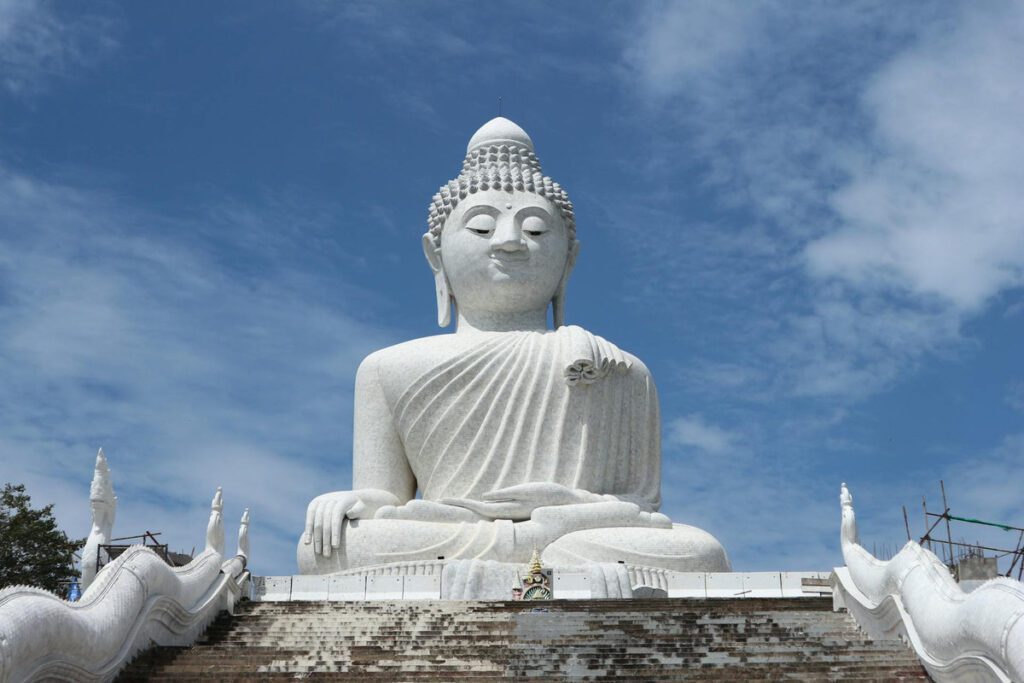
Big Buddha Phuket is a white marble statue 45 meters tall on Nak Kerd Hill above Kata Beach. After the reopening, you can again plan a trip to see the statue, the temple area and the viewing terraces. A practical option without driving yourself is a taxi or a tour. Arrange the return trip from the hill before you set out.
Current as of the update date. This guide helps you choose transport, understand visiting hours and last entry, prepare clothing, and plan your sightseeing route. Reopening does not mean continuous access to all slopes and trails: conditions can change, especially after heavy rain.
For your visit, prepare clothing that covers your shoulders and knees, and leave extra time for the trip. If you are planning a wider route, see other attractions in Phuket.
Is the Big Buddha in Phuket open and who runs the complex
According to the Visit Thailand guide, the reopening took place March 3, 2026, after a landslide in August 2024. The reopening makes it possible to include the site in a tourist route, but on its own does not confirm the condition of every section of the hill.
Newspaper article in the press review on the website of the Royal Forest Department describes the transfer of exclusive management to Wat Kata. It refers to the use of an area permitted by the Forest Department, measuring 15 rai under strict compliance with 25 conditions. These conditions concern how the territory is used; describing them only as safety regulations would be inaccurate.
The press review contains newspaper material, not an engineering assessment or the original permit. It cannot be used to conclude that all slopes are reinforced, that all trails are accessible, or that the complex has been officially renamed.
The local outlet The Phuket News reported that the reopening happened while court proceedings related to the landslide were ongoing. This describes the circumstances of the reopening, not confirmation of a current closure or the status of the proceedings as of October.
Opening hours, last entry and admission cost
The schedule and cost details come from different sources. For planning your trip, it is convenient to separate them:
- Opening hours: in the reopening announcement, daily from nine in the morning to six in the evening.
- Last entry: at half past five in the evening, according to the Silqhaus guide for September 2026. It also gives opening hours of nine in the morning to six in the evening.
- Admission: free, donations are voluntary, according to the Window on Phuket guide.
- Parking: free, according to the local guide “Phuket Sto Odin”.
There is a nuance about cost. In the initial report by The Phuket News, free admission was announced only for the first month: the temple planned to assess management costs and visitor numbers. Later guides continue to describe the visit as free, but the current cost has not been established directly by the operator.
Check the cost before your trip. A limited initial period does not prove that admission has become paid, and a voluntary donation should not be treated as a mandatory ticket. The update date of this guide also does not mean the operator confirmed the rate in October.
Managing temple Wat Kittisangharam (known as Wat Kata) is a separate location. This map leads to the temple, not to the statue on the top of the hill.
How to get to the Big Buddha and arrange the return trip
A landmark in the Chalong area — Chalong Circle. Choose the end point of your trip separately: Big Buddha.
The “Thailand Addict” guide describes the approach from Chao Fa West Road through Soi Yot Sane 1. Beyond that, it is about 6 kilometers of climbing on a winding paved road, steep in places. This is the route description in the guide, not a current confirmation of road conditions.
According to Visit Thailand, there is no public bus to the top. The main options are taxis, ride-hailing apps, or a tour.
| Option | Who it suits | What to arrange for the return |
|---|---|---|
| Taxi or tuk-tuk | For those who want to travel with a driver | Waiting time at the top or return time, meeting point and total price |
| Trip via app | For those who prefer to book transport from a smartphone | Possibility of returning with the same driver; a separate return booking does not guarantee a vehicle |
| Tour | For those who want a ready-made route | Pickup time, boarding point and included stops |
| Rental car | For a driver with suitable experience | Return plan and parking location |
| Rented scooter | For an experienced driver familiar with steep, winding roads | Return planned around weather and road surface condition |
The Visit Thailand guide does not recommend this approach to inexperienced scooter riders. Phuket Spirit separately warns about slippery wet surfaces and difficult steep bends. If you have little experience, choose transport with a driver.
Before boarding, discuss waiting time, the return trip, additional stops and the total cost. With a tuk-tuk you can agree that the driver will wait at the top; the price is by agreement. By the way, it is more convenient to compare the cost of the whole route, not only the climb. The options are explained in more detail in the Phuket transport guide.
What to see: the statue, temple area and viewing terraces
The Big Buddha in Phuket stands on the summit: Nak Kerd Hill — the site of the statue. Its height of 45 meters and white marble cladding are described in a Tourism Authority of Thailand article.
The Window on Phuket guide describes access to the statue, the main staircase, the temple area and the viewing terraces. The visit can be structured in this sequence:
- After arrival, start at the lower terrace and assess the climb ahead.
- If the staircase suits you, climb up to the base of the statue.
- Look at the Buddha figure and the smaller golden statue beside it.
- Walk along the accessible terraces and the temple area, without obstructing prayers and offerings.
According to a government publication from the Public Relations Department, the statue’s structure is reinforced concrete, with marble cladding. The fingers of the right hand point downward: the Buddha calls the earth to witness, confronting the temptations of Mara. This detail helps you understand the image, not just assess its scale.
According to the Silqhaus guide, construction began in 2004 and was funded by public donations. It also describes the smaller golden brass Buddha statue beside it.
The MegaTour Phuket guide notes views toward Kata, Karon, wooded hills and the west coast. The panorama depends on where you stand, so it makes sense to walk along the accessible terraces. To compare routes, it will be useful to see the Karon viewpoint (Karon Viewpoint).
Here, sightseeing and religious life coexist. You may see prayers, offerings and blessings, but the presence of a monk and receiving a sai sin thread are not guaranteed. A blessing is not a service included in the visit.
Dress code, rules of conduct and what to bring
For the visit you need covered shoulders and knees. Sleeveless tops, shorts above the knee and beachwear are not suitable; shoes are removed where signs require, according to Visit Thailand recommendations.
The “Phuket Sto Odin” guide mentions free sarongs at the entrance. The current operator’s terms for providing them are not confirmed, so it is more convenient to arrive already prepared or bring your own wrap. Do not assume that clothing will necessarily be given to every visitor.
Recommendations from the Visit Phuket guide help you behave respectfully:
- Speak quietly and do not play loud music.
- Do not block the way of people praying or making offerings.
- Set your phone to silent in the prayer area.
- Do not climb on Buddha images, statues, railings or sacred structures for a photo.
- Ask permission before photographing monks, ceremonies or personal moments.
For photos, choose a spot where you do not disturb others, and follow the signs. Advice about standing with your back to the statue should not be taken as a confirmed general ban on the complex. Other cultural nuances are explained in rules of etiquette in Thailand.
For a walk, bring:
- Water.
- Shoes with good grip.
- Headwear.
- Sunscreen.
- Insect repellent.
- Your own wrap if your clothing does not cover your shoulders or knees
Advice on water, footwear, and protection from the sun and insects is in the “Phuket Sto Odin” guide’s piece on the walk from Karon. The list does not confirm that the walking trail is open now.
When to visit and how much time to allow
A practical option is the morning, shortly after opening. The “Phuket Sto Odin” guide recommends it for the cooler temperatures and smaller crowds. This is a planning recommendation, not a promise of an empty parking lot or an open viewing area.
Plan an evening trip around the schedule: according to the Silqhaus guide for September 2026, the last entry is at half past five in the evening, and closing is at six in the evening. Arriving by last entry is not the same as leaving time for a relaxed visit. Being able to stay until actual sunset is not guaranteed.
For a regular visit, “Phuket Sto Odin” suggests a guideline about an hour. If you want to take photos at a leisurely pace, walk the terraces and rest, allow extra time. Plan the road and waiting for transport separately from sightseeing.
Rain can make the approach slippery, and cloud cover can block part of the view. Do not tie your trip only to the light you want for photos: weather, visiting hours and the return trip matter more than a rigid plan.
Staircase, accessibility and walking up from Karon
The “Phuket Sto Odin” guide describes 94 steps to the base of the statue. It also notes that you can drive to the lower terrace. If the staircase does not suit you, the lower level can be treated as a separate destination.
However, driving up does not confirm a fully accessible route for a wheelchair or stroller. Arrange the drop-off point and access to the needed area in advance: stopping a car and having a continuous unobstructed path are different questions. The staircase description also does not mean there is no alternative way up.
What about the walking route from Karon? Descriptions of such a trail exist, but its official current status after the reopening has not been established. The old route cannot be used as a confirmed instruction for a permitted passage.
So do not make the walk up the only way to reach the complex. The Window on Phuket guide recommends checking access on the day of your trip, especially after heavy rain; reopening the complex does not automatically mean all trails around it are open.
How to combine the visit with Wat Chalong
The Tourism Authority of Thailand includes the Big Buddha and Wat Chalong in one recommended route. It is convenient to combine both visits in one trip and arrange stops with the driver in advance.
Do not confuse the temples: Wat Chalong is a separate attraction, while Wat Kata is the managing temple of the Big Buddha complex. The name of the managing temple does not indicate a stop at Wat Chalong.
For a morning trip, this sequence works:
- Agree with the driver on both stops, the waiting time and the end point of the route.
- Arrive at the Big Buddha after opening.
- Look around the accessible terraces, the statue and the temple area.
- Continue the trip to Wat Chalong.
- Return to the agreed meeting point.
If you change the order, leave enough time before the last entry to the Big Buddha. It is better not to plan a fixed travel time: here the route matters more than an exact timetable. To prepare for the second stop, it will help to read the Wat Chalong guide.
Frequently Asked Questions ❓
How much does admission to the Big Buddha in Phuket cost?
Guides list free admission and parking, and donations are described as voluntary. The initial report provided for free admission only for the first month; the current cost has not been established directly by the operator. Check it before your trip: this does not mean a confirmed admission fee has been introduced.
How can I get to the Big Buddha without a car?
You can use a taxi, a ride-hailing app or a tour: there is no public bus to the top. Before departure, agree on waiting time or the return trip, additional stops and the total price. Do not count on a vehicle being guaranteed to be available at the top.
Can I visit the Big Buddha in shorts or revealing clothing?
Clothing must cover the shoulders and knees; shoes are removed where signs require. The guide mentions free sarongs, but the current operator’s conditions for providing them are not confirmed. It is safer to arrive in suitable clothing or bring your own wrap.
How much time do I need to see the Big Buddha?
A local guide suggests about an hour for a regular visit. For leisurely photos, rest and a walk along the accessible terraces, allow extra time. This is a planning guideline, not a limit on how long you may stay.
Is it better to go to the Big Buddha in the morning or the evening?
A practical option is shortly after opening. According to the guide for September 2026, the complex operates from nine in the morning to six in the evening, with the last entry at half past five in the evening. Plan an evening visit within this schedule; the chance to stay until actual sunset is not guaranteed.
Is the Big Buddha in Phuket open after the 2024 landslide?
The reopening took place on March 3, 2026, after the landslide in August 2024. A publication from a Forest Department press review describes the use of a permitted area of 15 rai, subject to compliance with 25 conditions. Reopening is not equivalent to a guarantee that all slopes and trails are safe; after heavy rain, check the access status on the day of your trip.
Conclusion
People go to the Big Buddha in Phuket for the white marble statue, the temple atmosphere and the views from the viewing terraces. For a relaxed visit, choose suitable transport, prepare clothing that covers your shoulders and knees, and bring water. If you are not used to steep winding roads, a trip with a driver helps you avoid climbing the hill on a scooter yourself.
Arrange the return from the hill in advance, and include waiting time and extra stops in the agreement. The visit can be combined with Wat Chalong, leaving time to see both places. Opening hours and access conditions can change, so plan your route with some margin. To continue preparing for the trip, it will help to read the guide to Phuket’s beaches.


Prepared by MyThai.online editorial team.