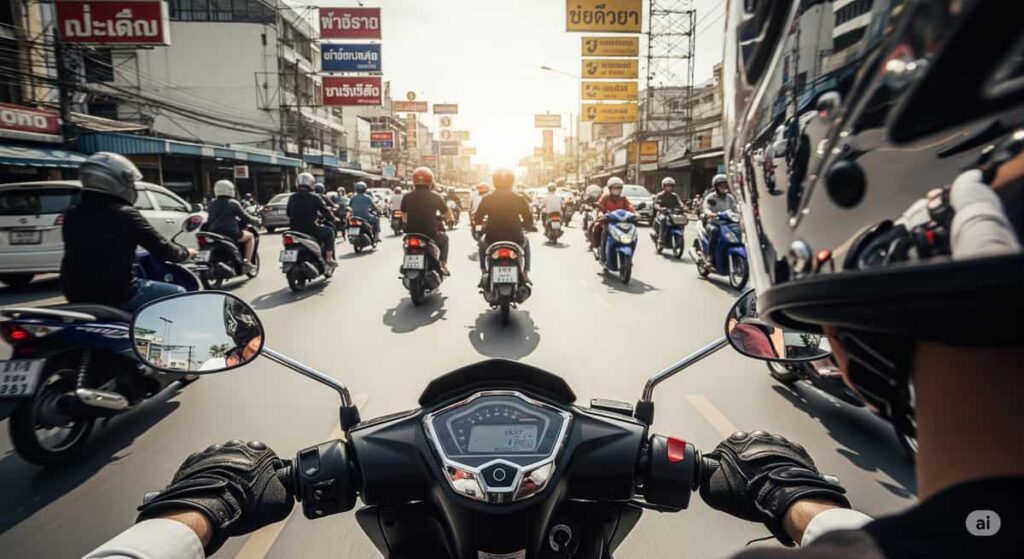
In this article:
What has changed: Maximum fines for not wearing a helmet have been added: up to 2,000 baht for the driver and up to 4,000 baht for the driver when a passenger is not wearing a helmet. Blood alcohol thresholds for different driver categories have been clarified, as well as possible consequences of riding without valid licenses for insurance.
Before riding on your own, check your driving documents, assess your skills, inspect the vehicle, and understand the insurance terms. Road safety in Thailand starts before you get the keys: a rental operator’s agreement to hand over a scooter does not replace a motorcycle license, and the words “insurance included” do not explain who will pay for treatment or repairs.
If you are tired after the flight, unsure about driving, or traveling with children, consider a taxi, a transfer, or public transport. Passengers also need preparation: check the helmet or seat belt, and agree on where to get on and off. Pedestrians should choose a crossing with good visibility and watch traffic along the road edge.
Current as of publication. Conditions may change. Neither suitable documents, nor protective gear, nor a completed checklist rule out a traffic accident or guarantee an insurance payout, but they help you make more considered decisions before setting out.
How to Choose a Vehicle Based on Experience and Route
Start with your route and your abilities. Riding on your own requires suitable documents and the skills to operate the chosen vehicle; a wish to move freely around the island does not in itself mean you are ready for the road. Reading this guide does not replace learning to ride a motorbike.
After landing, it is better to rest first. Watch traffic as a passenger or pedestrian: how intersections are arranged, where you can stop, and how convenient it is to get to your accommodation. Don’t rush to take a vehicle just because a rental shop is near your hotel.
Before choosing, ask yourself a few questions:
- Can you confidently drive exactly this kind of vehicle?
- Do you have documents authorizing you to drive a car or motorcycle?
- Is the route clear, including the return?
- Will you be carrying a passenger, children, or luggage?
- Do the weather and your condition allow you to ride calmly?
- Have you figured out your insurance coverage?
If any answer raises doubts, consider a trip with a driver or public transport. For a family route, plan in advance how to protect your child, handle seating, and stow luggage. For a motorbike, separately assess whether you are ready to ride with a passenger: such a trip should not be used as training.
Left-Hand Traffic and Unfamiliar Road Situations
When adapting to left-hand traffic, it helps to go over the route in advance, especially turns, U-turns, and leaving a parking lot. After each turn, consciously check your lane, road signs, and markings. If you miss an exit, it is better to re-route after stopping safely than to correct the mistake with a sudden maneuver.
Leave yourself extra space. Watch for vehicles on your side, possible lane changes, and traffic along the road edge. Don’t assume that other road users have necessarily noticed you or will keep going at their previous speed.
The saying “whoever is bigger has priority” does not explain the right-of-way rules. Make decisions based on how the specific intersection is organized, traffic lights, signs, and road conditions. A route involving a U-turn should also be studied in advance: don’t transfer the layout of a familiar interchange to an unfamiliar road.
For your first independent trips, choose a calm route that matches your skills. Set up navigation before departing, and to change the destination, pull over in a safe place. General preparation for your trip is complemented by safety in Thailand beyond the road — questions of documents and personal caution do not end at the parking lot.
What Licenses Are Needed for a Car and a Motorbike
Distinguish between a national driver’s license, an international driving permit, and a Thai driving license. When checking your set of documents, you need to understand which licenses are accepted in your situation and which vehicles the authorization covers. The name of a document does not replace checking its category and validity period.
For a motorbike the requirement is specific: valid motorcycle licenses are required. This is stated in the official Australian travel advice. A car license, even together with an international driving permit, should not be considered sufficient authorization for a scooter.
There is a simple nuance: handing over a vehicle and having the right to drive it are two different matters. A rental operator may agree to a rental contract, but its agreement does not confirm that your driving documents meet the requirements. It is better to check this before paying for the rental.
Russian citizens should not assume a universal set of documents without confirming the applicable requirements. Before traveling, check it with the Department of Land Transport of Thailand or a competent Thai consular office, stating the country that issued your license and the type of vehicle you need. Do not rely only on the experience of acquaintances with licenses from other countries.
If you are considering a local license, study getting a driver’s license in Thailand. Keep document preparation separate from training: getting or having a license is no reason to choose a vehicle you cannot yet handle confidently.
What to Check at the Rental Before Signing the Contract
Inspect the vehicle in good light and without rushing. Check the body or plastic panels, tires, mirrors, and the space under the seat; photograph noticeable scratches, cracks, and dents. A practical recommendation from rental services is to take good photos and a short video of the motorbike from all sides before setting out.
Record any damage together with the rental staff. Ask them to note the damage in the documents and keep the original inspection files. Photos help describe the condition of the vehicle when you pick it up, but they do not replace a clear contract.
Go through this checklist before signing:
- Check the brakes; on a motorbike, check that both brakes work.
- Inspect the tires and the condition of the mirrors.
- Check the lights and turn signals, and ask about checking the oil level.
- Ask for the contract and read the liability terms for damage.
- Find out the terms of the deposit and its return.
- Agree on the place and procedure for returning the vehicle.
- Write down the rental company’s contacts and the procedure for breakdowns or accidents.
- Find out which insurance documents apply to this vehicle.
The UK Foreign Office recommends that travelers not hand over the original passport as collateral. Offer a cash deposit and a copy, agreeing on terms in advance. This is a possible alternative, not an obligation of the rental operator; if a service accepts only the original, it is safer to look for another.
Do not choose a vehicle based on price alone: first assess its condition and the contract terms. If your route goes around the island, bike rental in Phuket will help you prepare questions for the rental operator.
Helmets, Seat Belts, and Traveling with Children
Under Thai law a helmet is mandatory for the driver and passenger of a motorcycle. This requirement is cited in the official Australian travel advice. The passenger’s protection should be checked as carefully as your own.
Inspect the specific helmet you plan to use. Make sure it fits, the buckle works, and the condition of the shell and visor raises no doubts. If the helmet is uncomfortable, damaged, or you cannot fasten it properly, ask for another one before setting out.
Don’t rate all rental equipment the same way. A suitable helmet of your own may be a convenient solution, but it too should be checked. Putting on a helmet and fastening it correctly are different actions.
In a car, we recommend wearing a seat belt in any seat. Before the trip starts, check whether the belts are accessible and the buckles work; this applies both to a rental car and to a car you have booked.
For traveling with a child, arrange a child seat in advance. Ask which seat is available and whether it suits the child, then check the installation before departure. If the necessary protection is not available, reconsider your choice of transport rather than leaving this question until boarding.
Alcohol While Driving and Confirmed Fines
According to data as of the update date, the Public Relations Department of Thailand lists the following maximum penalties. The wording is given in the official memo on helmets and fines; these are upper limits, not the same amount at every stop.
| Violation | Maximum penalty | Agency |
|---|---|---|
| Motorbike driver without a helmet | Fine up to 2,000 baht | Public Relations Department of Thailand |
| Motorbike passenger without a helmet | The driver may receive a fine of up to 4,000 baht | Public Relations Department of Thailand |
Note the party subject to the penalty in the second row: when a passenger is without a helmet, the driver may receive the fine. Therefore, before setting out, check the protection of both participants in the trip.
According to data as of the update date, in the official explanation of alcohol thresholds different thresholds for determining intoxication are specified:
- Above 50 mg% blood alcohol for drivers outside special categories.
- Above 20 mg% for drivers under 20 years old and holders of temporary driving licenses.
Practical advice is simpler than calculations: do not drink alcohol before driving. These thresholds cannot be converted into a universal permissible amount of drinks or used as a promise of a safe trip. If you plan to drink, choose transport with a driver in advance.
Other questions are covered in a separate article on fines for traffic violations · RU. Increased enforcement and changes to penalty amounts should be kept separate.
Tourist Insurance and Vehicle Insurance
A tourist medical policy and the insurance terms of a rented vehicle address different questions. Do not assume that the phrase “insurance included” means at once that your treatment, vehicle repairs, and damage to other parties are covered. Ask to see the documents and go through each type of expense separately.
A class or option name does not guarantee coverage. The words “active holiday” also do not automatically confirm that a policy suits riding a motorbike. Look for a description of the specific activity, the requirements for the driver, and the exclusions.
| Expense | Which Contract to Check | What Should Be Clear |
|---|---|---|
| Treatment after a traffic accident | Tourist medical policy; vehicle insurance terms, if they provide for such expenses | Whether riding a motorbike or riding as a passenger is covered, and what license requirements apply |
| Repair of rented vehicle | Rental contract and documents on damage coverage | What damage is covered and what the renter is responsible for |
| Damage to other parties | Vehicle liability insurance terms | What expenses the contract provides for and what limitations apply |
| Deductible | Contract under which a specific expense is claimed | What part of the costs the customer pays and how it is determined |
| Exclusions and uncovered expenses | All contracts related to the trip | Which circumstances exclude coverage and how to seek help |
Separately ask the rental company to explain which mandatory and voluntary insurance documents the vehicle has. Do not transfer promises about one type of coverage to another, and do not draw conclusions about treatment only from the name of a class.
The UK Foreign Office warns: driving without valid licenses may deprive a tourist of insurance coverage. The word “may” matters here: the outcome depends on the contract and circumstances, and having a license alone does not guarantee a payout.
Save the insurance assistance number, the procedure for contacting them, and an available copy of the policy before renting. To start reviewing your personal medical coverage, see choosing travel insurance for Thailand.
Rain, Night Roads, and Holiday Traffic
Assess the weather for your specific route, including the return trip. If rain prevents you from seeing road conditions, we recommend waiting it out in a safe place or choosing other transport. Don’t continue the trip just because the rental is already paid or the hotel is not far away.
Poor visibility is a reason to change your plan. For an evening route, think ahead about lighting and the possibility of stopping safely. If you are unsure about conditions on a rural road, reschedule the trip for daylight.
For a motorbike, choose closed shoes instead of flip-flops. Reflective elements on clothing can serve as an additional visibility measure; they do not replace working lights and an assessment of visibility. It is best to finish checking the vehicle’s lights while still at the rental.
During holidays, take into account announcements about road measures. In its Songkran announcement, the Public Relations Department of Thailand listed stricter sobriety checks, more checkpoints, and additional inspections of public transport.
Such an announcement describes measures for the holiday period. It does not mean a permanent regime and does not by itself confirm new fine amounts. When planning a trip, leave room to change your departure time or mode of travel.
What to Do During a Police Check
When asked to stop, calmly choose a safe spot and follow the officer’s instructions. Do not make sudden maneuvers trying to sort out the situation on the go. Begin communicating after you have stopped.
The practical sequence is as follows:
- Present the requested documents.
- If the purpose of the request is unclear, ask for an explanation.
- Clarify which violation is being alleged against you.
- Ask about the procedure for official payment.
- Keep the documents and receipt you receive.
Paying a fine does not replace correcting the violation. A receipt should not be taken as permission to keep driving without suitable licenses or a helmet. If continuing the trip raises questions, discuss them with the officer and contact the rental company.
Do not look for a way around the checkpoint or offer an unofficial payment. It is better to prepare the documents, rental contacts, and insurance assistance details before setting out, so that at a stop you don’t have to search for them among messages and photos.
For Pedestrians and Passengers: How to Prepare for the Trip
Pedestrians should watch traffic even next to the sidewalk and when exiting a building or vehicle. Do not assume the roadside space is clear: look around first. When crossing, choose a place with good visibility and make sure drivers have stopped.
Don’t start crossing just because you expect to be let through. If parked vehicles block your view, look for a clearer spot. With a child, agree in advance where you will stop and when you will cross together.
A car passenger should check the seat belt before departure, and a motorbike passenger should check the helmet’s size and buckle. Agree on safe boarding and disembarking: ask the driver to stop where you won’t have to get out directly into traffic. If the conditions of the trip cause you concern, say so before the vehicle starts moving.
In Bangkok, compare public transport with taxis for your specific trip. Assess the location of stops, transfers, luggage, and the walk; transport in Bangkok will help you choose a suitable option without assuming that every route is convenient to cover in just one way.
What to Do After a Traffic Accident and Whom to Call
After an incident, stop and assess whether the place is safe. Look to see whether anyone is injured and whether there is still danger from moving traffic. If possible and appropriate, turn on your hazard lights; do not step into traffic to inspect the damage.
Emergency contacts card:
| Number | Whom to call |
|---|---|
| 1669 | Emergency medical help, National Institute of Emergency Medicine |
| 191 | Police |
| 1155 | Tourist Police |
The medical assistance and tourist police numbers are given in the Thai government directory. The police number is also listed in the official Australian travel advice.
Then act according to circumstances:
- Call the necessary help. Give the location, prominent landmarks, and the condition of those involved.
- If it is safe, photograph the damage, license plate numbers, the vehicle’s position on the road, and nearby signs. Do not step onto the roadway for a better angle.
- Contact your insurer. Describe what happened and ask what actions and documents are needed for your case.
- If the vehicle is rented, notify the rental company and keep the correspondence.
- Ask for an explanation or translation of unclear documents before you sign them.
Do not sign a document whose meaning you do not understand. The request for translation is a practical precaution; it does not mean a translator is guaranteed. Coordinate contacting the police and recording the incident with the circumstances and your insurer’s instructions.
Do not rush to replace recording an accident with a monetary agreement, especially if people are injured. First get the necessary help and deal with the official procedures. Additional preparation for contacting services is provided by emergency assistance in Thailand.
Frequently Asked Questions ❓
Can you drive in Thailand with Russian driver's licenses?
Do not assume that a Russian national driver’s license is sufficient just because the rental company provided the vehicle. Before your trip, confirm the set of documents accepted for the country that issued your license with the Department of Land Transport of Thailand or a competent Thai consular office. For a motorbike, valid motorcycle licenses are required; a universal full list of documents for Russian tourists is not given here.
Is a helmet mandatory on a motorbike in Thailand?
Yes, a helmet is mandatory for both the driver and the passenger. For a driver without a helmet, the fine is up to 2,000 baht; when a passenger is without a helmet, the driver may receive a fine of up to 4,000 baht. These are maximum amounts, not an identical fine at every stop.
What should you do if you are in a traffic accident in Thailand?
Stop, assess the safety of the place and the condition of anyone injured. For emergency medical help call 1669, for police 191, and for the Tourist Police 1155. If it is safe, document the incident, contact your insurer and the rental company, and ask for an explanation or translation of any documents you do not understand before signing them.
Does tourist insurance cover a motorbike accident?
This depends on the terms of the specific policy and the circumstances of the incident. Before renting, check coverage for riding a motorbike, license requirements, exclusions, and the procedure for seeking help. Riding without valid licenses may deprive you of insurance coverage; the name of an additional option alone does not guarantee a payout.
Can road rules and fines change?
Yes, before your trip you should check current requirements against official explanations. The date this guide was current is noted in the introduction. An announcement of increased road checks does not by itself mean that fine amounts have changed at the same time.
Are car licenses enough for a motorbike?
No, car licenses alone do not authorize you to ride a scooter. You need a valid motorcycle license and the set of driving documents accepted in Thailand. The rental operator’s agreement to provide a bike does not replace such authorization.
Can I leave my passport as collateral for a bike?
The official recommendation for travelers is not to hand over the original passport to the rental company as a guarantee. Offer a cash deposit and a copy, agreeing on terms in advance. If the rental requires only the original, it is safer to choose another service.
Can I drink a little alcohol before a trip?
The practical recommendation is not to drink alcohol before driving. For drivers outside special categories, the intoxication threshold is above 50 mg%; for drivers under 20 years old and holders of temporary licenses, it is above 20 mg%. These values cannot be converted into a universal permissible number of drinks.
Conclusion
Road safety in Thailand starts with choosing a vehicle based on your skills and the conditions of your route. Before renting, prepare your driving documents, inspect the vehicle, keep photos of any damage, and read the contract. Check passenger protection: a suitable helmet, a working seat belt, or an agreed-upon child seat.
Keep the emergency contacts card and your policy terms on hand before picking up the keys. Separate questions of treatment, repairs, and liability toward other participants, and write down the contacts of the rental company and insurer. If fatigue, weather, or lack of experience keeps you from riding calmly, choose another vehicle. These steps help you prepare but do not guarantee that there will be no traffic accidents or insurance payouts. Requirements may change; before your trip, check them against official explanations.
Prepared by MyThai.online editorial team.