In this article:
What changed: Added rental terms from the rental company (Hertz) and the rental company (Avis): deposits, payment methods, insurance coverage, and vehicle return. The section on entering with your own car now includes an expanded list of fees for the temporary permit (FVP): the administrative fee is 5 baht per vehicle.Updated: October 4, 2026
What changed: Mandatory motor insurance provides up to 80,000 baht for bodily injury and up to 500,000 baht for death or total permanent disability, subject to the policy terms. Added conditions for entering with your own vehicle, driving document options, and a warning about the suspension of land crossings between Thailand and Cambodia.
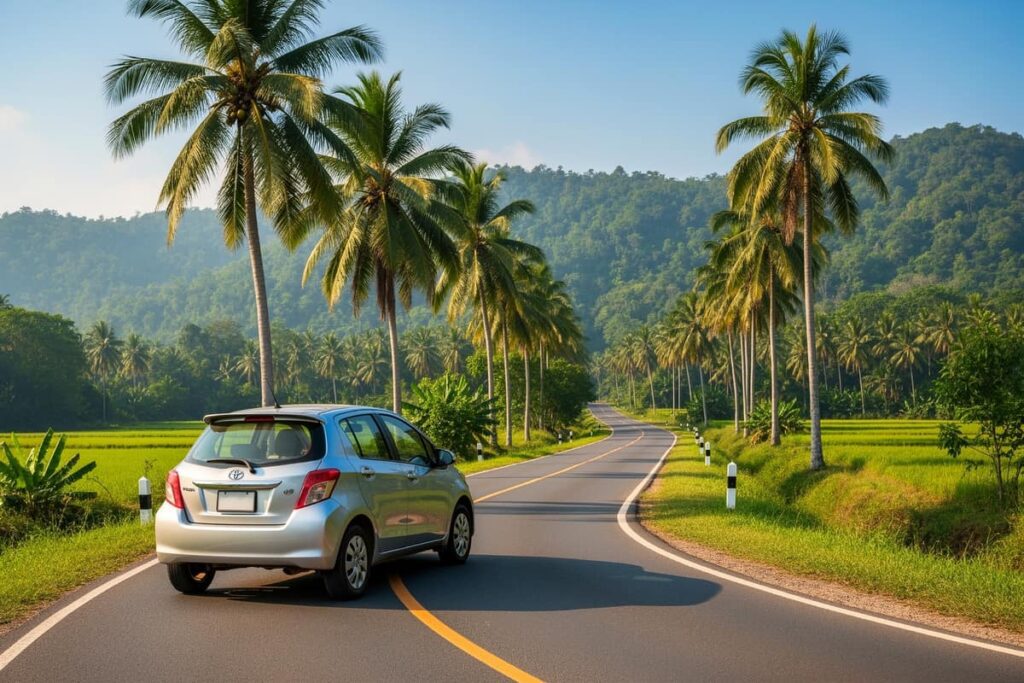
A road trip around Thailand lets you choose your own stops, pace, and overnight stays. Start with a feasible route, then choose a car, prepare your driving documents, and understand the insurance. When planning, leave time not only for driving but also for picking up the car, refueling, parking, and strolls.
The main scenario of this guide is renting a car within Thailand. Entering with your own foreign-registered vehicle is covered separately: the requirements for such a vehicle cannot be applied to a standard rental. For a family trip, plan breaks and a suitable child restraint in advance.
Current as of publication. Conditions may change, and safety depends on the driver, the weather, and the condition of the road. Below: a comparison of routes, the terms of specific rental companies, and the steps for preparing for the trip, from choosing a car to paying tolls and what to do after an incident.
How to choose a route for a road trip around Thailand
Choose a route based on your interests and the amount of driving. For a beach holiday, leave time for coastal stops; for historic cities, leave time for walks; and for northern side routes, separately assess your readiness for mountain roads.
| Route | Start and finish | Type of stops | Preparation and driving load |
|---|---|---|---|
| Gulf of Thailand coast | Bangkok → Hua Hin → Prachuap Khiri Khan | Beaches, coastal walks, city stops | The driving load can be spread across overnight stays; do not fill the whole day with driving |
| North | Bangkok → Ayutthaya → Sukhothai → Chiang Mai → Chiang Rai | Historic cities, temples, mountain scenery | This long route calls for spreading out the drives; mountain side routes add to the workload |
| Andaman coast | Phuket → Krabi → Trang | Coastline, rocky landscapes, nature stops | The workload depends on the chosen access roads and stops; confirm the area of travel and possible ferry crossings |
| East | Pattaya → Rayong → Chanthaburi → Trat | Coastal stops, old town, markets | Break up the drives with walks; for an island extension, plan the ferry crossing separately |
Driving time and trip length are different things. On top of driving time, add picking up the car, finding parking, rest, and visiting sights. First mark the stops you want, then choose overnight stays, and only after that decide the rental period.
If you are traveling with children, plan breaks and comfortable accommodation. Being able to cut back the day’s schedule is more useful than a packed list of places you would have to reach while tired.
When to go: weather and route changes
As of October 2026, the UK Foreign, Commonwealth & Development Office (FCDO) describes the general rainy season as May–October. On Koh Samui and in the southeast, it usually falls between November and March. A calendar for one coast cannot be applied to the whole country.
For help choosing dates, see the guide when to go to Thailand. But a seasonal guideline does not describe the condition of a specific road on the day of your trip: before each drive, assess the weather and whether the chosen section is open.
Wait out heavy rain in a safe place. Continue driving based on visibility and road conditions, not on the assumption that the rain will stop after a set time. Do not try to drive through a flooded section to keep to your schedule.
Choose in advance which stops can be skipped or replaced with a city walk. Plan overnight stays so that changing the itinerary does not force you to keep driving when the driver is already tired.
Car rental: choosing a vehicle and checking the contract
How to choose a car for your route
Start with your route, the number of passengers, and your luggage; after that, it is easier to pick a car for the trip. Renting a car in Thailand requires comparing the vehicle’s usage terms together with the booking price.
For paved roads, a sedan or crossover is an option. Discuss unpaved access roads and mountain side routes with the rental company: a trip to the north does not in itself require four-wheel drive, and an SUV does not replace driving experience.
What to clarify before booking
Don’t rush to book. First get answers to the questions the whole route depends on:
- In which provinces is the car allowed to be used?
- Are ferries permitted, and what restrictions apply to ferry crossings?
- How do I add an additional driver?
- Is there a mileage limit, and how is excess mileage calculated?
- Can I return the car in a different city?
- Who pays for tolls, and how are the charges confirmed?
- How do I get help in case of a breakdown and arrange towing?
- What fuel level is required when returning the car?
As of October 2026, the operator (AMP) allows the rented car to be used only within Thailand, without crossing the border. The rental company (Hertz) accepts renters aged 21 to 70. These are the terms of specific companies, not general rules for any rental.
Inspection at pickup and return
Photograph the body, windows, and wheels, and record any damage you find on the inspection report. Check the spare tire and jack, and ask to see the emergency equipment. Ask about the presence of a first-aid kit and fire extinguisher as a practical preparation question.
Before driving off, adjust the mirrors, find the hazard lights, and familiarize yourself with the controls. Keep the contract and photos for the return, when you inspect the car again and compare its condition to the report.
As of October 2026, the rental company (Hertz) has a minimum rental period of 1 day, or 24 hours. The allowed grace period for a late return is 59 minutes; after that, an extra daily charge applies at the pickup branch’s rate. Allow time for the drive to the return location and for the inspection.
Returning the car in another city
As of October 2026, the rental company (Hertz) allows this kind of rental for bookings of 3 days or more. For a 3–4 day rental, a fee based on the distance between branches applies; for 5 days or more, the fee for this service is waived.
This helps you plan a route without driving back. Agree on the return city and branch when booking: the terms of one company do not automatically apply to another.
Driver’s documents and international driving permit
Entry documents for a person, the right to drive a car, and the terms for releasing a vehicle are separate questions. The rental company’s consent to hand over the keys does not confirm the legality of driving.
To prepare, gather:
- passport;
- your national driver’s license;
- a suitable international driving permit (IDP), if one is required in your case;
- rental agreement that names the driver;
- vehicle insurance details and the insurer’s contact information.
The Thai Embassy in London indicates that an IDP should be presented together with a passport and national driving licenses. This note does not replace an assessment of your specific citizenship and the specific license format. The Thai Department of Land Transport (DLT) separately lists IDPs under the Geneva and Vienna Conventions, as well as licenses issued by competent authorities of ASEAN member states.
Prepare your documents before the trip and confirm the set with the rental company. Do not count on getting an IDP after arrival based on your Russian driver’s license.
As of October 2026, the rental company (Avis) requires original documents when you pick up the car and does not accept copies or photos. The UK Foreign, Commonwealth & Development Office (FCDO) warns that driving without valid licenses may invalidate your travel insurance and leave you without payouts after an accident or injury. Check your license categories and insurance terms before getting the car.
Insurance, deposit, and trip budget
What different types of insurance cover
Mandatory motor insurance, voluntary vehicle coverage, and personal travel insurance serve different purposes. The insurer Roojai states that mandatory insurance is required by law; it cannot be called a comprehensive Type 1 policy or reduced to paying for medical treatment only.
As of October 2026, the published form of compulsory motor insurance (OIC) provides for:
- up to 80,000 baht per person for bodily injury or harm to health;
- up to 500,000 baht per person for death or total permanent disability.
These are limits subject to the policy terms, not a guaranteed payout to each injured person. For voluntary options, the insurer Roojai uses the following descriptions:
| Option | Insurer’s description |
|---|---|
| Type 1 | Comprehensive motor insurance |
| Type 2 | Coverage for theft and fire only |
| Type 3 | Third-party liability coverage only |
These descriptions refer to the insurer’s products. They do not define coverage at other companies and do not disclose all policy exclusions.
Deposits and payment methods
As of October 2026, the published terms of the rental companies differ:
| Company | Deposit or pre-authorization | Payment method |
|---|---|---|
| Operator (AMP) | 3,000–30,000 baht depending on the model | Cash or a hold on funds on a credit card |
| Rental company (Hertz) | 5,000 baht | Physical credit card in the renter’s name; cash, transfers, and debit cards are not accepted for payment of services or the deposit |
| Rental company (Avis) | 8,000 or 15,000 baht depending on the vehicle type, rental cost, and additional charges | Credit card in the renter’s name with sufficient available credit; cash and debit cards are not accepted for the deposit |
The operator’s (AMP) terms page is dated June 22, 2026. This is the date the page was updated, not proof that every price has changed.
A deposit and a deductible are different contract terms. The deposit secures the renter’s obligations, while the deductible describes the renter’s share of costs in cases provided for in the contract. The size of the deposit alone does not determine maximum liability.
Deductible and exclusions
As of October 2026, the operator (AMP) lists a deductible of 3,000 baht for an accident. The rental company (Hertz) has a deductible of 2,000–10,000 baht when the renter is at fault or when no third party is identified.
As stated in the published terms of the rental company (Hertz Thailand), standard damage coverage (CDW) does not extend to windows, tires, the interior, the roof, and the underbody. Additional coverage that reduces the deductible (SCDW) lowers the deductible for damage to zero, but does not cover loss or theft of the vehicle.
This rental company’s full package includes the following components (SCDW, TP, TW). As of October 2026, the published price is 267.50 baht per day for small models, 374.50 baht for mid-size, and 642.00 baht for large. This is the price of the additional package, not of the car rental.
It is easy to mix up these terms: a rental company’s deposit may be smaller than the deductible, and a zero deductible for damage does not mean theft is covered. So compare the deposit, deductible, exclusions, and the contents of additional services separately.
What makes up the budget
Don’t estimate the cost of the entire trip from a sample deposit or insurance package. For your chosen dates and vehicle, break down expenses by category:
| Category | How to plan |
|---|---|
| Rental | Based on the offer for the chosen vehicle and period |
| Insurance and additional services | Based on the booking contents and contract |
| Fuel | Based on the route, the car’s fuel consumption, and station prices |
| Tolls and parking | Based on the selected road sections and parking |
| Accommodation and meals | Based on the itinerary and reservations |
| Attraction visits | Based on the selected stops |
| Refundable deposit | Separate from expenses: the funds must be available |
| Unexpected expenses | A separate reserve based on the contract |
Confirm current prices and the terms of your chosen booking. For personal medical coverage, read how to choose travel insurance: a car insurance policy does not replace it.
Driving routes: north, south, and two coasts
These driving routes around Thailand can be adapted to your interests. A road trip around Thailand gives you more freedom when overnight stays are spread out according to the amount of driving each day, and some stops can be moved.
From Bangkok to Hua Hin and Prachuap Khiri Khan
The sequence is Bangkok → Hua Hin → Prachuap Khiri Khan. This route is for relaxing along the Gulf of Thailand, coastal walks, and city stops. In Hua Hin, add the Khao Takiab hill to your plan.
Choose overnight stays near the places where you want to linger. If you don’t need to drive back to the starting point, agree with the rental company on returning the car in another city and on the area where the car may be used. A coastal route does not promise empty roads or calm traffic.
From Bangkok through Ayutthaya and Sukhothai to the north
The sequence is Bangkok → Ayutthaya → Sukhothai → Chiang Mai → Chiang Rai. Decide in advance what to see in Ayutthaya, so the stop does not turn into mere transit. Then plan for the Sukhothai Historical Park and the White Temple in Chiang Rai.
The travel aggregator GetYourGuide gives an estimate of 891 kilometers and 14 hours of driving time for the northern option under review. This is not a guaranteed time for the whole itinerary with stops, nor a recommendation to drive without rest.
Split the route with overnight stays near the places you choose. Discuss mountain side routes, the car model, and road surface restrictions with the rental company separately.
From Phuket through Krabi to Trang
The sequence is Phuket → Krabi → Trang. This route suits coastal and nature stops, rocky landscapes, beaches, and caves. Choose specific places that fit your available time, without trying to cover everything in one drive.
Anchor overnight stays to the areas you want to explore. Agree with the rental company on travel between provinces, road surface restrictions, and ferries if they are part of the itinerary.
From Pattaya through Rayong and Chanthaburi to Trat
The sequence is Pattaya → Rayong → Chanthaburi → Trat. In Chanthaburi you can visit the Chanthaburi Old Town and the Chanthaburi Gem Market. A possible extension is Koh Chang, if the rental company permits the car to be transported there.
Choose overnight stays based on the stops you want to see without rushing. As of October 2026, the UK Foreign, Commonwealth & Development Office (FCDO) reports the suspension of land border crossings between Thailand and Cambodia and advises avoiding travel within 20 km of the land border unless absolutely necessary.
This warning cannot automatically be applied to all of Trat or Koh Chang. Before traveling, check the border situation and do not build your itinerary around crossing a closed checkpoint.
Left-hand traffic and road safety
Thailand drives on the left. If you are used to right-hand traffic, pay special attention when turning, crossing intersections, and pulling out of parking areas. Start on a stretch where you can calmly focus on driving.
Keep a safe distance, watch for motorcyclists alongside your car, and check your mirrors before changing lanes. Start overtaking only when visibility is sufficient, and never to make up for lost time. Additional guidance is in the guide road safety in Thailand.
Speed limits depend on the area and the characteristics of the road section. For an ordinary passenger car, the 2021 ministerial regulation sets the following upper limits:
- no more than 80 km/h in Bangkok, Pattaya, city municipalities, and settlements;
- no more than 90 km/h outside them;
- no more than 100 km/h outside them on a road with two or more lanes in each direction and a physical divider.
In Bangkok, a stricter traffic police regulation published on December 23, 2024 applies: no more than 60 km/h on all streets except the thirteen highways named in it. On certain sections of highway that have a median barrier and no at-grade U-turns, as designated by the road authority, the regulation of March 4, 2021 allows up to 120 km/h; in the rightmost lane there, you may not drive slower than 100 km/h.
If a sign shows a lower speed, the sign applies. Do not treat the listed limits as permission to drive at that speed in any visibility or weather.
Buckle up and ask passengers to do the same, and make sure children have a suitable child restraint. Do not drink alcohol before driving and do not use your phone while driving; change the navigation route only after stopping safely.
Avoid night drives and driving while tired. Plan to reach your overnight stay before dark, especially on an unfamiliar road: it is better to skip a stop in the itinerary than to keep going when exhausted.
Toll roads and paying for travel
Transponder and lane choice
On toll sections, cash payment, transponders, and barrier-free plate reading are used. Which option is available depends on the road and the car’s equipment.
Before setting off, ask the rental company:
- whether a transponder is installed, for example for electronic toll passage (Easy Pass);
- which lanes suit the car’s equipment;
- who pays for barrier-free passage;
- whether you pay yourself or through an operator;
- how to check charges and confirm payment on return;
- whether there is a separate fee for the rental company’s services.
Before the payment point, look at the lane markings. Don’t choose electronic passage just because the queue is shorter there; the payment procedure is explained in the material on toll roads and payment systems · RU.
Barrier-free payment (M-Flow)
As of October 2026, the barrier-free system (M-Flow) works on a pay-later basis and is available to both registered and unregistered users. The absence of a barrier does not mean free passage.
On the Bang Yai — Kanchanaburi route, tolling on the Bang Yai — Kanchanaburi motorway (M81) began on January 16, 2026 at 00:01. The described procedure provides for self-payment within 7 days after passing: outstanding charges can be looked up by license plate number, and QR payment and payment at convenience stores (7-Eleven) are available.
This deadline applies to the described payment procedure on that route. It cannot be applied to Thailand’s entire road network.
Toll examples and calculating with the rental company
As of October 2026, the published toll for the Don Muang Tollway for the period December 22, 2024 through December 21, 2029 is 130 baht per trip for a four-wheeled car. For vehicles with more than four wheels, the listed rate is 170 baht.
Agree on who pays charges linked to the license plate before your first trip through a toll. If the rental company handles the charges, find out how it confirms the amounts; if you pay yourself, keep receipts. This makes it easier to avoid paying twice.
Fuel stations, parking, and navigation
Along the route, you can look for PTT, Shell, Caltex, and Bangchak stations. Check whether a café, shop, and other services are available at the specific stop.
Fill the car with the fuel specified in its manual. Ask the rental company to show you the correct marking: choosing gasoline or diesel based on the car’s body is unreliable. Before taking secondary roads, plan to refuel with a margin; the rule of thumb of not letting the tank drop below a quarter is a practical tip, not a legal requirement.
The fuel policy for return is a separate contract term. As of October 2026, the rental company (Hertz) provides the car with a full tank and requires it to be returned with a full tank; otherwise, additional refueling charges apply.
The rental company (Avis) requires the car to be returned with the same amount of fuel it was given, usually a full tank. If the car is returned without a full tank, its terms page provides for the cost of a full tank plus an administrative fee. Record the starting fuel level when you pick up the car.
Download offline maps and save your overnight address and help contacts so you can reach them without internet. A navigation service (Google Maps) or an offline map app (Maps.me) helps you prepare your route, but it is better to skip shortcuts over unsuitable road surfaces. For staying connected, see the guide mobile service and internet in Thailand.
When parking, look at the signs, parking terms, and payment procedure. Don’t assume a free spot at every temple or gas station, and do not leave valuables visible in the car, even briefly.
What to do after a breakdown or road accident
Save the rental company’s and insurer’s contacts before setting off. In case of an incident, first look after people, then move on to photos, documents, and arranging repairs.
- Ensure safety. Assess whether you can stop and leave the car safely; do not step out into moving traffic.
- Make your stop visible. Turn on the hazard lights and use available emergency equipment, if doing so does not create additional risk.
- Call for help. If anyone is injured, report the need for an ambulance; for a road accident, contact the police.
- Notify the rental company and the insurer. Give the location and circumstances, and agree on repairs, towing, and next steps.
- Document the scene. If it is safe, photograph the positions of the vehicles, the damage, license plates, and signs.
- Review the paperwork. Do not sign any document you don’t understand; ask for a translation or explanation.
As of October 2026, emergency numbers:
- 1669 — ambulance;
- 191 — police;
- 1155 — tourist police.
The Tourist Police hotline operates around the clock and provides support in eight languages. This does not guarantee a response in a specific language every time you call.
Do not stay in a dangerous spot to take photos, and do not leave the scene of an accident without dealing with the police and the other parties involved. In a serious incident, also contact the trip organizer, if there is one; additional guidance is collected in the guide emergency assistance in Thailand.
If you are entering with your own car
For a foreign-registered vehicle, a separate temporary permit procedure through the system (FVP) is provided. It does not apply to a standard rental of a car with Thai registration.
As of October 2026, in the official guidance of the Department of Land Transport the procedure is described as being submitted through a Thai travel agency. For a vehicle covered by the procedure, the agency submits the application at least 5 working days before entry.
The following vehicles are eligible for the application:
- passenger car with no more than 9 seats, including the driver’s seat;
- pickup truck weighing no more than 3,500 kg;
- motorcycle.
Campervans, motorhomes, buses, and trucks are listed as not eligible for the application under this procedure. This is a limitation of the described procedure, not a universal ban on any entry of such vehicles.
The guidance exempts vehicles registered in Laos, Malaysia, and Singapore from this procedure. The exemption does not cancel other entry requirements or border checks.
As of October 2026, the following parameters and fees have been published:
| Parameter | Value |
|---|---|
| Route under one application | No more than 30 days |
| Annual quota per vehicle | 60 days |
| Application processing | 500 baht per vehicle |
| Administrative fee | 5 baht per vehicle |
| Issuance of permit for a passenger car or pickup truck | 500 baht |
For a group of 1–5 vehicles, at least one escort and one escort vehicle are required. For a group of 6–15 vehicles, at least two escorts and two escort vehicles are required. The permit fees are not equal to the full cost of arranging entry.
Agree in advance with the agency on whether the procedure applies, the route, escort arrangements, and document preparation. The vehicle permit does not determine a person’s visa period and does not open a closed border crossing. Consider travelers’ documents and the status of the chosen border separately.
Related articles:
Frequently Asked Questions ❓
Do I need an international driving permit to drive in Thailand?
The Thai Embassy in London recommends presenting an IDP together with your passport and national driving licenses. Prepare the appropriate set of documents and agree on them with the rental company before getting the car. Handing over a car does not in itself confirm the legality of driving, and the UK Foreign, Commonwealth & Development Office (FCDO) warns of possible loss of travel insurance coverage when driving without valid licenses.
Which side of the road do they drive on in Thailand?
Thailand drives on the left. Pay special attention when turning, crossing intersections, and pulling out of parking areas. Choose the start of your route according to your experience, without assuming you will get used to it within a set amount of time.
Can I rent a car in Thailand without a credit card?
It depends on the company: the operator (AMP) accepts a cash deposit or a hold on a credit card, with a published range of 3,000–30,000 baht depending on the model. The rental company (Hertz) requires a physical credit card in the renter’s name and a 5,000 baht deposit, while the rental company (Avis) requires a credit card for pre-authorization of 8,000 or 15,000 baht. As of October 2026, these are the terms of specific companies; confirm the payment method before booking.
What are the fines for traffic violations in Thailand?
Check current fine amounts in the official rules for the specific violation. For a trip, you need valid driving documents, compliance with road signs, use of seatbelts, and no alcohol before driving. Receiving a car from a rental company does not release the driver from these obligations.
Is it safe to travel by car around Thailand with children?
Safety depends on the driver, the route, the weather, and how well the car is prepared. Arrange a suitable child restraint in advance, plan stops, and avoid night drives and driving while tired. A coastal route alone does not guarantee a safe road.
What car is best to rent for a road trip around Thailand?
Choose a car based on the road surfaces, luggage, passengers, and your own experience. For paved roads, a sedan or crossover is an option, while unpaved access roads and mountain side routes should be discussed with the rental company. A trip to the north does not by itself mean you necessarily need an SUV.
Where is it best to refuel in Thailand?
Along the route, look for PTT, Shell, Caltex, and Bangchak stations, after first confirming which fuel your car needs. A practical rule of thumb is not to let the tank drop below a quarter, especially off the main highways. When returning the car, follow your contract: the rental company (Hertz) requires a full tank, while the rental company (Avis) requires the original fuel level and provides for charges if this condition is not met.
Conclusion
Start your road trip around Thailand with a feasible route and convenient overnight stays. Prepare your driving documents, check the contract, deposit, and insurance, agree on how tolls will be paid, and save the help contacts. Choose the car to suit the road surfaces, passengers, and luggage, and plan the drives based on the driver’s readiness.
Requirements, rental and insurance terms, weather, and the border situation can change. Leave room to shorten the itinerary, wait out rain, or move a stop, without trying to keep the schedule at any cost. For your own vehicle, look separately at the entry and escort procedure. Once your route is set, move on to choosing a car and compare offers based on the terms of the whole trip. A time and money buffer will help you change plans without rushing.
Prepared by MyThai.online editorial team.