In this article:
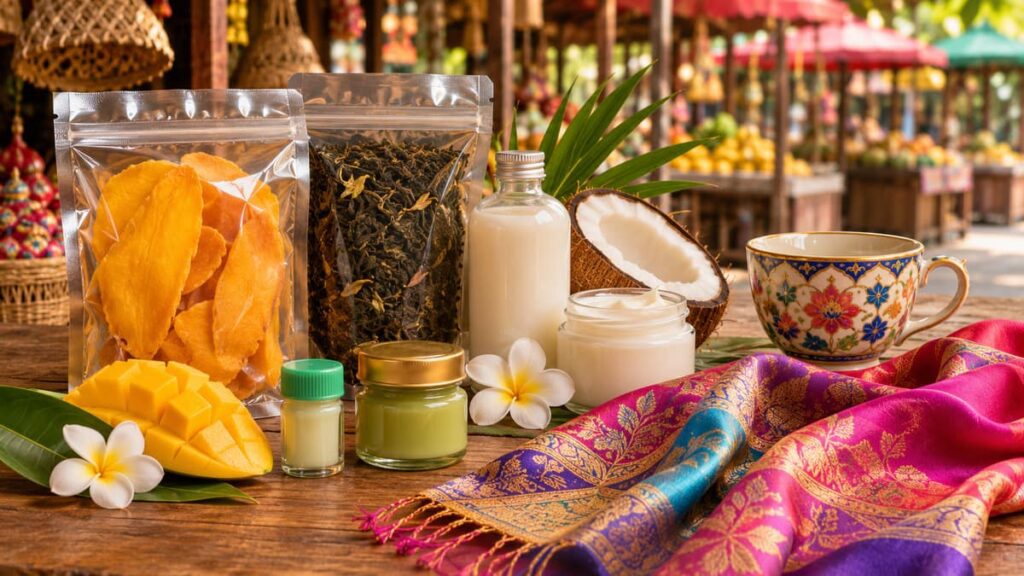
Deciding what to bring back from Thailand for yourself, your family, or your colleagues? Start with packaged dried fruit, Thai tea, spices, herbal balms, cosmetics, textiles, and small handmade items. A practical gift does not have to be expensive. What matters much more is whether it suits the recipient and will survive the trip in a suitcase.
Current as of November 2026. Prices and product ranges vary between stores, and transport conditions and customs requirements may change. Before buying, split your check into three questions: whether the item is allowed to leave Thailand, whether the airline on your route will accept it, and whether it can be imported into your destination country. Even an item from an ordinary souvenir shop does not exempt you from these checks. Below you will find a comparison of gifts, examples of confirmed prices, and clear guidelines for choosing without risky promises about transport.
What to Bring Back from Thailand: Gift Ideas for Your Suitcase
| Purchase | Who It Suits | Packaging example | Confirmed price and date | Where to find it | Transport |
|---|---|---|---|---|---|
| Dried mango | Family, colleagues | Sealed bag | Check the price with the seller | Supermarket | Check food import rules |
| Dried or freeze-dried durian | For lovers of unusual flavors | Airtight pack | Check the price with the seller | Food department | Check the carrier’s rules |
| Fruit snacks | Friends | Factory-sealed pack | Check the price with the seller | Supermarket | Check the ingredients and import rules |
| Thai tea | For drink lovers | Tea bags or a tin | Instant tea mix (ChaTraMue), 5 × 20 g — 62 baht, from a third-party review dated November 12, 2026 | Supermarket | Check the ingredients and route |
| Coffee | For coffee lovers | Airtight pack | Check the price with the seller | Grocery store | Check import rules |
| Curry paste | For the home cook | Sealed pouch or jar | Check the price with the seller | Supermarket | Check the ingredients and rules for pastes |
| Thai sauce | For fans of Asian cuisine | Sealed bottle | Check the price with the seller | Food department | Check the rules for liquids and ingredients |
| Inhaler | Colleagues, friends | Individual packaging | Inhaler (Poy-Sian) — 23 baht, from a third-party review dated November 12, 2026 | Pharmacy, supermarket | Check the ingredients and route |
| Herbal balm | For an adult recipient | Closed jar | Check the price with the seller | Pharmacy | Check the purpose and restrictions |
| Coconut oil | For skincare fans | Bottle with a seal | Check the price with the seller | Cosmetics store | Check the rules for liquids |
| Soap | For a small gift | Factory box | Check the price with the seller | Cosmetics store | Check the ingredients |
| Silk scarf | For textile lovers | Protective packaging | Check the price with the seller | Brand store | Check the labeling and composition |
| Cotton item | Family, friends | Folded item with a tag | Check the price with the seller | Market, clothing store | Check the size and return policy |
| Woven accessory | For craft lovers | Case or box | Check the price with the seller | Craft market | Check the material and export rules |
| Ceramics | For collectors | Box with cushioning | Check the price with the seller | Craft shop | Protect from impact, check the item’s status |
Prices for the tea mix and inhaler are taken from a third-party review of store product ranges, not from the current price list of a specific branch. Confirm prices on site: identical products can differ in price between outlets, and pack size affects comparisons. If you want to explore shopping formats, open the guide to shopping in Thailand.
Gifts by Budget: What to Choose for Colleagues, Family, and Friends
You do not need to tie your choice to arbitrary price tiers. It is easier to consider how many people are expecting a gift, what they eat, whether they like scents, and how fragile an item you are willing to carry. This approach works better than trying to pick the “most Thai” souvenir by its bright packaging.
| Scenario | What to consider | What to check |
|---|---|---|
| Many identical gifts for colleagues | Small snacks, tea bags, soap | Total cost, shelf life, identical pack sizes |
| Light set for family | Mango, tea, a few dry seasonings | Ingredients, weight, sealed packaging |
| Mild gift for a child | A neutral fruit snack or a fabric accessory | Age labels, allergens, absence of hot spices |
| Set for a fan of Thai cuisine | Curry paste, dry spices, sauce | Spiciness, animal-derived ingredients, transport |
| Gift for a craft enthusiast | Scarf, ceramic cup, woven item | Material, origin, condition |
| Unbreakable item for a short trip | Fabric bag, scarf, dry goods | Luggage volume, seam quality, sealing |
If the recipient is vegetarian, has a food allergy, or cannot tolerate strong smells, read the ingredients first. On the label, clear ingredients and warnings matter more than a striking design. Gifts from Thailand are good when the recipient can actually use them.
Edible Souvenirs: Dried Fruit, Snacks, and Sweets
Dried fruit is convenient because it is sold in sealed packs and you do not have to choose ripe fruit before your flight. But dried product and fresh fruit are different categories for storage and possible checks at the border. For luggage, compare not only taste but also ingredients, weight, package integrity, and shelf life.
In the official selection of Thai souvenirs dried mango, durian, and bananas are listed, as well as freeze-dried durian and mangosteen. Drying removes moisture, while freeze-drying gives a different, often lighter texture. This is a product description, not a promise of automatic import clearance into every country.
- Dried fruit: check whether sugar has been added, what the product was treated with, and whether the bag is tightly sealed.
- Freeze-dried snacks: check the packaging for damage and confirm storage conditions.
- Sweets and mixes: check the ingredients for nuts, dairy, and other possible allergens.
- Fresh fruit: separately confirm phytosanitary requirements and transport conditions with the airline.
For ideas on food and where to buy it, see the article on food and markets in Thailand. Edible souvenirs from Thailand are best chosen by a clear label, not by a seller’s promise that “all tourists take this home.”
Thai Tea, Coffee, Curry Pastes, and Sauces
Tea and coffee are good options when you want to bring home the taste of your trip without fragile decor. Loose tea, instant mix, and powdered milk drink should not be treated as one product: they may differ in sugar, additives, and preparation method. In the official list of souvenirs instant Thai tea is named separately.
There is one specific price example: a mix for Thai milk tea (ChaTraMue) in a pack of 5 × 20 g — 62 baht, according to a third-party review of purchases dated November 12, 2026. This is not a current universal price and not the cost of another jar or pack of the same brand. Check the price tag for the pack size you need before paying.
Curry pastes and sauces need a bit more attention. Dry spices, powdered mixes, thick pastes, and liquid sauces may fall under different transport rules, even if all of them are sold in a grocery store. Read the ingredients carefully: fish, shrimp, and oyster ingredients matter for people with allergies, vegetarians, and the customs requirements of the destination country. Also check right away whether the packaging could leak in your suitcase.
Inhalers, Balms, and Cosmetics: How to Read the Ingredients
Before buying a Thai inhaler (ya dom), check the label and official information about the specific product for its purpose, composition, warnings, and legal status. Do not automatically assume that every such inhaler is a non-medical product or safe for everyone. Aromatic oils, herbal balms, soap, and skincare cosmetics also differ in purpose. The official Thai selection of souvenir products mentions balms and essential oils but does not promise to cure any illness with them.
What to Check Before Buying
- Read the full ingredient list and purpose on the label, especially if you are sensitive to smells.
- Check the expiration date, factory seal, and container integrity.
- See whether there are clear instructions and usage warnings.
- Distinguish ordinary cosmetics from medicines, especially products with restricted ingredients.
- Before paying, confirm whether the specific product can be taken out of Thailand and brought into your destination on your route.
Thai cosmetics as a gift can be a good purchase if the recipient knows the ingredients and has no contraindications to the components. Do not choose prescription medicines as a universal souvenir and do not rely on stories about the “miraculous” effect of a balm. To prepare your own necessary medicines for the trip, read the article on choosing a first-aid kit for Thailand.
Silk, Clothing, and Latex: How to Check the Quality of Your Purchase
Thai silk is included in the official description of typical souvenirs. A scarf is a convenient gift if you know the recipient’s preferences in color and texture. But the words “Thai style” do not confirm the fabric’s composition or where it was made.
For a silk scarf, ask for a label with the composition, check the edge finishing, seams, and return conditions. In the article about checking silk the certification mark “Royal Peacock” is mentioned. It is best to confirm with the seller whether the mark and documents are in place: feeling the fabric alone does not prove authenticity.
With cotton T-shirts, batik, and fabric bags, it is easier to judge quality right before buying: compare sizes, fabric density, stitching, and color fastness according to the care instructions. For a large item, first measure the available space in your luggage. This is especially relevant for a latex pillow: it takes up volume, and the seller’s claims of “naturalness” should be checked against the composition, labeling, and return conditions, without taking a marketing description for a certificate.
Ceramics, Woven Items, and Local Crafts
If you want a gift that will not be eaten right after you land, consider decorative ceramics, woven accessories, baskets, wooden items, and local textiles. A good find is an item that suits the recipient’s home, not just one that looks exotic. When choosing wood and natural materials, check restrictions on export and import.
A special option is Benjarong ceramics. In the article about traditional souvenirs it is described as hand-painted porcelain using five colors, historically associated with the Thai royal family. This is a cultural reference, not confirmation of the age or origin of a particular cup.
Before buying, check exactly what the seller claims: “made in Thailand,” “Thai brand,” or just “Thai pattern.” These labels are not interchangeable. For a fragile item, ask for cushioned packaging, protect the handles and protruding parts, keep the receipt, and photograph the item before packing. If the item looks like an antique or a religious object, separately find out its legal status.
Where to Buy Souvenirs: Markets, Supermarkets, and Brand Stores
For food, tea, and everyday items, compare the ranges at the Big C and Lotus’s chain supermarkets and small shops near home. For balms and cosmetics, it is more convenient to choose places where you can read the packaging carefully. For designer textiles and handmade items, specialized shops and markets are worth visiting. It is best to check on site whether a specific brand is available.
In Bangkok, you can start with the Chatuchak Weekend Market. Before visiting, read the separate guide to the Chatuchak market in Bangkok: the market is useful for getting to know different types of souvenirs, but always check the origin of goods and the price with the seller.
For textiles, there is the Jim Thompson Iconic Store. Its official page lists the opening hours 09.00AM–07.00PM. The Jim Thompson House Museum — a separate site, for which the visiting schedule is published separately. Information on the official pages is as of November 2026; before your trip, confirm the hours, product availability, and visiting conditions, and do not confuse the store with the museum.
What to Look for in Bangkok, Phuket, Pattaya, and Other Regions
Planning where to buy souvenirs in Thailand on your way to the airport? Choose not the “most famous” city, but a type of shop that is convenient for your route. Market and store ranges change, so below are pointers for searching rather than a list of stock verified on site.
- Bangkok: compare chain stores, shopping malls, Chatuchak, and brand-name textiles. More details are in the guide to shopping in Bangkok.
- Phuket: look at food departments, cosmetics stores, and tourist souvenir shops; more details are in the guide to shopping in Phuket.
- Pattaya: start with supermarkets for edible gifts and separate shops with clothing and handmade items.
- Koh Samui: choose between usual grocery shopping and souvenirs in shopping areas, checking opening hours right before your visit.
- Hua Hin: compare food products in supermarkets and small handmade items in craft shops.
- Chiang Mai: look closely at textiles and handicrafts, asking the seller about their origin.
Without confirmed addresses and up-to-date stock, it is not possible to promise that a particular item will definitely be found in the right place. For an expensive purchase, it is wiser to ask the store in advance for photos, the composition, and documents.
How to compare prices and tell an original from a fake
A useful rule: compare like with like. One price for a tea blend says little about a different package size, and an attractive label does not guarantee natural fabric or local production. Be especially careful with expensive silk, jewelry, and items made of exotic leather.
Before paying, follow these steps in order:
- Look for several offers for the same product in the same package size, not look-alike packaging.
- Check the expiration date, ingredients, and package integrity; for clothing, check the label, size, and seams.
- Compare the markings, the manufacturer’s name, and the declared origin with the seller’s documents.
- Ask about the return policy, get a receipt, and keep the papers for any expensive item.
- For items made from animal materials, check in advance whether export and import documents will be required.
At a market, you can negotiate the price with the seller, while in a supermarket, go by the posted price tag and the terms of the promotion. There is no confirmed universal discount, which you can count on at every store. And a very low price should certainly not be taken as proof of a fake on its own: origin is confirmed by documents and verifiable features of the item.
How to pack gifts and carry purchases on a plane
A souvenir that is legal to buy and take out of the country may still not meet airline transport rules. The rules depend on the carrier, the airport, connections, the product category, and whether the item goes in carry-on or checked baggage. Identical recommendations for all routes are unreliable here.
- Dry foods: Keep factory packages sealed, and make sure the ingredients and expiration date are legible.
- Liquids, gels, and pastes: Check that they are permitted in your chosen type of baggage, make sure they are leakproof, and review the individual requirements of the airports on your route.
- Ceramics and glass: Use cushioning layers and protect handles; check the carrier’s rules for fragile items.
- Fresh fruit and plants: Check the airline’s requirements and the phytosanitary conditions for export and import separately.
- Electronics and items with batteries: Check the rules for the battery type and where it will be carried, and do not automatically pack everything into your suitcase.
Checklist before departure
- Check the restrictions at your departure airport and all transfer points.
- Look up your airline’s rules for carry-on and checked baggage.
- Compare the item with the requirements of the destination country and keep the necessary documents.
- Pack liquids to prevent leaks, and fragile items to protect them from impacts.
- Prepare receipts and proof of origin for items that may need them.
Fresh durian often raises specific questions because of its smell, but declaring a single worldwide ban is wrong. Check the position of the specific carrier; treat dried durian separately from fresh fruit. It is just as risky to rely on someone else’s universal weight limit for a fruit basket.
What cannot be taken out of Thailand and what requires a permit
The question of “what cannot be taken out of Thailand” is better answered by the legal category of the item than by forums. Thai customs distinguishes prohibited goods and restricted goods, for which permits from competent authorities may be required. The list and responsible agencies are published on the official website of the Thai Customs Department.
- Protected animals and species listed under the Convention (CITES): Among the prohibited categories, customs separately lists protected fauna. The material of the item and the status of the specific species must be checked.
- Images of the Buddha, works of art, antiques: The list of restricted goods names the Fine Arts Department. Do not rely on a supposedly universal rule about the height of a statuette.
- Plants and their parts: The competent authority is the Department of Agriculture. This does not mean an automatic ban on every plant-based item or an automatic permit for a packaged seedling.
- Shells, corals, seeds, and items made of exotic leather: Before buying, find out the status of the species and material and any possible document requirements. A name on a price tag does not establish that export is legal.
Neither a receipt nor a purchase at a tourist shop replaces an export permit. If a seller claims that a special document is not needed, ask the relevant authority to confirm this before you pay, especially for religious, natural, and expensive collectible items.
What to check before bringing souvenirs into Russia
Rules for leaving Thailand and entering Russia are separate checks. An item cleared by Thai customs may require additional documents, inspection, or compliance with restrictions on the Russian side. Numerical limits should not be taken on trust without current confirmation from the competent authority.
| Category | What to check before buying and departing |
|---|---|
| Fresh fruit, plants, seeds | Phytosanitary requirements and whether personal import is allowed |
| Packaged dried fruit, snacks, tea | Ingredients, origin, rules on importing food products |
| Fish and shrimp sauces, pastes | Presence of animal-derived ingredients and applicable veterinary requirements |
| Cosmetics, balms, medicines | Product status, ingredients, and restrictions on specific substances |
| Alcohol | Current customs conditions and restrictions of the country of arrival |
| Expensive purchases, art, natural materials | Documents on value, origin, export, and possible permits |
For travel to Russia, check the requirements against the official explanations of the Federal Customs Service and Rosselkhoznadzor. The attached materials contain no verified primary document that would allow stating current numerical limits for each category, so none are given here. For flights to Belarus, Kazakhstan, and other countries, additionally check the destination country’s own rules and the applicable EAEU rules, and do not apply Russian requirements to every route.
How to get VAT back on purchases in Thailand
The VAT Refund for Tourists program is not a store promotion. Under the official terms, the minimum purchase for the program is 2,000 baht with VAT at one store per day, and the goods must be taken out of Thailand within 60 days after purchase. These terms are set out on the official website of the Thai Revenue Department as of November 2026.
How to prepare for the refund
- Before paying, check whether the store takes part in the program and whether you meet its conditions as an applicant.
- Ask the seller to issue the documents the program requires and keep the original receipt.
- Check which purchases qualify for a refund and whether there are exceptions for the specific item you choose.
- Before departure, find out the rules for presenting purchases, inspection, processing, and paying out the refund at the airport.
- Check your documents against the current instructions of the Revenue Department, not just the advice of the cashier.
A separate official page about the program for tourists states that a refund is available when leaving Thailand by air. Simply making a purchase of the required amount does not mean every traveler automatically gets money back. Conditions may change: before your flight, double-check your eligibility, the required forms, and the procedures on the official website.
Related articles:
Frequently Asked Questions ❓
What can I bring from Thailand as an inexpensive gift for colleagues?
Look at small packs of snacks, tea, and individually wrapped soap. The section on gifts by recipient includes a matrix that helps you pick consistent presents without unplanned spending.
Which Thai foods are easier to pack in a suitcase?
Sealed packages of dried fruit, tea, and dry spices are usually more practical. Check the ingredients and import rules for your route; details on choosing are covered in the sections on snacks and drinks.
Can I take durian and other fresh fruit on a plane?
The answer depends on the airline, transfer airports, and destination country. The packing section explains why fresh durian cannot be automatically equated with dried durian and why universal rules are unreliable here.
How do I choose Thai cosmetics and an inhaler safely?
Check the intended use, ingredients, expiration date, seal, and warnings. Medicines require additional checks; see the checklist in the section on inhalers and balms.
Can I take out Buddha statuettes, seashells, or items made of animal skin?
Some such items are subject to restrictions or permit requirements. Do not rely on the size of the figurine or the seller’s assurances; check the specific item and its material in the section on customs rules.
Which purchases can be processed for a VAT refund at the airport?
Only purchases and applicants that meet the conditions of the tourist refund program. Check the store’s participation and your documents in advance; the step-by-step procedure is in the section on VAT refunds.
Where is it better to look for souvenirs in Bangkok and Phuket?
For food products, compare supermarkets; for handicrafts, specialty shops and markets. The section on regions suggests types of venues but does not promise that a particular store will be cheaper than another.
Conclusion
Now it is easier to decide what to bring back from Thailand: for everyday gifts, sealed food products, tea, small cosmetics, and textiles are good choices; for a special occasion, a handicraft with a clear origin. Do not chase the most unusual souvenir if it is hard to pack or its documents cannot be checked. Choose gifts to suit each recipient, compare identical package sizes, and keep your receipts. For more ideas, see the shopping guide; the link is at the beginning of this article. Rules for transport, import, export, and tax refunds may change; check them before your trip on the official websites of the agencies and with your airline. Also check prices and selection right before you buy.
Prepared by MyThai.online editorial team.