In this article:
What changed: The exchange operator (SuperRich Thailand) does not exchange coins, and the limit for exchanging baht into foreign currency is 800,000 baht. Since August 2026, the TAGTHAi Easy Pay tourist payment service no longer requires a physical prepaid card; the monthly transaction limit is 50,000 baht.Updated: October 5, 2026
What changed: From June 5, 2026, the fee charged by UOB bank for cash withdrawals with a foreign card of the Mastercard payment system is 350 baht per transaction instead of 250 baht. The exchange operator (SuperRich Thailand) lists cash rubles in its exchange table and requires a valid passport or identity card. An exchange office license can be checked through the license verification service (BOT License Check).
When exchanging currency in Thailand, start by comparing specific exchange counters: how many baht you will get for your currency and your banknotes after any separate fees. A well-known chain, a bank sign, or a location at the airport does not by itself determine whether the deal is good. Base your decision on the agreed payout amount, not on the biggest number on the display board.
Prepare your money before the trip, check whether your card can be used, and keep an independent cash reserve. Before handing over your banknotes, find out the exchange direction, the terms for accepting them, and the transaction costs. Count the baht you receive at the counter, and keep the confirmation.
Current as of publication. Rates and conditions may change; this material does not replace individual financial advice. Compare the offer for your banknotes before the exchange itself.
Where to exchange money: an exchange office, a bank, or an airport
When choosing where to exchange money in Thailand, ask the same questions at a specialized exchange office, a bank branch, and an airport counter. Do they accept your currency? What rate will they apply to your banknotes, is there a separate fee, and how many baht will they hand out?
| Option | What to compare | Advantages | Limitations |
|---|---|---|---|
| Specialized exchange office | Available currency, denominations, buying rate, fees, and the final payout | You can choose an operator for a specific currency | Documents and banknote acceptance terms need to be checked |
| Bank branch | Exchange direction, terms for your banknotes, and the amount after fees | Can be considered alongside exchange offices | The bank’s name does not confirm a rate advantage |
| Airport counter | Currency acceptance, the rate for your denominations, and the final amount in baht | Convenient for getting cash after arrival | Location does not guarantee favorable terms |
The operator (SuperRich Thailand) states that it does not charge a separate commission or fee for exchange. This is a condition of that specific operator, not of all exchange counters in the country. Even with no commission, the result depends on the buying rate.
If the offer available after arrival does not suit you, you can exchange part of your money for immediate expenses and the rest later. There is no mandatory amount here: go by your own plans. Estimate in advance your budget for a week in Thailand, so you know how much cash you will need right away.
How to read the buying rate and compare the final amount
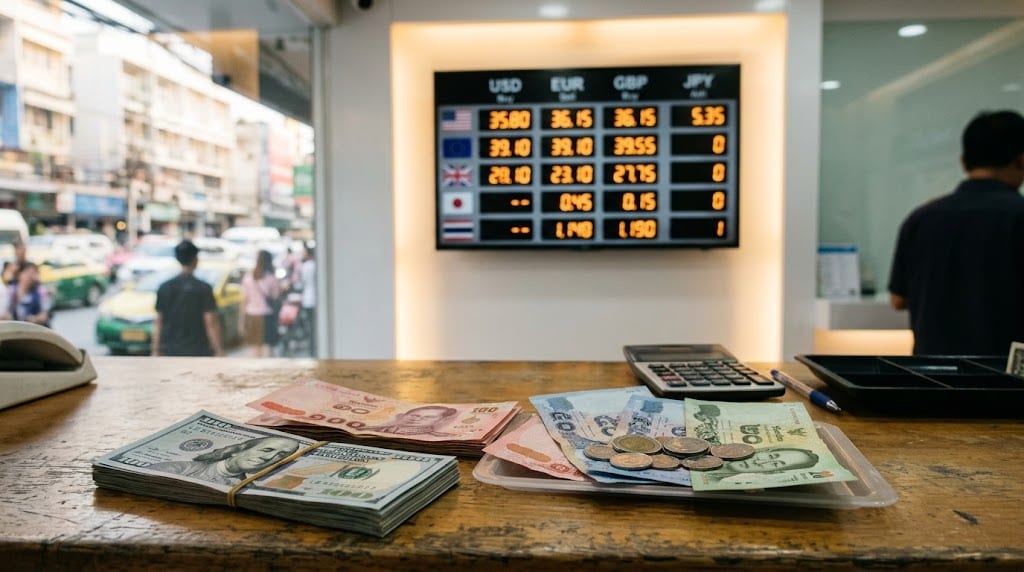
Read the board from the exchange office’s perspective. In the operator’s (SuperRich Thailand) calculator, the buying rate (Buying Rate) means exchanging foreign currency for baht. The selling rate (Selling Rate) applies to the reverse direction: you give up baht and receive foreign currency.
Don’t choose a column just because its number is larger. The difference between the buying and selling rates is also not the same as a separate fee: if a separate fee applies, it is counted on top.
Amount of foreign currency units × buying rate − separate fees in baht = baht in hand
To compare offers, write down the operator, branch, time, currency, and banknote denominations. Compare the same amount; if the banknotes fall into different groups, ask for the payout to be calculated for the entire batch.
The reference rate of the baht against the dollar answers a different question. The Bank of Thailand calculates a weighted interbank indicator based on purchases and sales of US dollars against baht, while average rates at bank counters are separate. None of these indicators promises a rate at a specific exchange counter.
When exchanging currency in Thailand, the final benchmark is the amount the counter agreed for your specific money. After the transaction, compare it with the cash you received and the confirmation.
What currency and banknotes to take on the trip
The choice between dollars, euros, and rubles starts before the trip. If you still have to buy the currency, compare the whole path to getting baht: the costs of preparing cash, the exchange terms on site, and any separate fees. If you already have the money, evaluate the offer for it before exchanging currency just because you have heard the usual advice.
When deciding which dollars to take to Thailand, look at the denomination and condition. The operator’s (SuperRich Thailand) official table separates dollar and euro banknotes by denomination; the buying rate can differ between groups. So an offer for a different banknote does not necessarily suit yours.
With the old design, there is no universal answer. The Senate Exchange blog reports that the T.T. Exchange chain accepts old dollars without the blue stripe at the same rate as new ones, if the banknotes are in excellent condition. This is an observation from the blog, not a guarantee of acceptance at every branch.
Here is a useful detail: the denomination and condition of a banknote answer different questions. The denomination may affect the quoted rate, while the condition affects whether the banknote will be accepted. Inspect the money for tears, writing, and damage, and find out the terms for doubtful banknotes before handing over the full amount.
Where to compare exchange offices at the airport and in tourist cities
Suvarnabhumi Airport
At Suvarnabhumi Airport, the landmark is basement level B near the Airport Rail Link Suvarnabhumi Station. The Fizen financial service blog lists exchange counters there, including the operator (SuperRich Thailand). This is a guide for finding them, not confirmation of the best rate or opening hours.
If you need baht right away, first assess the available counter and your immediate expenses. It is convenient to plan the remaining steps using the instructions on what to do at the airport after arrival.
Bangkok
In Bangkok, the operator (SuperRich Thailand) serves as an example for comparison: it publishes a rate table and exchange rules. Check the offer for the currency you need and your own banknotes at the specific branch.
Do not plan a trip across the entire city based on the chain’s name alone. First compare the expected payout with the travel costs, then decide whether the route is worth it.
Pattaya
In Pattaya, the T.T. Exchange chain can be considered in light of the Senate Exchange blog’s observation about accepting old dollars in excellent condition. It helps you frame a question for the cashier, but it does not confirm the terms at every location.
Find out whether your banknotes will be accepted and what rate will be applied. The chain’s name does not replace agreeing on the payout amount.
Phuket
In Phuket, the approach is the same: compare the available counters by currency, banknote acceptance terms, separate fees, and final baht amounts. First show your banknotes, then ask for a calculation.
A sign near a tourist spot says nothing about the result by itself. The decision requires the terms of the specific transaction.
What documents are needed for currency exchange
The operator (SuperRich Thailand) specifies a valid identity card or passport for buying or selling currency. This is stated in the exchange rules on the operator’s official website (SuperRich Thailand). This condition applies to this operator only; it cannot be transferred to all exchange offices.
A foreign tourist should practically prepare a valid passport. A photo or copy is not confirmed as a substitute for the document according to the operator’s wording. If you plan to use them, find out whether this is possible before your visit.
The preparation order is simple:
- Check the validity period of your document.
- Show the banknotes and find out the acceptance terms.
- Find out the rate for your banknotes.
- Agree on the final amount in baht and any separate fees.
- Hand over your money only after the terms are agreed.
If some banknotes are not accepted, revise the calculation before confirming the transaction. Do not automatically agree to the new amount: first find out which banknotes are included in the exchange and at what rate.
It is best to prepare your document in advance so you don’t have to look for it at the window. It is also convenient to separate your money by currency and denomination: this makes it easier to match the banknotes with the counter’s offer and check the result.
Cash withdrawals: ATM fees and card costs
ATM fees in Thailand depend on the bank and the card. Since June 5, 2026, UOB has raised the fee for cash withdrawals with a foreign card on the Mastercard network at its ATMs from 250 to 350 baht per transaction. The change is listed in UOB’s official fee schedule.
This rate applies to UOB ATMs and the payment system mentioned above. It cannot be treated as the general fee of all banks in the country.
The full cost of getting cash may include:
- A fee charged by the ATM owner.
- The fee charged by the bank that issued the card.
- Currency conversion costs according to the card’s terms and the transaction.
Before confirming, read the fee shown on the screen, and check the issuer’s tariff separately. The ATM screen does not replace the terms of your card, including any possible fee reimbursement.
To compare with cash exchange, compare the total costs of getting the same amount of baht. With a fixed fee, it makes sense to think about how often you withdraw, but unconditional advice to withdraw the maximum does not suit everyone. Take into account your card’s limits and a safe cash reserve.
It is best to choose your main payment method together with a backup one. Additional material how to pay in Thailand · RU helps you prepare for different situations on the trip.
Dynamic currency conversion: how to decline DCC
Dynamic currency conversion, or DCC, is an offer from a seller or an ATM to process the transaction in the card’s home currency. Such an offer has its own conversion rate, and there may be additional fees. A clear amount in a familiar currency does not yet mean a good result.
Visa requires the rate and any additional fees or markup to be shown on the screen and on receipts. The seller or ATM must give the customer a choice: accept the conversion or decline it. The choice cannot be made for the customer.
To decline the offered conversion:
- Find the transaction currency.
- Read the rate, fees, and markup.
- Choose to process the transaction in baht, THB.
- Check the currency before final confirmation.
Button labels may differ, so focus on the meaning of the offer. Agreeing to DCC is a separate decision, and you should not accept it just because the amount is shown in a familiar currency.
According to Visa’s explanation, accepting or declining DCC does not by itself deprive you of the ability to make purchases or withdraw cash abroad. However, this is not a guarantee that a specific transaction will be approved. Declining also does not cancel the ATM fee or the conversion under your card’s terms; a fixed saving cannot be promised.
Russian cards and cashless payment
Before the trip, ask your card-issuing bank whether your card supports payments and cash withdrawals in Thailand and what limits and fees apply. An answer about a different card or a different bank does not replace checking your own. Access to a banking app alone does not mean that payment is possible.
Prepare an independent reserve in case the transaction is declined. If you plan to use the app, think ahead about network access: see the article on mobile service and internet in Thailand. For long-term stays, separately study opening a bank account for a foreigner: this is a separate task that depends on the bank’s terms.
The TAGTHAi Easy Pay tourist payment service
The TAGTHAi Easy Pay tourist payment service no longer requires a mandatory physical prepaid card since August 2026. The service specifies a monthly transaction limit of 50,000 baht.
These terms do not mean that the wallet can be topped up with a Russian bank card or that registration is open to every user. The cancellation of the physical card also does not confirm specific methods of topping up and of refunding the balance.
It makes sense to consider such a service as a backup only after checking that it is available to you specifically. Do not leave preparation until your main card has already been declined and you have no cash for immediate expenses.
How to get baht for rubles and evaluate an intermediary
Exchanging rubles for baht can be considered a cash option: the operator’s (SuperRich Thailand) published table includes the ruble, RUB. This confirms that the currency is listed in the operator’s table, but not that every transaction can be carried out at every branch. Find out the terms for accepting your own banknotes separately.
Compare direct exchange with a route that goes through obtaining another foreign currency. For the same starting budget, estimate how many baht you will get after all stages and fees. An attractive rate at one stage does not yet determine the result of the whole route.
Third-party cashless exchange requires separate verification. Before any prepayment, find out:
- Which legal entity provides the service.
- What activities it is allowed to conduct.
- Who receives the transfer.
- What amount of baht will be paid out after fees.
- How payouts and refunds work if a transaction fails.
The ability to transfer via SBP does not prove the intermediary’s reliability. A license for cash exchange also does not automatically confirm the right to carry out money transfers, cryptocurrency operations, or issue cash by code.
Do not send large amounts to an unverified recipient. If you specifically need a transfer, separately compare ways to transfer money to Thailand: the terms of such a service cannot be substituted with the rules for exchanging banknotes at the counter.
Exchange safety and a checklist before the transaction
For currency exchange in Thailand, choose an operator with a clear legal entity and clear service terms. The Bank of Thailand website has a section with information on financial service providers under regulatory supervision. Mention of supervision alone does not confirm every service you are offered under a familiar name.
Compare the legal entity, the recipient of the money, and the type of transaction. Be especially careful with schemes where one person receives the transfer while another promises to pay out the cash. Before handing over any money, the amount, the payout procedure, and what happens if the transaction is refused should be clear.
Avoid exchanging with unknown private individuals. A promise of an especially favorable rate does not replace transparent terms and confirmation of the transaction; recommendations how to reduce the risk of fraud help assess a suspicious offer.
Checklist before exchanging:
- Independent reserve is prepared.
- The operator and the offered service are clear.
- Document is ready.
- The rate applies to your currency and banknotes.
- Fees and the final payout are agreed.
- Received baht counted at the counter.
- Transaction confirmation saved.
Count the money before stepping away from the window. If the result differs from what was agreed, sort it out with the staff member right away, while the transaction and its terms are still in front of you. Hurrying does not help here: first check the amount, then put away the money and the document.
What to do with leftover baht
Before exchanging back, estimate your upcoming expenses and set aside the amount you will still need. To receive foreign currency in exchange for baht, look at the Selling Rate column. In the SuperRich Thailand calculator, it applies specifically to this direction.
Before the transaction, agree on the final payout, the availability of the currency you need, the documents, and any separate fees. Do not assume in advance that the counter can pay out suitable banknotes or accept your entire remaining cash. Comparison makes sense only for a transaction the exchange point is ready to carry out.
The operator (SuperRich Thailand) does not exchange coins and specifies a limit 800,000 baht when exchanging baht for foreign currency. These are the operator’s terms. The limit must not be described as a customs restriction, a general national norm, or a daily limit.
If you plan to use its services, separate coins from banknotes when you prepare. Do not postpone estimating your leftover amount until there is no time left to compare: first determine how many baht you need to keep, then choose an offer for exchanging back.
Frequently Asked Questions ❓
Do Russian bank cards work in Thailand?
Check with your issuing bank before the trip whether your card can be used: clarify support for transactions in Thailand, restrictions, and fees. Access to a banking app alone does not mean the card will work for payment or withdrawal. Prepare an independent reserve in case a transaction is declined.
Where in Thailand is currency exchange most favorable: at an exchange office, a bank, or an airport?
Compare specific exchange counters by the buying rate for your currency, the terms for your banknotes, separate fees, and the final baht amount. The name of the network and its location do not guarantee the best result. The operator (SuperRich Thailand) states that it charges no separate fee, but the buying rate still needs to be compared.
How much does it cost to withdraw cash from a Thailand ATM with a foreign card?
UOB raised the fee for cash withdrawals with a foreign card from the Mastercard payment system at its ATMs from 250 to 350 baht per transaction as of June 5, 2026. This is the tariff of a specific bank and payment system. Factor in any possible issuer fee and conversion costs separately.
What is DCC and how do you decline the offered conversion?
DCC is an offer from a merchant or ATM to process the transaction in the card’s home currency. The Visa payment system requires showing the rate and any additional fees or markup and leaving the choice to the customer. To decline DCC, choose to process the transaction in baht; other expenses depend on the card and the terms of the transaction.
Which currency is best to bring to Thailand, and in what banknotes?
The choice depends on the cost of preparing cash and the exchange terms. The operator’s table (SuperRich Thailand) breaks down dollar and euro banknotes by denomination, so compare the offer for your own bills. Ask the chosen operator in advance about acceptance of old-design banknotes and the condition they must be in.
How can a tourist pay without cash if the card does not work?
Prepare an independent payment method in advance, and keep baht cash as a reserve. The tourist payment service TAGTHAi Easy Pay has cancelled the requirement to have a physical prepaid card since August 2026; the monthly transaction limit is 50,000 baht. These terms do not mean that the wallet can be topped up with a Russian bank card.
Can you exchange rubles for baht directly in Thailand, and what are SBP services?
RUB is listed in the operator’s published table (SuperRich Thailand), but being listed does not guarantee that your banknotes will be accepted at every branch. Third-party cashless exchange services have separate terms and prepayment risk. The possibility of a transfer via SBP does not replace checking the legal entity, the service, the recipient, and the agreed payout amount in baht.
Do you need a passport at an exchange office, and is it safe to exchange money "from private individuals"?
The operator (SuperRich Thailand) specifies a valid ID card or passport; this wording does not mean that a photo or copy is enough. For the trip, prepare a valid passport. Choose a clear operator, agree on the amount before handing over money, count the baht at the counter, and avoid exchanging with unknown private individuals.
Conclusion
Prepare your money and an independent reserve before the trip. For currency exchange in Thailand, compare the specific transaction: your banknotes, the needed rate direction, separate fees, and the agreed payout amount. Count the baht you receive at the counter and keep the confirmation.
Do not treat one network as the best choice for every case. Before exchanging, compare the available offers and decide whether the difference justifies the extra trip. For further preparation, open the guide to money and finances in Thailand and choose a main payment method along with a backup. This way, your immediate expenses will not depend on a single card or counter. Exchange rates, fees, and the availability of payment methods may change.
Sources
- In the operator’s FAQ (SuperRich Thailand) — documents, fees, coins, and exchanging back.
- In the operator’s table (SuperRich Thailand) — currencies and the breakdown of rates by denomination.
- In the operator’s calculator (SuperRich Thailand) — buying and selling directions for currency.
- In UOB’s official tariff — the fee for withdrawing cash with a foreign card from the Mastercard payment system.
- In Visa’s explanation — terms of dynamic currency conversion.
- In the Bank of Thailand’s methodology — interbank and bank counter rates.
- On the Bank of Thailand website — information on financial service providers under regulatory supervision.
- In the description of the tourist payment service TAGTHAi Easy Pay — cancellation of the mandatory physical card and the monthly limit.
Prepared by MyThai.online editorial team.