In this article:
What changed: the entry information was updated. From September 15, 2026, Russian citizens can enter Thailand without a visa for up to 30 days; as of late September, the tourist entry fee has not been introduced.
Current as of May 2026. When planning a weekly budget for Thailand, it’s important to understand that prices are subject to inflation, seasonal fluctuations (high/low season), and changes in exchange rates between THB ↔ USD ↔ RUB. This breakdown of a tourist’s actual spending over 7 days across three comfort levels will help you get oriented, from the budget backpacker to premium travel.
Short answer: plan on $350 to $2,000+ per week, depending on your travel style. This article breaks down the final amounts by category (housing, food, transport, activities), compares regional differences, and looks at the impact of seasonality and hidden costs. All budgets are approximate, so before your trip, be sure to check current prices for housing, flights, and insurance.
How Much Does a Week in Thailand Cost: Short Answer
| Level | Total for 7 days (USD) | Total for 7 days (THB) | Approximate in RUB | What’s included |
|---|---|---|---|---|
| Economy | $350–500 | 8 000–12 000 ฿ | ≈ ₽30 000–45 000 | Hostel, street food, motorbike rental, or public transport |
| Mid-range | $800–1 400 | 15 000–25 000 ฿ | ≈ ₽70 000–125 000 | 3–4* hotels, restaurants and cafés, Grab taxis, tours |
| Comfort | from $2,000 | 35 000–80 000 ฿ | from ₽180,000 | Villas and 5* hotels, fine dining restaurants, private transfers |
These amounts do not include airfare or visa processing. This is an approximate cost of living in Thailand for an extended stay or a short vacation for one person, based on data as of May 2026. The RUB equivalent is calculated at the average market rate (as of May 2026, ~₽90 per $1 and ~₽3.75 per 1 ฿) and is approximate, since the exchange rate changes daily.
Level 1: Economy Budget (Backpacker)
A backpacker budget in Thailand is a Southeast Asian classic. Housing in a hostel or dorm bed usually costs from 300–500 ฿ per night, although the exact price depends on the city and season.
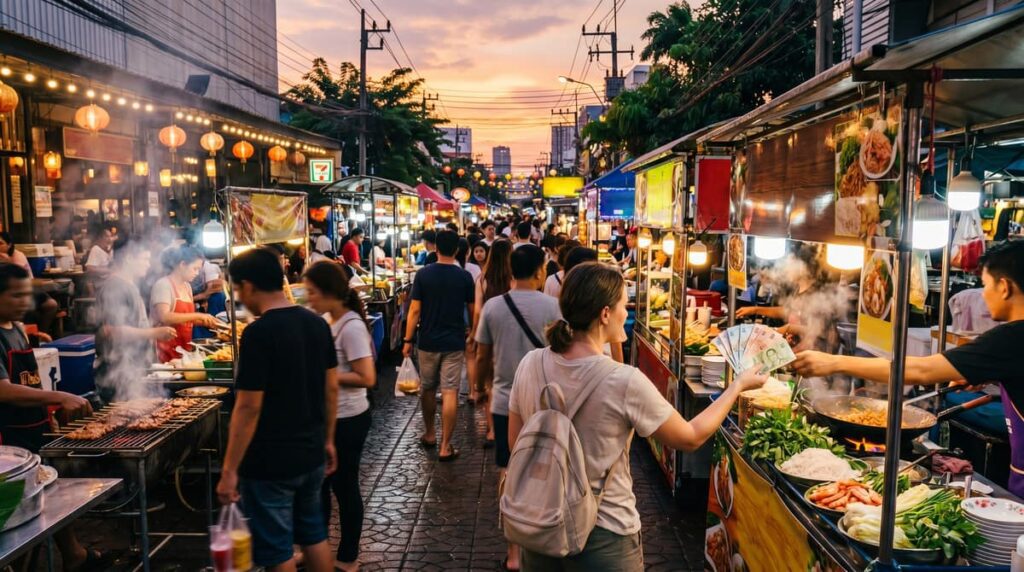
When it comes to food, street food saves your wallet. A budget traveler spends about 300–500 ฿ a day on food and drinks. A full day of eating at street food stalls comes to 300–400 ฿ (~$9–12). Typical dishes are reasonably priced: Pad Thai can be found for 50–80 ฿ in non-tourist areas, a bowl of Tom Yum costs 60 ฿, and Pad Krapow runs 45–60 ฿. However, in popular tourist areas of Bangkok, such as Khao San or Sukhumvit, the same dishes rise to 100–180 ฿.
Transport costs are also minimal. Using public transport (the BTS/MRT metro in Bangkok, songthaews in Pattaya, local buses) keeps daily spending to $25–50. Activities for budget travelers include free beaches and inexpensive Thai massage, which usually starts at 200 ฿. Total for the week: $350–500, or 8,000–12,000 ฿, based on data as of May 2026.
Level 2: Mid-Range Budget
The mid-range budget for a tourist in Thailand offers the optimal balance of price and quality. Housing here means comfortable 3–4 star hotels. Daily spending for a mid-range budget comes to 2,150–3,600 ฿ ($60–100), which already includes hotel and restaurant meals.
A typical day looks like this: breakfast at the hotel, lunch at a cozy café with air conditioning, dinner at a restaurant. Meals cost roughly $25–40 (900–1,400 ฿) a day, which is already included in the overall daily limit of $60–100. It’s easier to get around by metered taxi or through the Grab app. As for entertainment, a day tour usually costs several thousand baht, depending on how packed the itinerary is. All in all, a week of mid-range travel will cost $800–1,400 (or 15,000–25,000 ฿), excluding airfare and visa costs.
Level 3: Comfort Budget (Premium and Luxury)
For those who prefer premium and luxury, a week’s vacation in Thailand starts at $2,000 and has no upper limit. A weekly “premium” budget ranges from 35,000–80,000 ฿ (5,000–12,000 ฿ per day). Daily spending in the luxury segment easily exceeds $350.
Housing here consists of luxurious 4–5* hotels and private villas. Food means fine dining restaurants, gourmet breakfasts at hotels, and chef-driven cuisine. Transport includes a private airport transfer, a car rental with a private driver, and, if needed, domestic flights. Activities match the level: yacht charters, private tours, and high-end spa treatments. Spending money for a comfortable trip is about $350 in cash per person for 10 days (excluding tickets and lodging). For comparison, a package tour for two for 10 days costs $1,500–2,200 in the economy option and $2,500–4,000 in the comfort class.
Where the Money Goes: Breakdown by Category
Understanding how expenses are structured helps you plan your budget for a trip to Thailand. The main expense is housing, which takes about 40–50% of the budget at mid-range and comfort levels (from a hostel at 300+ ฿ to a 5* villa at 10,000+ ฿ per night). Food accounts for 15–25% of spending, while a full day of street food costs only 300–400 ฿ (~$9–12). Transport (Grab, tuk-tuks, motorbike rental) makes up 10–15% of spending. The remaining 15–25% goes to activities and tours.
Expense checklist:
- Housing: hotels, villas, hostels.
- Food: street food vs. restaurants.
- Transport: public transport, taxis, motorbike rental.
- Activities: tours, spas, massage.
- Shopping: souvenirs, clothing, local markets.
Regional Differences: Bangkok vs Pattaya vs Phuket vs Chiang Mai
The region has a major impact on how much a week in Thailand costs. As of May 2026, Pattaya remains the most budget-friendly resort: a stay here is about 20% cheaper than in Phuket. Bangkok is an ideal choice for budget travelers who prefer busy city life and inexpensive street food. Phuket offers hotels with good value for money, but food and entertainment cost more there.
Backpackers should definitely consider Pattaya or Bangkok. Tourists looking for a beach vacation and comfort at a reasonable price will also like Pattaya. Those who appreciate developed infrastructure and beautiful nature are better off choosing Phuket, but should be ready for higher prices. For where to eat on the island and how much it costs, see our guide to food in Phuket: markets, restaurants, and street food.
Chiang Mai — a separate category for those who come for mountains, coffee, and a slow pace. In terms of price, it’s close to Bangkok: housing and food are generally cheaper than on resort islands, while infrastructure for longer stays (coworking spaces, cafés, motorbike rentals) is stronger than in Pattaya. It’s a popular choice among digital nomads and those who want to combine a week-long break with the cooler climate of northern Thailand.
High and Low Seasons: How to Save on Travel Dates
The time of year is your main lever for saving money. High season runs from December to January. On popular islands such as Phuket, Koh Samui, and Koh Phangan, hotels cost 50–100% more than during the green season (June–October).
November–February is the peak of tourist traffic and maximum prices. From March through May, intense heat sets in across the country; prices drop slightly but remain high. During the green/rainy season, you’ll find the best housing prices, but there is a risk of prolonged downpours. If you want to save money, choose the green season. For comfortable weather without overpaying, April or November (shoulder months) are a great choice.
Hidden Costs and Fees
When planning expenses for a trip to Thailand, tourists often overlook non-obvious costs. Before entry, you must fill out the digital TDAC arrival card · RU — the procedure is free but mandatory. There is no tourist entry fee yet: as of late September 2026, it is still under discussion, and the government has not yet approved the amount or start date. Follow official news closely on the official website of the Tourism Authority of Thailand.
From September 15, 2026, Russian citizens can enter Thailand without a visa for up to 30 days. If you plan to stay longer, you will need an electronic visa (e-Visa Thailand): a consular fee for a single-entry tourist visa is 40 US dollars. For communication, the easiest option is a tourist SIM — prices range from 49 to 1,599 ฿. The AIS operator offers 6 packages (49–1,599 ฿), while True/dtac packages for 8/15/30 days cost 449–1,199 ฿. For more details, read about SIM, eSIM, and mobile internet in Thailand.
Don’t skimp on safety — you will definitely need reliable travel insurance for Thailand. Also keep in mind that ATMs in Thailand usually charge a fixed fee for cash withdrawals with foreign cards, so check the amount on the screen. At hotels, you may be asked for a cash deposit or have an amount frozen on your card at check-in.
How to Pay in Thailand: Card, Cash, PromptPay, Wise
Payment questions are closely tied to the topic of finances in Thailand: banks, transfers, and cards. Cash is necessary for paying for street food, taxis, tuk-tuks, and in small businesses. Visa and Mastercard cards are accepted at large hotels, shopping centers, and chain restaurants, but keep in mind that Russian-issued bank cards are not accepted, so bring UnionPay, a foreign card, or a sufficient supply of cash.
The local PromptPay system lets you pay instantly by QR code, but it is usually available only to holders of Thai bank accounts. The Wise service is popular with expats thanks to its favorable interbank exchange rate, but for a tourist visiting for a week, it is less critical.
Frequently Asked Questions ❓
How much money should I bring for a week in Thailand?
For a budget trip, you will need about $350–500; for mid-range, $800–1,400. If you prefer premium comfort, plan on at least $2,000. These amounts do not include airfare.
Which ATMs in Thailand offer the best rate, and what fees do they charge?
The conversion rate depends on your bank, while local ATMs usually charge a fixed fee per withdrawal (around 220 ฿). It is more economical to withdraw larger amounts at once.
Can I pay by card in Thailand, or do I need only cash?
Foreign bank cards work well at shopping centers, hotels, and large restaurants. For markets, street food stalls, and tuk-tuks, always carry cash in baht.
Is a week in Thailand expensive for a Russian traveler in 2026?
The cost of a trip to Thailand depends on the exchange rate of the ruble against the dollar and the baht. The economy option remains affordable, while the mid-range segment has noticeably risen in price due to global inflation.
Is it safe to carry cash, and how much should I keep on hand?
Thailand is fairly safe, but carrying large amounts is not recommended. Keep enough cash on hand for 1–2 days (for example, 2,000–5,000 ฿), and store the rest in the hotel safe.
How can I save on housing during high season?
Book hotels several months before your trip or choose less popular locations and beaches. Renting accommodation a bit farther from the sea often lets you save up to 30% of your budget.
Can weekly prices in Thailand change significantly, and how often should I check current rates?
Prices are subject to inflation, seasonal fluctuations, and exchange rate changes. Before your trip, check rates on booking aggregators and official websites so you don’t go over budget.
Conclusion
To sum up, there are 3 budget levels for a week: from $350–500 for backpackers and $800–1,400 for mid-range comfort, up to $2,000+ for premium travel. The final total depends heavily on the region you choose, the season and your habits. Current as of May 2026: conditions change, so before your trip, check current exchange rates and prices on booking aggregators and official websites, and also check the disease situation on the WHO website on epidemics in Thailand.
Make your plan, book housing in advance for the green season, and be sure to get travel insurance for your trip to Thailand — by our calculations, this is the cheapest budget item with the greatest protection. If you’re thinking of staying in the country for a month or two, or even moving there long term, a weekly estimate won’t tell you much; expand the figures in the full cost of living in Thailand by city and level and the general guide to life and daily living in Thailand for expats and long-term tourists.
Prepared by MyThai.online editorial team.