In this article:
What changed: Added menu price examples: massaman at a cafe (Nana Tam) — 140 ฿, rice separately — 20 ฿, pad thai with chicken at a restaurant (HIP Restaurant) — 220 ฿. Expanded the section on southern cuisine: gaeng som, khua kling and bai liang leaves with egg.
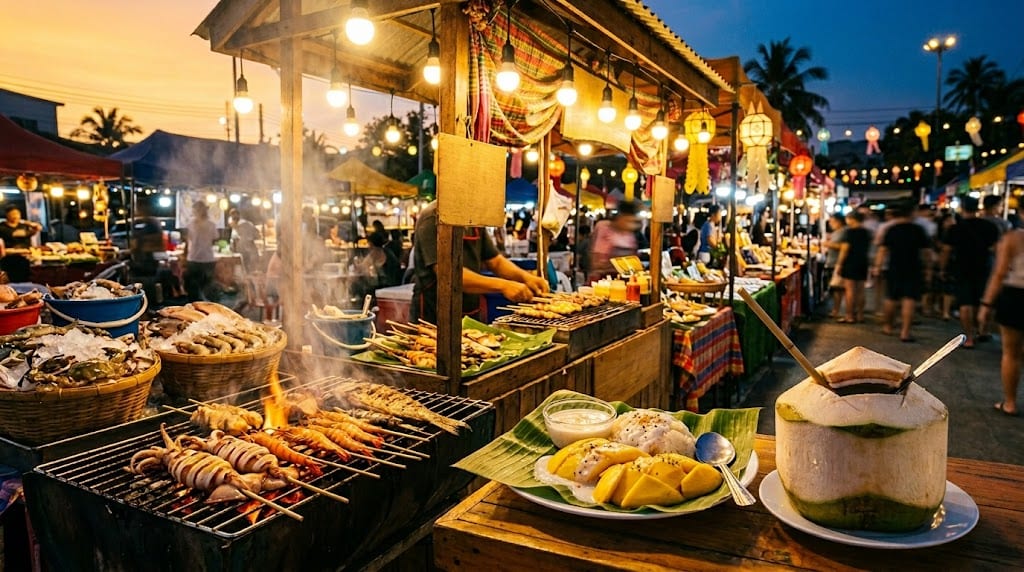
Food on Koh Samui means massaman with coconut milk, sour and spicy tom yum, crispy som tam, pad thai, seafood and coconut desserts. These are a good starting point for island cuisine, and then you can move on to southern dishes: gaeng som, khua kling and bai liang leaves with egg. Choose by taste. Massaman suits curry lovers, pad thai suits those who prefer noodles, and sweets can be saved for an evening stroll.
Where to eat on Koh Samui depends on the nearest district and format: a market, a local cafe or a restaurant each offers different ways to order. Below are specific menu prices, district guidance and tips on handling spiciness and separate side dishes. Dinner can be combined with a walk through Fisherman’s Village; other places for your route are listed in the guide to Koh Samui attractions.
What to Try on Koh Samui: Familiar Dishes and Southern Cuisine
To start, divide your choices into popular Thai dishes and southern cuisine. Pad thai, tom yum and som tam will help you get to know different flavors, while gaeng som and khua kling add regional accents. You don’t have to order everything at once: choose a main dish, then decide whether you want a salad or dessert.
- Massaman curry — curry with coconut milk. At a Thai food cafe (Nana Tam) it is made with chicken or pork, potatoes, onions and peanuts.
- Tom yum goong — sour and spicy soup with shrimp, lemongrass and galangal.
- Som tam — crispy green papaya salad. It’s best to discuss the spice level before it’s prepared.
- Pad thai — rice noodles stir-fried in a wok.
- Grilled shrimp and squid — options for getting to know seafood.
- Roti — a thin fried flatbread, which you can try with banana and condensed milk.
The Michelin Guide describes massaman through potatoes, Asian spices and a mild heat softened by coconut milk. This describes the flavor, not a promise that every portion will be free of pepper. If spicy food doesn’t suit you, discuss your preferred taste when ordering.
Southern dishes have different accents. Gaeng som — a sour and spicy fish curry with turmeric, chili and tamarind; khua kling — a dry stir-fried dish with minced pork or beef, turmeric, kaffir lime leaf and southern chili paste. Bai liang leaves with egg (bai liang pad khai) are stir-fried with garlic, sometimes with a little chili added.
Don’t judge how spicy a dish is by its appearance alone. Even greens with egg may contain pepper. If you continue your food journey on another island, a useful resource is food in Phuket — a separate guide for your next trip.
Coconut desserts and drinks
Coconut options are easiest to choose by format: a drink, a cold dessert or warm baked goods. A coconut smoothie can be ordered on its own, ice cream after the main dish, and khanom krok while strolling between stalls. There’s no need for a complicated order here: look at what each vendor is making.
Coconut ice cream is often served in a coconut half, sometimes with peanuts and pieces of flesh on top. The shell serves as the bowl; the edible part is the dessert itself and its toppings. If the ingredients matter to you, ask about them before ordering.
Khanom krok — small warm coconut rice pancakes with a crispy edge and a creamy center. This is a different option from cold ice cream, so you can choose by mood. Don’t expect to find all the coconut desserts at every market: check each stall’s range, not just the name of the venue.
How much food costs on Koh Samui: examples from menus
Prices are taken from the available menus. The table shows individual items from a cafe and a restaurant, not the average cost of eating on the island. It helps compare specific dishes and see which parts of an order are listed separately.
Massaman and plain rice are listed on the cafe’s own menu (Nana Tam). Pad thai options, massaman with chicken and shrimp with curry powder are listed on the restaurant’s menu (HIP Restaurant).
| Venue | Menu item | Price | What to consider |
|---|---|---|---|
| Cafe (Nana Tam) | Massaman with chicken or pork | 140 ฿ | Rice is listed as a separate item |
| Cafe (Nana Tam) | Plain rice (Rice Plate) | 20 ฿ | Not automatically counted as included in the curry |
| Restaurant (HIP Restaurant) | Pad thai with chicken | 220 ฿ | Other options have a different price on the menu |
| Restaurant (HIP Restaurant) | Pad thai with pork, beef or shrimp | 250 ฿ | The price applies to the listed options |
| Restaurant (HIP Restaurant) | Massaman with chicken | 220 ฿ | The side included with the listed menu item is not specified |
| Restaurant (HIP Restaurant) | Shrimp with curry powder and vegetables (Goong Pad Pongkari) | 240 ฿ | Specific menu item |
One small detail changes the comparison: the same dish name doesn’t mean the same order contents. At the cafe (Nana Tam), rice is listed separately, so the price of the curry alone doesn’t describe a meal with a side. Compare what you intend to order as a whole.
According to an estimate from a tourism resource (Sabai Sabai), most dishes at the Fisherman’s Village market it describes cost 40–120 ฿. This is an estimate for one specific venue, not the vendors’ price list or a range for all markets on Koh Samui. Check the current price of the items you choose before ordering.
Markets and pedestrian shopping streets: where to go for food
For an evening stroll, the best choice is Fisherman’s Village in Bophut. Among the food options here are pad thai, satay skewers, spring rolls, khanom krok, mango with sticky rice and steamed mussels. Choose based on what’s on offer on the specific evening.
A guidebook to the island (Inside Samui) describes the Friday transformation of the main street into an evening market. Another tourism resource (Samui Maps Collective) lists several operating days, including Friday. A Friday evening is the described visiting option, but not a complete schedule: these details do not establish the organizer’s final calendar, so confirm the schedule of the venue you choose before your trip.
Chaweng — a reference point for finding a pedestrian shopping street and evening food. The market venues in the district, including the market by the central shopping complex (Central Festival), should not be treated as a single venue with a shared schedule. The district name helps you choose a direction, but for a trip you need a specific point.
Lamai Night Market — another option for an evening stroll with street food, roti and seafood. Nathon is worth saving for a morning visit. A night market and grocery stalls serve different needs: an evening stroll with dinner versus finding food in the morning.
Where to eat by district: Chaweng, Lamai, Bophut and Maenam
Start with the nearest district. If the goal is an ordinary lunch, compare menus nearby; if you want to combine food with a stroll, choose a shopping street or market. Traveling across the island makes more sense for a specific dish or place you want to visit.
- Chaweng: a restaurant in a beachfront complex (HIP Restaurant) — an example for comparing pad thai, massaman and shrimp with curry powder. Prices for individual items are in the table above.
- Lamai: a Thai food cafe (Nana Tam) — a reference for massaman with chicken or pork. When comparing an order, keep in mind the separate rice item.
- Bophut: Fisherman’s Village suits combining a stroll with choosing food at the stalls. First decide on the venue, then the dish.
- Maenam: look for cafes and coconut drinks if you’re staying in this district. A coconut smoothie can be chosen as a separate drink, without a trip to the evening market.
These examples help match a district with a dining format. They don’t mean the named venue has the lowest prices in the area. To find an affordable lunch, compare specific items and the contents of the order.
Seafood: what to order and how to check the cost
For fish, shrimp, squid and mussels, look to Chaweng and the Ban Rak / Bangrak. A separate landmark is the seafood restaurant (Bangpor Seafood) with southern Thai cuisine and waterside tables. Don’t count it as a venue in Ban Rak: it is a separate name for your search.
If you want a clearly defined item in advance, the menu at HIP Restaurant lists shrimp stir-fried with curry powder and vegetables for 240 ฿. This is the price of one specific dish, not a benchmark for any shrimp or fish dinner.
When choosing seafood, ask a few questions:
- How is the cost of the chosen item calculated?
- What is included in the portion?
- Is preparation included?
- Is there a side dish, or does it need to be ordered separately?
Don’t apply the pricing method of one dish to the whole menu. Fish and a ready portion of shrimp may have different ordering conditions; sort them out before the food is prepared. And after dinner you can continue your walk by the water; for choosing a direction, see the Koh Samui beaches.
Where to have breakfast on Koh Samui
Nathon — a reference point for breakfast. A tourist guide (Thailand Vloggers) describes a daily morning market here. This format suits you if you want to look at grocery stalls and choose breakfast on the spot, without a set restaurant menu.
Another option is the Lamai Fresh Food Market. This is a separate venue from the night market: among the fish and vegetable vendors there are small food stalls. The reference to the Lamai night market doesn’t mean these grocery stalls.
For a morning visit, first choose a district, then see what the stalls offer. Don’t tie your trip to a required specific breakfast: choose from the selection on the spot. If you’re interested in a particular dish, ask the vendor about it instead of relying only on the word ‘market’.
How to order food: spiciness, contents and rice separately
It’s easier to put together an order step by step: first the main dish, then its variant and side. Don’t hesitate to ask about the contents before cooking. This is more useful than trying to guess ingredients from a photo on the menu.
- Choose the dish and the variety of meat or seafood. One item may have different options and prices.
- Ask for the spiciness you want. The dish name doesn’t promise there will be no chili.
- Check the contents. For example, massaman at the cafe (Nana Tam) includes coconut milk and peanuts, as well as potatoes and onions.
- Check the side dish. On the same cafe’s menu, plain rice is priced separately — 20 ฿, massaman with chicken or pork — 140 ฿.
- Agree on the cost of additional items before cooking.
Don’t assume rice is automatically included with the curry. If you want to compare lunch options, first determine the same order contents. A dish description also doesn’t confirm that it’s suitable for allergies or for vegan or halal diets: discuss the required conditions separately, without assuming anything from the name.
Frequently Asked Questions ❓
What should I definitely try to eat on Koh Samui?
For getting to know the cuisine, massaman, tom yum goong, som tam, pad thai and seafood are good choices. For sweets, coconut ice cream and khanom krok. For southern cuisine, choose gaeng som, khua kling or bai liang leaves with egg; discuss your preferred spiciness when ordering.
Where on Koh Samui can I find inexpensive markets and pedestrian shopping streets?
You can start at Fisherman’s Village in Bophut, the market venues in Chaweng and the Lamai night market. For morning food, head to Nathon or the Lamai food market. Friday evening at Fisherman’s Village is described by sources, but this is not a complete schedule; check the price of a dish with the vendor.
Where on Koh Samui is there seafood?
Good places to look are Chaweng, the Ban Rak area and, separately, the seafood restaurant Bangpor Seafood. On the HIP Restaurant menu, shrimp with curry powder and vegetables costs 240 ฿. Before ordering, find out what the item’s price includes.
How much does it cost to eat on Koh Samui?
According to the available menus, massaman with chicken or pork at the cafe (Nana Tam) is listed at 140 ฿, and rice separately at 20 ฿. At the restaurant (HIP Restaurant), pad thai with chicken costs 220 ฿, with pork, beef or shrimp — 250 ฿. These are specific items, not the island’s average bill.
Is it safe to eat street food on Koh Samui?
A stall’s popularity and queue do not guarantee that a dish is safe. Before ordering, check the ingredients and the way it is prepared. Detailed recommendations are in the article about food and water safety in Thailand.
What coconut dishes and desserts should I try on Koh Samui?
Choose a coconut smoothie, ice cream served in a coconut half or khanom krok. Presentation and toppings depend on the vendor. Not all of these options are necessarily found at every market.
Is rice included in the price of curry?
It depends on the menu. At the cafe (Nana Tam), rice is listed as a separate item at 20 ฿, and massaman with chicken or pork at 140 ฿. For another venue, check which side dish is included in the order.
Conclusion
Food on Koh Samui offers a clear choice: familiar Thai dishes, southern curries, coconut desserts and seafood. Start with the nearest district and the dish you want to try, then compare specific menu items. When ordering curry, check the side dish, and for seafood, check how the cost is calculated and what the portion includes.
Prices may change, so use the published menu as a guide when choosing. For planning other expenses, see the cost of living in Thailand, and for choosing a month, the guide when to go to Thailand. Now choose a dish and the nearest district for your next breakfast or dinner.
Prepared by MyThai.online editorial team.