In this article:
What changed: Clarified the palace’s location in Cha-Am and the name of the pavilion for theatrical performances. Added information on the restoration of the complex and the award received by its woodworking workshop in 2021.
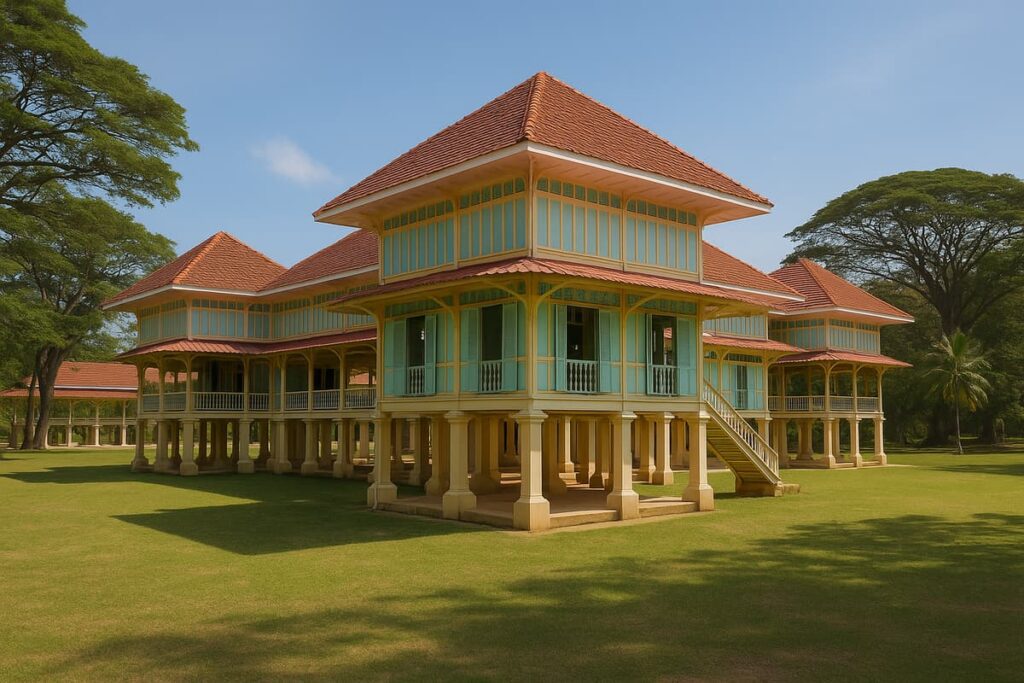
Mrigadayavan Palace is a former summer residence of King Rama VI on the seaside. Administratively it is located in Cha-Am, Phetchaburi Province, although trips here are often planned from Hua Hin. Points of interest here include the teak buildings on stilts, the covered wooden walkways and the history of the royal pavilions.
For an introduction to the resort, the guide to Hua Hin will help, but visiting the residence needs a separate plan. Information on opening days, tickets and tours varies, so check current conditions before your trip, especially if you want to go inside the pavilions.
Below are the published visiting options, road reference points and clothing tips. Regular admission and guided tour offers are described separately: buying a ticket does not mean free access to all rooms. It is best to base the length of your visit on the option you choose, and arrange return transport in advance.
Where the palace is and who will enjoy the trip
According to the tourist directory (Gplace), the residence is located in Cha-Am district, Phetchaburi Province, on the grounds of Camp Rama VI. A tourist brochure from the Tourism Authority of Thailand describes it as a seaside summer palace between Cha-Am and Hua Hin. So the link to Hua Hin is convenient for planning a holiday, but administratively the palace belongs to Cha-Am.
The encyclopedia (Wikipedia) describes it as a former residence of King Vajiravudh, Rama VI. To search for the site, use the name “Mrigadayavan Palace”: it will help you tell the right complex apart from other royal landmarks. The map link is given in the section on getting there.
The trip suits those interested in wooden architecture, the historical layout of a royal residence and the combination of pavilions with the seashore. The main theme here is the complex itself: the materials of the buildings, the stilts and the walkways that connect them. If your goal is a specific room or a tour of the upper floors, choose a visit based on which areas are open, not just the ticket name.
Opening hours and access: what the directories say
The tourist directory (Lovethailand) lists regular visits from Friday to Sunday. It describes Thursday separately: for groups and schools by prior arrangement. This information does not allow us to confidently state that Monday, Tuesday and Wednesday are the operator’s current days off.
Opening hours differ between directories. The Lovethailand directory gives the range 09.00–17.00, while the tourist directory (Gplace) gives — 09:00–16:00. Do not use the later closing time as a reliable guide for your arrival: the current schedule, holiday exceptions and last admission time have not been established.
The local publication (Hua Hin Today) reported that public visits to the residence resumed on May 23, 2024. This is the historical date of its opening to the public, not confirmation of today’s schedule. It also does not determine which rooms are open for a particular visit option.
The operator’s information source is the palace’s official website. When planning your trip, you need answers to related questions: whether individual visitors are accepted on the chosen day, which areas are included in the visit, and whether a tour booking is required. Do not build your route on the assumption alone that the published hours mean free access to the entire complex.
Tickets and tours: published options
The report from the local publication (Hua Hin Today) on resumed visits lists separate fares for adults and student categories. The adult ticket also applies to foreign visitors; the tourist directory (Lovethailand) gives the same fare. The high school student category should not be extended to all schoolchildren.
Information from published sources; check current conditions before your trip.
| Visit option | Amount in baht | What the source reports | Limits on currency |
|---|---|---|---|
| Adults, including foreign visitors | 90 ฿ | Local publication (Hua Hin Today); the same adult fare is listed in the directory (Lovethailand) | The operator’s current fare has not been established |
| University students and teachers | 60 ฿ | Report from the local publication (Hua Hin Today) on the resumption of visits | Current conditions of use and required documents have not been established |
| High school students and their teachers | 30 ฿ | Report from the local publication (Hua Hin Today) on the resumption of visits | Age limits and current conditions of use have not been established |
| Guided tour option with herbal drink | 316 ฿ | Described as a donation for visiting the pavilions | The current offer and booking procedure have not been established |
| Guided tour option with tea and snacks | 716 ฿ | Separate article from the local publication (Hua Hin Today) | Cannot be treated as a confirmed current offer |
| Guided tour option with tea set | 916 ฿ | Report from the local publication (Hua Hin Today) on the resumption of visits | It is not established whether it replaces the 716 ฿ option |
Check the current cost. Regular admission and the guided tour donation should not be automatically added together: the published sources do not establish whether the entry ticket is included in the guided tour option. So the total budget depends on what the chosen visit includes, not on simply adding up the rows of the table.
A separate article from the local publication (Hua Hin Today) links a special tour with access to the upper floors and describes donations with herbal drink or with tea and snacks. The same publication’s report on resumed visits lists a different option, a tour with a tea set. The difference in amounts does not allow the conclusion that the more expensive option replaced the earlier one.
When choosing a tour, it is useful to find out its route, what the offer includes and how to book. A drink in the description does not explain which rooms can be visited. Conditions for child and other concessionary visits, parking and additional payments are also not confirmed; do not plan your budget around free entry or no fees.
How to get to Mrigadayavan Palace
For navigation, use the saved map point: Mrigadayavan Palace. It helps you select the site, but on its own does not confirm the entry procedure to the camp grounds or parking availability. When arranging the trip, tell the driver that you need the palace complex.
The guidebook (Renown Travel) places it at about 15 km north of Hua Hin and 10 km south of Cha-Am. The Russian-language guide “Travelbelka” gives the starting point as about 15 km north of central Hua Hin. These are location reference points, not a measured driving distance from every hotel.
For a trip on your own, consider a taxi, a rented car or a motorbike. Which option is most convenient depends on where you are staying and your onward route. If you arrive in the city by train, the Hua Hin railway station can help you plan your arrival, after which transport to the palace needs to be arranged separately.
Practical preparation steps:
- Show the driver the location of the complex and agree on a drop-off point.
- Discuss the return trip: waiting time, a meeting point or a separate vehicle pickup.
- If you drive yourself, check the entry and parking conditions in advance.
- Leave a time buffer between arriving in the city and visiting the palace.
By the way, the return journey deserves as much attention as the trip there. Availability of a free car or a working taxi-booking app at the complex exit is not guaranteed. There is also no confirmed songthaew route to the palace gates.
History and architecture of the teak palace
According to the encyclopedia (Wikipedia), construction of the residence took place in 1923–1924 under the direction of Italian architect Ercole Manfredi. It was the summer residence of King Vajiravudh, Rama VI. The history of its construction explains the purpose of the complex, but does not determine today’s tourist route.
Golden teak and three connected main pavilions are mentioned in the description by the state organization (DASTA). The buildings raised on stilts are linked by walkways, so the palace is better understood as a complex rather than a single monumental block. The wooden links between the pavilions are part of its architecture.
The tourism publication (PlacesAndFoods) describes 16 teak buildings, connected by balconies and corridors, as well as a blend of the Thai method of raising buildings on stilts with Western details. The Russian-language encyclopedia article also gives three groups and 16 buildings linked by a covered wooden corridor. This layout helps explain the plan: the separate blocks form one connected residence.
The encyclopedia (Wikipedia) places the personal royal chambers in the part of the complex called Samutphiman. The pavilion for meetings and performances is Samosorn Sevakamart, Thai name: สโมสรเสวกามาตย์. The tourism portal (Kapook) describes it as an open space for meetings, club events and theatrical performances.
The name of the palace is linked to the Deer Park at Isipatana in India, where the Buddha gave his first sermon; the encyclopedia (Wikipedia) explains this link. A tourist brochure uses the nickname “Palace of Love and Hope.” This is a nickname, not a literal translation of the name.
How the palace is preserved: restoration and the workshop’s award
A study published by a university program (BSAC) reports on the first restoration works in 1987. They involved the Border Patrol Police and the Fine Arts Department of Thailand. In 1992 the royal family established the Palace Foundation, to which the care of preserving the complex was transferred.
For visitors, this history adds another theme to the architectural tour: the preservation of a wooden residence. The pavilions are interesting for their original layout, while restoration is the work of maintaining historic buildings. At the same time, the dates of earlier works say nothing about the current opening or closure of any particular hall.
The cultural portal (Thailand NOW) reports that in 2021 the palace’s woodworking workshop received a special award for sustainable development. The award was given under the UNESCO program for the conservation of cultural heritage in the Asia-Pacific region. The recognition went to the workshop itself.
This award should not be understood as the palace being added to the UNESCO World Heritage List. Its meaning relates to heritage conservation and sustainable development. For a trip, this is an interesting historical and cultural context, but it is not evidence that the workshop is open to visitors or that restoration rooms can be visited.
What to see and how much time to allow
The main themes of the visit are teak architecture, buildings on stilts, covered walkways and the residence’s seaside location. Pay attention to how the individual pavilions connect into one complex. Even without a detailed list of interiors, this layout helps you understand how the summer palace is organized.
The historical purpose of parts of the complex provides additional reference points: there were personal royal chambers here and a space for meetings and performances. However, a description of these functions does not promise entry into the corresponding rooms. Your route depends on open areas and the visit option you choose.
Do not tie your visit to a fixed number of hours. A walk focused on architecture and a tour of the pavilions may take different amounts of time; it is better to build a specific plan around the accessible route. If the tour matters to you, align its length with the return trip rather than setting the driver’s return time at random.
To get acquainted with the complex, you can watch a video about the palace. It helps you picture the site, but does not confirm current access to the rooms or the seafront. Free access to the beach and passage through all the corridors should not be considered part of a regular ticket.
For more to do on your holiday, there are standalone destinations: Takiab Hill and Khao Sam Roi Yot National Park. Choose them based on your own interests and transport plans. Combining all these places into one day requires a separate route plan.
Dress code, footwear and photography rules
The tourist directory (Lovethailand) recommends a top with sleeves and trousers or a skirt covering the knees. It is simpler to prepare suitable clothing in advance than to count on renting it at the entrance. The availability and terms of such rental are not confirmed.
Footwear that is easy to take off and put on is a practical choice in case a requirement applies in a particular room. This is advice for convenience, not a statement that shoes must be removed in every hall. Follow the signs and staff requests along your route.
Bring water for the journey. The tourism portal (Kapook) reports a restriction on eating and drinking food and beverages brought from outside in the palace area, but whether this restriction is current has not been established. It also does not prove a ban on carrying water across the whole site: link the possibility of drinking or snacking to the rules of each specific area.
The same practical approach applies to photos and videos. Follow the signs and ask for permission in each specific room, including for the use of flash and tripods. Free photography throughout the complex or the absence of extra fees cannot be promised.
Before you leave, it is handy to check this short list:
- Clothing with sleeves and covered knees.
- Footwear that is easy to take off if needed.
- Water for the journey.
- Return transport arranged.
- Understanding the route of the visit you have chosen.
General etiquette rules in Thailand will help you prepare for a visit to a cultural site. On the grounds, keep a calm tone and follow the marked route. For a family visit, plan separately how to get around with a child: continuous passage with a stroller through the entire complex has not been confirmed.
Frequently Asked Questions ❓
Where is Mrigadayavan Palace?
The palace is in Cha-Am, Phetchaburi Province, on the grounds of Camp Rama VI by the sea. Hua Hin serves as a tourist reference point for the trip. For navigation, use the map link in the section “How to get to Mrigadayavan Palace.”
How much does admission to Mrigadayavan Palace cost?
The local publication’s report on resumed visits (Hua Hin Today) lists tickets at 90 ฿ for adults, 60 ฿ for university students and teachers, and 30 ฿ for high school students and their teachers. The directory (Lovethailand) also gives the adult fare of 90 ฿. The operator’s current fare as of the update date has not been established; check the current cost of the visit you choose.
How do I get to Mrigadayavan Palace from Hua Hin?
Use the palace’s location on the map and arrange transport there and back in advance. Travel time depends on your departure point and traffic. Availability of a free car or of a taxi-booking app at the palace exit is not guaranteed.
On which days can I visit Mrigadayavan Palace?
The directory (Lovethailand) lists regular visits from Friday to Sunday, and Thursday for groups and schools by prior arrangement. Its hours are 09.00–17.00; the directory (Gplace) gives 09:00–16:00. The operator’s current schedule and holiday exceptions should be confirmed before your trip.
Can I visit Mrigadayavan Palace with children?
When planning a family visit, find out the cost of a child’s visit and which areas are open. Prepare clothing with sleeves and covered knees, and follow the signs on the grounds. Free entry for children and the ability to go the full route with a stroller have not been established.
Conclusion
Mrigadayavan Palace is worth a visit for its teak pavilions on stilts, the walkways that link them, and the history of Rama VI’s seaside residence. It is better to plan the trip around the accessible route rather than expecting to see all the royal rooms. Start by choosing a visiting day, prepare suitable clothing and arrange return transport.
Regular admission and guided tour options are described separately; what a payment includes and access to rooms depend on current conditions. If after getting to know the palace you want to keep exploring the region, see trips around Hua Hin. Choose your next destination based on your interests and allow it enough time, rather than trying to fit every sight into one route.
Prepared by MyThai.online editorial team.