In this article:
What changed: Passenger trains have used the new elevated station since December 11, 2023; the switch to the new timetable was scheduled for December 15, 2023. Added a historical note about a festival announced for August 10–18, 2026, and a historical exhibition (Next Move) in its program.
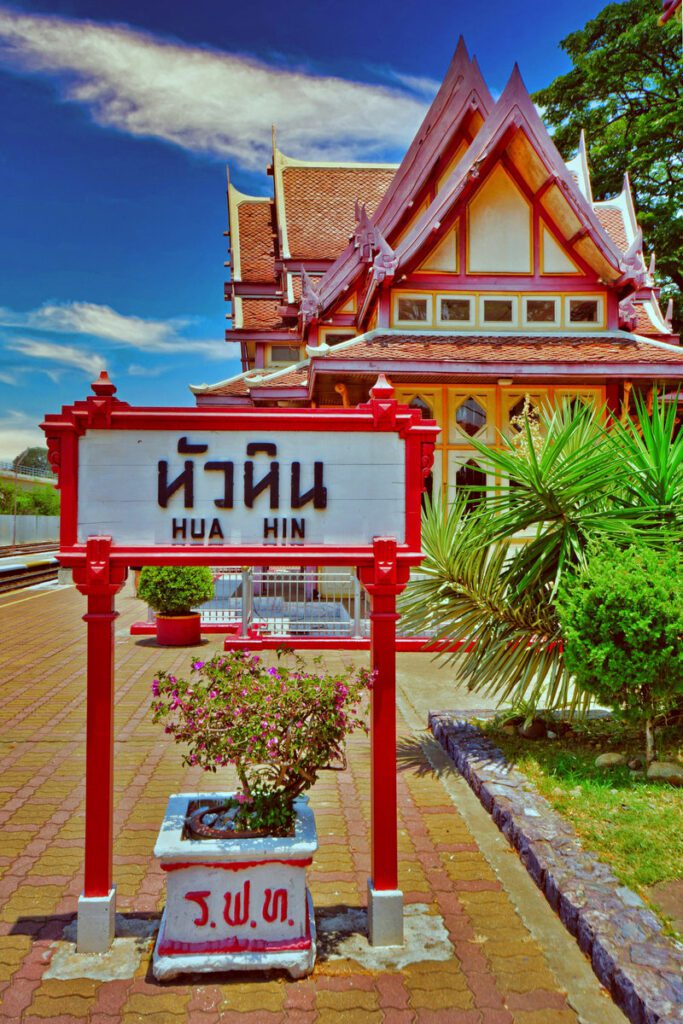
Hua Hin Railway Station is a place where you need to tell apart a sight from a passenger station. The historic station (Old Hua Hin Railway Station) is visited for its red-and-cream wooden architecture, carved details and the Phramongkutklao Pavilion. Passenger trains are served by the new elevated station (Hua Hin Railway Station) nearby.
Address landmark: Prapokklao Road. As of October 2026, the official tourist listing gives the phone number 032-511-073. If you’re taking a train, specify the passenger station from the start; for a stroll, choose the historic complex.
Here you can look closely at the wooden carvings, photograph the building as a whole and see the displayed steam locomotive. The visit fits easily into getting to know the town, rather than building the whole trip around it. To choose other stops, see the guide to Hua Hin.
Old and new Hua Hin stations: where to go
| Place | What to go for | What to look for |
|---|---|---|
| Historic station | Architecture, pavilion, photos from accessible areas | Red-and-cream wooden building |
| New station | Passenger departures and arrivals | Elevated structure and passenger signs |
As of October 2026, the tourist guide (Thai Holiday Guide) reports: since December 11, 2023, all passenger trains have used the new elevated station. The switch to the new Southern Line timetable was planned separately for December 15, 2023, according to a local newspaper report (Hua Hin Today).
An official notice from the Tourism Authority of Thailand also separates the station’s opening under the old timetable from the later launch of the new timetable on the double-track line. Put simply, the opening of the building and the change in schedule are different events. Archived reports explain this transition, but you need to check the departure time for your specific train.
According to a report on the opening, the new station is about 100 meters from the old one. This is an estimate of the distance between the two sites, not the exact walking length between entrances. To board, follow the entrance and signs of the new station, even if the historic building is already in view.
The historic Hua Hin station is a red-and-cream wooden building for architectural sightseeing.
The new Hua Hin station is an elevated passenger station for train departures and arrivals.
History of Hua Hin Railway Station
The history of Hua Hin Railway Station begins earlier than the story of the building familiar from photographs. A secondary reference, the encyclopedia (Wikipedia), gives the station’s opening date as November 25, 1911. The travel guide (Meridiela) dates the current historic building to the year 1926 and describes its red-and-cream wooden finish with carved details.
These dates answer different questions: when the station began operating and when the surviving building appeared. They should not be merged into a single founding date for the architectural ensemble. The railway ties the site’s history to the Southern Line; the arrival of the new station has continued its transport history by changing where passengers board.
A report on the opening of the new station on the local portal (LocalPlus) describes the former station as a historic site registered by the Department of Fine Arts. It also reported plans to preserve it as a landmark.
For a walk, this is an important distinction: the historic heritage remains a separate reason to visit the station. At the same time, preservation plans alone do not mean there is a permanent museum here with an established schedule for interior visits.
The Royal Pavilion and station architecture
The Phramongkutklao Pavilion is a separate element of the complex, not just a decorative part of the main building. The origin of the royal waiting room is described in the official listing of the Tourism Authority of Thailand: it was moved from Sanam Chandra Palace in Nakhon Pathom Province. The same listing notes Victorian influence and the red-and-cream coloring of the pavilion.
The Thai culture reference (THAILEX) describes the royal waiting hall through the chaturamukha style: a building with four gables or four entrances. This describes the pavilion itself; there is no need to apply this scheme to every building in the station complex.
The site has an interesting visual feature: a shared color palette unites the buildings, although the pavilion has its own history. If you linger over the carved details, the architecture reveals itself better than in a single overall shot. Color, wood and roof shape give different reasons to look at the complex more closely.
To find it, you can open Hua Hin station on the map. Searching by the general name helps you find the station area, but does not mark a separate entrance to either the historic building or the passenger building.
Fans of wooden architecture can plan separately a visit to the palace (Mrigadayawan Palace). It is a standalone topic for a trip, not an extension of the station grounds.
What to see and photograph
Start with an overall view of the historic building, then move on to individual details. This order helps you see the complex as a whole and choose what you want to look at more closely. These are good for photos:
- The red-and-cream facade — an overall shot of the historic station.
- Wooden carvings — close-up shots of decorative details.
- Station sign — a shot with the place name.
- The Royal Pavilion — its own architectural subject.
- The displayed steam locomotive — a contrast with the wooden buildings.
The antique locomotive on the station grounds is mentioned in the official tourist listing. It can be included in the walk as a separate exhibit, without tying the visit to passenger train movements.
Choose angles from the accessible areas. You don’t need to go past barriers or try to get onto active platforms for a photo. A good shot of the pavilion also doesn’t require access inside: you can show its shape and details from outside.
Video about the station complements your introduction to the place. For planning boarding and visits, rely on the separate information about the new station and accessible areas.
Where the station is and how to get there in Hua Hin
As of October 2026, the official tourist listing gives the address as Prapokklao Road, Hua Hin, Prachuap Khiri Khan Province, postal code 77110. English search entry: (Prapokklao Road, Hua Hin, Prachuap Khiri Khan, 77110). The phone number from the same listing — 032-511-073.
The English name of the station is Hua Hin Railway Station, and the Thai name is สถานีรถไฟหัวหิน. These names are handy to show a driver or use in search, but also state your purpose: the historic building for a walk or the new station for boarding.
The Renown Travel tourist guide describes the approach from Phetkasem Road through Soi 76. Use this as a reference for reaching the station area, and at the buildings follow local signs and available passages.
If you’re traveling by train, don’t make the historic facade the endpoint of your local trip. It’s better to say right away that you need the passenger entrance. This saves you from searching for the right building with luggage.
Admission, visiting hours and access inside
As of October 2026, the tourist guide (Thai Holiday Guide) lists free admission. This entry does not set uniform conditions for all parts of the complex. Free access to the grounds does not mean free entry into the pavilion or onto the passenger platforms.
| Area | What you can plan | Access conditions |
|---|---|---|
| Historic complex grounds | Viewing the building and taking photos from accessible areas | The guide lists admission as free |
| Pavilion interior rooms | Exterior viewing as the main option | No confirmed hours for interior visits |
| Operating passenger station | Arrival, departure and access to your train | Follow passenger signs and the operator’s rules |
Exact hours for free visits to the historic building have not been set. The station’s operation does not mean round-the-clock access to the historic rooms. We recommend confirming the current cost and access conditions for the area you need before your visit.
The same guide describes an elevator and escalator to the new station’s platforms, as well as a pedestrian walkway below it. Knowing about the equipment is useful when traveling with luggage, but it does not guarantee that it will be working on the day you arrive or a fully accessible route for a stroller. If you need help, contact station staff.
How to get there from Bangkok
For a trip from Bangkok, you can choose a train, bus or car. Compare options based on your date, luggage and onward route around Hua Hin. There is no single travel time for all modes of travel.
Hua Hin station is included in the official timetable of the Southern Line of the State Railway of Thailand (SRT). Start a train trip by checking the specific train in the official ticket service (SRT D-Ticket):
- Choose your travel date and the direction to Hua Hin.
- Check the departure station in Bangkok for the chosen train.
- Check the departure and arrival times.
- Review the ticket conditions.
- For arriving or boarding in Hua Hin, use the new station.
Don’t choose the departure station based only on the general advice to “go from Bangkok.” It depends on the specific train. As of October 2026, the operator’s official hotline is — 1690.
If you prefer a bus or car, plan your route to the point you need in Hua Hin: your accommodation, the historic complex or the passenger station. Without tying it to a specific trip and road conditions, it is not possible to promise a travel time.
A separate sightseeing theme is covered in the article on the retro train from Bangkok to Hua Hin · RU. Use it to get a sense of the trip format, not as a current regular timetable.
Tips for visiting and what to see nearby
Bring water and a hat, and choose your walking time based on light and weather. Morning can work for photos, but it does not guarantee coolness or the absence of other visitors. It is better to look at how the facade is lit than to aim for a universal “perfect hour.”
There is no required amount of time for the visit. If you only want to see the complex, the walk will be shorter; if you’re interested in the carvings, pavilion and photos, leave more free time. Don’t tie the architectural visit closely to boarding a train.
The walk can be continued to the beach (Hua Hin Beach) and Hua Hin Night Market. As of October 2026, the secondary reference, the encyclopedia (Wikipedia), gives the distance from the station to the beach as about 850 meters. This is a location reference, not a measured length of the chosen walking route.
For a dinner stop, see the article on food and markets in Hua Hin. If you want to extend your trip beyond the walk around the station, separate options will be the mountain (Khao Takiab), Mrigadayawan Palace and the family park Fantasy Village. Plan them as separate stops, without counting on walking to them from the station.
There is also a historical note about events at the station. The state portal announced a heritage and tourism festival here for August 10–18, 2026, with a historical exhibition (Next Move) in its program. As of October 2026, the announced dates have already passed; the announcement does not confirm that the festival actually took place or that a permanent exhibition is operating now.
Frequently Asked Questions ❓
Can I catch a train at the old Hua Hin station?
No. According to the tourist guide (Thai Holiday Guide), since December 11, 2023, passenger trains have used the new elevated station. The historic building nearby is visited as a sight; for departures, go to the new station.
How much does admission to Hua Hin Railway Station cost?
Admission is listed as free in the tourist guide (Thai Holiday Guide), as of October 2026. This entry does not set access conditions for entering the pavilion or the active passenger platforms. Check the current cost and availability of the area you need before your visit.
How much time do you need to visit the station?
It depends on whether you just want to see the complex or look closely at the architecture and take photos. Plan the visit separately from your boarding time and check the timetable for your train.
How do I get to Hua Hin station from Bangkok?
You can plan the trip by train, bus or car. For the rail route, check the specific train, its departure station and time in the official railway ticket service (SRT D-Ticket); passenger trains arrive at the new station. There is no single travel time for all options.
What else is there to see near Hua Hin station?
You can continue the walk to the beach and the night market. A secondary reference gives the distance from the station to the beach as about 850 meters, as of October 2026; this is not a measured length of a specific walking route. Mrigadayawan Palace and Khao Takiab are separate options for extending the trip.
Can you go inside the Royal Pavilion?
Current hours for entering the interior have not been set. Plan your visit and photos from the accessible area, and check on site whether you can go inside.
Conclusion
Hua Hin Railway Station is worth including in your route for its historic architecture, the Royal Pavilion and the displayed steam locomotive. Start with an overall view of the complex, then look at the wooden carvings and individual details. For a passenger trip, use the new elevated station and plan boarding separately from the walk.
After your visit, you can continue exploring Hua Hin at the beach and night market. For another trip, save Mrigadayawan Palace or the park (Khao Sam Roi Yot National Park). Choose your next route using the general guide to Hua Hin linked at the beginning of the article, so the stops match your interests and plans for the day.
Prepared by MyThai.online editorial team.