In this article:
What changed: Added the current rules: from September 15, 2026, visa-free stay for Russian citizens is up to 30 days, a tourist visa extension is up to 30 days for 1,900 baht at the officer’s discretion, and the conditions for extending the visa exemption for Russian citizens are described in the extension section; the overstay fine is listed as 500 baht per day, up to 20,000 baht.
In 2026, holders of ordinary Russian passports may stay in Thailand without a visa for up to 30 days under the bilateral agreement between Thailand and Russia. From September 15, 2026, the previous 60-day visa exemption has been abolished; those who entered earlier remain until the end of the period in their stamp. Extensions are handled at an immigration office: on a tourist visa, up to another 30 days may be possible, while for the Russian visa exemption, the Russian Ministry of Foreign Affairs states one week in special cases.
Verified October 21, 2026: visa exemption period — Embassy of Thailand in Moscow; tourist visa extension — Embassy of Thailand FAQ; extension of the Russian visa exemption — Consular Department of the Russian Ministry of Foreign Affairs.
It is important to understand: the steps and set of documents depend on your basis for stay (tourism, study, work, family, retirement, etc.), so below is a general algorithm that helps you prepare and not miss basic checks.
In this guide, we’ll cover where to apply, how to assemble the package, how to carefully fill out TM.7, what to check in advance, and which mistakes most often lead to unnecessary trips to the office. Rules and requirements can change, and may also differ by office and category — so always double-check the details before applying.
What is a “visa extension” and what to check in your passport before applying 🛂
In Thailand, a “visa” usually refers to the basis for entry, while the “permitted length of stay” refers to how long you may remain in the country according to the stamp or status after entry. So when people say “extend the visa,” they usually mean extension of stay Thailand — extending your stay through immigration.
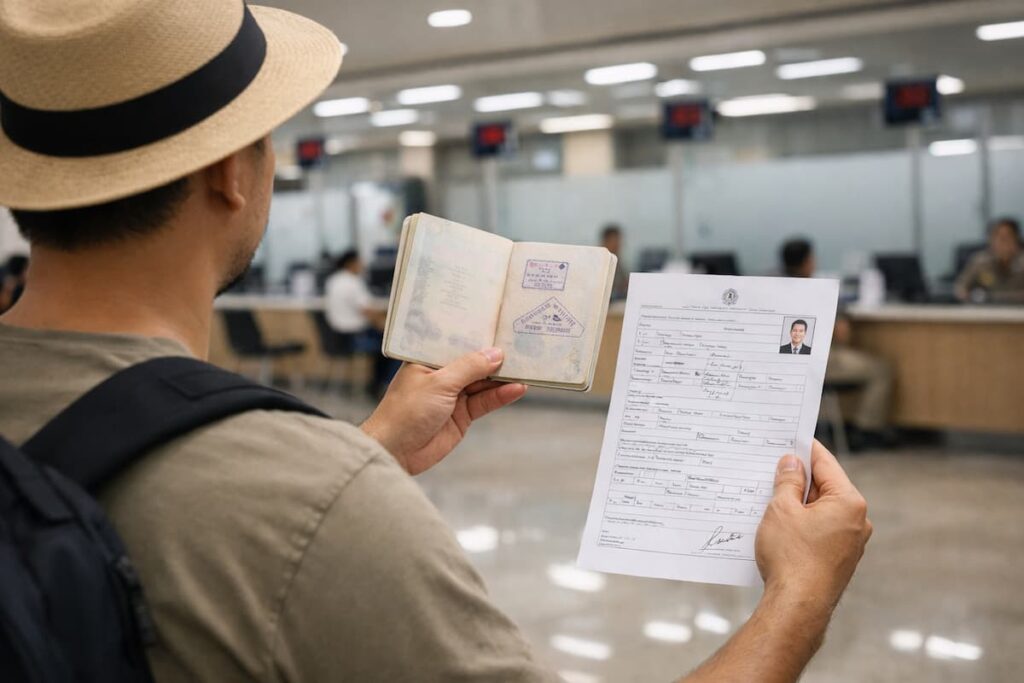
Before taking any action, open your passport and find your current stay record: the type (for example, a visa-exemption stamp or stay on a visa) and the date until which you are allowed to remain in the country. It is best to apply before your permitted period of stay ends, so you don’t end up in a last-day situation and risk overstaying.
It helps to understand in advance what is currently recorded for you, especially if you have entered Thailand more than once, since sometimes the details depend on your entry history and stamps. For reference, check the stamps and limits for visa-exempt entry in this guide: check the stamps and limits for visa-exempt entry.
Another important point: practical requirements can differ between regions and offices (for example, for copies, the format of proof of address, or queuing procedures). Even if you have extended before, do not assume that “everything will be the same as last time” — double-check the requirements before your visit.
Which extension options are available in 2026, and who each one suits 🇹🇭
To simplify, extension options can be divided into two broad groups: “short-term” scenarios for tourist purposes and “long-term” grounds for those living in the country for study, work, family, or other reasons. Within each group, requirements can differ significantly, both in terms of documents and in how the application is actually reviewed.
1) Extension after visa-exempt entry or a short stay (tourist scenario).
This route is usually considered by those who entered on a visa-exemption stamp or tourist visa and want to legally extend their stay. But the exact conditions depend on your current status, entry history, and the specific immigration office Thailand, so it is better to treat this as a “category” with possible nuances rather than a guaranteed scheme.
After visa-exempt entry of a Russian citizen under the bilateral agreement, Consular Department of the Russian Ministry of Foreign Affairs specifies a paid one-week extension, usually in special cases with documentary proof. The Embassy of Thailand in Washington allows an extension of up to 30 days at the officer’s discretion for the new tourist scheme for listed countries; this does not confirm such an extension for Russian citizens under the bilateral agreement. Open official Thai pages do not state a separate extension period for this agreement. Contact the immigration office before the period in your stamp ends, and do not plan your trip counting on extra days.
2) Extension on a tourist visa (if you entered specifically on a visa).
The logic here is similar: you extend your permitted period of stay within your current basis. If you applied for a tourist visa, see the requirements and scenarios in a separate article: if you applied for a tourist visa, see the requirements and scenarios. This helps you understand in advance the terminology and the typical supporting documents you may be asked for.
3) Long-term grounds (study, work, family, retirement, etc.).
In these categories there are usually more checks and more supporting documents: contracts, letters, certificates, proof of status, address, etc. For example, for an education-based stay, documents from the school or educational institution and the correctness of your status are often important, so it is useful to look separately at the nuances of extension on an educational basis (ED): the nuances of extension on an educational basis (ED).
The main idea: choose not the “most convenient” option, but the one that matches your actual basis for stay. If your grounds “do not match” your documents, even a perfectly assembled folder may not help, and then you will have to come back, provide additional proof, or change your approach.
Where to extend: immigration office, online booking, and regional differences 📋
In most cases, extension is handled at the immigration office for your actual place of stay or residence. In practice, this means you go to the office that serves your district or province (not “any convenient one”) and apply under its procedures. Choosing the “wrong office” is one of the common causes of wasted time.
In many places, there is an electronic queue, advance booking, or separate “windows” for intake by category. Some places still have a live queue, and others use a combination (registration in the morning plus being called by number). So a sensible approach is to first check the rules of the specific office, and only then prepare for the visit.
A checklist that usually helps you prepare without surprises:
Find out which office serves your address (district, province, place of residence).
Check current opening hours and days off (the schedule sometimes changes around public holidays).
Confirm whether booking or an electronic queue is required and how it works.
Ask (or check on site or in the office’s sources) which copies of passport pages are usually requested and in what format.
Prepare spare copies and a pen, since this sometimes saves hours.
To check official announcements and basic information, rely on the official website of the Immigration Bureau of Thailand: on the official website of the Immigration Bureau of Thailand. Even if document details differ between offices, the official website is useful as a starting point and for double-checking changes.
Step-by-step guide: how to extend your stay through immigration (TM.7 form) 🛂
Below is the general logic for applying through TM.7. Exact fields and attachments may differ by category, but the general outline of the process is similar in most cases.
Step 1. Prepare documents and copies
Check your passport: validity period, legibility of stamps, and availability of blank pages.
Make copies of the pages that are usually requested (photo page, pages with stamps or marks, other relevant pages, depending on the office).
Prepare proof of address or residence and documents for your basis of stay (if it is not tourism-based).
Arrange everything in a clear order: originals separately, copies separately.
Step 2. Fill out TM.7 carefully, without “guessing”
Form TM.7 is an application for extension of temporary stay. If you want to review the form in advance, refer to the official PDF: the TM.7 form on the immigration website.
Usually, pay attention to the following:
Write your details exactly as in your passport (Latin letters, order of names, numbers).
Give your address so that it matches what is confirmed by your documents or registration.
Describe the basis for extension correctly and consistently with your supporting documents.
Do not leave uncertain fields “somehow.” It is better to check with the office than to correct things on the spot in a rush.
Step 3. Photo and signatures
Prepare a photo in advance (if the office requires a photo of a specific format, it is better to check with your office).
Sign where required, and with the same signaturethat you usually use on documents.
Check that signatures on copies (if they need to be signed) are neat and consistent.
Step 4. Visiting the office: queue, submission, package check
Arrive with time to spare, since queues and intake “windows” may change.
At registration or in the queue, immediately ask which room or window accepts applications for your category.
Before submitting documents, go through the checklist once more: TM.7, photo, copies, proof of address, proof of basis.
Step 5. Payment and receipts (no surprises)
On the Thai government portal, for extension of stay on a tourist visa, a fee is listed as 1,900 baht. This page does not separately describe the fee for Russian citizens who entered without a visa under the bilateral agreement; the Consular Department of the Russian Ministry of Foreign Affairs describes such an extension as paid but does not specify the amount. Check the fee for your basis of stay and the payment method with your office. Keep receipts and any documents issued to you, as they help if a clarification or a repeat visit is needed.
Step 6. Receiving the decision and checking the stamp
After review, you are given a stamp or notation, or a decision under the office’s procedure. Be sure to check:
the date until which your stay is permitted;
that your name and passport number are spelled correctly;
that the category matches what you applied for.
Common mistakes that are easy to prevent
Applying at the wrong office (another office serves your address).
Incomplete copies or copies of the “wrong” pages expected by a specific office.
Errors in TM.7: typos in the passport number, incorrect address, mismatch between the basis and the documents.
Trying to “stretch” an unsuitable basis without proof usually ends in additional requests or refusal.
What documents are usually needed (checklist) and what immigration may additionally request 📋
Below is a basic list that often serves as a starting point. Important note: the exact list depends on the extension category and the specific office, so it is better to check the requirements in advance and not argue with “local practice” on site.
Usually requested as a baseline:
Passport (original) and copies of the main pages.
A completed TM.7 form.
A photo (it is better to check the format and requirements with your office).
Copies of pages with current stamps or records of stay.
Proof of residence or place of stay (options may vary).
Immigration may additionally request (depending on the basis):
Documents from your employer, educational institution, or family, whatever confirms your basis of stay.
Letters, certificates, or confirmations prepared according to the local requirements of the specific office.
Additional copies (sometimes more than you expect).
Clarifications on address registration and actual place of residence.
Practical tip: make a “backup set” of copies and keep them separately. Most often, problems arise not from complicated rules but from small details — one copy is missing, a signature is in the wrong place, or the address on the form differs from the proof.
If you rent or stay in a hotel: why address registration (TM.30) matters and how it relates to extension 🛂
Extension almost always depends on the question “where do you actually live?” The logic is simple: immigration needs up-to-date information about your place of stay, so before applying for extension of stay Thailand, it is better to make sure your address details are in order.
If you stay in a hotel, the hotel usually handles address notifications. If you rent accommodation, the process may depend on how your arrangement with the owner is set up and how notifications work in your province. Here, it is not wise to rely on luck: address discrepancies often come up precisely at the time of extension, when there is little time to fix them.
What is useful to do in advance (a soft checklist without firm promises):
Confirm with the owner or property manager that address registration is taken care of, and what confirmations they can provide if necessary.
If you have changed accommodation, check that your details have been updated correctly.
Keep handy documents and contacts that will help you quickly confirm your place of residence.
If you want to understand more deeply how this is usually connected with immigration procedures, it is useful to look into address registration (TM.30): look into address registration (TM.30). This reduces the risk that at your extension you are suddenly told, “First resolve the address issue.”
What to do if you can’t make it in time or have been refused: safe options and overstay risks (overstay) ⏱️
If you realize you may not make it in time, it is best to act as early as possible. Overstaying (overstay Thailand) usually leads to problems and complicates future trips and paperwork, so it is strategically wiser not to let the permitted period expire.
How much an overstay costs. According to the official Embassy of Thailand FAQ, the fine is 500 baht for each day, but no more than 20,000 baht (the cap is reached after 40 days). The Immigration Act (Section 81) provides for a fine of up to 20,000 baht or imprisonment of up to two years for staying without permission. For overstays of more than 90 days, you risk deportation and an entry ban, the length of which depends on the duration of the overstay.
If time is short, a safe course of action often looks like this:
Contact “your” immigration office as early as possible and find out exactly what is missing for your category.
Quickly collect the missing documents and bring the package in line with the office’s “local” requirements.
If additional proof is requested, write down exactly what is needed (as a list), so you don’t have to make several trips.
If you receive a refusal, do not draw hasty conclusions or try to “reframe” your basis without documents. Usually it is more sensible to:
Politely ask for the reason for the refusal or what needs to be corrected or provided.
Check whether your basis matches what you can actually prove.
If necessary, seek advice from official sources or licensed specialists, especially if the situation is non-standard.
One more important point for those who live in the country long-term: besides extensions and address matters, there may be other mandatory procedures. So that you don’t miss any “parallel” requirements, it is useful to understand in advance how the 90-day report works and when it is needed — this often helps you plan a calendar without stress.
Frequently Asked Questions ❓
When is it better to apply for a visa extension in Thailand: in advance or on the last day?
It is usually calmer to apply in advance, because queues, booking, and requirements for copies can unexpectedly take time. Applying on the last day increases the risk of mistakes and of situations where a document needs to be “brought in” but there is no time left. It is better to follow your office’s rules and not wait until the deadline.
Can a visa-exemption stamp be extended, and how does this differ from extending a tourist visa?
The conditions differ. For a tourist visa, the Embassy of Thailand indicates the possibility of extending for another 30 days through the Immigration Bureau. For the Russian visa exemption under the bilateral agreement, Consular Department of the Russian Ministry of Foreign Affairs specifies a paid one-week extension, usually in special cases with documentary proof. There is no separate confirmation in open official Thai sources of a 30-day extension of such a visa exemption. Check the period and conditions for the stamp in your passport with the immigration office.
Which documents are most often requested for TM.7, and why does the list “vary” between offices?
The basic set often includes a passport, TM.7, a photo, copies of key pages, and proof of address. A “shifting” list is a normal reality: offices may interpret practical requirements differently and also take your category and situation into account. That is why it is more reliable to check the list specifically for your office and basis of stay.
Do you need to book a queue slot or appointment at immigration, and where can you check this?
It depends on the specific office: some have online booking or an electronic queue, some have a live queue, and others use a mixed format. It is best to check through official channels and the information from your immigration office, as well as on the official website of the Immigration Bureau. Before going, it is useful to confirm the intake hours and the application procedure for your category.
What to do if the extension was refused: what next steps are possible?
Usually it is best to calmly ask for the reason for the refusal and a list of what needs to be corrected or provided. Often the problem can be solved by correcting documents or confirming your basis or address. If the situation is complicated, it is better to rely on official sources and consultations with licensed specialists, rather than on “stories from chats.”
Can extension conditions change during the year, and where should you check the current rules?
Yes, conditions and practice can change and also differ by region and category. The safest approach is to check current requirements before applying, on official resources and with your immigration office. This is especially important if you have not extended for a long time or have changed your basis of stay.
Conclusion
The easiest way to approach an extension of stay in Thailand is as a clear sequence: first check the current record and end date in your passport, then prepare the basic package and carefully fill out TM.7, then confirm the rules of your own office and apply in advance. If you live on a long-term basis, give special attention to the category documents and address questions, since they often become the “bottleneck.” Remember that requirements can differ between offices and change over time, so it is always best to verify the final information through official channels.
Save the checklist and check your stamps in your passport today so you have time to prepare without stress
Also read: how the 90-day report works and when it is needed.
Sources
- Embassy of Thailand in Washington — New Visa Exemption and Visa on Arrival to Thailand
- Thailand Public Relations Department — Revision of Thailand’s Visa Exemption and Visa on Arrival…
- Uttaradit Province Immigration Office (page in Thai)
- Embassy of Thailand in Helsinki — New Visa Exemption and Visa on Arrival (VoA) to Thailand
- Immigration Division of Sakon Nakhon Province (page in Thai)
- Immigration Division of Phitsanulok Province — “e-Extension” online application for temporary stay extension…
Prepared by MyThai.online editorial team.