In this article:
What changed: Added fines under Section 77 of the Immigration Act: up to 2,000 baht for a landlord and 2,000 to 10,000 baht for a hotel. Restored practical advice on hotels, condominiums, and private rentals, the difference from TM.28, and filing by a resident; removed unnecessary caveats.
The TM.30 form in Thailand is a notice to immigration authorities of a foreigner’s place of residence. It is filed by the host party: the head of household, the owner or holder of the housing, or the hotel manager. The foreigner can ask for confirmation that it was sent and for the submitted details to be checked. The official instructions set the deadline at 24 hours from the foreigner’s arrival; the form specifies the starting point as arrival at the place of residence. Data in the online system can be searched only for 7 days after the check-in date. Below: who files the notice and how, what fines apply, and what a resident should do if the landlord did not file it. Current as of September 2026.
What the TM.30 form is and who is responsible for the notice
The notice of a foreigner’s place of residence (TM.30) informs immigration authorities where the foreign national lives. The legal basis for the notice is linked to Section 38 of the Immigration Act.
The official instructions name the host party as the head of household, the owner or holder of the housing, or the hotel manager. The host party is responsible for the notice. If no record is found, the duty to file the notice does not automatically pass to the resident.
TM.30 is often confused with the notice that the foreigner files themselves (TM.28). These are different obligations: TM.30 is the responsibility of the host party, while under Section 37 of the Immigration Act the foreigner reports a change of address themselves within 24 hours after moving.
If you are renting, check with the owner in advance who will submit the details and how you can verify the record afterward. For help with rental questions, see the guide to renting housing in Thailand. After filing, ask the host party to confirm the submission and tell you which details were provided.
In practice, it works like this:
- Hotels, guesthouses, hostels usually submit the details themselves when the guest checks in; nothing is required from you.
- Condominiums with a management company often file the notice through the building office; ask the manager about this when you move in.
- Private rentals (house, villa, apartment from the owner) is the most problematic case: not all owners know about the obligation or are willing to go to immigration. Agree on who files the notice and when, even at the time you sign the lease.
Filing deadline: 24 hours from arrival at the accommodation
The official instructions set the deadline: the notice must be filed within 24 hours from the foreigner’s arrival. The form describes the starting point as arrival at the place of residence. Put simply, the deadline runs from moving in, not from entering the country: when you move to new accommodation, the 24 hours start over from the time you arrive there.
When a new record is needed: moving in, relocating, and returning
A new check-in and returning to a previous address are different situations. The clarification on returning refers to a notice from the Royal Thai Police dated June 30, 2020. According to it, TM.30 does not need to be filed again if a person returns to the same address within the period of stay stated in the most recent filing.
The rule applies only to the same address and within the period stated in the last filing. A new address or staying longer than the stated period is grounds for a new notice.
If you need separate information about entry stamps, read the article about passport stamps and visa-free entry limits.
How to file the notice online or in person
You can submit the details online through the official portal. The options are described in the official instructions from the Immigration Bureau of Thailand. The online form is for notifying one foreigner at a time; for several, the instructions provide for submitting a spreadsheet file (Excel).
A user gets one account and can file notices for several addresses if they own the relevant properties or are responsible for them.
To file in person, go to your local immigration office. If there is no such office in the area, the official instructions name the local police station. The TM.30 form can be picked up at the office itself. If the owner cannot come in person, some offices allow filing with a power of attorney; requirements for this differ between offices.
What information and documents are needed for filing
The online form asks for the address, the length of stay, and details about the foreigner. The instructions list these fields:
- address;
- check-in and check-out dates;
- passport number;
- first name, middle name if any, and last name;
- nationality;
- gender;
- date of birth;
- phone number.
The instructions separately list the host party’s documents: a copy of their ID card or passport, the house registration book (Tabien Baan) or the title deed (Chanote), and the rental contract.
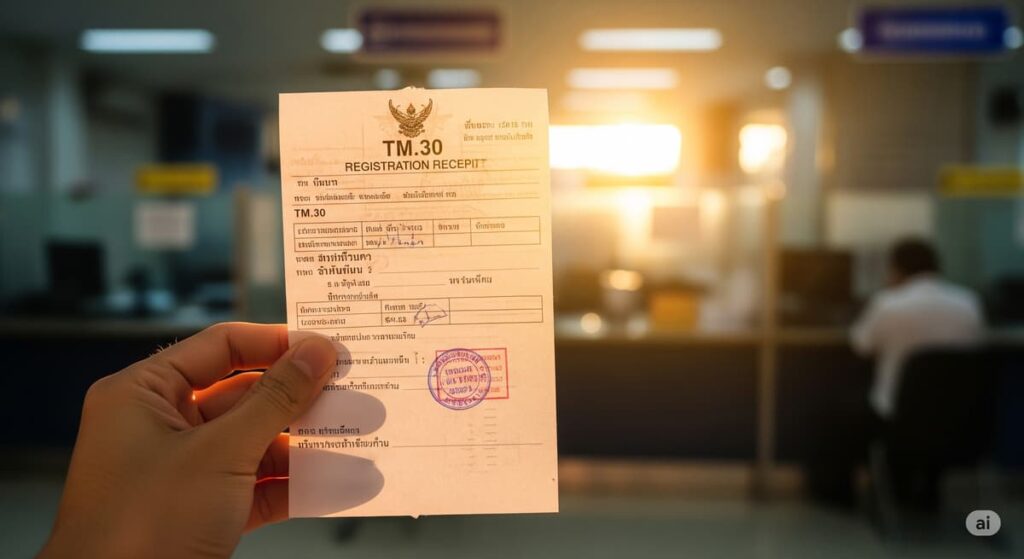
When filing in person, bring these documents and copies of the resident’s passport: the photo page and the page with the most recent entry stamp. After filing, the office usually issues a receipt as confirmation; keep it, as it may be requested for an extension of stay or your 90-day report.
How to check your TM.30 record and spot an error
Compare the TM.30 record with what the host party submitted. Check your first and last name, passport number, address, and check-in and check-out dates. If the details do not match, contact the party that filed and ask them to check what information was sent.
There is a short window for searching: the data appears in the system only for 7 days after the check-in date. So check the record soon after filing, while it is still available.
First make sure the record is in the system, then compare its fields with the data that was submitted. If you find a discrepancy, ask your local immigration office how to correct it. Do not put this off beyond the search period.
Fines and consequences of not filing a notice
The fine is set by Section 77 of the Immigration Act: if the host party does not file a notice under Section 38, they face a fine of up to 2,000 baht, and a hotel manager faces a fine of 2,000 to 10,000 baht. More details — in the text of the Immigration Act.
The fine under Section 77 is issued to the host party, not the resident. But the absence of a notice also affects the resident: when extending your stay or filing your 90-day report, the officer may send you to file a TM.30 first, which means an extra trip and another queue.
How TM.30 differs from the 90-day report TM.47
These are separate notices with different purposes. TM.30 is filed by the host party; the 90-day report for foreigners (TM.47) applies to those who stay in Thailand for more than 90 consecutive days.
| Form | What it reports | Who it applies to |
|---|---|---|
| Notice of a foreigner’s place of residence (TM.30) | The foreigner’s place of residence | Notice is filed by the host party |
| 90-day report for foreigners (TM.47) | Report on staying more than 90 consecutive days | Foreigners who are in Thailand for more than 90 consecutive days |
If you need detailed information about the second procedure, read the 90-day report in Thailand. One does not replace the other: the foreigner files the 90-day report themselves, even if the TM.30 is in order.
What to do if the host party did not file the notice
First contact the owner of the accommodation, the property manager, or the administration of the property. Ask them to check whether the details were sent and what information was provided.
If the owner cannot or does not want to go to immigration, ask the office whether they will accept a notice from you: some offices allow this if there are copies of the owner’s documents (ID card or passport, house registration book) and the rental contract. Ask there, too, how to correct the record if it contains an error.
While you sort out the process, keep the address, dates of stay, and the passport details that were submitted on hand. This helps the office find the right record faster.
Frequently Asked Questions ❓
Do I need to file TM.30 myself if I stay in a hotel?
No. The hotel manager is responsible for the notice, and hotels usually submit the details themselves when a guest checks in. If you later need confirmation (for example, for an extension of stay), ask the hotel administration for it.
Do I need to file a new TM.30 notice after each departure from Thailand?
No, if you return to the same address within the period stated in the latest notice: according to the clarification referring to the Royal Thai Police notice of June 30, 2020, re-filing is not required in this case. For a new address or staying longer than the stated period, a new notice is needed.
Can a foreigner file TM.30 instead of the property owner?
The official instructions classify the head of household, the owner or holder of the housing, and the hotel manager as the host party. In practice, some offices accept a notice from a resident if they have copies of the owner’s documents and the rental contract. Ask your local office about this.
What details should I check in the electronic TM.30 record?
Check the address, check-in and check-out dates, passport number, first name, middle name if any, last name, nationality, gender, date of birth, and phone number. These are the fields listed in the online system’s instructions.
How long is a TM.30 record searchable?
According to the official instructions, the data can be searched only for 7 days after the check-in date. Check the record within this period.
Is the TM.30 notice related to the 90-day report (TM.47)?
They are separate notices: the first reports the place of residence, and the second is a report for foreigners who are in Thailand for more than 90 consecutive days. TM.30 is filed by the host party, while the 90-day report is filed by the foreigner themselves.
Conclusion
The host party must file the notice within 24 hours of the foreigner’s arrival at the place of residence; failure to file carries a fine of up to 2,000 baht for the host party and 2,000 to 10,000 baht for a hotel. After filing, check the address, passport details, and dates while the record is searchable; for several foreigners, submitting a spreadsheet file (Excel) is provided for. Re-filing when returning to the same address depends on the period previously stated: the clarification refers to a notice from the Royal Thai Police dated June 30, 2020. Rules and practice may vary, so check the official instructions and your local office before filing. For the next immigration step, read about the visa extension process in Thailand.
Prepared by MyThai.online editorial team.