In this article:
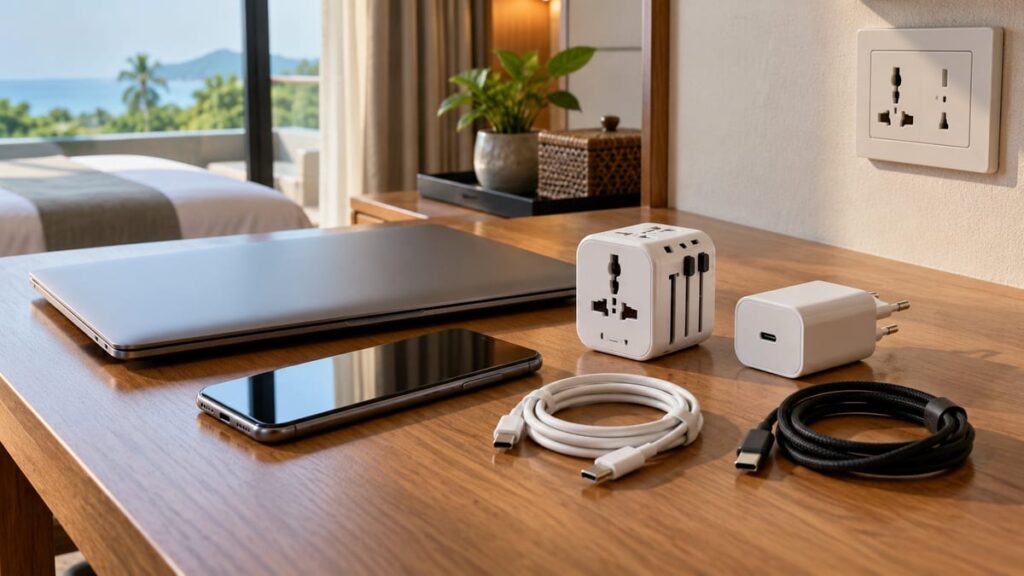
In Thailand, outlets often accept the common two-pin Euro plug, but it is best to check the equipment in your specific room in advance. A suitable travel adapter is useful to bring along. However, plug shape and whether a device is compatible with the power supply are different questions: being able to insert the prongs into an outlet alone does not confirm that the connection is safe.
For phones, laptops and personal electrical appliances, the decision is made separately. You need to check the input voltage, frequency and the manufacturer’s grounding requirements, and then choose the connection. Don’t judge a hair dryer by a phone charger, even if their plugs look alike.
Current as of publication. Before your trip, check the room’s equipment with the hotel, and compare your devices’ specifications with the manufacturers’ instructions. Conditions may change. A general list of what to pack for Thailand will help with the rest of your packing; here we cover only power for devices and charging accessories.
Power outlets in Thailand: which plugs work for tourists
According to the official guide, Thailand’s mains voltage and frequency are — 220 V and 50 Hz. Descriptions of the contacts are provided in the official guide to outlets and electrical supply. The letters indicate plug types, which make it easier to match your charger with a photo of the hotel’s outlet.
The guide describes these designs:
- Type A — flat parallel pins without grounding. Such plugs fit hybrid outlets.
- Type B — flat parallel pins and a round grounding pin.
- Type C — a Euro plug with round pins. The guide notes that it is compatible with Thai type O outlets.
- Type O — Thai plug with round pins, including a grounding pin.
This list does not mean that every design is equally common in every hotel. For your trip, it is more useful to get a photo of your room’s outlets than to rely only on the general description of the country. A photo lets you compare the shape of the pins, but it cannot confirm that the connection is in good working order.
The Tourism Authority of Thailand, or TAT, reports that outlets are compatible with European plugs C and F. However, this is not a guarantee for a specific room and does not confirm that grounding is maintained with every kind of connection.
So for the question of whether Russian plugs work in Thailand, there is no single answer for all devices. For a charger with a Euro plug and a device that requires grounding, connection conditions may differ. Look at the specific plug and the device’s instructions, not just the country where it was bought.
How to check the voltage on a charger and a household appliance
Start with the markings on the power adapter, the device housing, or in the manufacturer’s instructions. Find the input power ratings: they describe which mains supply the device may be connected to. Output parameters show what the charger supplies to the connected gadget, and they are not enough to check compatibility with a wall outlet.
The input may be marked “input” or with the English designation (INPUT). The charger from the manufacturer’s documentation (Google) lists the range 100–240 V, 50/60 Hz: voltage from 100 to 240 V and frequency 50 or 60 Hz. These parameters cover the values of the Thai mains, but they apply to that specific device.
For the USB power adapter from the manufacturer (Apple), an input of 100 to 240 V at a frequency of 50 to 60 Hz is confirmed. Do not transfer these specifications to any charger with a similar case. Check laptop power supplies, hair dryers and other appliances separately.
| Device or scenario | What to check | Solution for the trip |
|---|---|---|
| Phone charger | Input voltage, frequency, plug shape | If the input range is compatible, only the plug shape needs to be solved |
| Laptop power supply | Input parameters and grounding requirements | Choose the connection according to the instructions for this exact unit |
| Hair dryer or other heating appliance | Voltage, frequency and power | Do not assume it is compatible by analogy with a phone charger |
| Device rated for 110 V only | Input voltage restriction | Do not plug in directly; consider not bringing it along, or a suitable solution as specified by the manufacturer |
| Device with unreadable markings | Specifications in the documentation | Do not check compatibility by a trial power-on |
It is easy to get this wrong: a familiar plug shape creates the feeling that the question is already settled. But voltage information is on the device itself or its power supply. So checking the markings must come before connecting it.
The Tourism Authority of Thailand does not recommend using devices rated for 110 V in the country. If the label has worn off, find the documentation for your exact model. A trial power-on does not replace checking the specifications.
When you need an adapter and a voltage converter
An adapter connects the plug to the outlet, while a converter changes the voltage. A regular travel adapter does not make a device with an unsuitable input voltage compatible with the mains. So choose one only after checking your equipment, when it is clear that the remaining issue is just the shape of the connection.
If the device’s input range suits the Thai mains, pick an adapter that matches its plug and the room’s outlet. If the voltage is not suitable, the question is more complicated: you must follow the manufacturer’s instructions. Sometimes it is more practical to leave the device at home than to bring it along with extra equipment.
Before using a transformer, TAT recommends matching its power rating with the device’s power rating. Frequency compatibility is checked separately: some devices rated for 60 Hz may work poorly at 50 Hz. You should not assume that changing the voltage automatically resolves the other connection issues.
Grounding is a separate requirement. If a device needs it, choose the connection according to the manufacturer’s instructions. Do not remove the protective contact, do not modify the plug, and do not choose a connection method that bypasses this requirement.
The state power authority PEA warns: the presence of a three-pin outlet alone does not prove that grounding works. Only a specialist should check the system. A tourist only needs to tell the hotel the device’s requirements and ask it to arrange a suitable connection, without inspecting the wiring themselves.
What to bring for charging a phone and laptop
It is easiest to put together a kit based on the devices you will use. Lay out your phone, laptop and their power supplies, then check that each has a compatible charger and a suitable cable. This way you choose accessories for your own equipment.
A compact kit may include:
- your own chargers with verified input parameters;
- cables for the devices you use;
- a travel adapter for your plugs and the room’s outlets;
- a multi-port charger, if its specifications suit all the planned equipment;
- a power bank, if you need one on your trip and it meets the carriers’ rules.
A multi-port unit can help make the kit more compact. But check its total output, power distribution between ports, and compatibility with devices against the documentation for the specific model. The number of ports alone does not confirm that your phone and laptop will both get the power they need at the same time.
An extension cord is not required. If you decide to take one, PEA advises checking for the Thai TIS standard mark, the permitted load, and the integrity of the cable and plug. Do not assume that every extension cord suits all the equipment you have managed to plug into it.
A power bank is a separate accessory with its own transport conditions. Before flying, study power bank rules for airplanes in Thailand · RU and check with the carriers on your route. Questions about connecting your phone to the network are covered separately: mobile connectivity and internet in Thailand.
What to ask the hotel about outlets and charging
It is best to tie your question about outlets to the category of your booked room. Ask for a photo and confirm where the available power points are located. You can send the property a ready-made request:
Could you please send a photo of the outlets in a room of my category? Are there outlets available by the bed and desk, USB ports, and an adapter for guests? I plan to charge my phone and laptop.
It is helpful to attach a photo of your plug to the message. If the device requires grounding, ask what connection the hotel can offer that meets this requirement. This will make it easier for staff to understand exactly what you need.
A photo helps determine the outlet shape, but does not confirm the condition of the wiring or the grounding. Even if the contacts visually match, the device’s specifications still need to be checked on its label. A photo solves part of the preparation questions, but does not replace a technical check.
It is better not to build your whole charging plan around the hotel’s USB ports. Check whether they exist, their connector type, and their compatibility with your equipment; do not assume fast charging without confirmation. Your own compatible charger and cable will let you prepare without relying on unconfirmed room equipment.
How to use an outlet in your room safely
Before plugging in, check for any visible damage to the outlet, plug, adapter and cable. If the contact is loose, there is a smell of burning, damage, or suspicious heating, stop using it and contact the staff. Do not keep charging in the hope that the problem will go away on its own.
PEA notes that a loose contact increases electrical resistance. If the plug wobbles, do not bend the contacts or secure the plug with improvised objects. Do not use an adapter as a way to hide an outlet fault.
The risks of unsuitable, overloaded and damaged extension cords are described in recommendations from the state power authority PEA. They can overheat, cause a short circuit, and start a fire. Check the permitted load against the specifications of the specific product, not the number of free sockets.
A tourist’s actions in case of a doubtful connection are simple:
- stop using the problematic outlet or accessory;
- tell the staff exactly what you noticed;
- ask for an inspection by a specialist;
- agree on a suitable place to charge your devices.
Do not take apart the outlet or try to repair the room’s wiring. Staff, with a specialist’s help, should distinguish between an internal fault and an external power outage. Self-checks of the wiring are not part of a tourist’s preparation for charging a phone.
PEA does not repair internal wiring and recommends a licensed electrician for such work. In a hotel, a call for one should be arranged through the staff. If the situation requires urgent help, the procedure for getting it is described in the guide emergency assistance in Thailand.
Frequently Asked Questions ❓
Will a Russian phone charger fit an outlet in a Thai hotel?
A two-pin Euro plug often fits, but outlets in Thai hotels should be checked for the specific room. Separately, check the input parameters of the charger itself.
Do you need to bring an adapter if your charger has a round plug?
It is useful to prepare a suitable travel adapter if compatibility with the room has not been confirmed. The round shape of the contacts alone does not settle the grounding question.
Do you need a converter for a charger marked 100–240 V?
For voltage, this range covers Thailand’s 220 V. If the frequency is also compatible, you don’t need a converter to change the voltage; the plug connection is checked separately.
Can I bring my own hair dryer if its plug fits?
A matching plug alone is not enough. Check the voltage, frequency, power and the manufacturer’s requirements for this specific hair dryer.
Can I rely only on the USB ports in the room?
It is better to get the hotel’s confirmation in advance and check compatibility. Bring your own suitable charger and cable so you don’t depend only on the room’s equipment.
What should I do if the plug wobbles in the hotel outlet?
Stop using this outlet and inform the staff. Do not try to hold the plug in place with improvised objects or fix the contacts yourself.
Does a three-pin outlet prove that grounding is working properly?
No, the presence of a protective contact alone does not confirm this. PEA recommends a system check by a specialist.
Conclusion
Outlets in Thailand may fit your plug, but a safe connection requires a separate check of the device’s specifications. First find the input voltage and frequency, then check the grounding requirements and choose the connection. After that, prepare your own chargers, cables and the needed adapter.
Before packing your equipment, check the markings on each device and send a request to the hotel with a photo of the plug. Room equipment and battery transport rules may change: check specifications against the manufacturers’ instructions, and conditions against the hotel and carrier. You can cover other packing questions with preparing for your first trip to Thailand.
Prepared by MyThai.online editorial team.