In this article:
What changed: For the Chainat–Pasak–Gulf of Thailand channel, a framework budget of more than 160 billion baht and an eight-year implementation period have been announced; financing is still under discussion. In Nakhon Si Thammarat, clearing of five drainage channels has been completed and two sets of Bailey bridges have been prepared.Updated: October 19, 2026
What changed: The project provides for expanding the Chainat–Pasak channel from 130 to 930 cubic meters per second and a new channel to the Gulf of Thailand with a capacity of 600 cubic meters per second. The Asian Development Bank is preparing a financing package for modernizing irrigation channels in the lower eastern Chao Phraya basin.Updated: October 17, 2026
What changed: According to the Matichon newspaper, the readiness of the flood-control structure at Rama III in Bangkok is 10%, with a length of about 300 meters. On the side of the Rong Si community, 44 of 45 houses have been dismantled or relocated; the temporary earthen barrier is still under construction.Updated: October 14, 2026
What changed: Added information on installing a mobile pump in Nong Chok and on monitoring water levels in the Rangsit Prayunsak and Hokwasailang channels. Added recommendations on checking the emergency bag and replacing expired supplies.Updated: October 7, 2026
What changed: Added recommendations on preparing buildings, actions during flooding and returning after the water recedes, as well as phone numbers of the Royal Irrigation Department for reporting water problems
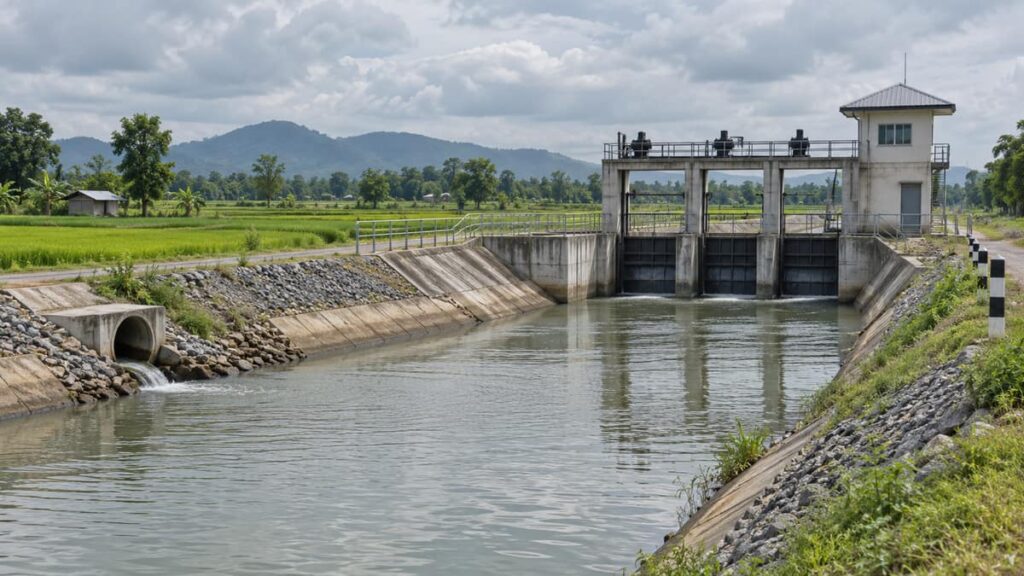
Flood protection in Thailand combines long-term projects with maintenance of existing channels: the government has approved the Chainat–Pasak–Gulf of Thailand channel, with a framework budget of more than 160 billion baht and an implementation period of eight years, while financing sources are still under discussion. Separately, the Royal Irrigation Department reported that clearing of drainage channels in Nakhon Si Thammarat is complete. These are finished works, which should be distinguished from future construction, the preparation of a financing package and historical reports about local coastal structures. If you are planning a trip or live near the water, the weather in Thailand will help you make sense of the forecast, but it does not replace local official warnings: announced plans do not confirm the safety of a particular house or route.
Current as of publication.
What is known
The approval of the Chainat–Pasak–Gulf of Thailand channel is described in a statement from the government of Thailand. It names a framework budget of more than 160 billion baht and an implementation period of eight years. These parameters relate to a separate drainage project.
The World Bank describes the basin program for the Chao Phraya River as nine projects under the common name “Nine Plans.” This describes what the program includes, not the number of finished facilities; it also does not mean that all the projects are already under construction.
The basin program, urban drainage and local coastal protection address different tasks. Put simply, the scale of the program and the readiness of a specific structure are different questions: the overall plan does not show whether protection near a particular residential community is finished.
Flood protection: construction at Rama III
In previous updates, reports from Matichon were cited about a coastal structure near the Rong Si Community on Rama III Road, in the Yan Nawa District. At that time, the work involved pile driving, clearing the site and building a temporary earthen barrier.
This information describes the earlier course of construction. Current readiness of the site has not been established, but the absence of a recent figure does not mean construction has been canceled. Clearing the site and temporary protection alone do not confirm that the main structure has been completed.
Channels, pumps and long-term plans
The project provides for construction of a drainage channel that will connect Chai Nat, the Pa Sak River and the Gulf of Thailand. The government says implementation begins in fiscal year 2027, which is fiscal year 2570 in the Thai Buddhist calendar. This is a financial target rather than an exact calendar start date for construction work.
A separate report concerns completed maintenance of drainage in Nakhon Si Thammarat. According to the Royal Irrigation Department, dredging and the removal of vegetation and obstructions have been completed in all five channels that run through the city.
The department has also prepared two sets of Bailey bridges to help areas where the need arises. Prepared sets do not yet mean that bridges have been installed. A future channel, completed clearing and a reserve for assistance belong to different stages of flood protection.
Financing and preparation stage
According to the government, agencies are discussing financing sources for the Chainat–Pasak–Gulf of Thailand channel, including the possible use of borrowed funds. Considering a loan does not mean that the credit has already been approved or the money transferred.
Separately, the Asian Development Bank reported its participation in supporting the Thailand-led master plan for flood management in the lower eastern Chao Phraya basin. The bank is preparing a financing package for modernizing irrigation channels, including co-financing from partners. Preparing the package also does not confirm any transfer of funds.
The French Development Agency describes the master plan as a government program with a twenty-year time frame. That time frame applies to the program as a whole: it cannot be applied to the construction period of an individual channel or coastal wall.
What to do
Residents of coastal and low-lying areas are advised to closely follow the situation and official reports, as stated in a notice from the Royal Irrigation Department. Before traveling, check local warnings near your accommodation and on your chosen route. Construction near a home does not guarantee safety.
If you need service contacts, see the article “Emergency help in Thailand“. Conditions may change. Before traveling, check current reports from the Thai Meteorological Department (TMD), the Royal Irrigation Department and local authorities.
Sources
- Government of Thailand — channel approval, framework budget, timeline and financing discussion
- Government of Thailand — fiscal year when implementation begins
- World Bank — makeup of the program “Nine Plans”
- Asian Development Bank — partner participation and financing preparation
- French Development Agency — master plan time frame
- Royal Irrigation Department — channel clearing and preparation of Bailey bridges in Nakhon Si Thammarat
- Royal Irrigation Department — recommendation to follow official reports
Prepared by MyThai.online editorial team.