In this article:
What changed: A proposal for a pollution control zone in the Prachin Buri River basin has been considered; water and sediment samples were taken in Chachoengsao. 613 residents were screened; the plan is to monitor risk groups for at least two yearsUpdated: October 21, 2026
What changed: The industry minister announced inspections of facilities across Thailand and interagency coordination. Results of a health screening of 250 Prachinburi residents and recommendations for protection after contact with potentially contaminated water were addedUpdated: October 18, 2026
What changed: Recommendations were added for after contact with potentially contaminated water: rinse off with clean water and change clothes. For questions about illnesses and health threats, the Department of Disease Control’s number is listed as 1422.Updated: October 16, 2026
What changed: According to Thai channel Nation TV, participants in a meeting in Prachinburi approved sending a proposal to close four facilities and revoke their licenses. A facility’s suspension under an official order remains temporary; an engineering inspection of the fencing and buildings has been ordered; the deadline is December 2026.Updated: October 14, 2026
What changed: The Department of Industrial Works reported a barrier of sandbags around the source of oily pollution. After the water level drops, the agency plans to inspect affected areas both inside and outside the facility.
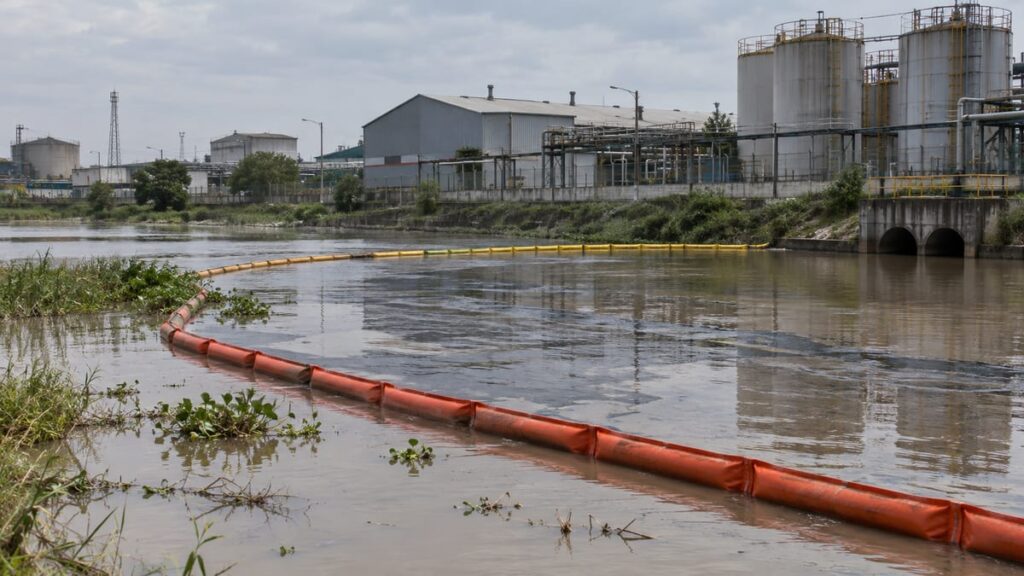
The chemical leak in Prachinburi has prompted inspections of facilities and health screening of residents. New information includes the consideration of a proposal for a pollution control zone in the Prachin Buri River basin and its tributaries, the sampling of water and sediment in Chachoengsao, and a report from the Department of Disease Control on a broader group of screened residents and plans for long-term health monitoring of risk groups. For residents and those in potentially contaminated areas, the recommendation to avoid contact with water and sediment remains in place; however, consideration of the proposal does not yet mean that the area has been given a special status, and the presence of symptoms among those screened does not by itself confirm chemical poisoning.
Current as of publication.
What is known
The committee considered a proposal to designate the Prachin Buri River basin and its tributaries as a pollution control zone. This is stated in an official message from the environmental agency.
The meeting took place on November 5, 2026. The message about consideration of the proposal does not confirm that such a status has been introduced. This date refers to the committee meeting.
Background: see the article on inspection of flood water contamination in Prachinburi · RU. Flood water contamination has become a subject of industrial monitoring and medical screening; the new information adds to this story but does not automatically confirm compliance with earlier orders.
Chemical Leak: Order to a Facility and Inspections
The Department of Industrial Works reported an order to temporarily suspend all operations at the facility under Part 1 of Article 39. A temporary suspension is not the same as a final closure. The message about the order itself also does not confirm that it has already been carried out.
Separately, the agency reported approximately 3,000 licensed facilities in categories 105 and 106 across Thailand in its statement on nationwide inspections. This is the scale of the industry nationwide, not the number of violators in Prachinburi.
Here it is important to distinguish between legal measures: a proposal to close a facility, an order to temporarily halt operations, and an actual final closure have different meanings. The temporary nature of an order does not allow one to determine when operations may resume.
Where Water and Sediment Were Tested
The Regional Office of Environment and Pollution Control reported sampling in the Bang Pakong River in Chachoengsao Province. The work took place in the districts of Bang Nam Priao and Bang Khla: water was collected at three points and sediment at one.
According to the agency’s preliminary measurements, dissolved oxygen levels at the surveyed points were 0.13–0.91 mg/L. Samples were sent for additional analysis to the laboratories of Regional Office No. 13 and the Pollution Control Department; the message does not contain the results of this analysis.
Dissolved oxygen is a separate indicator. It cannot be substituted for biochemical oxygen demand or the concentration of petroleum hydrocarbons and other substances. Measurements at specific points do not describe the condition of the entire river, the whole province, or tap water.
What the Resident Health Screenings Found
Screened 613 people: 497 without symptoms and 116 with symptoms, according to the Department of Disease Control. The agency plans to monitor the health of risk groups continuously for at least two years.
The presence of symptoms by itself does not prove chemical poisoning. It also does not establish a causal link to a specific facility.
In the previous stage, 250 people were screened. High risk was identified in 52, medium risk in 145, and low risk in 53; no dangerous symptoms were identified in this group.
Urine samples were collected from 50 people in the high-risk group to test for substances associated with exposure to petrochemical compounds. Sampling does not mean that such substances were detected.
These groups cannot be added together without confirming their composition. A risk category is not a diagnosis, and the absence of dangerous symptoms in the earlier group does not mean there are no effects of any kind.
What to Do
The Department of Disease Control recommends that residents in risk areas avoid contact with water and sediment that may contain chemicals. These recommendations apply to potentially contaminated locations and do not mean that all water or all products from the province are dangerous.
After contact with such water, the department recommends doing the following right away:
- Wash off with clean water.
- Change clothes.
If you have unusual symptoms, seek a medical evaluation. Tell your doctor about contact with the water or chemicals.
The Department of Disease Control’s hotline for illnesses and health threats — 1422. Other contacts are listed in the article “emergency assistance in Thailand».
The situation and recommendations may change. Check official messages from environmental agencies, the Department of Disease Control, and local authorities.
Sources
- Regional Office of Environment and Pollution Control: consideration of the proposal for a pollution control zone
- Regional Office of Environment and Pollution Control: sampling in Chachoengsao and preliminary measurements
- Department of Disease Control: health screening of 613 residents and recommendations
- Department of Disease Control: previous health screening of 250 residents
- Department of Industrial Works: nationwide inspections
- Department of Industrial Works: temporary order to a facility
- Department of Disease Control: hotline 1422
Prepared by MyThai.online editorial team.