In this article:
What changed: Starting October 20, a phased update of the transport function in the Samsung Wallet has begun. The One-Day Pass costs 150 baht and is valid only on the Green Line on the date it is issued or registered. The time limit in the BTS paid area is 300 minutes; exceeding it incurs a surcharge at the highest published fare.Updated: October 1, 2026
What changed: The One-Day Pass costs 150 baht. The standard transport card (Rabbit Card) costs 200 baht: 100 baht for issuance and 100 baht as initial balance. Promotional prices for trip packages (Xtreme Savings) apply from April 1, 2026 to March 31, 2027; the packages include a limited number of trips over 30 days. The time limit in the paid area is 300 minutes; if exceeded, a surcharge applies at the highest published fare. A 45-baht fare cap and EMV payment are provided for by a government decision; whether such travel is possible on the BTS must be checked separately.
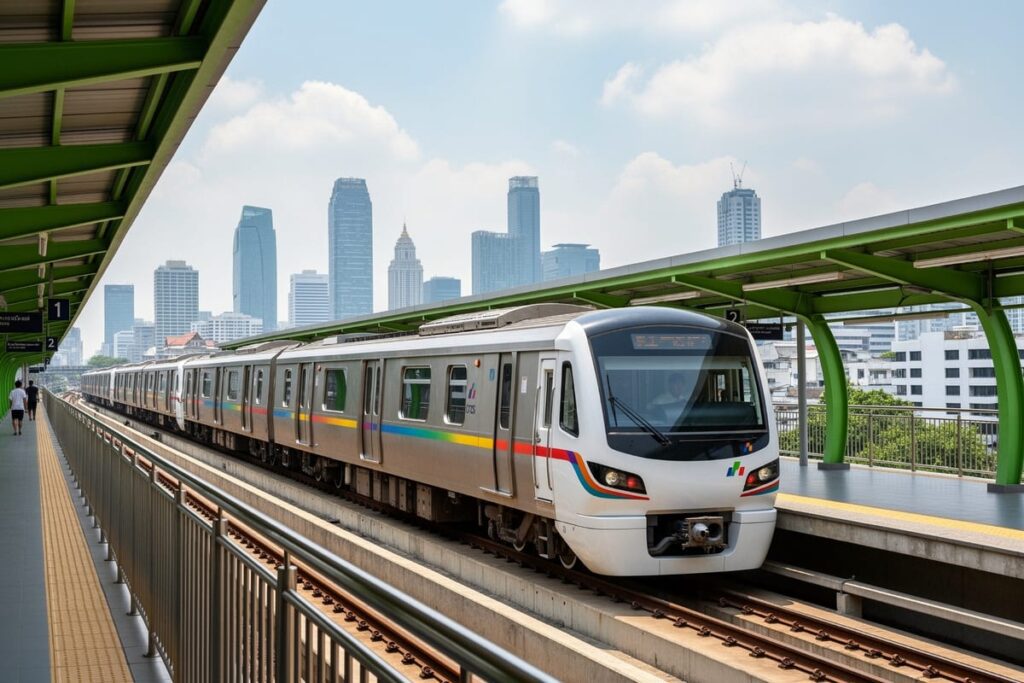
The elevated metro (BTS Skytrain in Bangkok) helps you get around the city by elevated trains. Preparing for a trip is simple: choose your departure and destination stations, identify transfers, check the fare with the operator, and get a ticket. The main lines are Sukhumvit and Silom; the connection between them is at Siam station.
For a single outing, a single-journey ticket will do; for a day with several trips, consider the one-day pass; and for regular use, a rechargeable transport card. Each option has its own costs and restrictions. Using the same payment method on different lines does not mean a shared fare or a free transfer.
Current as of October 2026. Conditions may change. Below we cover buying a ticket, passing through the turnstiles, the transport card, transfers from the airport, and planning the return trip. Start with your route: this makes it easier to see which sections you will need to pay for separately.
BTS elevated metro lines and transfer at Siam station
The official BTS description highlights the main Sukhumvit and Silom lines. Their terminal stations help you choose a direction, and the transfer at Siam lets you connect the lines on one route.
| Line | Terminal stations | Transfer |
|---|---|---|
| Sukhumvit Line | Kheha in Samut Prakan — Khu Khot | To the Silom Line at Siam station |
| Silom Line | Bang Wa — National Stadium | To the Sukhumvit Line at Siam station |
The Bangkok Spirit guide describes the transfer at Siam between platform levels without exiting through the turnstiles or paying again. Follow the signs for the line and direction you need inside the station.
Consider the Gold Line separately. The Thailand with Tereza guide describes its connection to Krung Thon Buri station and the ICONSIAM shopping center via Charoen Nakhon station.
The Right Tour travel guide lists the physical transport card (Rabbit Card) among payment options on the Sukhumvit, Silom, and Gold lines, and the yellow and pink MRT lines. This compatibility does not establish the terms of the virtual card.
It’s easy to get confused here: the payment card, line affiliation, and fare are separate questions. If your route includes other types of transport, it is easier to put together the overall picture with the guide to transport in Bangkok.
How much does a BTS ride cost in 2026
As of October 2026, the Tourist Bangkok guide lists the price of a single-journey ticket 17–65 baht depending on the destination. This is a reference range: the lower bound does not mean that every short trip will cost exactly that amount.
Separately, the BTS publishes a maximum fare that includes extension sections — 65 baht. For your route, check the fare with the operator for your chosen stations, rather than substituting the maximum amount for a calculation.
The news outlet Thai Newsroom reported that from November 1, 2025, the extension-section fare on the Green Line rose from 15 to 17 baht. The change applies to extensions; it does not mean that the entire system first switched to a particular fare calculation method on that date.
For the Gold Line, the fare guide (BTSBangkok.com) gives a reference price 17 baht for a single trip between any of its stations; check the current fare. Consider this fare separately from the range for the main routes.
If during the day you go out into the city and then ride again, include each trip in your expense plan. This way you can compare single tickets with the one-day pass without relying on a made-up universal break-even threshold.
Single-journey ticket, one-day pass, and transport card
Choose your payment method to suit your route. A single-journey ticket is convenient for an individual trip, the one-day pass for a suitable plan on the chosen date, and a rechargeable card for regular use.
As of October 2026, the One-Day Pass costs 150 baht. According to BTS’s official terms, it allows unlimited trips only on the Green Line on the date it is issued or registered, is sold at BTS ticket offices, and is non-refundable.
| Option | Cost | Coverage | Restrictions | Suitable scenario |
|---|---|---|---|---|
| Single-journey ticket | Reference range 17–65 baht; depends on destination | The selected BTS trip | Destination station must be determined | A single outing |
| One-Day Pass | 150 baht | Green Line only | Date of issue or registration; no refunds | A day with several planned trips |
| Rechargeable transport card (Rabbit Card) | The issuance fee and trip funds are paid separately | Supported lines | Card compatibility does not mean a single fare | Regular trips |
To assess the one-day pass, add up the cost of your planned trips that fall within its coverage. A financial benefit appears if their total exceeds the price of the pass; the number of stops alone does not show this.
A rechargeable card has a different benefit: you don’t need to buy a new single-journey ticket before each trip. However, the issuance fee is also part of the initial costs, so the card does not guarantee automatic savings.
How to buy a BTS ticket at a machine and at the counter
Start with the name of your destination station. Show it to the ticket counter staff or find it on the machine screen, then check the fare and the payment options offered.
Safe purchase sequence:
- Determine your destination station.
- Check the selected station and the displayed fare.
- See which payment methods that particular device offers.
- Complete the purchase following the on-screen instructions.
- Take your ticket and keep it until you exit the paid area.
The official BTS instructions state that the machine issues a maximum of 4 cards per transaction. If you don’t select a quantity, the machine automatically issues 1 card. When buying for a group, check the quantity before completing the transaction.
Don’t assume all machines accept the same payment methods. If a machine does not offer a suitable option or you have trouble choosing your route, ask a ticket counter staff member for help.
The One-Day Pass is sold at BTS ticket counters. Name the type of ticket you need: a single trip, the one-day pass, and a rechargeable card have different terms.
Transport card (Rabbit Card): issuance, top-up and refunds
As of October 2026, a reference publication on transport in Thailand (Visit-Thailand.org) lists an issuance fee of 120 baht. Funds for travel are considered separately: this amount cannot be treated as the universal total cost of the card including the balance.
To get a card, go to a BTS ticket counter. Keep the issuance fee and money for trips separate: the fee should not be called a refundable deposit.
To top up, tell the ticket counter staff the amount you want to add. As of October 2026, the reference blog Peanutmo lists a minimum top-up of 100 baht and a maximum balance of 4,000 baht; this information comes from the publication, not a quote from the card’s official regulations.
The Sweet Escape Thailand guide distinguishes between the validity period of the physical card and that of the funds. It states 7 years from the card’s issuance and 2 years after the last use or top-up for the funds. After a long break, simply having the card does not answer the question about the balance status.
Before topping up or finishing your trip, check with the transport card service (Rabbit) about the procedure for refunding the remaining balance and any applicable restrictions. Don’t count on getting back the issuance fee together with unused funds: these are separate parts of the cost.
Trip packages (Xtreme Savings): timing and coverage
As of October 2026, BTS offers trip packages (Xtreme Savings) valid for 30 days with 35, 25, 15, or 10 trips. Their base sections run from Mo Chit station to On Nut station and from National Stadium to Wongwian Yai station.
The official program page specifies the promotional purchase period from April 1, 2026 to March 31, 2027. It does not replace the validity period of an individual package.
When choosing, separate the terms:
- the period when the package can be bought at the promotional price;
- the package’s duration;
- the number of trips included;
- the sections where it applies.
Put simply, this is a limited package, not a monthly unlimited pass for the whole network. If your usual route goes beyond the base sections, don’t assume the entire journey is covered just because part of it runs along them.
For further reading, see our article on monthly passes for the BTS and MRT · RU. It helps you understand the options but does not replace the terms of a specific package.
Bank card, QR code, and virtual card in the wallet (Samsung Wallet)
Buying a ticket and passing through the turnstile are separate transactions. A QR code can be used to pay for a purchase where the equipment offers this option; after successful payment, follow the instructions for receiving and using the ticket.
A device’s support for QR codes does not mean this method is available at every station. Nor does it prove that you can tap a regular bank card or phone on the turnstile instead of a transport ticket.
The start of the phased update of the wallet’s transport function from October 20 is reported in an official announcement (Samsung). The phased update of the wallet (Samsung Wallet) does not mean the function is available to every user at the same time.
Consider the physical transport card and Rabbit Virtual Card separately. A list of lines that accept the physical card does not by itself establish the compatibility of the virtual version.
For a trip on the BTS Skytrain in Bangkok, choose your entry method according to BTS terms and the equipment instructions. An announcement about a virtual transport card does not confirm that a regular bank card can be used for direct entry.
How to ride the BTS: turnstiles, paid area, and rules
Have your ticket or transport card ready before you reach the turnstile. Keep the ticket or card at hand until your trip is complete.
Steps:
- Follow the entry turnstile instructions for your ticket.
- Wait for permission to pass.
- Check that the platform direction matches your route.
- Let exiting passengers off first, then board the car.
- Keep track of stations and transfer signs.
- At the exit, use your ticket according to the equipment instructions.
The exit mechanism may differ for different ticket types. If the turnstile does not open, ask a station staff member for help.
As of October 2026, the time limit in the paid area is 300 minutes. Exceeding it incurs a surcharge at the highest published fare; this refers to time spent inside the paid area, not only to train movement. The ticket usage rules are compiled in the official BTS terms.
A separate rule prohibits spitting and littering at stations and on trains. For violations, the official BTS rules provide a fine of up to 2,000 baht. This is an administrative penalty and should not be confused with the surcharge for exceeding the time limit.
Families and passengers with luggage should plan their approach to the station in advance. Keep the passage and the space by the doors clear, and ask staff for help if you have difficulties.
BTS opening hours and the last train
As of October 2026, the official opening hours of BTS stations are from 06:00 to 24:00. This range helps you plan your day but does not replace the schedule of last departures.
An open station does not mean a train in the right direction will depart right before closing. For your evening return, determine your boarding station, direction, and the last suitable train in advance.
If you have a transfer, check whether you can continue your journey after it. When switching to another transport system, you will also need to take its schedule into account.
Don’t leave buying your ticket and finding the platform until the station is about to close. If you’re returning with children or luggage, plan your approach and transfers in advance: the station’s opening hours do not guarantee boarding right up until closing.
Transfers and the route from Suvarnabhumi Airport
From Suvarnabhumi Airport, you can reach the BTS via the Airport Rail Link. The BestPrice Travel tourist guide describes this connection, and the Bangkok Spirit guide notes the connection to the Sukhumvit Line at Phaya Thai.
Route plan:
- Find the Airport Rail Link station in the airport.
- Get a ticket to Phaya Thai Airport Rail Link Station.
- After your ride, go to Phaya Thai BTS Station.
- Get a ticket for the BTS section and the direction to your destination station.
Account for the airport section separately when planning costs and tickets. A transfer connects routes but does not in itself mean a single ticket.
To continue to the ICONSIAM shopping center, use the connection via Krung Thon Buri and Charoen Nakhon station on the Gold Line. It is described in the Thailand with Tereza guide.
By the way, one payment card and a free switch between systems should not be confused either. Break your route into sections and for each one identify the line, the ticket, and the transfer point — this makes it easier to prepare for a trip with suitcases.
Trips to Bangkok’s attractions
Start planning a walk with the sight, then find a suitable station on the map and separately plan the route from it to the place. The ticket covers the transport section, while the rest of the approach remains part of your route.
For a shopping-focused plan, consider Siam Paragon. Our article on the Siam Paragon shopping center will help you choose activities, and the guide to shopping in Bangkok — will help you compare different options.
Another option is Chatuchak Weekend Market: details about visiting are in the article about the Chatuchak market. For a museum outing, you can choose the Jim Thompson House and read the article about the Jim Thompson House museum.
If you want a different itinerary, see Bangkok’s temple route. To continue your outing on the water, see the guide to river taxis in Bangkok.
First put together your plan, then compare tickets. Part of the day may be spent walking or on the water, so a packed itinerary does not necessarily mean many paid BTS trips.
Frequently Asked Questions ❓
How much does a ride on the BTS elevated metro in Bangkok cost in 2026?
As of October 2026, the Tourist Bangkok guide lists a range of 17–65 baht depending on the destination. The BTS publishes a maximum fare that includes extension sections of 65 baht. The One-Day Pass costs 150 baht and is valid only on the Green Line on the date it is issued or registered.
Can I pass through the BTS turnstile with a bank card?
Paying for a ticket and passing through the turnstile are separate operations. Follow BTS terms and the equipment instructions: paying for a purchase by QR code or an announcement about a virtual transport card does not confirm direct entry with a regular bank card.
How much does it cost to get a transport card (Rabbit Card)?
As of October 2026, a reference publication (Visit-Thailand.org) lists an issuance fee of 120 baht. Funds for trips are considered separately; this amount does not set a universal total price for the card and does not mean the fee is refundable.
Does the physical transport card (Rabbit Card) work on all MRT lines?
The Right Tour guide lists the yellow and pink MRT lines. This list does not mean compatibility with all MRT lines or the Airport Rail Link. Terms for the physical card cannot automatically be applied to the virtual one.
What are the BTS station operating hours?
The official operating range of stations is 06:00 to 24:00. Check the last departure for your station and direction, including whether you can continue your journey after a transfer.
How do I get from Suvarnabhumi Airport to the BTS?
Take the Airport Rail Link to Phaya Thai and transfer to the BTS. Account for the airport section separately when choosing tickets and planning your transfer.
What happens if you stay in the BTS paid area too long?
The limit is 300 minutes. Exceeding it incurs a surcharge at the highest published fare. If you have trouble exiting, ask a station staff member for help.
Are the trip packages (Xtreme Savings) a monthly unlimited pass?
No: the 30-day trip packages (Xtreme Savings) include 35, 25, 15, or 10 trips on the designated sections. The promotional purchase period runs from April 1, 2026 to March 31, 2027; this is a separate condition, not the duration of each package.
Conclusion
For a trip on the BTS Skytrain in Bangkok, choose your stations, identify transfers and costs, then get your ticket. Plan your return journey for the whole route, especially if you’ll switch to another system after the BTS. Include the route from the station to your destination in your plan too.
A single-journey ticket, a one-day pass, a rechargeable card, and a trip package suit different scenarios. Compare the costs of your planned trips and consider the coverage of each option. Fares, card terms, and timetables may change; check with the operator before traveling. Choose your next outing in Bangkok and check its sections before buying a ticket.
Prepared by MyThai.online editorial team.