In this article:
What changed: PEA and MEA warn about scammers posing as solar panel installers: before a visit, it is recommended to check the contractor in the official registry, call the company back yourself, and confirm the surveyor’s authority. The program offers a 50,000 baht subsidy, and registration runs until January 31, 2027.Updated: November 6, 2026
What changed: PEA and MEA warned about fake installers: the company and the surveyor’s authority must be verified before letting them into the home. The 50,000 baht payment cannot be combined with the tax benefit on purchase and installation of a solar system specified in the program’s terms.Updated: November 4, 2026
What changed: Support for installing a solar system can be received once per program; installation is permitted through MEA, PEA, or a contractor registered with them. The grid connection application must be submitted by August 31, 2027, and the connection must be completed by September 30, 2027.
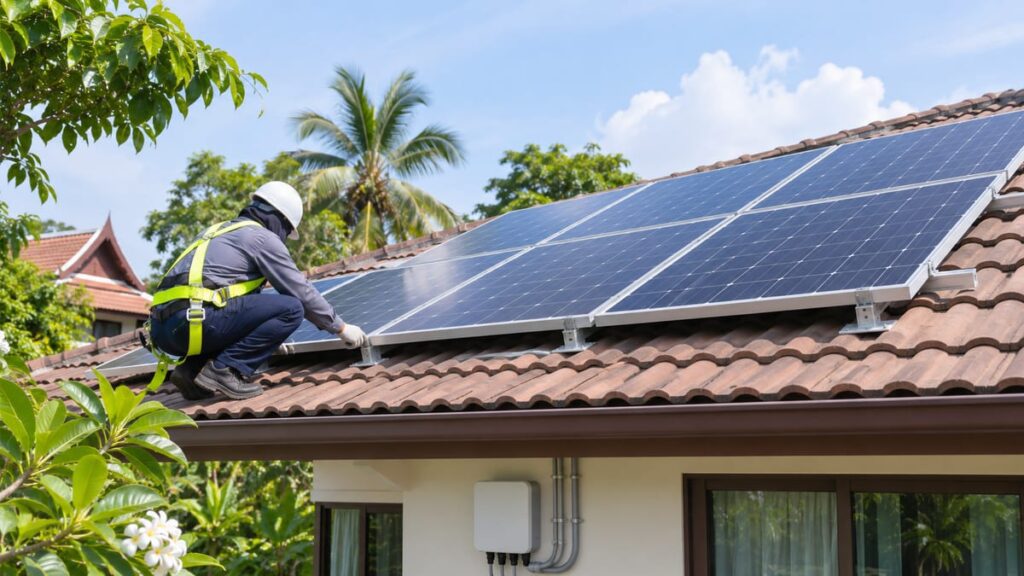
Solar roofs in Thailand have become the subject of an official warning about scammers who pose as electricity grid employees or equipment installers. The Provincial Electricity Authority (PEA) and the Metropolitan Electricity Authority (MEA) advise checking not only the company’s name but also the identity of the person who plans to survey the home. A company’s presence in the registry alone does not confirm the authority of the person who called.
According to the provincial authority, as of November 2, 2026, the following had registered in its service area: 42,666 applicants. This number does not mean that payments have already been approved or equipment installed. State support for purchase and installation amounts to 50,000 baht per applicant, but entitlement to it depends on the program’s terms.
Current as of November 11, 2026. Below is what the agencies exactly reported, where to find official contractors, and why discussion of prices does not mean the authorities have set an installation rate.
What is known
The electricity grid authorities warned that scammers may pose as their employees or installers to obtain personal data or gain access to the home. The official recommendation is to check the installer’s contacts yourself and confirm the visit before letting in the surveyor.
A separate matter concerns documents from the provincial authority. PEA said that an internal document for surveying installation companies had not received official approval and had been canceled; the agency also stated its intention to appoint a commission to examine the circumstances. This is not a report on a completed investigation, proven price inflation, or the cancellation of the support program. Background on the project can be read in the article on the solar roof support program · RU.
In addition, the leadership of both electricity authorities was instructed to speed up the program, cut administrative steps, and make services more convenient for the public. No new monetary limits were announced in this report.
Solar Roofs: Where to Check Contractors
The list of companies depends on the region. For provinces outside the Metropolitan authority’s service area, check the company in the official PEA installer registry; for Bangkok, Nonthaburi, and Samut Prakan, in the official MEA installer registry. Registration of installation companies and suppliers ran from August 1 to September 30, 2026, and publication of companies that passed it began on October 15. The lists may be updated.
The verification procedure is set out in the official warning from the Provincial Electricity Authority (PEA). Find the organization’s phone number on its official page, call back yourself, and confirm the caller’s name, the makeup of the survey team, and the arrangement for the visit. Before entering the home, ask for identification and proof that they are authorized to represent the company.
Never share one-time codes (OTPs) or make hasty transfers in response to a demand over the phone To verify information, contact centers are available from the provincial authority 1129, and the metropolitan one 1130. Separately, reporting on developments in technical rules is available in news about requirements for solar panels · RU.
Why installation costs and warranties are under discussion
Various payments come up in discussions of solar roofs. 50,000 baht in state support is intended for the applicant’s equipment and installation, while the cost of a finished system depends on the configuration and the work. Another category is financial security for the installer’s obligations, not a contribution from the household.
The Bangkok Post cites an example of a standard 5 kW kit costing up to 140,000 baht. Batteries, roof reinforcement, and upgrades to the electrical network may require additional costs. This figure is a reference from a press report, not a single price approved by the government for all homes.
The same report mentioned a contractor’s bank guarantee 50,000 baht for the order and separate security 10,000 baht for later maintenance. These amounts describe the installers’ expected obligations in a newspaper overview, not an official requirement for a resident to pay a deposit. Before signing a contract, it is worth checking the equipment list, scope of work, and itemization of the estimate; an automatic deduction of the subsidy from the price does not guarantee the final cost.
Who is eligible for the subsidy and what the deadlines are
The terms are published on the official portal of the Metropolitan Electricity Authority (MEA). The support is 50,000 baht for purchasing equipment and installation, and the program is capped at 1,000,000 applicants nationwide or until the approved budget runs out. Registration alone does not mean the payment has been approved.
Main requirements for the recipient and the system:
- The applicant is an individual with citizenship of Thailand, a residential electricity customer in category 1; the applicant’s name matches the meter owner’s name.
- The payment can be received 1 time during the program. Residing in Thailand as a foreigner or owning a home does not by itself give the right to the subsidy.
- Installation is carried out by the electricity grid authorities or an installation company registered with them. System capacity is 5 to 10 kWp per meter; solar panels and an inverter are required.
- The payment cannot be combined, fully or partially, with the income tax exemption for equipment and installation under the Royal Decree No. 805 of 2026. The date on the tax invoice must not be earlier than the opening of registration.
As of November 2026, registration is accepted from October 27, 2026 to January 31, 2027. The grid connection application must be submitted by August 31, 2027, and the connection must be completed by September 30, 2027. The registration deadline and the connection deadline are separate stages. For understanding household costs, see the separate article on utility bills and electricity in Thailand.
What to do
- Check whether you meet the payment conditions, and find a contractor in the registry for your region.
- Once you have the right to participate, contact the chosen company yourself and arrange the survey.
- Call back on the official number, confirm the visit, and check the surveyor’s documents before letting them into the home.
- Do not share personal data or one-time codes (OTPs) with unverified people; do not transfer money under pressure over the phone.
Terms, registries, and deadlines may change. Before signing a contract or making a payment, check with the electricity authority: the provincial one — 1129, the metropolitan one — 1130.
Sources
- Official warning about installers and scammers — provincial authority
- Subsidy terms and connection deadlines — metropolitan authority
- Registration period and solar system parameters — provincial authority
- Cancellation of an internal survey and registration information — provincial authority
- Registration and publication of installation company lists — provincial authority
- Meeting on speeding up the program — provincial authority
- Kit prices and installers’ financial obligations — Bangkok Post
Prepared by MyThai.online editorial team.